

Some words name things you can touch, and some name the force that keeps a person moving when touching the goal is still months away. The perseverance meaning belongs to the second kind: perseverance is the quality of continuing to try to achieve something despite difficulties, obstacles, or discouragement. In short, the perseverance meaning is “not giving up, steadily, for as long as it takes”. Teachers praise it, athletes depend on it, and one famous robot on Mars is named after it. This guide covers the definition, pronunciation, synonyms, real-life examples, and the small differences between perseverance and its closest cousin, persistence.
What Is the Perseverance Meaning?
Dictionaries define perseverance as steady persistence in a course of action, especially in spite of difficulties, obstacles, or discouragement. Three ideas are packed into that sentence. First, steadiness: the effort does not spike and vanish, it continues at a sustainable pace. Second, purpose: there is a course of action, a goal the effort serves. Third, resistance: difficulty is present, and the effort continues anyway. Remove any one of the three and you no longer have perseverance. Effort without difficulty is just routine, and difficulty without continued effort is just a hard day.
The word is a noun, pronounced per-se-VEER-ance (roughly /pur-suh-VEER-uhns/). Its verb form is “persevere”: a person perseveres, and the quality they show while doing it is perseverance. The adjective is “persevering”, as in “a persevering student”. Dictionaries mark the noun as approving, which matters: English speakers use this word to praise, never to criticise. Nobody is ever insulted by being told they have perseverance.
You will usually meet the word in encouraging contexts: speeches, report cards, sports stories, and graduation cards. It is formal enough for a ceremony and warm enough for a friend. That combination of dignity and kindness is rare in vocabulary, and it helps explain why the word gets chosen for important names and moments.
How Perseverance Is Used in Sentences
The fastest way to feel a word’s meaning is to watch it work. These examples show the standard patterns:
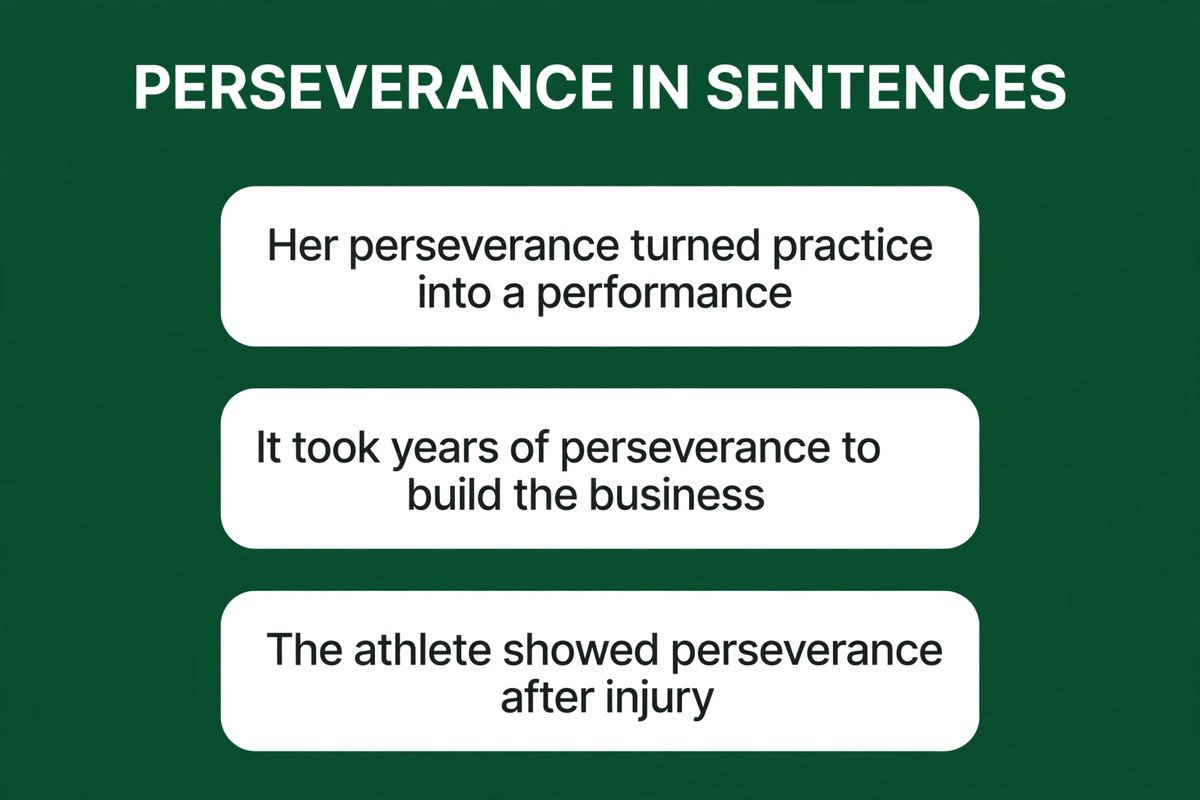
- Her perseverance in practising the piano turned shaky scales into a concert performance.
- It took years of perseverance, but the small shop finally became a successful business.
- The athlete’s perseverance after injury inspired the whole team.
- With patience and perseverance, he learned the language one lesson at a time.
- They showed great perseverance in the face of repeated setbacks.
Notice the grammar habits. Perseverance often follows words like “great”, “dogged”, “sheer”, and “quiet”. It pairs with verbs like show, demonstrate, and require. It also loves the phrase “in the face of”, because the word is almost always discussed beside the difficulty it overcomes. Like the feeling-word in our limerence meaning guide, perseverance names something invisible that quietly drives visible behaviour.
Perseverance vs Persistence: Is There a Difference?
Persistence is perseverance’s closest synonym, and the two overlap heavily. Both describe continuing despite difficulty. However, careful writers feel a slight difference in flavour. Persistence is the broader, more neutral word. A person can be persistent in asking a question, persistent in knocking, even persistent in being annoying. The word reports the continuing, without judging it.
Here is a quick test that separates them in practice. Compare “his persistent cough” with “his perseverance through illness”. The first is a medical nuisance that will not stop; the second is a person refusing to be stopped. Same root behaviour, opposite emotional charge. Or compare “persistent rain” with “the farmers’ perseverance through the drought”. Rain cannot show character, so persistence is all it gets. People can, so the language gives them the grander word.
Perseverance carries more weight and more praise. It suggests a long effort, real hardship, and a worthy goal. A dripping tap is persistent; a student working two jobs to finish a degree shows perseverance. Duration matters too: persistence can last minutes, while perseverance usually measures itself in months or years. In everyday writing you can swap them safely most of the time. But when you want the sentence to honour the effort, perseverance is the word that does it.
Synonyms and Antonyms: Words Like Perseverance
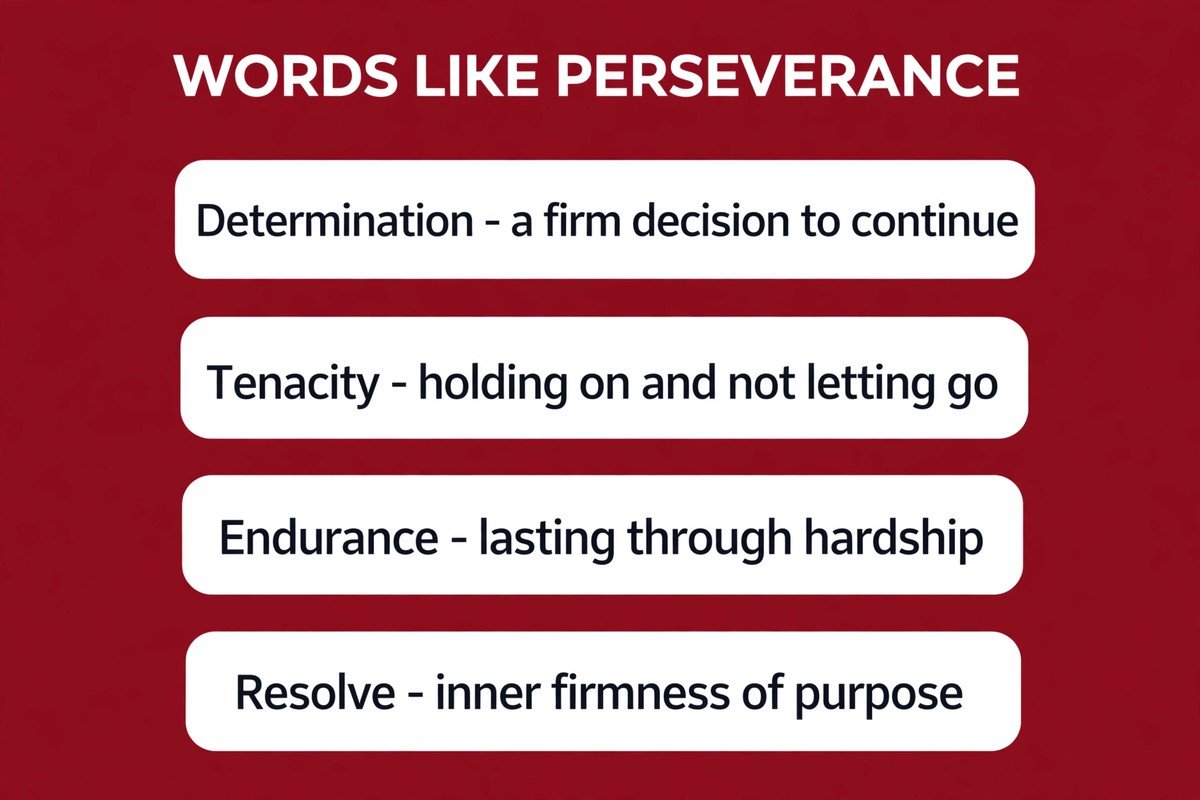
English keeps a rich shelf of near-synonyms, each with its own shade. Determination stresses the firm decision behind the effort. Tenacity adds a grip metaphor, holding on like a dog with a rope. Endurance focuses on lasting through hardship over time. Resolve is the inner firmness that refuses to bend. Doggedness is the stubborn, unglamorous version, and steadfastness sounds almost biblical in its loyalty. Diligence adds care and steady workmanship to the picture.
The antonyms draw the opposite portrait: giving up, quitting, irresolution, apathy, and surrender. None of them is a single tidy noun, which is itself interesting. The language owns one strong word for keeping going, and only phrases for stopping. Perhaps that is because keeping going is the behaviour worth naming, celebrating, and teaching.
Where the Word Comes From
Perseverance travelled into English from Latin through French. Its root is the Latin verb perseverare, to continue steadfastly, built from per- (thoroughly) and severus (strict or severe). So the word’s deep structure is “being thoroughly strict with yourself”, which is a surprisingly honest description of the quality. Reference works such as Wiktionary’s perseverance entry trace that path in detail.
The rover’s name itself has a story worth keeping. NASA chose it through a nationwide student essay competition, and the winning essay argued that every previous Mars rover name (curiosity, spirit, opportunity) described a human quality, and that perseverance was the one a Mars mission needs most. That reasoning is hard to argue with. A Mars mission is seven months of travel, a terrifying seven-minute landing, and then years of slow work in a place where no repair shop exists. If any machine ever earned the name, that one did.
The word also carries a specialised religious sense. In Christian theology, “the perseverance of the saints” is the doctrine that those who are truly saved will continue in faith to the end. And in 2020 the word reached another planet, at least in name: NASA’s Perseverance rover landed on Mars in February 2021, chosen as a name because every Mars mission is a long exercise in solving problems that refuse to be solved quickly. Few vocabulary words can claim a theology and a spacecraft; this one can.
Perseverance Meaning in Real Life
Abstract definitions stick better with faces attached. Perseverance in study looks like the student who fails an exam, changes method, and sits it again rather than changing dreams. Perseverance in sport looks like the injured runner doing dull rehabilitation exercises for months to earn one race. Perseverance in business looks like the founder whose first three products fail quietly while the fourth slowly finds its people. Perseverance in creativity looks like the writer collecting rejection letters until one envelope says yes.
Language learning is the quietest example, and maybe the most common. Nobody becomes fluent in a dramatic moment. They become fluent through hundreds of ordinary sessions, most of which feel unrewarding at the time. The learner who improves is rarely the most talented person in the class. They are simply the one still attending, still practising, still reviewing, a year after the others drifted away. Ask their teacher for the secret and the answer is this word.
Two features unite these stories. First, the people adjust their methods without abandoning the goal; perseverance is stubborn about destinations and flexible about roads. Second, their progress is mostly invisible while it happens. The quality only becomes obvious at the end, looking back. That is why the word so often appears in speeches at finish lines: graduation days, award nights, and launch pads.
How to Build Perseverance: Small Habits That Work
Because perseverance is partly a skill, it can be trained like one. The most reliable method is shrinking the step. Big goals discourage because daily progress on them is invisible. Break the goal into steps small enough to finish today, and the effort becomes measurable. A page written, a lesson completed, a kilometre run: each one is proof that the course is still being held.
Tracking helps for the same reason. A simple calendar mark for every day you showed up turns an invisible quality into a visible chain, and people protect chains surprisingly fiercely. Rest matters too, and it surprises people: perseverance is not grinding without pause. Planned rest protects the effort, while unplanned collapse ends it. The steady pace in the definition is deliberate, not decorative.
Finally, borrow other people. A study partner, a training group, or a mentor adds accountability on the days when private motivation runs out. Most long successes that look solitary in speeches were quietly social in practice. Perseverance may be a personal quality, but it grows best in company.
One warning belongs with the advice: perseverance is not the same as refusing to stop a failing plan. Wise effort reviews the road regularly and changes direction when the evidence demands it. The goal deserves loyalty; the method does not. Knowing the difference keeps perseverance a virtue instead of a trap.
FAQ’s
How do you pronounce perseverance?
Say per-se-VEER-ance, with the stress on the third syllable: pur-suh-VEER-uhns. The British and American pronunciations are very close, and both stress the same syllable, so the word is easy to say once you have heard it once.
What is a good example of perseverance?
A classic example is an athlete who returns from a serious injury through months of rehabilitation to compete again. Everyday examples count just as much: learning a language lesson by lesson, or retaking a failed exam after changing how you study.
Is perseverance a skill or a trait?
It behaves like both. Some people are naturally steadier than others, which is the trait side. But habits like breaking goals into small steps, tracking progress, and resting without quitting can be practised, which makes perseverance a skill you can genuinely grow.
What is the difference between persevere and perseverance?
Persevere is the verb, the action: she persevered with her training. Perseverance is the noun, the quality or the act itself: her perseverance paid off. If you are doing it, you persevere; the thing you are showing is perseverance.
What does perseverance mean in the Bible?
In Christian teaching, perseverance describes believers continuing in faith through trials until the end. The related doctrine called the perseverance of the saints holds that those truly saved will not finally fall away. It is the same core idea (continuing steadfastly) applied to spiritual life.
What is the opposite of perseverance?
There is no single perfect antonym, but the closest ideas are giving up, quitting, irresolution, and apathy. Where perseverance keeps a steady effort alive despite difficulty, its opposites let the effort die at the first or second obstacle.
Conclusion
The perseverance meaning can be carried in one line: steady effort toward a goal, continued in spite of difficulties and discouragement. Around that core, the word gathers praise, patience, and time. It differs from persistence mainly in weight, since perseverance implies a longer road, a harder climb, and a goal worth honouring. Its Latin roots even confess the secret: being thoroughly strict with yourself, kindly, for years.
Words like this survive because lives need them. Whether the goal is an exam, a recovery, a business, or a rover crossing the sky to Mars, the perseverance meaning names the exact quality that gets people there. Effort is common, and talent is common too. Steady effort, maintained when encouragement runs out, is the rare thing, and now you have its name.


Leave a Comment