

You have probably seen the word “prorated” on a bill, a lease, or a payslip and paused for a second. The prorated meaning is simpler than it looks: something is prorated when it is adjusted in proportion to how much of it you actually used. In other words, the prorated meaning is about fair shares. If you use a service for half a month, you pay for half a month. This guide explains the term in plain English, shows the formula with worked examples, and covers the places you will meet it most often, from rent to salaries to subscriptions.
What Does Prorated Mean? The Prorated Meaning in Plain English
The word comes from the Latin phrase pro rata, which means “in proportion” or “according to the share”. When a charge is prorated, the full amount is divided to match a partial period. A simple example makes it obvious. Imagine a gym membership that costs $60 a month. If you join on the 16th of a 30-day month, you only use half of that first month. A prorated first bill would therefore be $30, not $60. You pay for the share you received, and nothing more.
Proration is the opposite of splitting evenly. An even split gives everyone the same amount regardless of use. Proration, instead, weighs the actual time, usage, or ownership involved. That is why the idea shows up wherever money meets a calendar. Rent, wages, insurance premiums, dividends, and utility bills all rely on it. Without proration, anyone who started or stopped mid-period would either overpay or underpay, and both sides would argue about it. With proration, the maths settles the argument before it starts.
Shareholders meet the idea as well. When a company pays dividends or issues new shares, each investor receives a pro rata share based on how much they already own. Someone holding two percent of a company receives two percent of the dividend pool. Nothing is split evenly per person; everything follows the existing proportion. That same logic explains why the word travels so easily between billing, payroll, and investing. The settings differ, but the promise is always that the distribution follows the stake.
You will see the word used as an adjective most often: a prorated charge, a prorated refund, prorated rent. Behind each of those phrases sits the same promise. The amount will match the portion, exactly.
The Prorated Meaning Formula, Step by Step
The calculation behind the prorated meaning is one short formula. Here it is:
Prorated amount = Full amount × (Units used ÷ Total units in the period)
Units are usually days, but they can also be weeks, hours, or seats on a software plan. To use the formula, follow three steps. First, find the full price for the whole period. Second, count how many units were actually used, and how many units the full period contains. Third, multiply the full price by that fraction. The result is the fair amount for the partial period.
Here is a yearly example to show the formula is not only about months. An annual software licence costs $365. If a team cancels after exactly 100 days, the used share is 100 out of 365, so the earned amount is $100 and the refundable share is $265. Notice how the daily rate came out at exactly one dollar, which makes the maths easy to check. Real cases are rarely that tidy, but the method is always the same.
Now let us run the formula on a rental example. A flat costs $1,200 a month, and the month has 30 days. The daily rate is $1,200 divided by 30, which is $40 a day. Suppose the tenant moves in on the 11th, so they occupy the flat for 20 of the 30 days. Their prorated rent is $40 times 20, which equals $800. As finance guide Ramp explains in its proration guide, this same time-based formula sits underneath nearly every prorated bill you will ever see.
How Prorated Billing Works When Plans Change
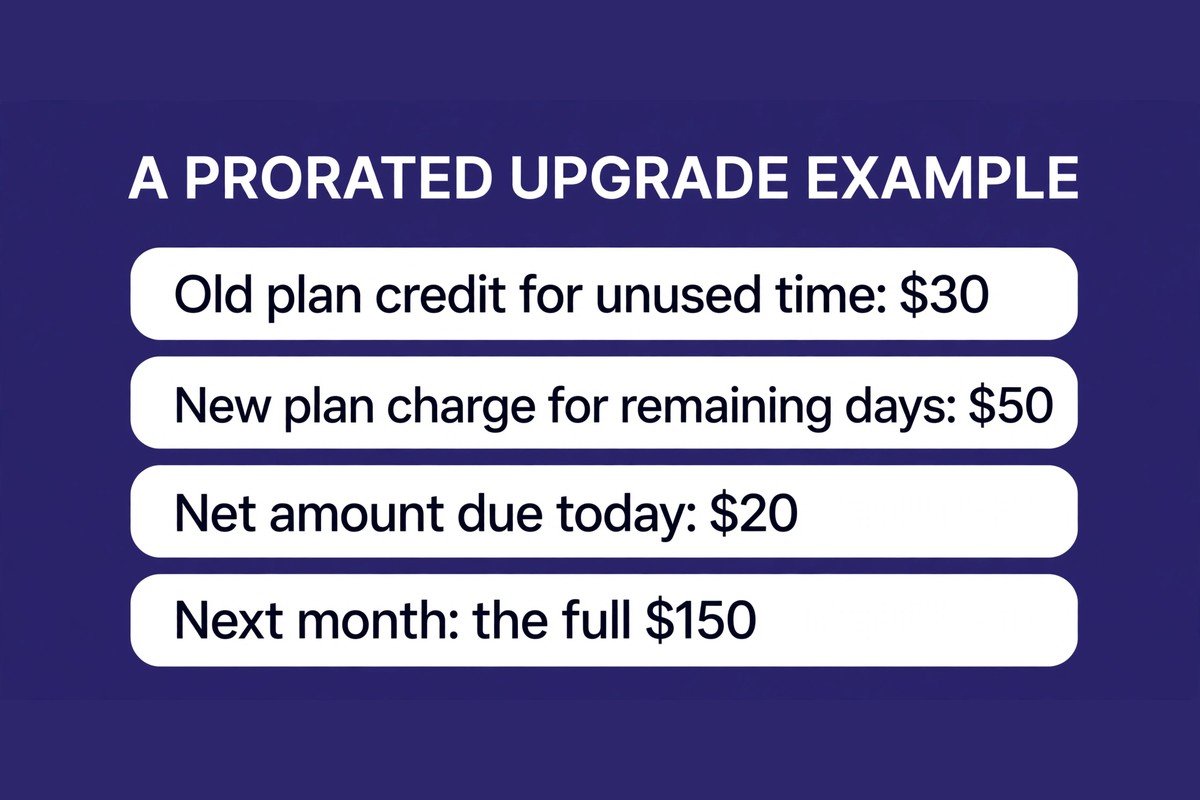
Subscriptions add a twist, because a mid-cycle change creates two amounts instead of one. There is a credit for the unused part of the old plan, and a charge for the remaining part of the new plan. Your invoice then shows the difference. A widely used example shows how it balances out. Say you pay $90 a month for a plan, and on day 20 of a 30-day cycle you upgrade to a $150 plan. Ten days remain.
The unused part of the old plan is 10 out of 30 days, so your credit is one third of $90, which is $30. The remaining part of the new plan is also 10 days, so your charge is one third of $150, which is $50. The net amount due is $50 minus $30, a charge of $20. From the next cycle onward, you simply pay the full $150. A short exchange shows how support teams often explain it:
- Customer: Why is there an extra $20 charge on my bill?
- Support: You upgraded on day 20. We credited the unused $30 of your old plan and charged $50 for the rest of the month on the new one. The difference is $20.
- Customer: And next month?
- Support: Just the standard $150, with no adjustments.
Downgrades run the same maths in reverse and produce a credit instead. Most companies apply that credit to your next invoice rather than refunding it. Either way, no day is charged twice, and no day is free. Business terms like this one often appear next to metrics in reports, which is why our kpi meaning guide makes a useful companion read.
Prorated Meaning in Rent, Salary, and Insurance
Prorated rent
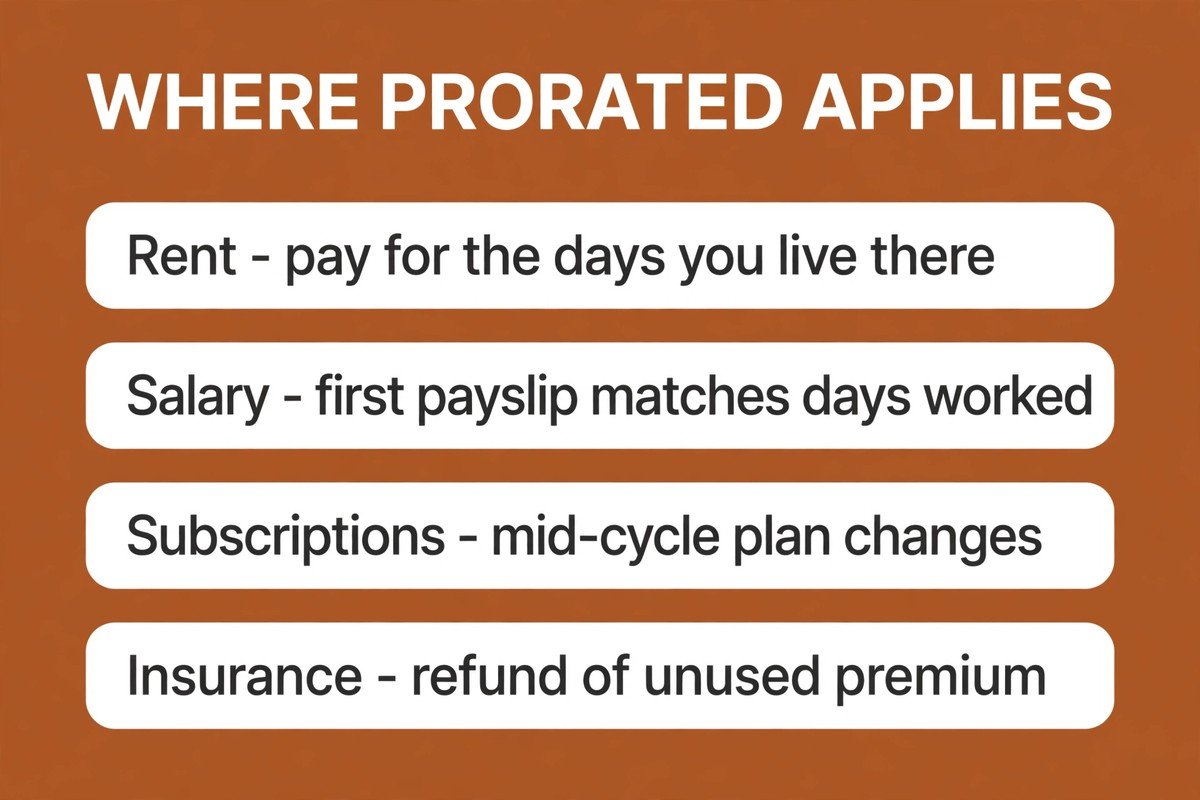
Rent is the most familiar home of proration. Tenants rarely move in on the first of the month, so landlords prorate the first month, and often the last one too. The daily rate method above is the standard approach. Some landlords divide by the days in that specific month, while others use a flat 30-day month. Your lease should say which method applies, so check it before you sign. A two-day difference in the method can shift the bill by a noticeable amount on expensive rent.
Prorated salary and leave
Payroll uses the same idea. If you start a job halfway through a pay period, your first payslip is prorated to the days you actually worked. A $3,000 monthly salary starting on the 16th of a 30-day month means 15 working days in that period, and a first payment of $1,500. Part-time arrangements use proration too. Someone working three days a week may receive a prorated salary set at three fifths of the full-time equivalent, along with prorated holiday allowance calculated the same way.
Prorated insurance and refunds
Insurance premiums are usually paid in advance, so cancelling a policy mid-term creates a prorated refund of the unused premium. Real estate closings also rely on proration. Property taxes and utility charges are split between buyer and seller according to the exact day ownership changes hands. In each case the principle never changes: the calendar decides who owes what share.
Prorated vs Pro Rata: Is There a Difference?
Short answer: not really. “Pro rata” is the original Latin term, used as an adjective or adverb, as in “dividends were paid pro rata”. “Prorated” is the English verb form built from it, used when someone actively adjusts an amount, as in “the bill was prorated”. Finance writers swap between them freely. If you understand one, you understand the other. Both point to the same proportional split, and neither implies an even division.
One small distinction exists in tone. Legal and financial documents lean toward “pro rata” because it sounds formal. Everyday billing, leases, and payslips lean toward “prorated” because it reads more naturally in a sentence. The meaning, however, stays identical in both worlds.
Common Proration Mistakes Worth Checking
Because prorated bills are calculated by systems and people, errors do happen, and they follow familiar patterns. The most common is the wrong day count: a bill that charges you from the 1st even though your service began on the 9th. The second is the wrong divisor, where a company divides by 30 in a 31-day month, or the reverse, nudging the daily rate in its own favour. The third is a missing credit, where an upgrade charge appears but the unused-time credit for the old plan never does.
Catching these mistakes takes one minute. Find your start or change date, count the days yourself, and run the formula from this guide. If your figure and the invoice figure disagree, contact the company with both numbers in hand. Billing teams fix clear arithmetic errors far more often than they argue about them, especially when the customer shows the working.
When Proration Is Not Applied
Not everything can be prorated. Metered services, such as electricity or pay-as-you-go data, are billed on actual consumption, so there is nothing to adjust. The usage itself is already the measure. Flat one-off fees, like a joining fee or a delivery charge, are also usually excluded. And some contracts choose a simpler rule, such as charging the full month regardless of the start date, which is legal in many places if the contract states it clearly. That is exactly why reading the billing terms matters. Proration is common and fair, but it is a policy, not a law of nature, unless a local regulation makes it one.
FAQ’s
What does prorated mean on a bill?
It means the charge has been adjusted to cover only part of the normal billing period. If you started or changed the service mid-cycle, you pay for the portion you used rather than the full month.
How is prorated rent calculated?
Divide the monthly rent by the number of days in the month to get a daily rate. Then multiply that rate by the number of days you will live there in that first partial month. The result is your prorated rent.
Is a prorated refund always the full unused amount?
Not always. Some companies deduct an administration or cancellation fee first, and some use a “short rate” method that keeps a small penalty share. Check the contract terms to see which method applies to you.
What does prorated salary mean for a new job?
It means your first payslip covers only the days you worked in that pay period. A monthly salary is divided across the period, and you receive the fraction matching your start date. Later payslips are the full amount.
Does prorated mean cheaper?
No. Prorated means proportional, not discounted. The per-day price is exactly the same as the full price. You simply pay it for fewer days, which is why the total looks smaller.
Conclusion
The prorated meaning is really a fairness rule written in maths: pay in proportion to what you used. Born from the Latin pro rata, it divides full amounts into honest shares for partial periods. You will meet it in prorated rent when you move mid-month, in a prorated first salary when you start a job, and in subscription bills whenever a plan changes mid-cycle. The formula never changes, even when the setting does: full amount, times the fraction of the period used.
Now that you know the prorated meaning, those lines on your bills and leases should read clearly. Check the daily rate, count your days, and confirm the fraction matches. When the numbers follow the formula, the charge is fair, and when they do not, you have the knowledge to ask why.


Leave a Comment