

Some words carry two lives at once, and this word carries two very different ones. The lobotomy meaning begins with a real brain operation from the 1930s. Today, however, the same word also labels chaotic memes and fried-brain jokes online. In short, one word points to a serious page of medical history and to modern slang at the same time.
This guide explains both lives of the word with care. First, it gives the medical definition in plain words. Next, it walks through the history honestly, without mocking the patients involved. Finally, it explains the slang sense that TikTok made famous across the internet.
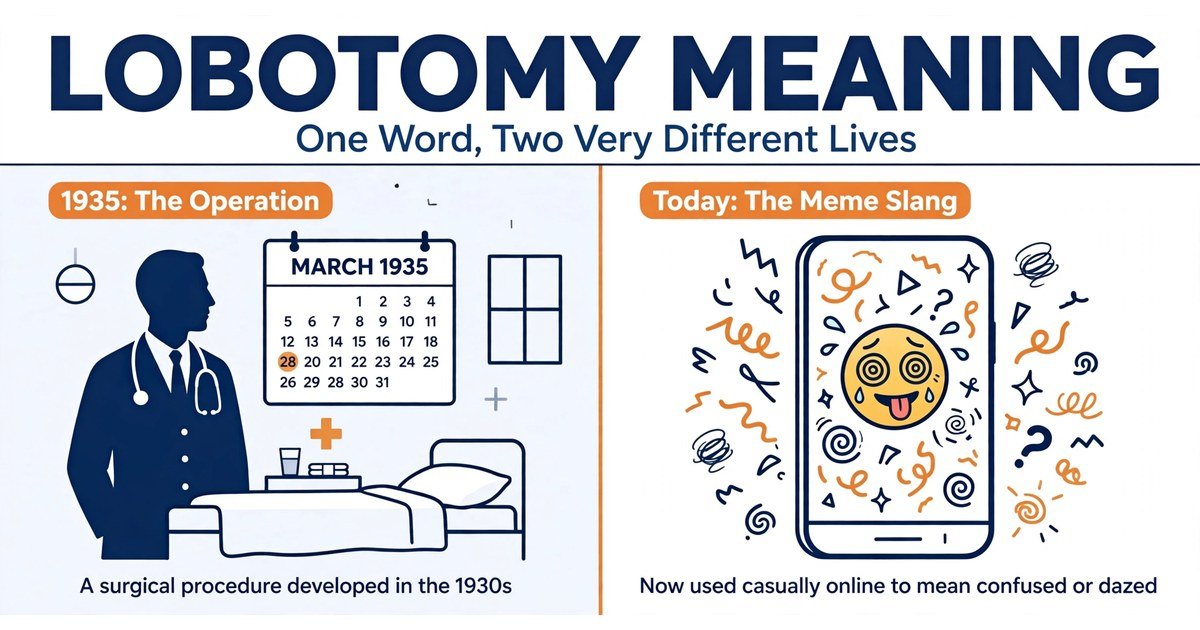
Lobotomy Meaning in Plain Words
In plain words, the lobotomy meaning names a type of brain surgery from the last century. A surgeon cut the connections between the frontal lobes and the rest of the brain. In particular, the surgeon targeted pathways that link the frontal lobes to the thalamus, a relay center deep in the brain. Doctors hoped, in fact, that this cutting would calm severe mental illness.
Dictionaries record the same core idea in drier language. Merriam-Webster, for example, defines it as the surgical severing of nerve fibers that connect the frontal lobes to the thalamus. The dictionary also notes the key time clue: doctors performed the operation mainly in the past. In other words, the word now belongs mostly to history books and slang.
The operation, in short, aimed to quiet overwhelming symptoms by cutting the brain’s own wiring. Doctors of the era lacked modern scans, tests, and medicines. They therefore judged success mainly by calm behavior in the ward. Families at home, in contrast, often met a very different person after the surgery.
- Word type: a noun; the plural is lobotomies
- Say it: luh-BOT-uh-mee
- Word parts: lobe plus -tomy, a Greek ending for cutting
- First known use in English: 1936
- Medical sense: cutting connections inside the frontal lobes
- Slang sense: chaotic, fried-brain humor online
Where the Word Lobotomy Comes From
The word itself joins two older parts. First, “lobe” names a rounded section of an organ, such as one section of the brain. Next, the ending “-tomy” comes from a Greek word for cutting. Together, therefore, the whole word simply means cutting into a lobe.
Doctors in Britain often used a twin name, leucotomy, for the same operations. American doctors, by contrast, settled on lobotomy as their everyday term. Words also travel far from their first sense, and serendipity shows the same habit. Our serendipity meaning guide traces that word from a Persian fairy tale into daily luck talk.
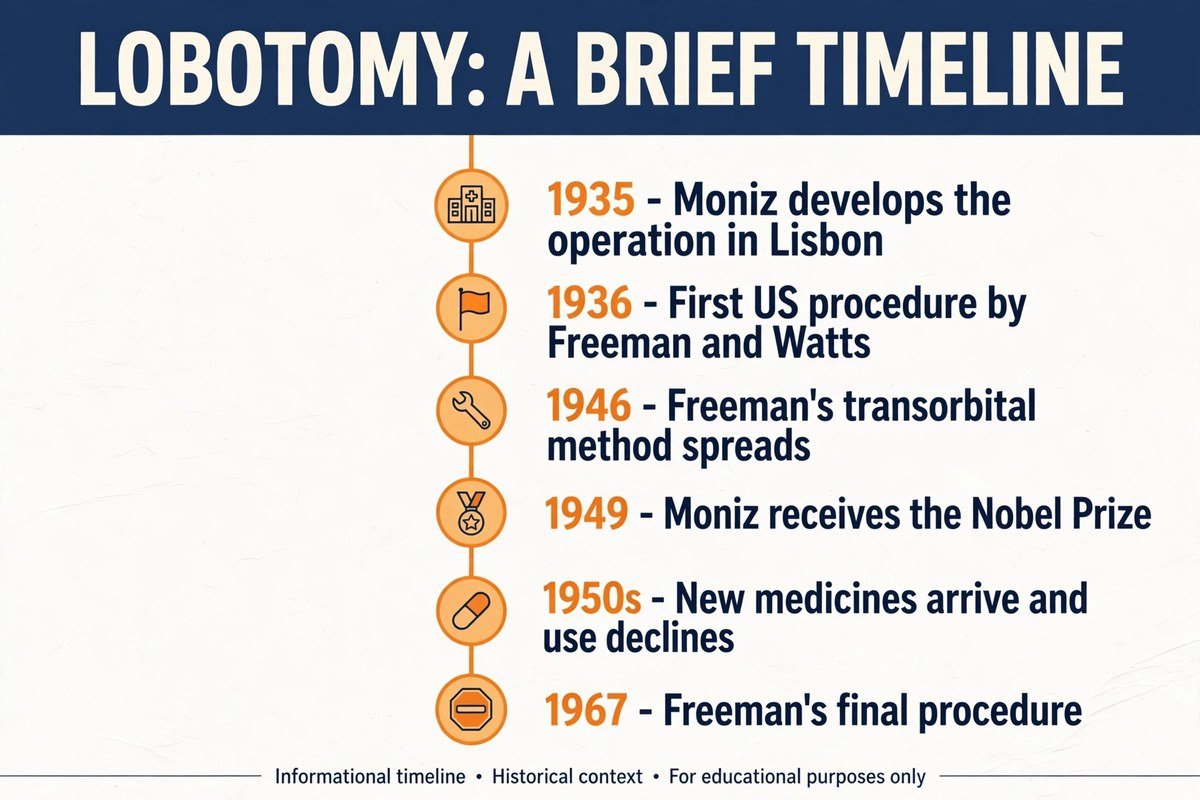
The History Behind the Lobotomy Meaning
The story starts in 1935 in Lisbon, Portugal. There, neurologist António Egas Moniz developed the first version of the operation. He believed, in fact, that severing frontal-lobe connections could calm people with severe mental illness. Hospitals at the time, moreover, had almost no effective treatments for such patients.
Crowded asylums created desperate pressure for a breakthrough. So, when Moniz reported early successes, doctors across Europe paid close attention. In 1936, American neurologist Walter Freeman performed the first such operation in the United States, together with surgeon James Watts. Freeman then promoted the procedure across the country with tireless energy.
The idea won striking official praise at first. In 1949, Moniz received the Nobel Prize in Medicine for developing the operation. Many doctors, meanwhile, treated the award as proof that psychosurgery had a future. Hospitals, as a result, added the operation to their regular treatment lists.
The Transorbital Method
In 1946, however, Freeman introduced a faster and far more controversial method. He inserted a slim, pointed instrument through the eye socket and into the frontal lobe. Then, he swept the instrument from side to side to sever the nerve fibers. The whole procedure, remarkably, often took only about ten minutes.
Speed made the method spread in a troubling way. Freeman performed an estimated 3,500 procedures during his career. He also toured hospitals in a van that later writers nicknamed the lobotomobile. Unlike the original operation, moreover, his method needed no operating theater and no surgical team.
The Human Cost
Tens of thousands of people underwent the operation in the United States alone. Outcomes, however, varied enormously from patient to patient. Some patients grew calmer, yet many lost drive, emotion, and independence. Others never regained the personalities that families remembered.
One famous case, in particular, shows the human cost clearly. In 1941, doctors performed the operation on Rosemary Kennedy, the 23-year-old sister of future president John F Kennedy. The operation left her with severe, lasting disabilities. She then lived in care institutions for the rest of her life, and her family kept the story private for decades.
Why the Practice Ended
The turning point arrived in the early 1950s with new medicines. Chlorpromazine, sold under the name Thorazine, calmed severe symptoms without any surgery. Hospitals therefore gained a safer and reversible option for the first time. As a result, doctors steadily abandoned the operation through the 1950s and 1960s.
In the end, Freeman performed his final procedure in 1967, after a patient died during the operation. Historians now read the whole era as a cautionary tale about desperation and unchecked enthusiasm. Readers who want the full medical record can explore a peer-reviewed history of psychosurgery at the National Library of Medicine. The review, in short, shows how quickly a hopeful idea outran the evidence.
Popular culture then sealed the word’s dark reputation for good. Ken Kesey’s 1962 novel One Flew Over the Cuckoo’s Nest portrayed the operation as a tool of control. The book and its later film adaptation, in addition, fixed the lobotomy in public memory as a symbol of medical overreach.
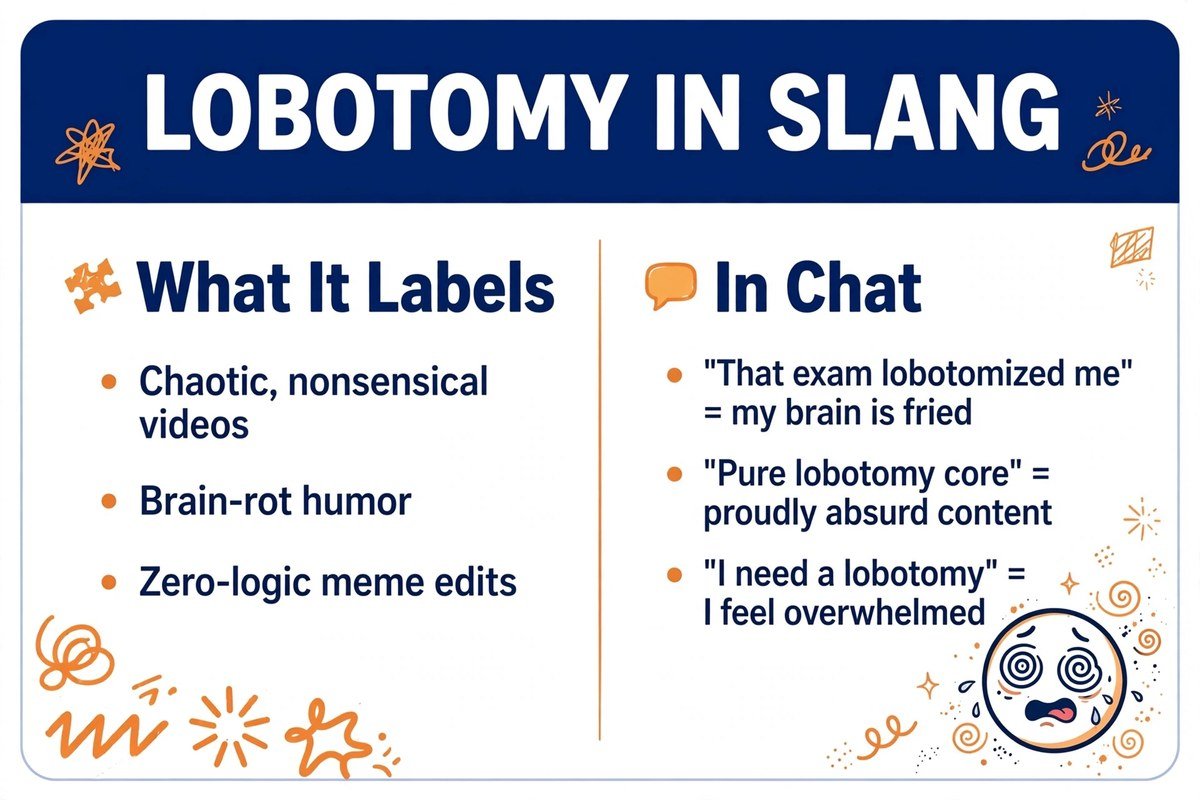
Lobotomy Meaning in Slang and Memes
Online, however, the word now lives a second and far lighter life. On TikTok, for instance, creators use “lobotomy” for content that feels joyfully nonsensical. Such posts scramble images, sounds, and jokes with no clear logic at all. Know Your Meme, for example, describes the slang as humor that mimics a brain working chaotically and slowly.
The slang grew out of a few viral formats. An early video called “Me Everytime After The Lobotomy” showed Bart Simpson bumping into walls in confusion. Hood Lobotomy videos then layered green-screen silhouettes over similar chaos. By early 2024, fans had also coined spin-off names like Lobotomy Kaisen and Lobotomy Dash. Comment sections, meanwhile, filled with the single word “lobotomy” under any confusing post.
Lobotomy Core and Brain Rot
Fans group this style under labels like lobotomy core and brain rot. Both labels celebrate humor that feels proudly broken and overstimulated. The nonsense, in other words, is the entire point of the joke. Fans, in fact, rate a post higher when it makes even less sense.
The style mixes rapid cuts, distorted audio, and random characters from unrelated shows. A quiet scene suddenly glitches, screams, and collapses into static. Viewers then share the clip precisely because nobody can explain it. In short, lobotomy core turns confusion itself into the punchline.
Lobotomized in Everyday Chat
People also use the adjective “lobotomized” far away from memes. A student might say a brutal exam left them completely lobotomized. In that sentence, the word simply means mentally blank and unable to think. Friends use it, similarly, after long meetings, heavy study sessions, or sleepless nights.
Context still matters with a word like this. The slang aims at silly content and everyday tiredness, never at real patients. Speakers therefore keep the jokes pointed at memes, exams, and their own fried brains. That small care, in practice, keeps the humor light instead of cruel.
How to Use Lobotomy in a Sentence
Examples show the two senses side by side more clearly than any definition. Notice, in addition, how the tone shifts between the medical and slang uses:
- “The textbook states the lobotomy meaning in a single, stark sentence.”
- “After that three-hour exam, my brain felt completely lobotomized.”
- “His whole feed is lobotomy core: random clips, loud sounds, and zero logic.”
- “Freeman toured the country and performed the operation thousands of times.”
The medical examples stay factual and careful in tone. The slang examples, by contrast, stay playful and obviously figurative. Your listener, as a result, reads the intended sense from context within seconds. Either way, nobody mistakes a meme caption for a medical claim. Short captions, in addition, often use the word alone, with no explanation at all.
Lobotomy, Lobotectomy, and Leucotomy
Readers often confuse lobotomy with a similar word, lobectomy. A lobectomy removes a whole lobe of an organ, such as part of a lung. Surgeons still perform lobectomies today for cancer and other diseases. A lobotomy, instead, cut connections inside the frontal lobe and removed nothing at all.
Leucotomy, meanwhile, names the same operation family under an older British label. Early British doctors favored that term during the first decades. In short, lobotomy and leucotomy overlap almost completely, while lobectomy stands apart as a different, living procedure.
FAQ’s
Are lobotomies still performed today?
No, doctors no longer perform the classic lobotomy anywhere in modern medicine. Modern psychosurgery, instead, survives only as a rare and tightly regulated last resort. Specialists use precise tools like deep brain stimulation for a few severe conditions. These modern procedures, moreover, target tiny areas and follow strict ethical review.
What does “I need a lobotomy” mean in a text?
The phrase works as playful exaggeration, never as a literal wish. A sender usually means that stress, boredom, or confusion has fried their brain. People also type it after baffling news, dense homework, or a chaotic group chat. In short, the line jokes about feeling mentally overwhelmed.
How long did a transorbital lobotomy take?
The transorbital procedure often took only about ten minutes from start to finish. Freeman prized that speed and sometimes completed several procedures in a single visit. That haste, however, formed part of the method’s danger. Modern brain surgery, by contrast, involves hours of planning, imaging, and careful teamwork.
Why did Moniz receive a Nobel Prize for the lobotomy?
At the time, doctors had almost no working treatments for severe mental illness. The Nobel committee therefore honored Moniz for opening an entirely new field of treatment. Many desperate families and hospitals, in addition, reported calmer patients after the operation. Later generations, however, judge the award far more harshly, and the debate continues today.
Is it okay to joke about lobotomies?
Most online jokes target memes, tiredness, and the joker’s own brain, and that target matters. Problems start when a joke aims at real patients or at people living with mental illness. A simple rule, therefore, keeps things decent: laugh at the chaos, never at a person’s suffering. That line, in practice, separates brain-rot humor from cruelty.
Conclusion
Overall, the lobotomy meaning holds two very different stories inside one short word. The first story belongs to medical history: a drastic operation that doctors embraced in the 1930s and then abandoned as safer medicines arrived. That history deserves accuracy and respect, because real patients and families lived through its consequences. The slang story, meanwhile, belongs to internet humor, where the word labels proudly nonsensical videos and fried-brain feelings.
Readers now hold both senses at once, and context always reveals the right one. A history book means the operation, while a TikTok caption means the chaos. In addition, a careful speaker keeps the slang aimed at memes rather than people. Keep that balance, and the word stays both informative and harmless. In the end, few words show so clearly how language can outgrow a dark beginning.


Leave a Comment