

Some people feel a spark the moment they meet someone new. Other people feel nothing at first, and the spark only arrives months later, if it arrives at all. The demisexual meaning describes that second pattern. In plain words, a demisexual person feels sexual attraction only after a strong emotional bond has formed. This guide explains the demisexual meaning clearly, calmly, and without jargon.
First, you will get the simple definition and the story behind the word. Next, you will see how demisexuality sits on the asexual spectrum. Then, you will find common signs, honest myths, and practical dating notes. By the end, the word will feel less like a label and more like a useful description.
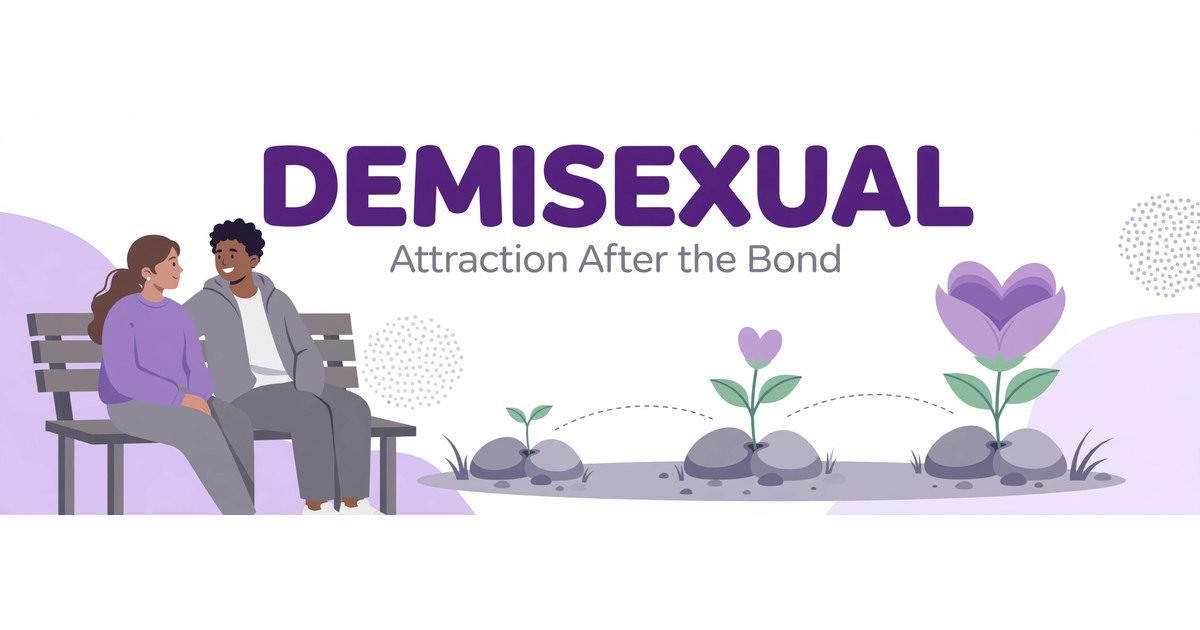
Demisexual Meaning in Plain Words
The demisexual meaning is a type of sexual orientation. A demisexual person, in short, does not feel sexual attraction to someone straight away. Instead, attraction becomes possible only after a deep emotional connection exists. That bond might grow, for example, through close friendship, long conversations, and shared trust. Without the bond, the attraction simply does not switch on.
Two points keep the definition clear. First, the rule concerns attraction, not behaviour. A demisexual person is not merely choosing to wait; the feeling itself is absent until the bond forms. Second, the bond does not guarantee attraction either. It only opens the door. Many close friendships, in fact, never turn into attraction at all.
An Everyday Example
An everyday picture makes the idea concrete. Imagine two colleagues who eat lunch together for a year. At first, one of them feels only friendly interest in the other. Over time, however, the talks grow deeper and trust builds steadily. Then, almost without warning, attraction appears where none existed before. That slow switch is the demisexual pattern in miniature.
Also, demisexual people differ widely from each other. Some form bonds in a few months. Others need years of knowing someone first. Some, in fact, rarely feel attraction across a whole lifetime. Others find it a handful of times. The shared thread, in short, is the order of events: connection first, attraction second.
Where the Word Demisexual Comes From
The word is younger than most people expect. It appeared in 2006 on the forums of the Asexual Visibility and Education Network, known as AVEN. Members there, in short, needed language for experiences that sat between familiar categories. The Wikipedia overview of demisexuality traces that history in more detail.
The prefix “demi” means half. Community members chose it because the experience can feel halfway between sexual and asexual. Likewise, a demisexual person shares the asexual pattern of no instant attraction. At the same time, they can feel attraction later, once a bond exists. The name, therefore, points at that middle ground. It is a description, not a diagnosis, and people adopt it only if it fits them.
The word then travelled far beyond one forum. During the 2010s, for example, it spread through blogs, pride groups, and social media. Young people, in particular, recognised their own histories in it at once. As a result, dictionaries and encyclopedias added entries for it. A term invented for a small community, in short, became everyday vocabulary within a decade.
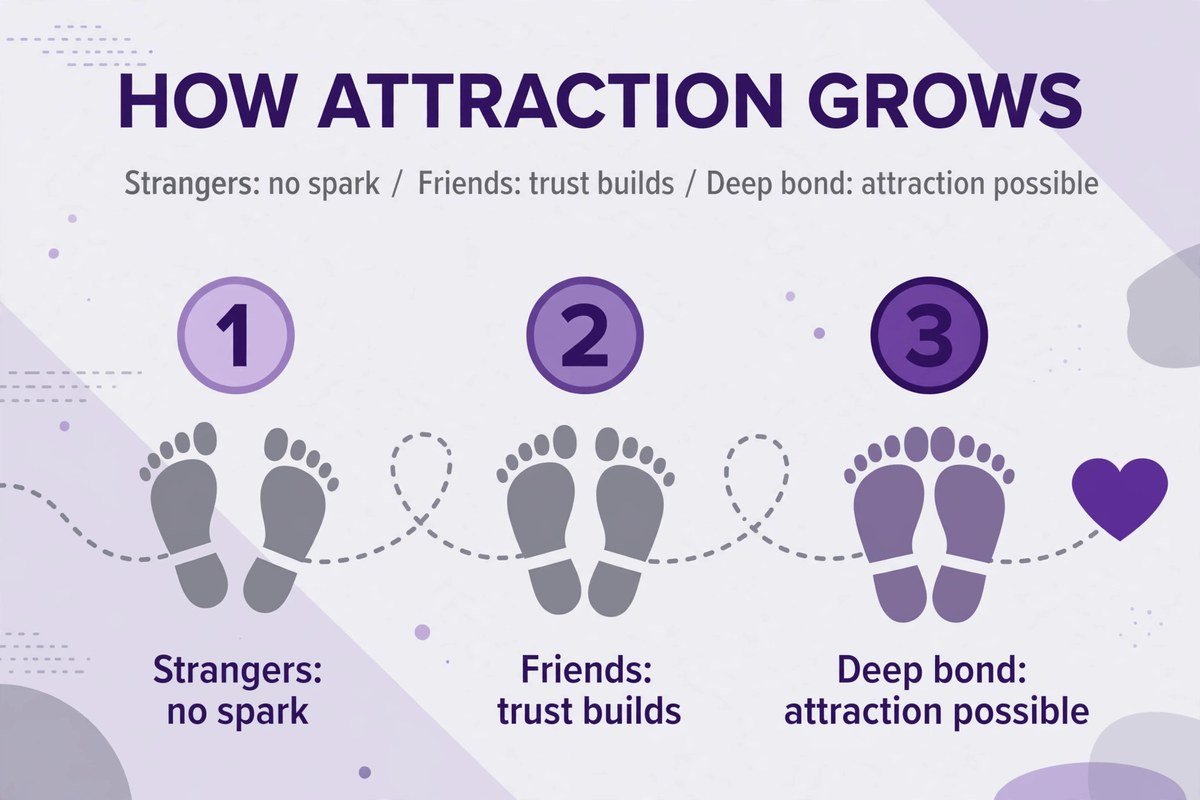
Demisexual Meaning and the Asexual Spectrum
Demisexuality sits under the wider asexual umbrella. Asexual people, in general, feel little or no sexual attraction to anyone. Demisexual people feel none at first either. The difference appears only after emotional closeness develops. For that reason, the community often calls this area the grey area of the spectrum.
A simple model from the asexual community explains the idea well. Primary attraction is the instant kind, based on looks, voice, or a first impression. Secondary attraction grows slowly from knowing a person’s character. Most people feel both kinds across their lives, however. Demisexual people, by contrast, generally feel only the secondary kind. That single difference, in practice, shapes their whole dating experience.
Demisexual vs Demiromantic
These two words sound alike, yet they describe different feelings. Demisexual concerns sexual attraction after a bond. Demiromantic concerns romantic attraction after a bond. A person can be one, the other, or both at once. Someone might, for example, fall in love slowly but feel physical attraction quickly. Keeping the two apart makes self-descriptions much more accurate.
Signs You Might Be Demisexual
No quiz can hand you an identity. Still, certain patterns appear again and again in demisexual people’s stories. See whether these feel familiar.
- Crushes are rare. You can count your real crushes on one hand, while friends lose count of theirs.
- Crushes grow from friendship. The people who attract you are almost always close friends first.
- Celebrity crushes feel puzzling. You can see that someone is good-looking, yet no spark follows.
- Dating apps feel empty. Swiping on photos gives you almost nothing to judge by.
- Attraction builds slowly. Feelings deepen over months of talking, not over one exciting evening.
- Looks rank low. Personality, humour, and trust decide far more than appearance ever does.
Of course, one sign alone proves nothing. The pattern across many years, however, tells a clearer story. If the list sounds like your whole romantic history, the word may fit you well. Only you, in the end, can decide whether to use it. Labels, after all, exist to describe you, not to grade you.
Demisexual in Everyday Life
Everyday life shows the pattern in quiet ways. At school or work, for instance, a demisexual person may watch friends swap crushes weekly and feel like an outsider. Their own feelings, meanwhile, stay silent for years at a stretch. Then a long friendship shifts, and suddenly everything changes at once. Moments like that can confuse friends as much as they confuse the person living them.
Media stories rarely help, either. Films usually sell instant chemistry as the only real kind. Books, in contrast, sometimes give bonds the time they actually need. Representation is growing slowly, however, across shows, novels, and online comics. Each honest portrayal, in turn, makes the next person’s self-discovery a little easier.
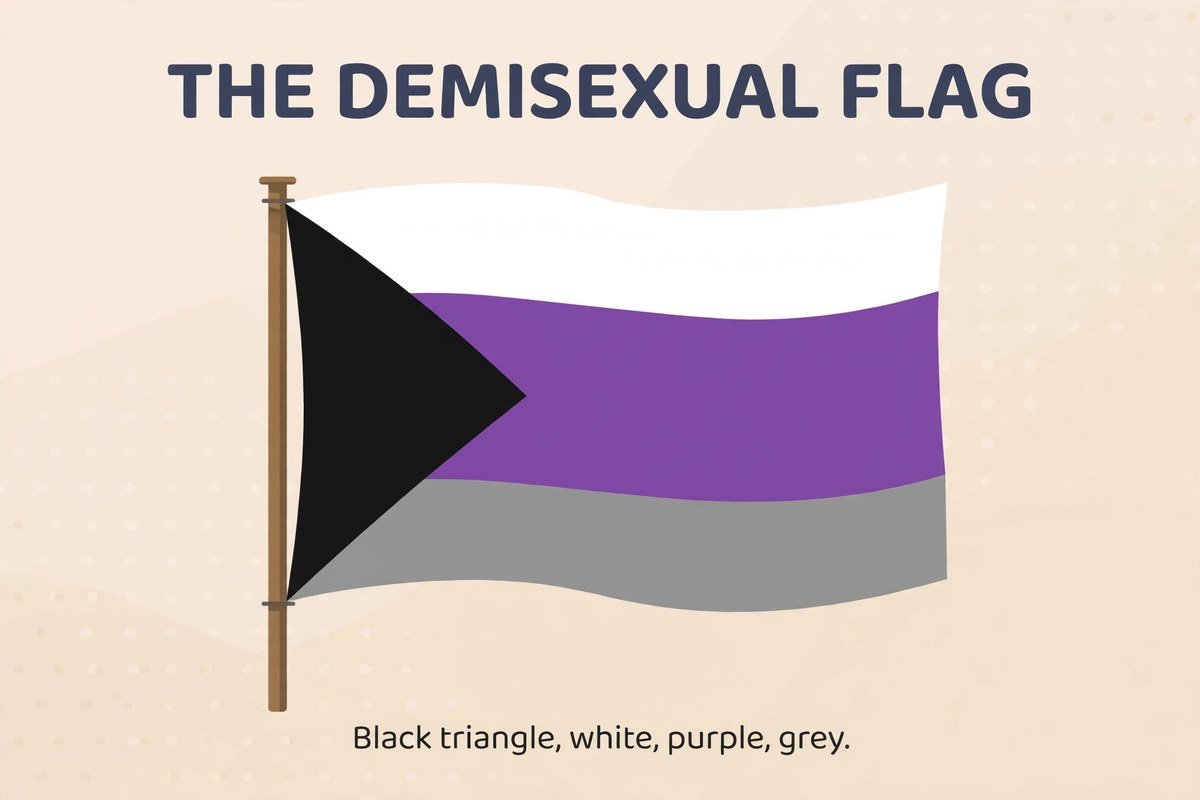
The Demisexual Pride Flag
The community flies a simple and striking flag. A black triangle points in from the left edge. Behind it, three horizontal stripes run in white, purple, and grey. Indeed, the design borrows its colours from the asexual pride flag on purpose.
Each part carries a commonly shared meaning. The black triangle stands for asexuality and the roots of the identity. The white stripe represents sexual attraction, which demisexual people can feel after a bond. Purple represents community, as it does on the asexual flag. Grey, finally, represents the grey area of the spectrum, where demisexuality sits. In fact, you will spot the flag at pride events and across social media every June.
Demisexual Meaning in Dating and Relationships
Dating works differently when attraction needs time. Many demisexual people prefer meeting partners through friends, work, hobbies, or study. Those settings let a bond grow naturally first. Apps built on instant photos, in contrast, often feel frustrating and shallow. Neither approach, in the end, is wrong. They simply reward different kinds of attention.
Talking About Pace
Honest communication makes relationships smoother. A demisexual partner may need months before any physical spark appears. That pace, in reality, says nothing about how much they value the other person. It only reflects how their attraction works. Couples who talk about pace early avoid most misunderstandings later. For a gentle comparison, our platonic meaning guide explains love that stays warm without romance at all.
The bond also does not need shared physical space. Many demisexual people form deep connections through messages, calls, and video chats. Over months, those conversations can build the same trust as daily meetings do. Attraction, as a result, can grow across an ocean. What matters, in the end, is the closeness itself, not the postcode.
Patience, in short, is the whole strategy. Rushing rarely creates a bond faster. Shared projects, long talks, and steady kindness do that job better. When attraction does arrive, it often arrives with unusual depth, because it stands on real knowledge of the person.
Common Myths About Demisexuality
Myths follow this word everywhere. Four of them appear most often, and each one deserves a calm correction.
- “Everyone is like that.” Most people can feel attraction to a stranger instantly, even if they choose not to act on it. Demisexual people generally cannot feel it at all before a bond.
- “It just means shy or old-fashioned.” Shyness is about nerves, and values are about choices. Demisexuality is about whether attraction appears in the first place.
- “It is just a phase.” People report this pattern across whole lifetimes. A stable pattern of attraction is an orientation, not a mood.
- “It means a low sex drive.” Attraction and drive are different systems. Once attraction exists, a demisexual person’s drive can be low, average, or high.
- “It means never feeling attraction at all.” That describes asexuality more closely. Demisexual people can and do feel attraction, once the bond exists. The door is narrow, in other words, but it is a real door.
- “You must be friends for years first.” In practice, the bond is about depth, not about the calendar. Some bonds form in months of intense, honest contact. Others never form at all, even after decades of polite friendship.
Overall, these myths share one mistake. They confuse behaviour that everyone can copy with attraction that nobody can force. In the end, a little precision dissolves the confusion.
FAQ’s
At what age do people realise they are demisexual?
In short, there is no set age. Many people recognise the pattern in their teens or twenties, when dating begins around them. Others name it much later, sometimes after years of wondering why romance felt different. The realisation, in fact, usually arrives as relief. At last, an ordinary word matches an ordinary life.
Is demisexuality part of the LGBTQ+ community?
Yes, generally it is counted within it. Demisexuality sits under the asexual umbrella, and the “A” in longer LGBTQIA+ versions includes asexual identities. Communities vary in style, of course. Still, demisexual people commonly march, organise, and celebrate within the wider queer community. Many local groups, for instance, run ace meetups that welcome demisexual members warmly.
How do you tell a partner you are demisexual?
First, choose a calm, private moment and keep the explanation simple. You might say that attraction grows for you only after real closeness, so you move slowly at first. Most partners respond well to honesty paired with warmth. As a result, the talk sets healthy expectations for both sides from the start.
Can demisexual people enjoy dating at all?
Absolutely. Many demisexual people love dating once the setting suits them. Friendship-first circles, hobby groups, and long conversations make dating feel natural instead of forced. In fact, the enjoyment comes from connection, shared humour, and growing trust. Romance simply follows a slower and steadier road.
Can a demisexual person’s attractions change over time?
The overall pattern usually stays stable, while individual attractions come and go. A bond with one person may fade, and feelings can fade with it. A new bond years later, meanwhile, may open the door again. The condition stays the same even as the people change.
Conclusion
The demisexual meaning, in the end, describes attraction with a clear order. First comes trust, friendship, and real knowledge of a person. Only then can a sexual spark follow. That order, in turn, places demisexuality on the asexual spectrum, in the grey area between instant attraction and none. It also explains the rare crushes, the empty dating apps, and the slow, deep bonds that demisexual people describe so often.
If the description fits you, treat the word as a tool, not a test. Use it when it helps you explain your pace to yourself or to a partner. Leave it when it does not. Either way, your pattern of attraction is valid exactly as it is. Connection first is not a flaw in the design. For many people, it is the design itself.


Leave a Comment