

Have you ever checked your phone forty times in an hour, hoping one particular person has replied? If so, you have probably searched for the limerence meaning at some point. Perhaps you had never even heard the word before. In short, limerence is an intense, involuntary state of romantic obsession. One person fills your thoughts. Hope powers the whole state, because you long for them to feel the same way. However, limerence is not the same as love, and it is far more consuming than an ordinary crush. Below, you will find a clear definition and the story behind the word. You will also find the main signs and stages. Finally, a simple comparison shows how limerence differs from love and from a crush.
Limerence Meaning in Simple Words
In simple words, limerence is a state in which your thoughts keep returning to one person, whether you want them to or not. More precisely, it is an involuntary emotional state of intense longing for another person, combined with an equally intense need for that person to return your feelings. Importantly, the center of the experience is not really the relationship itself. Instead, the center is one burning question: does this person want me back?
Interestingly, researchers give the person at the center of these feelings a special name. They call that person the “limerent object,” often shortened to LO. Meanwhile, people sometimes call the person doing the feeling the “limerent.” For example, a limerent might spend a whole evening analyzing one friendly comment. They hunt for hidden meaning in every word from their limerent object. In other words, limerence has a way of turning small moments into emotional earthquakes.
A few quick facts help pin the idea down. First, limerence is almost always one-sided, at least in the beginning. Second, it does not need a real relationship to exist, and it can even center on someone you barely know. Third, limerence is not a medical diagnosis. Instead, it is a well-documented pattern of human emotion. Psychologists have studied this pattern for decades. Reference works describe the same core pattern. Psychology Today’s limerence basics page sums it up just as clearly. It calls limerence an involuntary obsession. Uncertainty feeds that obsession, because you never know whether the other person desires you in return.
Who Coined the Term Limerence?
In fact, the word itself is younger than most people expect. Psychologist Dorothy Tennov coined the term in her 1979 book, Love and Limerence: The Experience of Being in Love. Interestingly, she did not borrow “limerence” from Latin or Greek roots. Instead, she invented a completely new word, precisely so it would carry no leftover meanings from older ideas about love.
Indeed, her research method was simple but powerful. Tennov interviewed hundreds of people about their experiences of being in love. She also gathered questionnaires, diaries, and personal accounts. Gradually, a clear pattern emerged from those stories. Again and again, people described intrusive thoughts, soaring highs, and crushing lows. They also felt a desperate need to know one thing. Did the other person return their feelings? As a result, Tennov concluded that this state was distinct enough to deserve a name of its own.
Before Tennov, writers folded experiences like these into broad labels. They used terms such as “infatuation” or “being in love.” However, those labels missed the obsessive and involuntary quality her interviewees kept describing. Since 1979, the concept has spread far beyond academic psychology. Today, relationship writers, therapists, and large online communities all debate the limerence meaning.
The Main Signs of Limerence
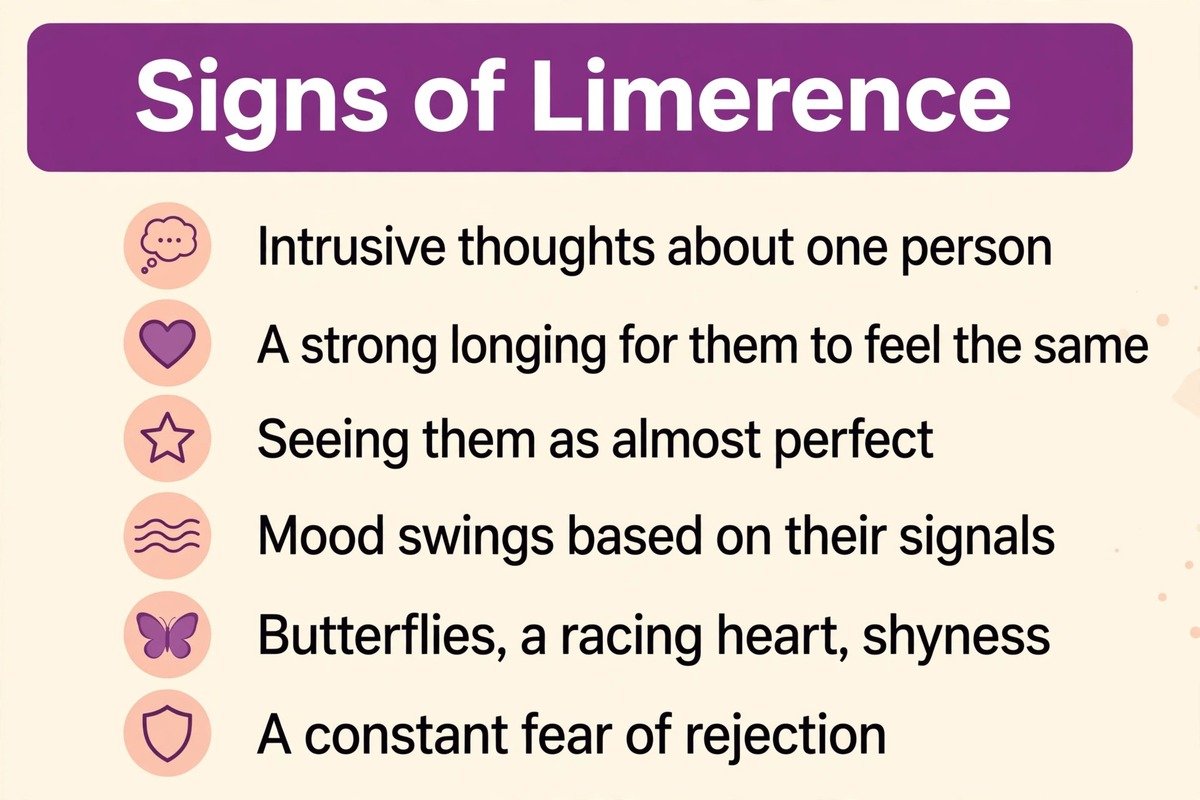
So, how does limerence actually feel from the inside? Although every person’s experience is slightly different, researchers describe a remarkably consistent set of signs. If several of the following points feel uncomfortably familiar, you are probably looking at limerence rather than ordinary attraction.
Intrusive Thoughts That Will Not Switch Off
First, the thoughts are intrusive, which means they arrive uninvited and refuse to leave. You might, for instance, replay a two-minute conversation word for word, or rehearse future meetings in careful detail. Consequently, focus at work or school often suffers. The limerent object keeps taking up mental space that other things need.
A Deep Longing for Reciprocation
Second, the central craving is reciprocation. More than anything else, you want clear proof that the person feels something for you in return. Therefore, one warm reply can lift your mood for hours. A short or delayed reply, meanwhile, can quietly ruin an entire day.
Idealization, or Crystallization
Third, limerence tends to idealize the other person. Tennov called this process “crystallization,” because the limerent object seems to glitter with almost perfect qualities. Meanwhile, the limerent explains obvious flaws away. They minimize the flaws, or they simply never notice them at all. In effect, you fall for a polished version of the person rather than the complete and complicated human being.
Physical Reactions and Fear of Rejection
Finally, the body joins in as well. People commonly report a racing heart and shaky hands. They also report butterflies, flushed skin, and sudden shyness around the person. At the same time, a fear of rejection runs underneath everything, so even tiny interactions can feel strangely high-stakes. In short, limerence is just as much a physical experience as an emotional one.
How Limerence Starts: The Three Stages
Limerence rarely arrives all at once. Instead, it usually grows through recognizable stages. The length of each stage varies a great deal from person to person. Moreover, simply knowing the pattern often makes the whole experience feel less mysterious and less shameful.
Stage 1: Infatuation
At first, you simply notice this person more than everyone else. Their jokes seem funnier, their messages feel more important, and ordinary encounters start to glow a little. Crucially, hope is still light and playful at this point, so the feelings are easy to enjoy.
Stage 2: Crystallization
Later, the feelings deepen into full limerence. The intrusive thoughts peak, and the idealization hardens into place. Your mood begins to rise and fall with every perceived signal. During this stage, even obstacles can make the feelings stronger. Distance and difficulty leave the fantasy untouched, so they rarely weaken it. As a result, crystallization is usually the most intense stage of all. It is also the most exhausting, since hope and uncertainty both peak here.
Stage 3: Deterioration
Eventually, the intensity starts to fade. Reality slowly replaces the fantasy, and the idealized image of the person begins to crack. Admittedly, this stage can feel like grief, even when nothing real was actually lost. Still, for many people it eventually brings genuine relief.
In addition, Tennov described three typical ways a limerent episode can end. One ending is consummation, where the feelings turn out to be mutual and a real relationship begins. A second ending is starvation, where hope slowly dies because reciprocation clearly never arrives. In the third ending, transference, the feelings simply move across to a new person. In each case, notably, what finally ends the state is the end of uncertainty, one way or another.
Limerence Meaning vs Love: The Key Differences
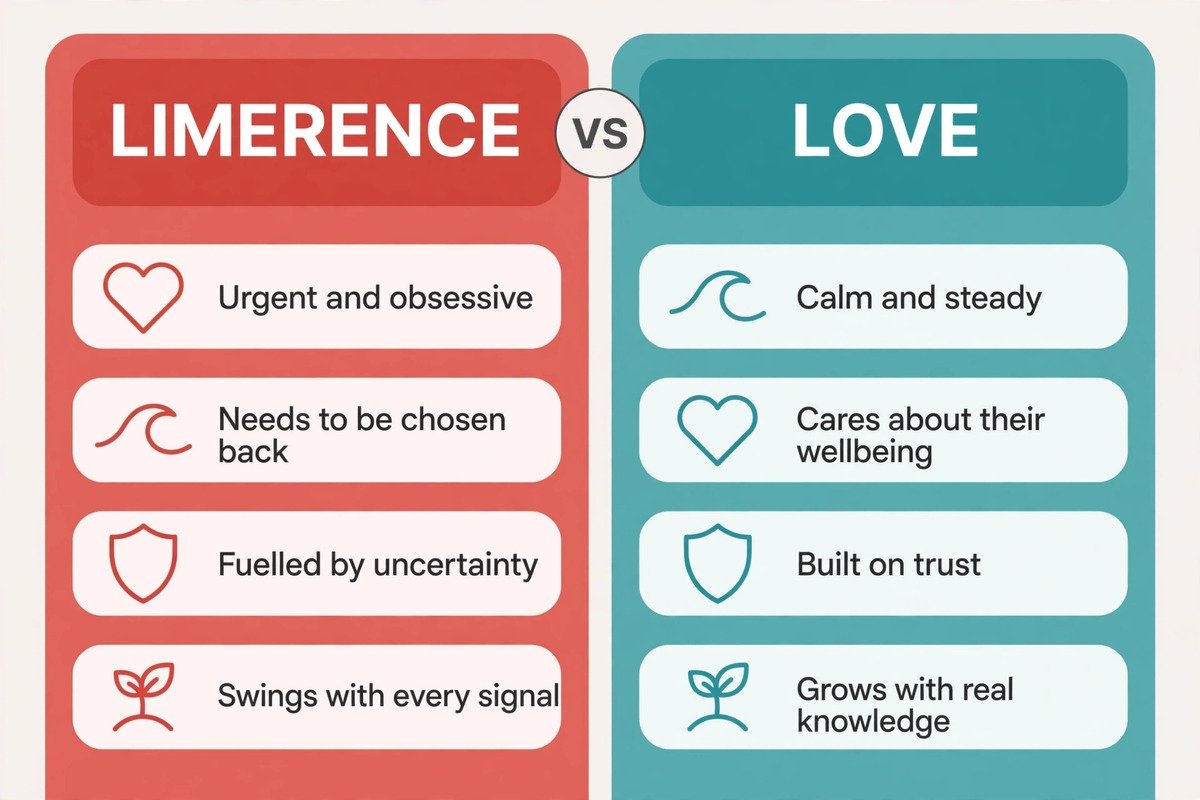
Comparing the limerence meaning with the meaning of love is where the concept really clicks. On the surface, the two can feel identical, because both involve strong emotion and a powerful pull toward one person. Underneath, however, their engines are completely different.
Love, at its healthiest, includes genuine care for the other person’s wellbeing. It holds that care in every moment, whether or not they return your feelings. Limerence, by contrast, centers on your own need to be chosen. For instance, a person in love can feel real happiness simply because the other person is happy. A person in limerence, meanwhile, feels happy mainly at one moment. They have just received a fresh sign that the person wants them back.
Similarly, stability is another clear dividing line. Love generally grows steadier over time. Trust, real knowledge, and shared experience hold it steady. Limerence, on the other hand, swings wildly with every message, glance, and rumor. In addition, love usually deepens as you come to know someone better. Limerence often depends on the opposite: not knowing them fully. Put simply, love is about the person, while limerence is about the answer to a question.
Limerence Meaning vs a Crush: Where the Line Is
If the limerence meaning still sounds a lot like a crush, the difference is mainly one of degree and control. Almost everyone has had a crush. A crush is a light, pleasant attraction. It adds a little sparkle to the day without taking the day over. After all, you think of the person now and then. You enjoy their company when it happens. Life carries on much as normal.
Limerence is the heavier version of that feeling. The thoughts are intrusive rather than occasional, and the emotional stakes feel enormous. Furthermore, a crush usually fades quickly when someone new appears. It also fades when the other person clearly does not return the interest. By contrast, limerence can survive months of silence, distance, or even direct discouragement. As a rough guide, watch what the feeling controls. If it runs your schedule, your sleep, and your mood, it has crossed a line. It is no longer a crush; it is limerence.
How Long Does Limerence Last?
Admittedly, there is no fixed expiration date, because situations differ so much. Even so, researchers can offer a useful range. Tennov estimated that a typical episode lasts somewhere between 18 months and three years. Nevertheless, some episodes burn out within a few weeks, especially when the answer becomes clear very quickly. Others, in contrast, can linger far longer. Fresh hope keeps feeding the uncertainty in those cases.
Generally, limerence lasts only as long as hope and uncertainty survive together. In fact, regular contact, mixed signals, and the occasional warm moment can all keep the cycle alive for years. Conversely, clear rejection tends to bring the state to an end. Long stretches of no contact can end it too. A settled mutual relationship does the same. In the end, time alone rarely cures limerence; clarity does.
Why Does Limerence Happen?
In short, limerence runs on two fuels: uncertainty and hope. Psychologists point out that uncertainty is essential to the state. A definite answer, either yes or no, would end it at once. Hope then does the rest of the work, turning every ambiguous smile or message into possible evidence. Together, the two create a loop that can be remarkably hard to step out of.
Meanwhile, brain chemistry plays a supporting role as well. Attraction links closely with reward-related chemicals such as dopamine. That is why a single message from the limerent object can feel like a prize. It can feel like winning something small and precious. Consequently, the brain starts chasing the next signal, much as it chases any other rewarding surprise. Importantly, this reward response is a normal feature of human attraction. The limerent version simply runs at a much higher volume.
Finally, limited knowledge of the person matters too. Limerence feeds on an idealized image. Because of that, not knowing someone well leaves room for fantasy. The fantasy then fills in every gap. Life circumstances can add fuel as well. Loneliness, stress, or major transitions can make a powerful fantasy feel like a welcome escape. Of course, none of this means that something is wrong with you. It simply reflects how human minds respond to hope, novelty, and one very unanswered question.
Is Limerence a Problem?
It is worth stressing that Tennov herself did not consider limerence an illness. In her research, healthy and ordinary people experienced it, and afterward their lives returned to normal. Therefore, having limerent feelings does not mean you are broken. Nobody should ever use the limerence meaning as a label for shame. It should never shame you or anyone else.
At the same time, honesty matters. The feelings may be taking over your days. They may disturb your sleep or leave you low most of the time. If so, you deserve support with that load. You would deserve it with any heavy emotional load. Talking things through with a trusted person can genuinely help. If it ever feels overwhelming, a qualified professional can help too. They can help you make sense of it all. Seeking perspective, after all, is a strength rather than a weakness.
FAQ’s
Of course, plenty of questions remain even after the basics are clear. Here are the ones people ask most often once they understand what limerence is.
Can Limerence Turn Into Real Love?
It can, although it never happens automatically. When feelings become mutual and a real relationship begins, the uncertainty that fuels limerence starts to disappear. What remains can then grow into love. Both people must build trust, honesty, and genuine care over time. In other cases, the connection simply fades once reality replaces the fantasy, and that outcome is perfectly healthy too.
Can Limerence Happen Inside a Long-Term Relationship?
Yes, in fact, it can, and this surprises many people. Sometimes a person in an established relationship develops limerent feelings for someone new. The new person might be a colleague or a friend. Typically, novelty and unmet emotional needs combine to make the new person look like an escape route. Recognizing the pattern for what it is, notably, can help people make clearer and kinder decisions for everyone involved.
Can Two People Be Limerent for Each Other at the Same Time?
Yes, mutual limerence does indeed happen, although it is less common than the one-sided kind. When both people feel the same intense pull, the early stage of a relationship can feel extraordinarily powerful. Even so, the feelings usually settle as certainty grows. Then the pair discovers something important. A calmer, more lasting love may be waiting underneath.
Can Limerence Be Aimed at Someone You Have Never Met?
Surprisingly, yes. Limerence can attach itself to a celebrity or an online personality. It can even attach to someone you have only seen from a distance. Imagination and interpretation build most of this state. Because of that, a person needs very little real contact. In fact, distance can protect the idealized image, since everyday reality never gets the chance to correct it.
Conclusion
In the end, limerence names a very common experience in romantic life. Few experiences get discussed less. It is an involuntary, hope-fueled obsession with one person. It also holds one question: do they want you back? Limerence differs from love in a key way. Love cares about the person rather than the answer. It also differs from a crush in intensity and staying power. Above all, naming the experience accurately is genuinely useful. A feeling you can name is a feeling you can begin to understand. That kind of honesty sits alongside other big questions. People ask them whenever life feels unsettled. They range from relationships all the way to what is the meaning of life itself.


Leave a Comment