

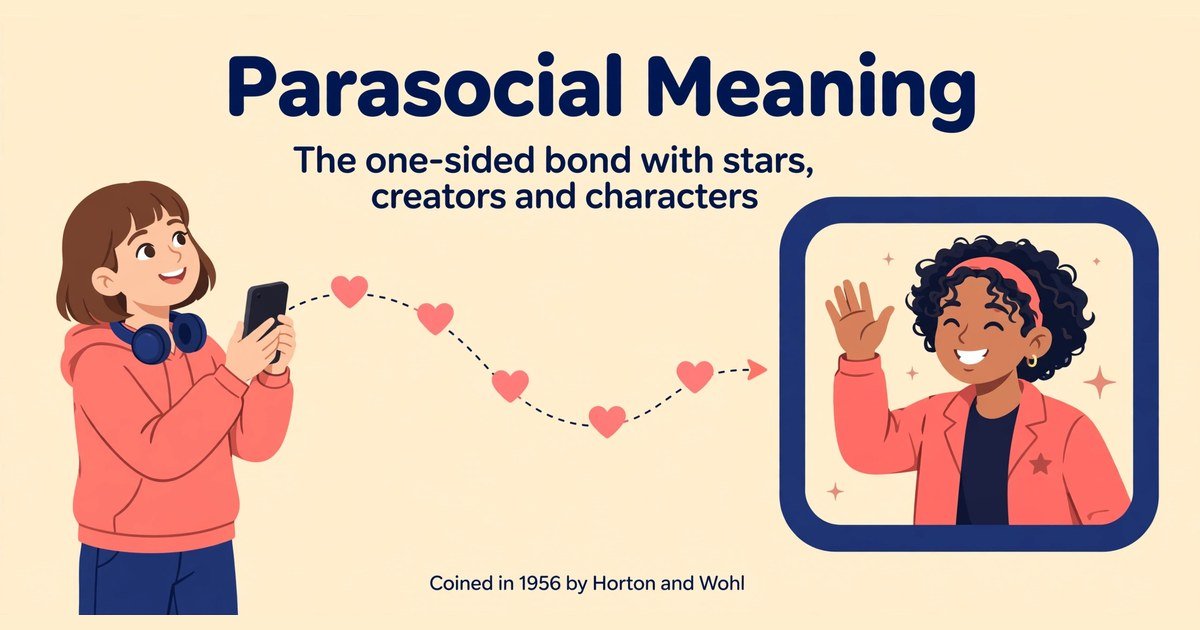
You follow a singer’s daily stories, laugh at a streamer’s jokes, and feel oddly close to both. Yet neither person knows your name. The parasocial meaning names exactly that one-sided closeness: a bond you feel with a famous person, a creator, or a character who cannot feel it back. In short, your heart treats a face on a screen like a real friend.
This guide explains the parasocial meaning in plain words first. Next, it travels back to 1956, when two researchers coined the term. Then, it shows why social media turned a rare feeling into a daily habit. After that, it lists the common signs and compares the bond with real friendship. Finally, it shares gentle ways to keep the feeling healthy and fun.
Parasocial Meaning in Plain Words
In plain words, the parasocial meaning describes a one-way emotional connection. You invest time, loyalty, and feelings in a public figure. That figure, however, speaks to millions at once and never answers you personally. In reality, the connection is strong on your side and absent on theirs.
Cambridge Dictionary defines parasocial as involving a connection that someone feels with a famous person they do not know, a character in a book or film, or even an artificial intelligence. That definition, notably, now includes AI companions alongside pop stars. The word itself, meanwhile, works as an adjective. In practice, people mostly use it inside the phrase “parasocial relationship”.
- Word type: an adjective
- Say it: pair-uh-SOH-shul
- Core idea: a one-sided bond with someone who does not know you
- Common partners: celebrities, streamers, fictional characters, and AI chatbots
Also, the feeling itself is not foolish or rare. Almost every fan has felt a small version of it. A favourite podcast host, for example, can feel like a friend who visits every morning. The word simply gives that everyday feeling a precise name.
Where the Word Parasocial Comes From
The term began in a university, not on the internet. In 1956, sociologists Donald Horton and Richard Wohl published a paper about television viewers. In particular, they noticed that viewers treated TV personalities like companions in the room. As a result, the pair coined the phrase “para-social interaction” for the illusion of a face-to-face relationship.
The prefix “para” helped their case. In Greek, it means “beside” or “alongside”. A parasocial bond, therefore, runs alongside a real social life without truly joining it. Horton and Wohl also observed something subtle. Notably, presenters who looked into the camera and spoke warmly made viewers feel personally addressed.
For decades, however, the word stayed inside academic journals. Television scholars used it, while few others had even heard of it. Then podcasts, YouTube, and social feeds carried the idea everywhere. In 2023, in fact, Cambridge Dictionary added “parasocial” to its main dictionary after spotting it across news and social media. A specialist term had quietly gone mainstream.
Why Social Media Made Parasocial Bonds Stronger
Television offered viewers a weekly glimpse of a star. Social media, in contrast, offers a daily window into a creator’s kitchen, car, and mood. Stories, livestreams, and vlogs arrive every few hours, too. That constant presence, naturally, deepens the feeling of knowing someone.
Creators also speak in a deliberately personal style. They say “you guys” to the camera and answer comments by first name. Some, for instance, read fan messages aloud or thank supporters in videos. Each small reply, of course, feels like a private moment, even when thousands watch the same reply.
Algorithms strengthen the loop further. First, a platform notices your interest and serves more of the same face. Soon, that face appears more often than your neighbours do. Meanwhile, AI companions have added a new chapter. A chatbot, in turn, answers instantly, remembers details, and never sleeps. For a lonely user, in short, the illusion of mutual care can feel stronger than ever.
Where Parasocial Bonds Show Up in Everyday Life
First, podcasts create some of the strongest bonds of all. A host’s voice joins your commute, your cooking, and your evening walk. Week after week, that voice shares jokes, opinions, and small personal stories. Soon, the host feels less like a presenter and more like a travelling companion.
Streamers build a similar closeness in a different way. They play live for hours and greet regular viewers by username. They also celebrate birthdays, answer questions, and react to chat in real time. For regulars, in fact, a stream can feel like hanging out with a funny friend.
Fictional characters, meanwhile, inspire bonds that can last for decades. A long book series or TV saga grows up beside its audience. Readers, for example, mourn a character’s death as if a real acquaintance had died. Sports stars create the same pattern on a bigger stage. Fans plan weekends around matches and feel a transfer rumour like personal news.
None of these examples, of course, requires fame on a global scale. A local radio host or a small channel can inspire the same warmth. The ingredients stay constant: regular contact, a personal tone, and stories that invite you in. Wherever those three meet, a parasocial bond can quietly grow.
Common Signs of a Parasocial Relationship
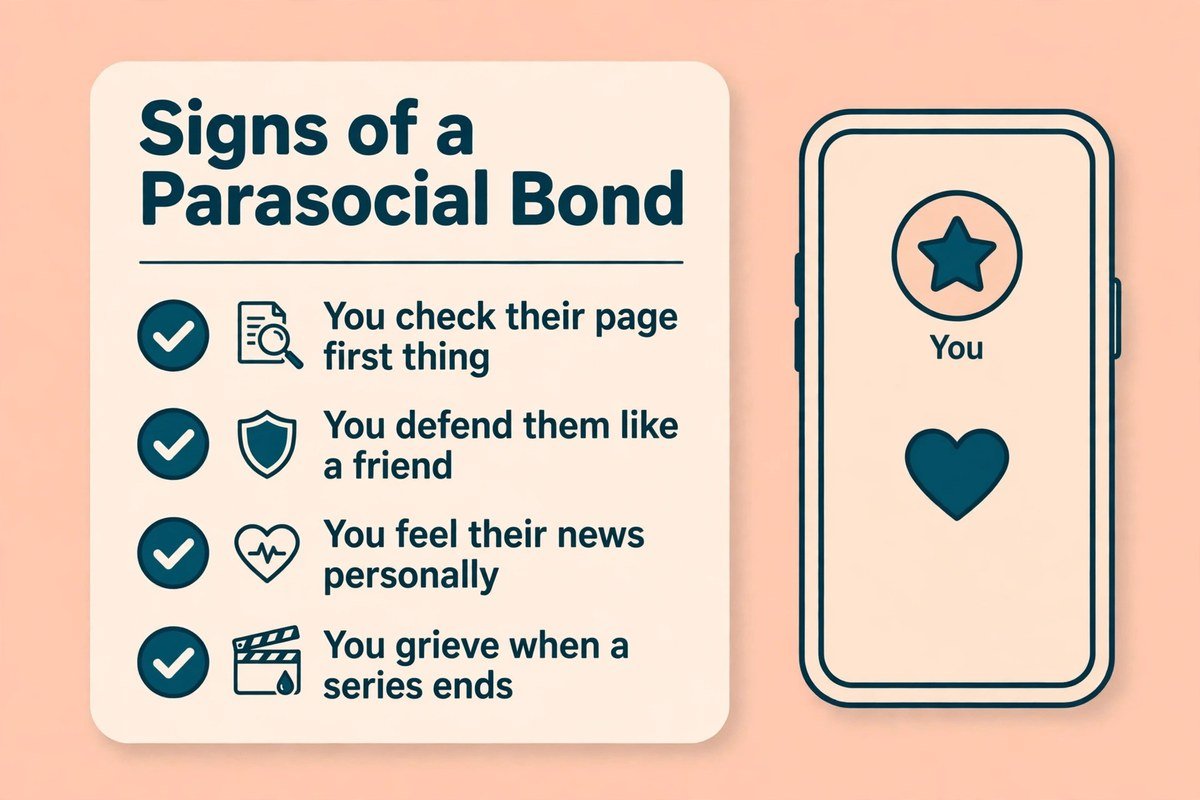
First of all, most signs are harmless habits that fans share. Together, however, they reveal how deep a one-sided bond can run. Then, see how many of these feel familiar to you.
- You follow a creator’s daily posts and feel genuinely worried when they seem sad.
- You defend a celebrity in arguments as if you were defending a close friend.
- You feel a small sting of betrayal when a star changes style, partner, or opinion.
- You buy products mainly because a favourite influencer recommended them.
- You know a character’s backstory better than your own cousin’s latest news.
- You talk about a podcast host’s life as if you had shared the experience.
- You feel real grief when a favourite series ends or a band breaks up.
- You check a creator’s page first thing, before your own messages.
None of these signs, on its own, signals a problem. Fandom, after all, brings joy, community, and comfort to millions of people. The signs simply show where friendly interest becomes emotional investment. Awareness, in practice, is the difference between enjoying a bond and depending on it.
Parasocial Meaning vs Real Friendship
The clearest way to grasp the parasocial meaning is to set it beside real friendship. Both bonds, after all, involve warmth, loyalty, and shared jokes. One crucial feature, however, separates them: reciprocity. A real friend, by contrast, knows you, answers you, and leans on you in return.
| Feature | Parasocial bond | Real friendship |
|---|---|---|
| Who knows whom | They do not know you exist | You know each other personally |
| Replies | Broadcasts to everyone at once | Answers you directly |
| Support | Flows one way, from you | Flows both ways |
| Endings | A channel can vanish overnight | Survives distance and busy seasons |
Our guide to platonic meaning explores the other side of this line: a deep, mutual closeness without romance. A parasocial bond can feel equally deep from the inside. Still, only one side carries real shared memories. The star’s “moments”, after all, were filmed for an audience of millions.
None of this makes the feeling fake. In fact, emotions do not check whether a bond is mutual before they arrive. Grief for a character, for instance, is genuine grief. The honest label simply helps you spend your time, money, and loyalty with open eyes.
Parasocial Meaning in the News: Word of the Year 2025
In November 2025, Cambridge Dictionary named “parasocial” its Word of the Year. Of course, the choice surprised nobody who follows online culture. Indeed, searches for the word had surged through the year, driven by influencer drama, pop-star news, and debates about AI companions. You can read the announcement on the Cambridge Dictionary blog.
Cambridge’s experts explained the pick simply. Millions of people now form these one-sided bonds, and many more are curious about them. A Cambridge psychologist noted that such bonds have redefined fandom and celebrity. In other words, a 1956 idea about television had become the perfect word for the social media age.
How to Keep a Parasocial Bond Healthy
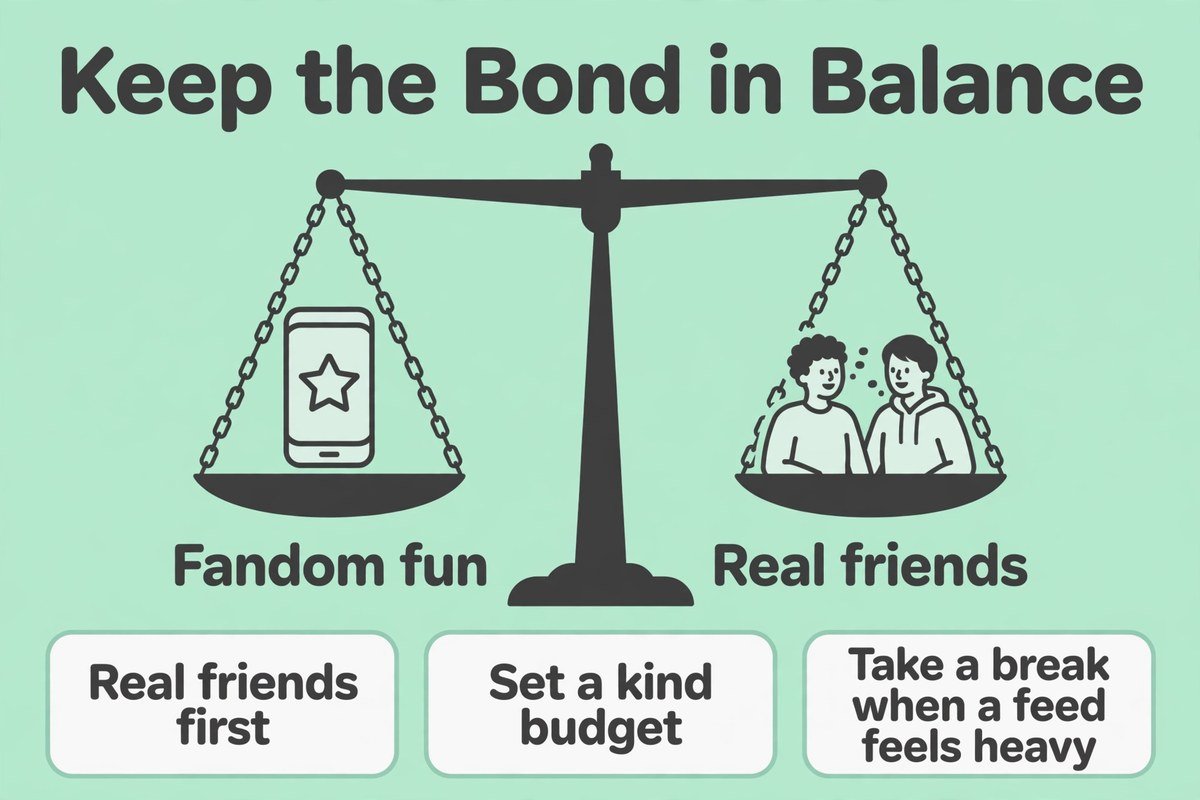
After all, enjoying a fandom is healthy, normal, and often joyful. Balance, therefore, is the goal, not cold turkey. In practice, these gentle habits keep the bond in its proper place.
- Keep real friendships first: message an actual friend before opening a fan page.
- Set a kind budget for merch, tickets, and fan gifts, and stick to it.
- Remember the frame: posts are edited highlights, not a person’s whole life.
- Notice your mood: if a feed leaves you anxious or jealous, take a break from it.
- Enjoy the community: fellow fans are real people, and friendships there are mutual.
- Protect your sleep: late-night livestreams can wait until morning.
If a bond starts to crowd out work, family, or rest, treat that as useful information. Instead, talk to someone you trust, or simply step back for a week. Most fans, in fact, find that a short break restores the fun. The goal is simple: the fandom should add colour to your life, not replace the life itself.
FAQ’s
Is a parasocial relationship the same as being a fan?
In short, being a fan is the wider label. Parasocial, in contrast, describes the personal, friendship-like feeling inside fandom. Many fans enjoy an artist’s work without that bond. The term applies when the connection starts to feel like a real relationship.
Can a parasocial bond ever be a good thing?
Yes, it genuinely can. Such bonds offer comfort during lonely seasons, motivation from role models, and a ready-made community of fellow fans. Psychologists, in fact, treat the feeling as normal in moderation. It turns unhelpful only when it starts replacing real contact.
What does parasocial grief mean?
Parasocial grief is the sadness people feel when a celebrity dies, a band splits, or a beloved series ends. The grief is real, even though you never met the person. After all, the bond shaped your routines and memories for years.
Can children form parasocial bonds too?
Yes, children form them too, with cartoon characters, kids’ presenters, and young creators. Parents can help by watching together and talking about what is real. In practice, a little shared context keeps the bond light and healthy.
Is a parasocial bond the same as obsession?
No. In fact, the two are different. A parasocial bond is a feeling, not a pattern of behaviour. Most fans keep a respectful distance and wish their favourites well. Unwanted contact or intrusion, by contrast, is a separate and serious matter.
Conclusion
In the end, the parasocial meaning describes a bond that runs in one direction. You know the star’s stories, songs, and sorrows, yet the star does not know yours. Horton and Wohl spotted the pattern in television viewers back in 1956. Social media then carried it into every pocket and onto every screen. That is also why the word helps so much: it names the feeling honestly, without mocking the fan who feels it.
So enjoy your favourite creators with clear eyes and a warm heart. Let the bond entertain you, comfort you, and connect you with fellow fans. Then, invest your deepest loyalty where it can flow back to you. Share the songs, defend the stories, and enjoy the fan community around them. Afterwards, close the app and call the friend who always calls back. Real friends answer, remember, and show up in person. A parasocial bond can brighten a day, but a mutual one can carry a lifetime.


Leave a Comment