

Some moments feel like pure luck, yet they change everything. The serendipity meaning is simple: it is the luck of finding something good while you look for something else. In fact, the word names those happy accidents that life drops in your path. A wrong turn, for instance, leads you to a tiny cafe that becomes your favourite place. Or an old book falls open at the exact page you needed. In short, serendipity turns chance into a small gift.
This guide explains the serendipity meaning in plain words first. Next, it traces the word back to a Persian fairy tale. Then, it compares serendipity with luck, coincidence, and fate. After that, it shares famous real-life examples and simple ways to invite more of it. By the end, you will use the word naturally and spot it everywhere.

Serendipity Meaning in Plain Words
In plain words, the serendipity meaning is a happy and useful discovery made by accident. You are not searching for that exact thing. Instead, you stumble on it while you do something else. Then, you notice its value, and that noticing matters as much as the accident itself.
Two ingredients, therefore, define the word. First, chance brings the moment to you. Second, your own attention turns it into a discovery. Without attention, in contrast, the moment simply passes by. That is why two people can live the same day and only one calls it serendipity.
Dictionaries phrase the idea in a similar way. They describe serendipity as the fact of finding valuable or pleasant things that you never expected. That wording, of course, is dry beside real life. Still, it confirms the same two halves: the find arrives by chance, and the find turns out well. A serendipity story, in other words, always ends with a small celebration.
- Word type: a noun; the adjective is serendipitous
- Say it: ser-en-DIP-i-tee
- Core idea: a lucky find you were not looking for
- Tone: warm, grateful, and always positive
Also, people often say “a moment of serendipity” or “pure serendipity”. Both phrases describe the same pleasant surprise. Meanwhile, the adjective “serendipitous” describes the find itself, as in a serendipitous meeting. Either way, the feeling stays bright and thankful.

Where the Word Serendipity Comes From
The word has a charming birth certificate. In 1754, the English writer Horace Walpole coined “serendipity” in a letter to a friend. He borrowed the idea from a Persian fairy tale called The Three Princes of Serendip. In the tale, three princes travel widely and keep making lucky discoveries. Again and again, they find things they were not looking for.
Serendip, meanwhile, was an old name for Sri Lanka. Walpole explained that the princes solved problems by accident and by sharp thinking. That mix impressed him deeply. As a result, he built a new English word on the island’s name. Readers can explore the full story on the Wikipedia page on serendipity.
One detail in Walpole’s letter deserves special attention. He stressed that the princes used sagacity, an old word for sharp wisdom. They did not merely trip over treasures by blind luck. Instead, they noticed clues and reasoned their way to the prize. That detail, in fact, is why the modern word needs both chance and attention. Pure luck alone never earned the name serendipity.
At first, almost nobody used the word. It slept in dictionaries for more than a century. Then, writers and scientists slowly adopted it during the 1900s. Today, in contrast, it appears in books, films, songs, and everyday chat. Few invented words enjoy such a happy second life.
Serendipity Meaning vs Luck, Coincidence, and Fate
People often mix serendipity with three close cousins. Each cousin, however, misses one part of the picture. The table below separates them clearly.
| Word | What it really means |
|---|---|
| Luck | Pure chance, good or bad; you play no part in it |
| Coincidence | Two events align in a surprising way; the result can be neutral |
| Serendipity | Chance plus your attention; you find something good and useful |
| Fate | A belief that events were meant to happen all along |
Luck, for example, needs no action from you. A lottery win is luck, because your choices change nothing. Coincidence, similarly, only asks you to notice a pattern. Two friends wearing the same shirt is a coincidence, yet nothing useful follows.
Serendipity goes one step further. The accident must hand you something valuable, and you must recognise its value. Fate, by contrast, removes chance entirely. It says the meeting was written in advance. Serendipity, in short, keeps the surprise and skips the script.
How to Use Serendipity in a Sentence
The word fits both small moments and life-changing ones. It also suits formal writing and relaxed chat. The examples below show its natural range.
- “By pure serendipity, I found my grandfather’s letters in a market stall.”
- “Meeting her was serendipity; we both missed the same train.”
- “The recipe began as a mistake, but serendipity turned it into our best seller.”
- “A serendipitous chat on the bus led to her first job.”
- “Travel writers love serendipity, because the wrong street often hides the best view.”
- “It was serendipity that the shop had one copy left.”
Notice two habits in those lines. First, the speaker never plans the discovery itself. Second, the discovery always brings something welcome. If the surprise hurts or helps nobody, another word fits better. Words like “accident” or “coincidence” cover those cases instead.
Famous Examples of Serendipity in Real Life
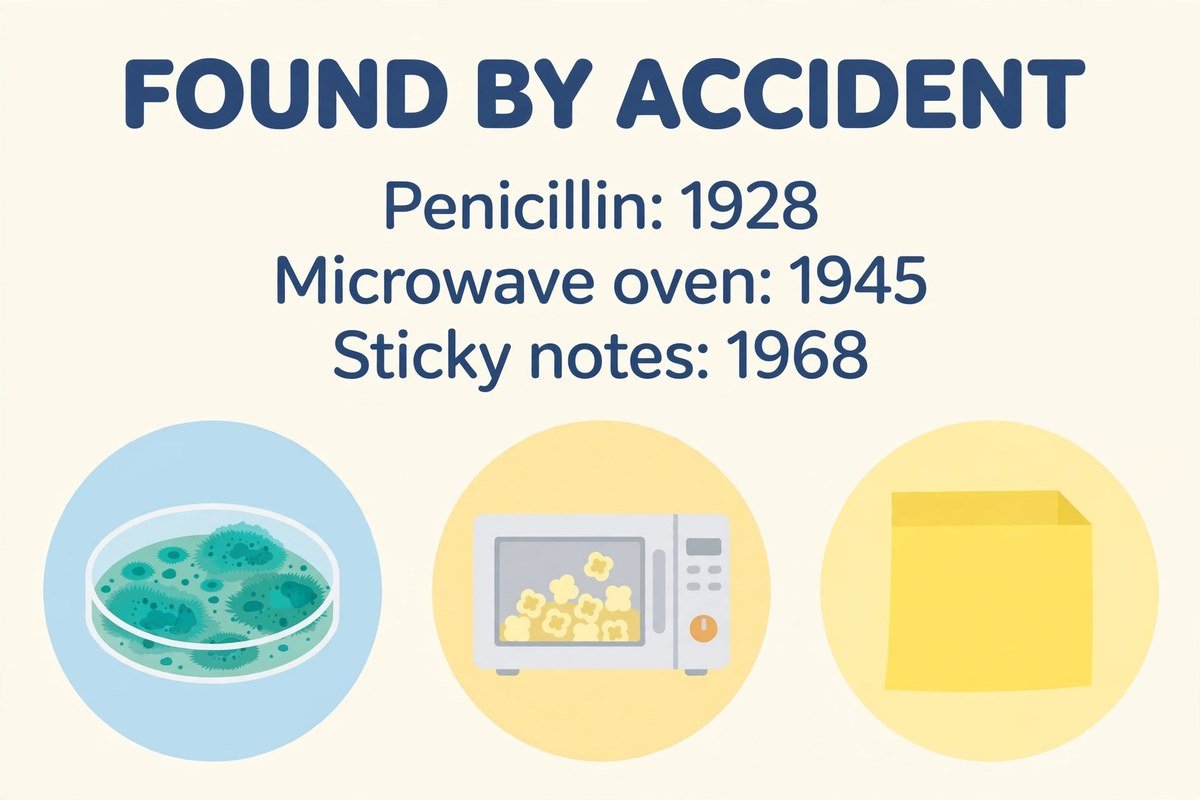
Science, in fact, runs on serendipity more often than textbooks admit. Four famous stories show the pattern clearly.
Penicillin, the Mould That Became Medicine
In 1928, Alexander Fleming returned from holiday to a messy lab bench. A mould had drifted onto his bacteria plates and killed the germs around it. Most people would bin the spoiled plates at once. Fleming, instead, looked closer and saw medicine. That mould became penicillin, the first widely used antibiotic.
The Microwave Oven and the Melted Chocolate
In 1945, engineer Percy Spencer worked beside a radar magnetron. Suddenly, he noticed the chocolate bar in his pocket had melted. Curiosity pushed him to test popcorn kernels next. They popped within seconds. As a result, a radar accident slowly became the microwave oven in our kitchens.
Post-it Notes and the Glue That Failed
In 1968, Spencer Silver created a glue that barely stuck to anything. The weak glue looked like a failure for years. Then, in 1974, his colleague Art Fry wanted a bookmark that stayed put. Fry remembered the weak glue at once. Together, the two men turned a failed glue into the Post-it note.
Velcro and a Walk With a Dog
In 1941, Swiss engineer George de Mestral returned from a walk with his dog. Burdock burrs clung to his trousers and to the dog’s fur. Under a microscope, he saw tiny hooks gripping the loops of cloth. That walk, in short, inspired Velcro. Nature had designed the fastener first.
Chocolate Chip Cookies and a Missing Ingredient
In 1938, innkeeper Ruth Wakefield ran out of baker’s chocolate at her Toll House inn. She chopped a bar of semi-sweet chocolate into the dough instead. She expected the pieces to melt through the biscuits. Instead, they held their shape and softened into pockets. Her guests loved the result at once. Thus, a shortage in one kitchen gave the world the chocolate chip cookie.
How to Invite More Serendipity Into Your Life
Nobody can schedule a happy accident. Still, you can raise the odds in simple ways. The princes in the tale, after all, kept moving and kept noticing. These habits copy their method.
- Stay curious. Ask questions about odd details instead of walking past them.
- Vary your routine. Take new routes, read new authors, and try new cafes.
- Talk to more people. Chance meetings grow where conversations happen.
- Carry a notebook. Small finds fade fast unless you capture them.
- Follow side interests. Hobbies connect distant ideas in surprising ways.
- Say yes more often. Invitations multiply the moments luck can use.
None of these habits guarantees a discovery. Together, however, they widen the net that chance can fall into. Serendipity favours the prepared and the observant. That, in the end, is the hopeful half of the word.
Serendipity at Work and in Your Career
Careers, in particular, run on well-timed accidents. A chance conversation at a conference, for example, can redirect a whole working life. Likewise, a temporary task can reveal a talent nobody planned to test. Mentors, partners, and even employers often enter a story this way. The door looks random only from the outside.
Inside the story, however, preparation does the quiet work. Skilled people notice openings because they know their field deeply. They also stay visible, so chance knows where to find them. In practice, then, professionals treat serendipity as a strategy with two rules. First, keep learning in public. Second, keep meeting people outside your usual circle. A single coffee with a stranger, after all, can outperform a month of cold applications. Luck handles the rest, in its own sweet time.
Serendipity Meaning in Texts, Captions, and Online Talk
Online, the word keeps its classic sense. People use it in captions for travel finds, book-shop luck, and sweet meet-cute stories. A photo of two old friends meeting abroad, for example, often carries the word “serendipity” alone. The tone stays warm and grateful every time.
Beyond captions, the word also lends its glow to titles and names. The 2001 romantic comedy Serendipity, for instance, builds its whole plot on a chance meeting in New York. Cafes, boutiques, and bookshops borrow the name for the same reason. It promises visitors a pleasant surprise before they even step inside. Few words advertise happiness so efficiently.
There is no secret code hidden inside the word. Unlike slang shortcuts, serendipity never flips into an insult or a joke at someone’s expense. It simply celebrates a lucky find in slightly fancy dress. If you enjoy rare and beautiful words, our esoteric meaning guide is another happy discovery.
FAQ’s
What is the opposite of serendipity?
Writers use the word “zemblanity” for the opposite. It means an unlucky discovery that feels unpleasant and predictable in hindsight. The word comes from a cold island in a Russian novel. Unlike serendipity, zemblanity names the find nobody wanted.
What is the adjective form of serendipity?
“Serendipitous” is the adjective. It describes the lucky moment or the lucky find itself. You can call a meeting, a discovery, or even a whole day serendipitous. The adverb, meanwhile, is “serendipitously”.
Is serendipity always a good thing?
Yes, the word carries a positive charge by definition. The discovery must please you or help you in some way. A nasty surprise, in contrast, is just bad luck. English keeps serendipity for the finds that make you smile.
What is the difference between serendipity and synchronicity?
Synchronicity means two events feel meaningfully linked, even without a clear cause. Serendipity, instead, centres on a useful discovery made by chance. One word stresses hidden meaning. The other stresses a happy, practical find.
Can serendipity describe meeting a person?
Absolutely. Meeting a future friend, partner, or mentor by chance is a classic case. The key parts still apply. The meeting was unplanned, and it brought something good into your life.
Conclusion
In the end, the serendipity meaning celebrates the finds you never planned. A writer invented the word in 1754 after a tale of travelling princes. Since then, it has named lucky accidents in labs, kitchens, and everyday streets. Unlike plain luck, it also honours your attention. The accident offers the gift, but you must notice it. Fleming and Spencer prove that genius often begins with a second look.
So keep the word ready for your next happy surprise. Use it for the book, the person, or the idea that finds you first. Then, perhaps, arrange your days the way the princes travelled. Stay curious, stay moving, and keep your eyes open. Serendipity loves a prepared mind, and it visits more often than you think.


Leave a Comment