

The platonic meaning, simply put, describes a bond full of love, trust, and closeness. Yet the bond holds no romance and no sexual attraction. Indeed, two people can feel deeply devoted to each other. Still, neither person wants a dating relationship. In short, platonic love is real love. It simply follows a different path than romantic love.
Many people, however, hear the word and feel confused. Naturally, they wonder whether it means cold or distant. In fact, it means the exact opposite. In reality, a platonic connection can feel warm, loyal, and life-changing. Below, you will learn where the word comes from. You will also see how it differs from romance and from ordinary friendship. Plus, you will find signs, boundary tips, and honest words for tricky moments.
Platonic Meaning in Simple Words
Simply put, the platonic meaning points to love without desire. One person cares for another person with depth and devotion. However, the care never turns into romantic longing. Neither person hopes for dates, kisses, or a wedding. Instead, both people value honesty, comfort, and emotional closeness.
Dictionaries describe the idea similarly. The Merriam-Webster entry for platonic, for example, defines it as a relationship marked by absence of romance or sex. That short definition still matches everyday use today. Friends, coworkers, and even family members can share this kind of love. The key point, however, is intention. Both people choose closeness without a romantic goal.
People often use the phrase platonic love for the same idea. In fact, the phrase highlights the depth of the feeling. After all, a platonic bond can anchor a person’s whole life. It can also outlast jobs, cities, and even marriages. Often, friends describe such a person as irreplaceable. Still, its strength never depends on romance. Instead, its strength comes from trust, respect, and shared history.
The word also describes single feelings and moments. For example, a platonic hug carries warmth without any desire. Similarly, a platonic crush admires a mind, a talent, or a spirit. In each case, however, the feeling stays free of romance. The heart feels full, yet it asks for nothing romantic.
Overall, the platonic meaning protects a simple truth. Deep love does not always wear a romantic face. Sometimes it wears the face of a lifelong friend.
Where the Word Comes From: Plato’s Big Idea
The word platonic comes from Plato, the ancient Greek philosopher who lived more than two thousand years ago in Athens. He also wrote dialogues about love, beauty, and the soul. His writings still shape how the West talks about love. For example, in one famous dialogue, the Symposium, wise speakers praise love. One speech, for example, describes love as a ladder. At first, a person admires one beautiful body. Then the person learns to admire beauty in every form. In the end, love becomes pure, deep, and spiritual.
Plato never used the modern phrase platonic love himself. Later thinkers, however, built the phrase from his ideas. During the Renaissance, meanwhile, scholars revived his dialogues with fresh energy. Writers then praised a love that lifts the mind and soul. Over time, the phrase slowly changed its focus. Slowly, though, it moved from philosophy toward everyday relationships. By the modern era, in fact, people used it for close bonds without romance. Today, the lowercase word platonic still describes that everyday bond. Even so, the old spirit survives inside the word. Modern use still honors depth, loyalty, and respect.
The ladder image still guides the modern idea. Indeed, love can climb from attraction toward admiration and devotion. Desire, meanwhile, grows quieter and quieter. Ultimately, what remains is reverence for a person’s mind and character. Readers still quote those dialogues in modern love debates.
Platonic Meaning vs Romantic Love
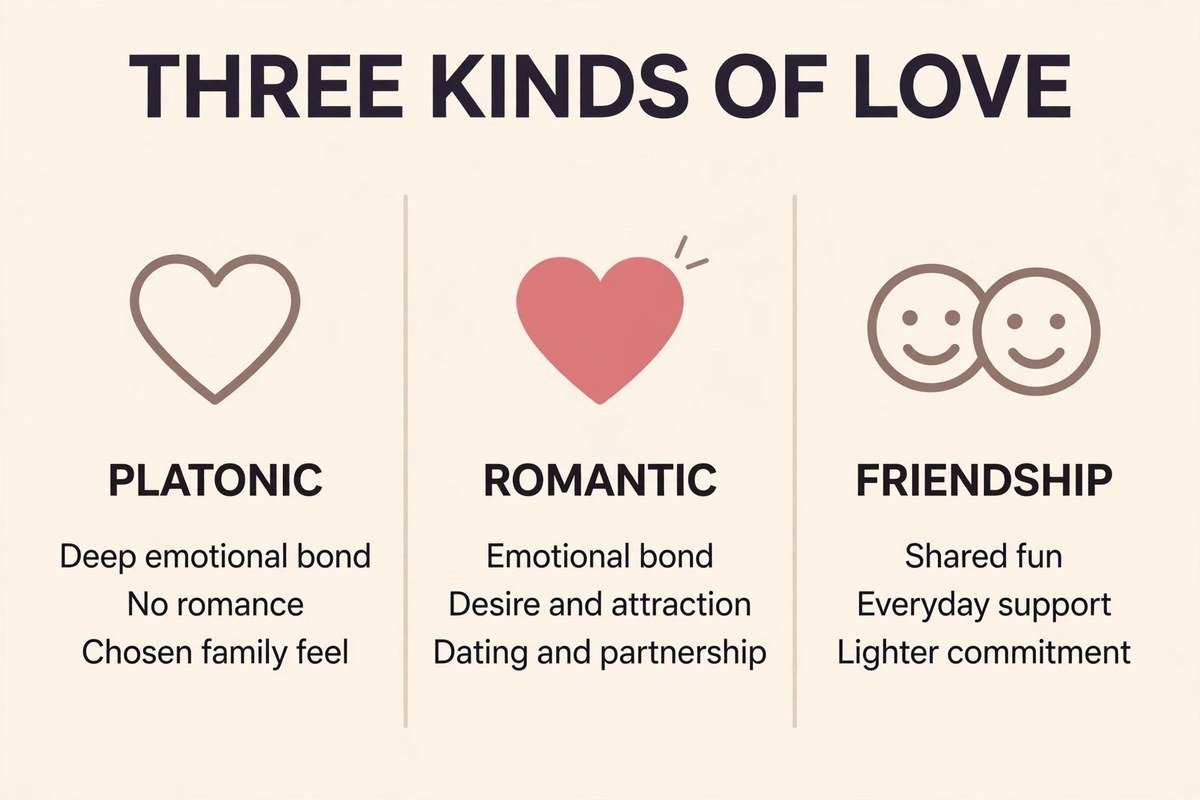
The platonic meaning and romantic love share some ground, and both bonds can hold trust, care, and fierce loyalty. Both can also survive hard seasons and long distances. However, the two loves aim in different directions. Romantic love usually pulls two people toward partnership. It often includes desire, exclusivity, and plans for a shared future. Platonic love, in contrast, asks for closeness only. Instead, it asks for trust, time, and emotional honesty. After all, nobody waits for a kiss or a proposal.
Jealousy also behaves differently inside each bond. Romantic partners often guard their bond with clear exclusivity. Platonic partners, meanwhile, cheer for each other’s dating lives. In fact, they celebrate a friend’s new romance with honest joy. Of course, a platonic bond can still feel intense. Intensity alone, however, does not make a bond romantic. In practice, the honest test stays simple. Ask what each person truly wants from the other.
Physical affection works differently in each bond too. Romantic love usually treats touch as a spark for desire. Platonic touch, instead, stays simple and innocent. Friends, meanwhile, hug, lean, and comfort without hidden meaning. In short, the touch says safety, not attraction. Both people understand the meaning without any talk.
Platonic Love vs Ordinary Friendship
At first glance, ordinary friendship and platonic love can look alike from outside. In general, friends share jokes, meals, hobbies, and everyday support. Platonic love, however, goes deeper than casual friendship. Indeed, it carries a rare level of devotion and priority. Two platonic partners often treat each other like family. They also share fears, dreams, and hard truths freely.
Time, in fact, reveals the difference most clearly. Casual friends often drift apart when life gets busy. Platonic partners, however, stay close through moves, jobs, and crises. For example, they call during emergencies without any hesitation. Better still, these partners show up early and stay late without being asked. They also remember the small details that truly matter. In other words, the bond works like a chosen family tie. In short, it rests on commitment, not on convenience.
For instance, think of ordinary friendship as a pleasant path. Two people walk together while the road stays easy. Platonic love is a road built for every season. Still, it holds during storms, losses, and long silences. In short, friendship enjoys company, while platonic love promises presence.
Signs of a Platonic Relationship
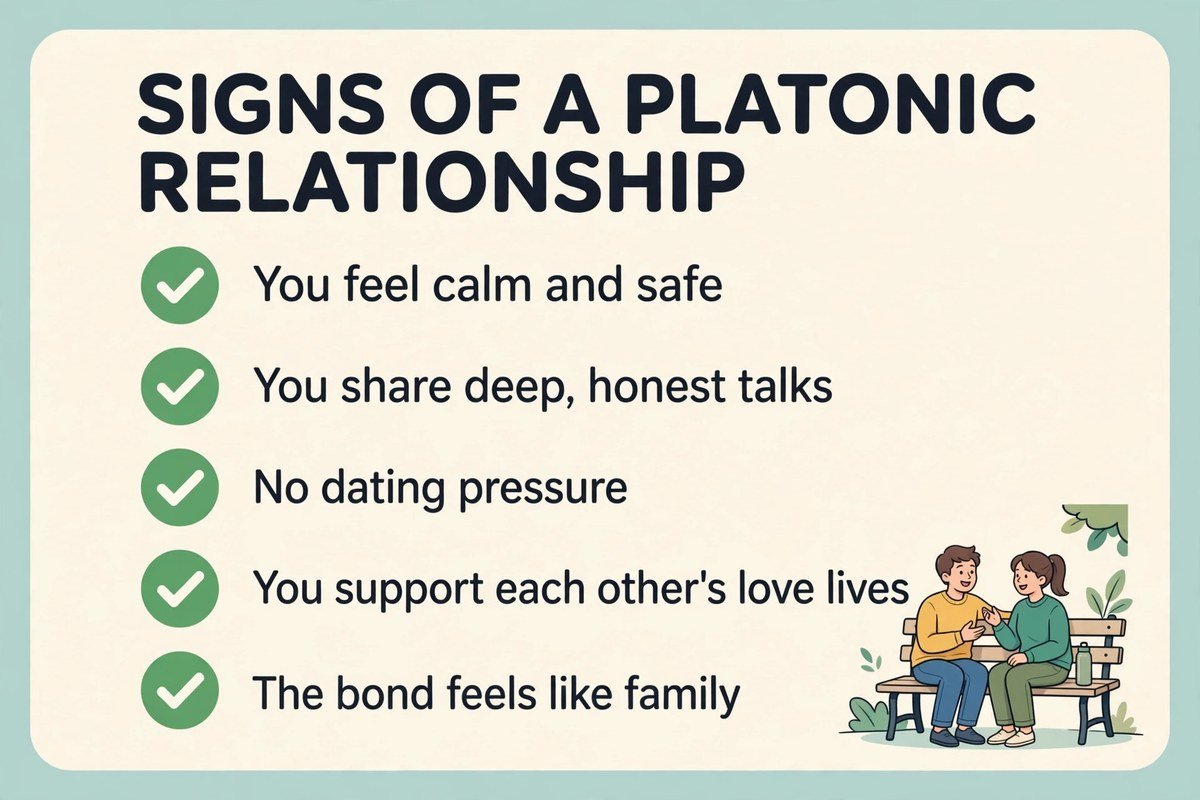
How can you tell whether a bond is truly platonic? Honest signs, however, appear in daily life again and again. Below, look for these steady signs in your own bond:
- You feel calm and safe around the person.
- Honest talks cover fears, dreams, and values.
- Neither of you pushes for dates or romantic gestures.
- Each of you also supports the other’s dating life with honest joy.
- Silence together feels easy, never awkward.
- You also treat each other like family during hard times.
- Respect guards each other’s partners and personal space.
- You miss the person like family, not like a lover.
One sign alone proves very little, of course. Together, these signs paint a clear picture. Overall, a platonic bond feels steady, warm, and free. It never needs a romantic label to feel complete.
You may, in fact, notice these signs over months, not days. In the end, time tests every bond without mercy. Still, a platonic bond passes the test quietly, and it asks for no label and no ceremony.
What Is a Platonic Soulmate?
In truth, a platonic soulmate feels like your other half in life. Yet the connection holds no romance at all. You finish each other’s sentences with real ease. You also share values, humor, and a deep sense of home. Many people, indeed, describe the feeling as instant recognition. In fact, the bond can feel old within the first week.
A platonic soulmate can stand beside a romantic partner in your life. One bond does not cancel the other bond. Instead, each bond feeds a different part of your heart. Honest communication keeps both bonds healthy and safe. First of all, your partner deserves clarity about the friendship. Likewise, your soulmate deserves honesty about your limits. With that honesty, all three people can finally feel secure.
Such a bond, moreover, often survives distance and busy seasons. Instead, it asks for honesty, not constant contact. A few true words can hold it together for years.
Some people, for instance, meet this person in childhood. Others meet them much later, at work or online. The recognition, in fact, feels calm and certain. It never arrives with panic or obsession.
Limerence vs the Platonic Meaning of Love
In contrast, some bonds feel intense, restless, and very hard to read. Indeed, Limerence names one such powerful state. Specifically, limerence brings obsessive thoughts about one single person. It also brings a desperate hope for returned feelings. The platonic meaning points the other way entirely. Platonic love, instead, feels calm, mutual, and secure. Indeed, nobody in a platonic bond aches for hidden signals. Nobody reads every text message like a secret code.
The contrast, in fact, helps you read your own heart honestly. Limerence, by contrast, feeds on doubt, secrecy, and uncertainty. Platonic love, instead, grows through clarity, openness, and trust. Pause and reflect whenever a bond keeps you anxious for months. Often, honest reflection can reveal the truth very gently. Then you can protect your peace with clear choices.
Neither state, of course, makes you a bad person. Each state, however, asks for a different response. For instance, limerence asks for distance and honest self-care. In contrast, platonic love asks for gratitude and steady care.
How to Keep Platonic Boundaries Healthy
Clear boundaries, in fact, protect a platonic bond from confusion. First of all, talk openly about the nature of your bond. Then say the quiet parts out loud, kindly and early. For example, you can name the bond as a deep friendship. Clear words prevent hopeful guessing on both sides.
Respect also guards the bond day by day. Check in when life changes for either person. A new partner may need extra clarity at first. Then give that clarity with patience and real warmth. Also, avoid mixed signals in jokes, touches, and late-night messages. Indeed, small signals can confuse a hopeful heart quickly. When both people honor the line, the bond stays safe. As a result, both people can relax and enjoy the closeness.
Daily habits, moreover, matter as much as big talks. In practice, keep promises small, clear, and easy to honor. Balance time together with time apart. As a result, healthy space keeps affection from turning into pressure. Over time, these small habits build trust month after month. Trust, after all, grows from repeated small proofs.
When Feelings Start to Shift
Feelings sometimes change, even inside strong platonic bonds. One person, for instance, may develop a quiet romantic hope. Then honesty matters most in that tender moment. Above all, share the truth gently, without blame or pressure. Then give the other person real space and time. Meanwhile, the bond may change shape for a little while. Even so, respect can carry both people through it.
What to Say When Someone Calls Your Bond Platonic
Sometimes other people question a very close bond. Often, they ask whether you two are secretly dating. A calm, kind answer, however, usually works best. Below, these simple lines can help you respond with grace:
- “We are deeply close, and we are not a couple.”
- “Our bond is platonic, and we value it exactly as it is.”
- “Think of us as family by choice.”
- “We love each other as friends, fully and honestly.”
Tone, in fact, matters as much as the wording itself. Speak with warmth, never with defense. A steady answer often ends the questions quickly. After all, you owe nobody a long explanation. Indeed, your bond needs no permission from outsiders at all. Simply put, a short answer, given kindly, protects the bond in public.
FAQ’s
Can married people have platonic friends?
Yes, married people can certainly hold deep platonic friendships. In fact, honesty with a spouse keeps the bond healthy. Clear boundaries also protect trust on every side. Many couples, in fact, welcome such friendships into their lives. Overall, the friendship adds support without threatening the marriage at all.
Is platonic love only between a man and a woman?
No, platonic love can actually grow between any two people. Indeed, gender plays no role in this kind of bond. In fact, friends of any gender can share deep, devoted closeness. Family members can share the same closeness too. In short, the bond depends on care and respect, never on gender. Clearly, culture and age change nothing about that truth.
Can you say “I love you” to a platonic friend?
Yes, many platonic friends actually say those words with ease. Simply put, the words express care, loyalty, and deep gratitude. Context, in fact, gives the words their true meaning here. Together, a warm tone and an honest history keep the meaning clear. Whenever the words confuse your friend, discuss them openly.
How is a platonic relationship different from a situationship?
A situationship, in contrast, hides romance inside mixed signals and vague hopes. One person usually waits for a real commitment. A platonic bond, however, does the exact opposite. Both people, instead, agree on the bond’s true nature. In short, nobody waits, hopes, or guesses in secret.
Is platonic love less valuable than romantic love?
No, platonic love clearly carries its own full value. Indeed, it offers loyalty, comfort, and lifelong support. In fact, many platonic bonds outlast marriages and casual romances. Each kind of love feeds a different human need. A rich life, in the end, often holds several kinds at once. Society often ranks love in a narrow order.
Conclusion
A platonic bond can hold real love, loyalty, and closeness. It simply leaves out romance and sexual attraction. Clear words and honest boundaries keep that bond strong for years. So use the word with confidence, and mean exactly what it says.


Leave a Comment