

One beautiful word lives three very different lives. The calliope meaning begins with a Greek goddess of poetry. It then travels to a roaring steam organ on American riverboats. Finally, it lands in modern baby-name lists, where parents keep rediscovering it. This guide untangles all three lives of the calliope meaning, one at a time. Each life, in fact, explains the next one beautifully.
First, you will learn what the name itself means in Greek. Next, you will meet Calliope the Muse, the eldest voice of epic poetry. Then, you will hear about the instrument that borrowed her name and her volume. After that, the guide covers the name’s modern life and its tricky pronunciation.
Calliope Meaning in Plain Words
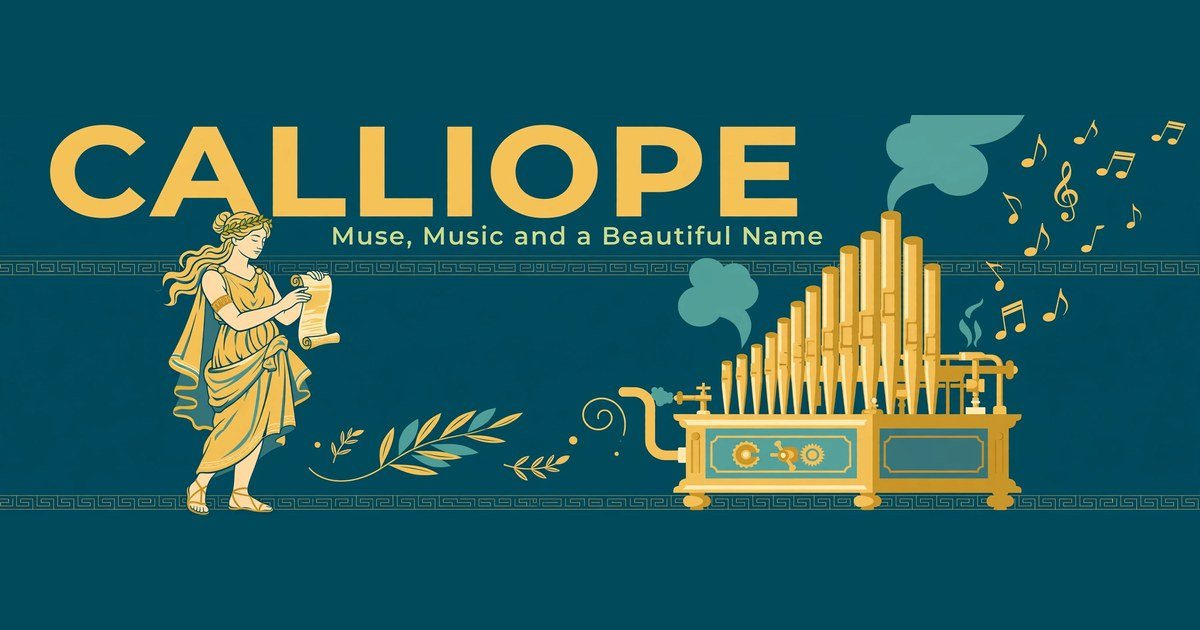
In plain words, Calliope means “beautiful-voiced”. The name comes from two Greek words joined together. Its first part, kallos, means beauty. The second part, ops, means voice. Put together, they describe a voice so lovely that people stop and listen. That single idea, in short, powers every later use of the word.
The word then points in three directions, depending on where you meet it.
- In mythology: Calliope is the Greek Muse of epic poetry, the chief of the nine Muses.
- In music: a calliope is a steam organ, famous on riverboats and at circuses.
- As a name: Calliope is a girl’s name that carries the same “beautiful voice” meaning.
Context, in fact, always tells you which life is meant. A poem points to the goddess. A fairground points to the organ. Meanwhile, a birth announcement points to a baby with a musical name. Each sense, notably, keeps the idea of a voice at its heart. The sections below give each life its own space.
Calliope, the Muse of Epic Poetry
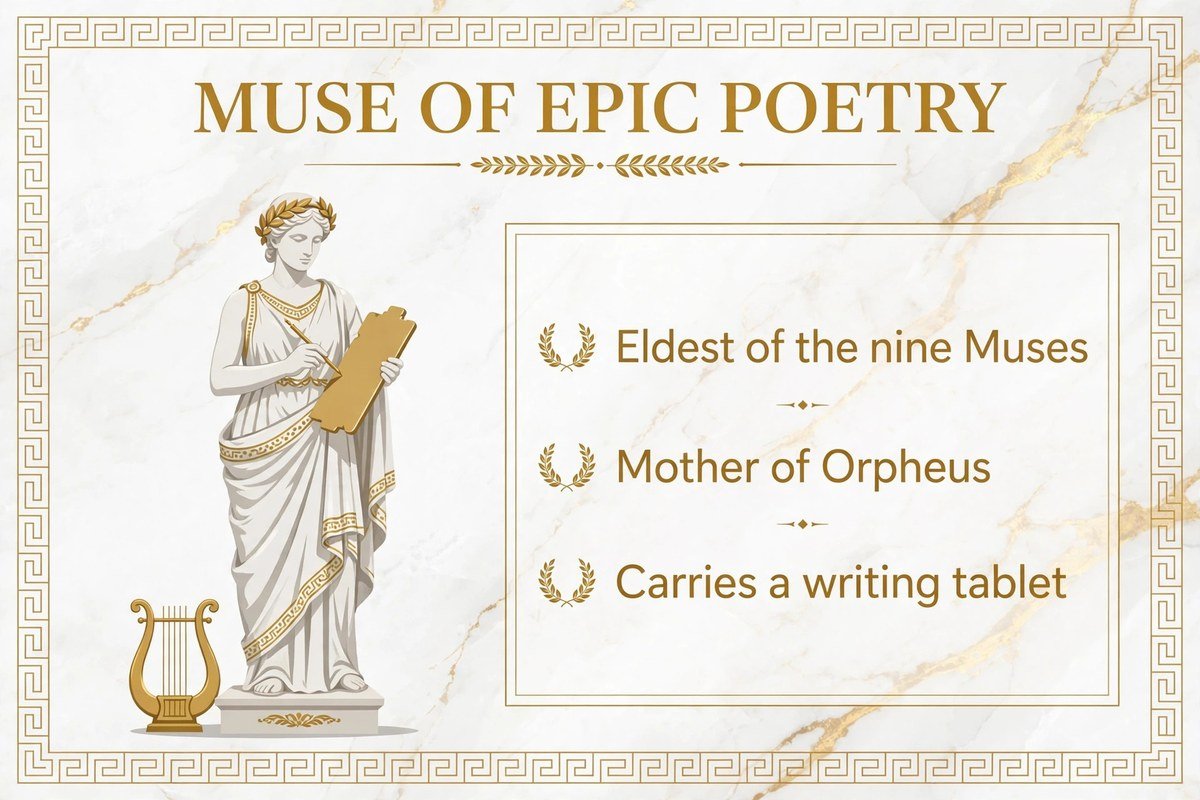
In Greek mythology, Calliope holds the highest seat among the nine Muses. The Muses were daughters of Zeus and Mnemosyne, the goddess of memory. Each sister guarded one art or science. Calliope, the eldest and the chief, guarded epic poetry. That genre covers the longest and grandest stories a culture tells, from the Iliad to the Odyssey.
Artists, in fact, usually show her with clear symbols. She carries a writing tablet or a scroll, and she often wears a laurel wreath. A stylus sometimes rests in her hand. Those props, in other words, announce her job at a glance: she preserves great deeds in verse. Poets, in turn, begged for her help at the start of their epics. An invocation to the Muse opens many ancient poems, because the poet claimed the song came through her.
Her family story adds to her fame. Calliope was the mother of Orpheus, the legendary musician whose songs could charm stones and beasts. Music and poetry, therefore, run in the same household in Greek imagination. Readers can explore her myths further on the Wikipedia page on Calliope. Even today, her name stands for eloquence itself. It names, in short, the art of speaking and writing beautifully.
Calliope in the Great Epics
The oldest Greek word-list of the Muses already gives her the crown. In Hesiod’s Theogony, she is named as the foremost of the sisters. Homer’s epics then open in her shadow, with the poet begging the Muse to sing through him. Virgil, in turn, begins the Aeneid in the same tradition. Much later, Dante calls on Calliope by name in his Purgatorio, asking her to lift his song. Milton, likewise, opens Paradise Lost with a plea to a heavenly muse. Across two thousand years, in other words, one voice starts the greatest stories. That tradition also explains a small classroom mystery. Students meet the cry “Sing, O Muse” in translation after translation. The singer they beg is, more often than not, Calliope herself. Her job, after all, was the long memory of nations.
The Calliope Instrument: A Steam Organ With a Voice
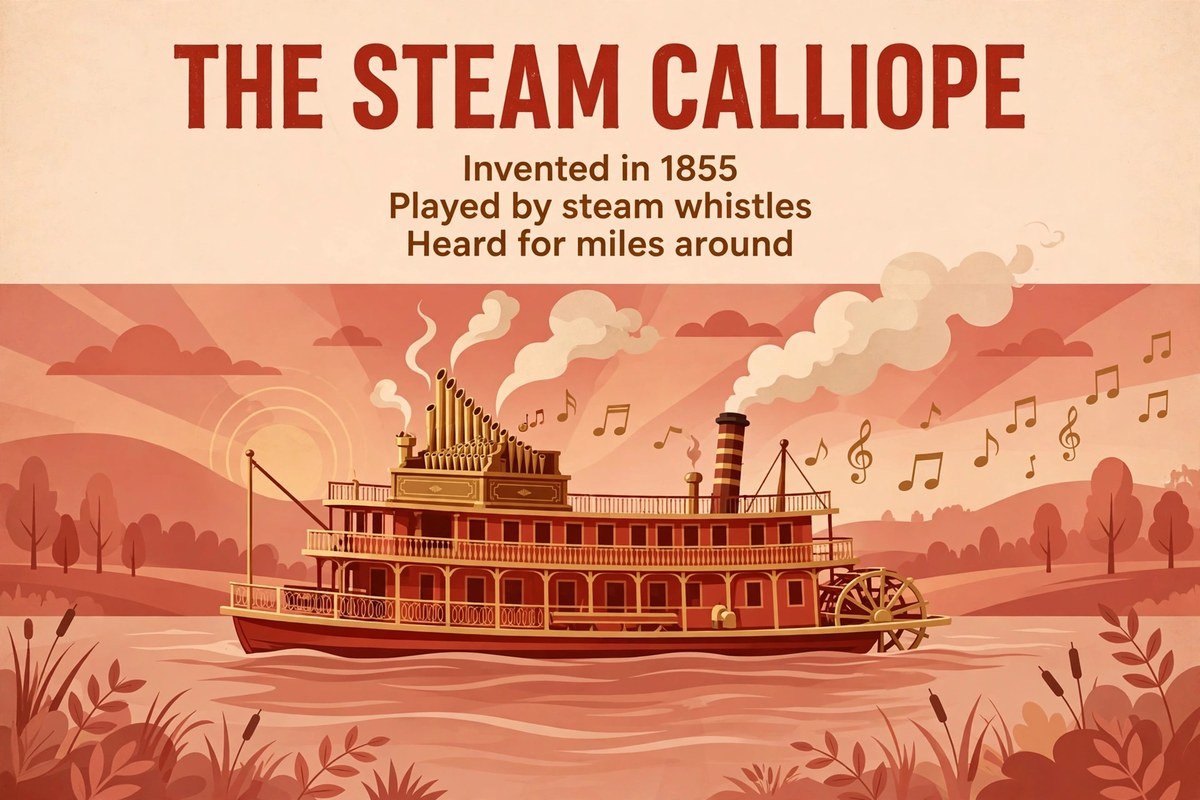
Centuries later, the name took a much louder job. A calliope is a musical instrument powered by steam. Rows of whistles replace ordinary organ pipes. A keyboard or a pinned barrel then decides which whistle sounds. American inventor Joshua C. Stoddard patented the design in 1855, and the young country adopted it with enthusiasm.
The instrument became the soundtrack of two worlds. On Mississippi riverboats, a calliope announced the boat long before the dock came into view. At circuses and fairgrounds, meanwhile, it pulled crowds toward the tents. Its voice carried for miles, which was exactly the point. In an age before loudspeakers, no advertisement travelled further.
That volume, however, came with a catch. Steam whistles are hard to keep perfectly in tune, and players cannot soften them much. A calliope, therefore, sounds cheerful, brash, and slightly wild all at once. Fans, in fact, love precisely that character. The instrument was named for the Muse, after all, because its makers wanted a voice that demanded attention. Hers was beautiful. Theirs simply refused to be ignored.
The Calliope Today
The instrument still plays, although working examples are now rare treasures. The steamboat Natchez in New Orleans, for example, carries a famous calliope that greets the riverfront daily. Circus heritage groups, meanwhile, restore old instruments for parades and festivals. Each performance, in fact, doubles as living history. Crowds hear exactly what their great-grandparents heard when the circus came to town. The Muse, in short, still announces arrivals in grand style.
Calliope Meaning as a Name for Girls
As a given name, Calliope carries its Greek meaning with it: beautiful voice. Parents who choose it often love books, music, or mythology. The name feels literary without feeling dusty. It also offers friendly short forms for everyday use. Callie is the most common of them, while Poppy and Lia appear as playful alternatives.
The name, meanwhile, remains uncommon in most English-speaking countries. That rarity, in turn, suits many modern parents, who want a name that stands out kindly. At the same time, its sounds are familiar, thanks to Callie and the musical instrument. The name also travels well across languages, since its Greek roots are widely recognised. If you enjoy word stories like this one, our serendipity meaning guide tells another happy tale.
One caution belongs in every naming chat. Teachers, doctors, and baristas will sometimes guess the pronunciation wrongly. A Calliope may spend years correcting “KAL-ee-ope” at roll call. Most families, however, treat that as a small price for a name with a muse, a melody, and a myth inside it.
Calliope in Modern Fiction
Modern stories keep borrowing the name for musical, magnetic women. Television fans, for example, know Dr. Calliope “Callie” Torres from Grey’s Anatomy, a surgeon with a singer’s name and spirit. In Neil Gaiman’s Sandman comics, meanwhile, Calliope herself appears as a Muse held captive for her inspiration. Both uses lean on the ancient promise of the name. Give a character this word, in other words, and the audience expects art, voice, and feeling to follow her into every scene.
How to Pronounce Calliope
The classic pronunciation is kuh-LY-uh-pee, with the stress on the second syllable. That is the standard for the Muse and for the girl’s name. Greek names in English often follow this pattern of a stressed “ly” sound. Think of Penelope, pronounced puh-NEL-uh-pee, as a close cousin in rhythm.
The instrument breaks the rule in much of America. Riverboat and circus tradition often says KAL-ee-ohp instead. Both pronunciations, in fact, are accepted for the organ, and locals defend theirs warmly. When in doubt, match your setting. A classics classroom wants kuh-LY-uh-pee. A fairground, in contrast, may happily answer to KAL-ee-ohp.
Calliope is not the only Greek name that traps English speakers, either. Persephone hides a “seff” sound where readers expect “phone”. Hermione, likewise, puzzled a generation until films spoke it aloud. The pattern, in practice, is simple: trust the classic stress, not the spelling. A quick listen in a dictionary, in short, beats a confident guess every time.
Calliope Meaning in Modern Culture
The word keeps popping up in surprising places. An asteroid, 22 Kalliope, meanwhile, carries the German spelling of her name through space. Astronomers named it in 1852, shortly after its discovery, following the fashion for mythological names. A moon even orbits it, which feels fitting for a muse with a famous musical son. That little moon, Linus, was spotted by astronomers in 2001.
Shops, boats, and bands also borrow the name for its sparkle. A bookshop called Calliope promises stories and a beautiful voice. A festival stage with the same name promises volume and joy. In each case, the borrower spends the word’s ancient credit: poetry, music, and a voice worth hearing. Few Greek words still earn their keep so cheerfully after three thousand years.
The word also survives in the names of real places. Small towns and streets in America carry the name, left behind by steamboat landings and railroad stops. Music teachers, meanwhile, pass it to their studios and choirs. Each use spends a little of the word’s meaning: beauty, voice, and welcome. Few brand names, in the end, arrive with three thousand years of free advertising behind them. Street signs, in fact, may be the humblest monuments any Greek goddess ever received.
FAQ’s
How do you spell Calliope, and what is Kalliope?
Both spellings, in fact, name the same figure. English usually writes Calliope with a C. German and some classical texts write Kalliope with a K, closer to the Greek kappa. The asteroid uses the K form. In short, whichever spelling you choose, the meaning and the story stay identical.
Can a calliope play quiet music?
Not really, and that is part of its charm. Steam whistles speak at full voice almost every time. Players can choose fewer notes, but they cannot truly whisper. After all, the instrument was built to summon a crowd across water and fields. Quiet, in short, was never in its job description.
What is a calliope hummingbird?
It is, in fact, a tiny hummingbird of western North America, named after the Muse. The species is often called the smallest bird in the United States and Canada. The male wears a striking magenta-striped throat that fans out during courtship flights. Birders prize sightings of it in mountain meadows each summer.
What are the names of the other eight Muses?
Calliope’s sisters each guard their own art. Clio guards history, Euterpe guards lyric poetry and music, and Erato guards love poetry. Melpomene guards tragedy, while Thalia guards comedy. Terpsichore guards dance, Polyhymnia guards sacred song, and Urania guards astronomy. In the end, the nine sisters cover nearly every creative pursuit the ancient world valued.
Why do poets call on Calliope at the start of epics?
Ancient poets, in fact, believed the Muse supplied the song itself. By invoking her, a poet asked for memory, skill, and truth before the story began. The habit also signalled ambition to the audience. A poem that opens with Calliope promises heroes, wars, and voyages. The invocation, in effect, was the epic’s opening drum roll.
Conclusion
The calliope meaning, in the end, always returns to a beautiful voice. For the Greeks, that voice sang the epics that held their whole culture together. American showmen then turned it into a steam organ that no town could ignore. For today’s parents, it is a name that hands a daughter a muse, a melody, and a story in four syllables. Each age, in other words, hears the same promise at a different volume. That is a great deal of work for one small word.
So the next time the word crosses your path, ask which of its three lives you are meeting. A poem wants the goddess. A fairground wants the organ. Meanwhile, a classroom register may hold a small Callie who answers to the full, glorious name. All three, in the end, are worth listening to. Listen for her, fittingly, the next time a riverboat rounds the bend. The tour, in short, ends where it began: with a voice.


Leave a Comment