

Three little letters can open a whole conversation, and WYF is one of the most common openers online. If someone has just sent it to you, the wyf meaning is straightforward in most cases: the wyf meaning is where you from, a quick way of asking where someone is from. People use it in DMs, dating apps, gaming chats, and comment sections when they want to learn a little about the person behind the screen. However, WYF has a few other readings too, and context decides which one applies. This guide covers the main meaning, the alternatives, and the best ways to reply.
What Is the WYF Meaning in Texting?
WYF is an initialism for the question “Where you from?” Strictly speaking, the full grammar would be “Where are you from?”, but texting drops the verb for speed. The question itself is classic small talk. It asks about your hometown, your country, or the place you live now, depending on the conversation. Nine times out of ten, this is the meaning a sender intends, especially at the start of a chat with someone new.
The abbreviation grew out of the same SMS era that produced most three-letter slang. Messages were short, typing was slow, and whole questions collapsed into initials. As chat moved to Snapchat, Instagram, and TikTok, WYF moved with it. Today it often appears as the second message in a conversation, right after “hey.” That position is a clue in itself. When WYF arrives early, it is almost always the location question, because the sender is still building a picture of who you are.
Tone changes how the question feels. Sent with a friendly comment, such as praise for an accent or a dish in a photo, WYF reads as warm curiosity about a place and its culture. Sent completely bare by an account you have never interacted with, it can feel abrupt. The letters are identical in both cases. The wrapping around them is what your instincts react to, and those instincts are usually right.
It is worth noting what WYF is not. It is not a rude demand, and it is not an order to share your exact address. Most senders want a city, a region, or a country at most. A general answer is completely normal, and a vague answer is always acceptable too. The question opens a door; it does not push anyone through it.
Why People Ask WYF Instead of the Full Question
It is fair to ask why anyone bothers shortening a four-word question at all. Speed is part of the answer. Three letters take a second to type, and in fast chats that speed keeps the exchange alive. But tone matters just as much. The full question, “Where are you from?”, can sound slightly formal, even interview-like. The shortened WYF feels lighter, more like a nudge than an interview. That softness is valuable at the start of a conversation, when both people are deciding whether they want to keep talking.
There is also a pattern at work. Online conversations tend to open with a ritual sequence: a greeting, then WYF or WYD, then a topic. Following the pattern signals that you understand how casual chat works. Breaking it is fine too, but the pattern explains why you will see WYF so often in brand-new threads. It is the second step of a dance almost everyone online already knows.
How WYF Is Used in Text and Chat
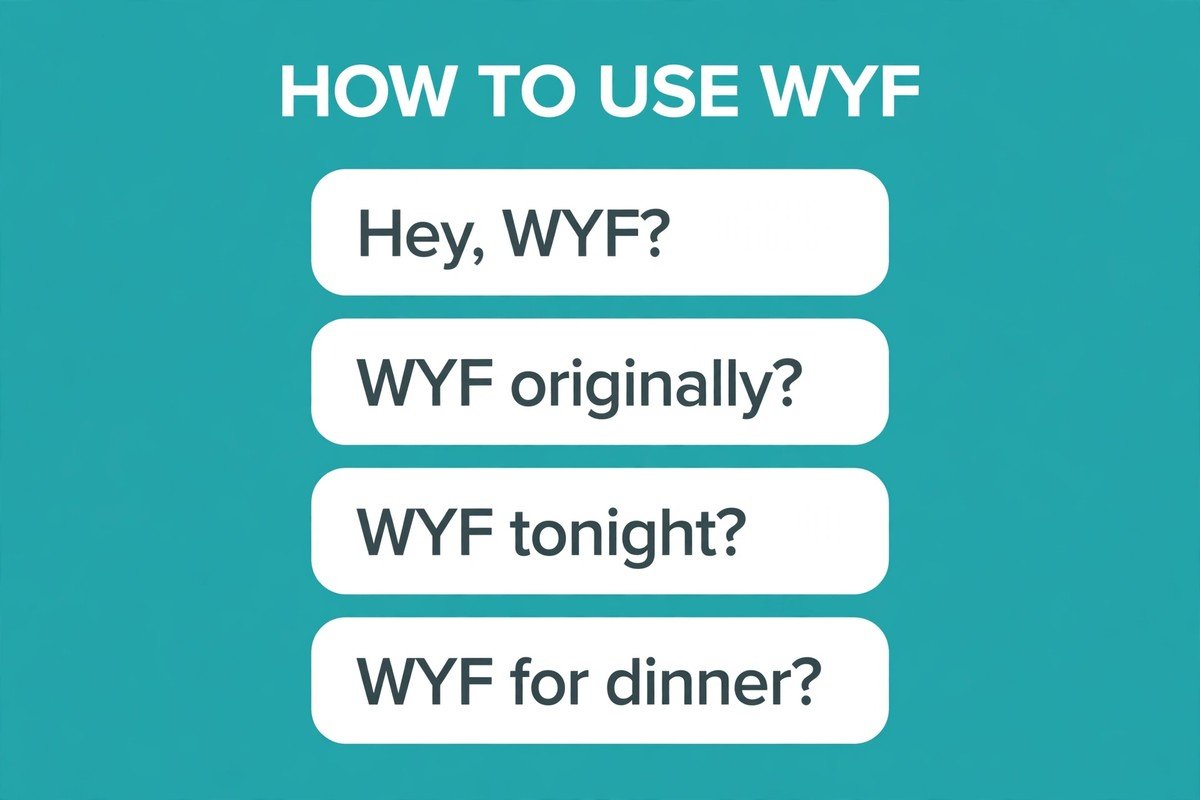
In everyday use, WYF appears in a few predictable settings. The first is the brand-new DM. Someone follows you, likes a post, and then asks WYF to start talking. The second is the dating app, where the question does double duty: it is small talk, and it quietly checks whether you live close enough to ever meet. The third setting is gaming. Players ask WYF to work out time zones and server regions before a match, which is practical rather than personal.
Comment sections use it differently again. Under a travel clip or a cooking video with a strong regional accent, WYF asks about the place in the video as much as the person posting it. Context, once again, does the heavy lifting. Here are a few example exchanges that show the range:
- New follower: Hey, WYF?
- You: From Chicago originally, living in Austin now. You?
- Dating app match: WYF? Maybe we are closer than we think.
- You: Not far from the city. How about you?
- Teammate: WYF? Trying to sort out time zones for tonight.
- You: UK, so I am five hours ahead of you.
Notice how the answers stay general. A city or a country is plenty. Nobody shares a street name, and nobody expects one. That balance is built into the slang itself, much like the open invitation in our hmu meaning guide, where the whole point is keeping contact easy and low-pressure.
WYF Meaning vs WYA and WYD: How They Differ
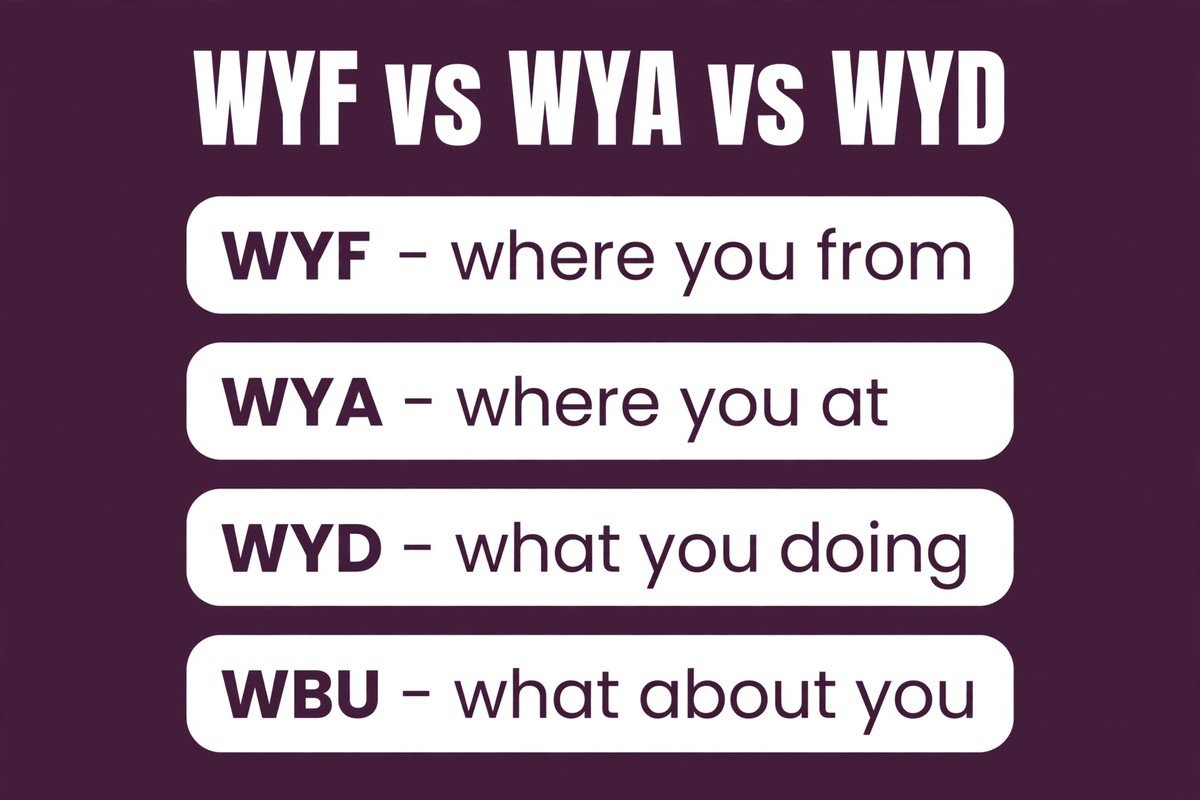
WYF belongs to a small family of three-letter questions, and the members are easy to confuse. WYA means “where you at”, which asks about your current location right now. WYD means “what you doing”, which asks what you are busy with at this moment. WYF, by contrast, asks about your origin or base. The last letter is the whole difference, so read it carefully.
One more relative is worth knowing: WBU, short for “what about you?”. WBU is not a starter but a return pass. Someone answers a question, then adds WBU to send it back. You will often see it right after a WYF answer: “I am from Leeds, WBU?”. Together, the four abbreviations can carry an entire opening exchange in under a dozen letters, which is precisely why this family of slang refuses to fade.
A quick example makes the split clear. If a friend texts WYA, the answer might be “at the mall.” If they text WYD, the answer might be “watching a film.” If they text WYF, the answer is “from Toronto.” Mixing up WYF and WYA is the most common mistake, because the two look nearly identical at a glance. When you are unsure, check what kind of answer would make sense. A place you are from points to WYF; a place you are standing points to WYA.
Other WYF Meaning Readings: Feeling, Favourite, and Fancy
Although “where you from” dominates, WYF occasionally expands into other questions. Among close friends, “WYF tonight?” can mean “what you feeling?”, a check-in about mood or plans. In a chat about food, “WYF for dinner?” usually means “what you fancy?”, asking what you feel like eating. In polls and comment threads, “WYF band right now?” means “what is your favourite?”. And in work or group chats, WYF sometimes asks “what is your feedback?”.
Two more readings appear now and then. After a shopping trip or a search, “WYF?” can mean “what you found?”, asking what someone picked up or discovered. In project chats, it can even stretch to “when you finish?”, although that one is uncommon and usually appears between people who already share a shorthand-heavy style. These edge cases prove the same point as the main ones: the letters are a frame, and the conversation supplies the picture.
These readings share a useful pattern: each one fits the sentence around it. If the location reading makes no sense, try the next option that matches the topic. A question attached to a thing you can pick, like a song or a dish, points to favourite or fancy. A question after a rough day points to feeling. If none of them fit, there is no shame in asking. A quick “where I am from, or something else?” clears it up in seconds, and most senders will happily clarify. Slang guides such as the Plisio guide to WYF list the same set of readings, with “where you from” firmly in first place.
How to Reply to WYF and Protect Your Privacy
Replying well depends on how much you want to share. An open reply keeps things flowing: name your city or country and return the question. A playful reply adds personality, such as naming your hometown and a fun fact about it. A vague reply protects your privacy while staying friendly: “the West Coast” or “not far from here” answers the social question without pinning you to a map.
A good answer also keeps the conversation moving. After naming your area, add one small hook, such as a famous food, a team, or the weather everyone complains about. That hook gives the other person something easy to reply to, which is the entire point of an opener. Alternatively, return the question with a light “WYF yourself?”. Turning the question around shows interest and balances the exchange, so neither side feels interviewed.
Privacy matters most with strangers. A bare WYF from an account with no photos and no posts deserves a careful answer, or none at all. You never owe anyone your location, and you should never share your exact address, school, or workplace in an open chat. On dating apps, many people wait until a conversation feels genuine before naming even their city. That caution is sensible, not rude. The slang is casual, but your safety rules do not have to be.
FAQ’s
What does WYF mean from a guy or a girl?
It means the same thing from anyone: usually “where you from?”. The sender is making small talk or getting to know you. It does not automatically signal romantic interest, although on a dating app it is often part of one.
Is WYF the same as WYA?
No. WYF asks where you are from, your origin or base. WYA asks where you are right now. The final letter changes the question, so check it before you answer.
How do I answer WYF if I do not want to share my location?
Stay general. Name a region or a country, or say you live near a big city without naming yours. You can also turn it back with “how about you first?”. A friendly vague answer is completely normal.
What does WYF mean on Snapchat?
On Snapchat, WYF is a common opener from someone who just added you. It almost always means “where you from?”. Because Snapchat chats can involve strangers, a general answer is the smart default there too.
What does WYF mean in gaming chats?
In gaming chats, WYF is practical. Players ask it to learn your country or time zone so they can plan matches and pick a fair server. A country-level answer is all anyone needs, and it is safe to give.
Can WYF mean something rude?
The abbreviation itself is not rude, and the readings covered here are all harmless questions. Tone and context decide how it lands. From a trusted friend it is friendly; from an unknown account, treat it with normal caution.
Conclusion
The wyf meaning is, above all, a conversation starter: WYF asks “where you from?”. It belongs to the same fast, friendly family as WYA and WYD, and it shows up wherever people meet online, from DMs to dating apps to game lobbies. Its rarer readings (what you feeling, what you fancy, what is your favourite) all reveal themselves through context, so the sentence around the letters is always your best guide.
Now that you know the wyf meaning, you can answer with confidence and with exactly as much detail as you choose. Share a city if you like, keep it regional if you prefer, and never feel pushed to give more. Good slang makes talking easier, and WYF, used well, does precisely that.


Leave a Comment