

The rheo meaning is simple once you see it: flow. Rheo is a Greek root that points to a stream, a current, or anything that moves along. You meet this root inside science words, health words, and a few everyday terms. Moreover, the rheo meaning stays steady across all of them. Once you learn it, long words start to open up like little puzzles.
This guide explains the root in plain words. First, you will see where rheo comes from. Next, you will meet real words that carry it. After that, you will learn how rheology works and how to say each word aloud. In addition, you will compare rheo with nearby roots that deal with water and motion. By the end, the root will feel familiar and friendly.
What Is the Rheo Meaning in Simple Words?
In simple words, rheo means flow or stream. Dictionaries treat rheo- as a combining form, so it joins other parts to build full words. For example, rheo plus logy gives rheology, the study of flow. Similarly, rheo plus stat gives rheostat, a device that controls an electric current. In each case, something moves, pours, or runs along a path.
Think of a river as your picture for this root. A river never sits still, and it always follows a course. Likewise, rheo words describe movement along a course. Some describe water itself. Others describe blood, air, electricity, or thick liquids. Still, the core picture never changes. Something flows, and the word watches it flow.
Where the Rheo Meaning Comes From
Rheo comes from the Greek word rheos, which means a stream or a current. That word links back to the Greek verb rhein, which means to flow. Ancient Greek writers used this family for rivers, tides, and running water. Later, scholars carried the root into Latin texts. After that, modern science adopted it for new inventions and new fields.
Greek also gave English the related form rheuma, a flowing humor in old medicine. Early doctors believed that flowing fluids inside the body caused many aches. That belief later shaped words like rheumatism and rheumatic. So, the root traveled from rivers into clinics. In short, one small Greek stream fed a whole family of English words.

The Rheo Meaning in Real Words
You already know several rheo words, perhaps without noticing the root. Below, four common examples show the root at work. Each one keeps the idea of flow, yet each one bends it toward a new field.
Rheology: The Study of Flow
Rheology is the science of how matter flows and changes shape. Rheologists study honey, paint, blood, lava, and even dough. Some materials pour fast, while others creep slowly over hours. For instance, ketchup sits still in the bottle, yet it flows after one good shake. Rheology explains that odd behavior with careful tests. Engineers then use those results to design pumps, pipes, and smooth coatings.
Rheostat: Controlling an Electric Current
A rheostat is a device that controls electric current in a circuit. You turn a knob or slide a contact, and the resistance changes at once. As a result, a lamp glows brighter or dimmer. Here, rheo points to the flowing current of electricity. Meanwhile, stat comes from a Greek idea of standing or setting. Together, the parts describe a tool that sets the flow.
Rheumatism and Rheumatic: The Flowing Humor
Rheumatism is an older, broad word for aches in joints, muscles, and tissues. People once blamed a flowing humor, called rheuma, for that pain. Modern medicine now uses sharper terms for each condition. Still, rheumatic survives in names like rheumatic fever and rheumatic heart disease. Doctors also use rheumatology for the branch that treats these conditions. That branch, fittingly, still carries the old flowing root.
Rheophile: A Creature That Loves the Current
A rheophile is a living thing that thrives in flowing water. Certain insect larvae grip stones in fast mountain streams. Some fish also hold steady against strong currents all day. Biologists use rheophile for these stream lovers. Its cousin rheophyte names plants that root in flowing water. In both words, rheo paints the moving stream, and the ending adds the living creature.
Rheometer: The Tool That Measures Flow
A rheometer is the main tool on a rheology bench. It spins, presses, or slides a sample in a careful, controlled way. Then, it records how the sample pushes back against that force. Thick lava, soft gels, and printer inks all reveal secrets this way. Consequently, factories can predict how a product will pour, spread, or set. Small root, huge workshop.
Rheology Explained in a Simple Way
Imagine two jars on a table. One jar holds water, and the other holds honey. You tip both jars at the same moment. The water rushes out first, while the honey crawls behind it. That simple race shows the heart of rheology. Scientists in this field measure how easily a material flows. They also study how materials bend, stretch, and settle under force.
Everyday life leans on rheology more than you expect. Paint must spread smoothly, yet it must not drip down the wall. Toothpaste must squeeze out neatly, then hold its ribbon shape. Blood must flow through narrow vessels without clumping. Food makers, doctors, and builders all ask rheologists for help. In short, flow science quietly shapes your whole day.
How Scientists Built New Words With Rheo
Some rheo words are ancient, while others are surprisingly young. In the 1840s, Charles Wheatstone described an adjustable resistor for electric circuits. Makers later called such tools rheostats, since they regulated an electric flow. Much later, in the 1920s, Professor Eugene Bingham helped coin the word rheology. The Society of Rheology then formed in 1929. So, scientists kept returning to this Greek stream whenever they needed a flow word.
That pattern still continues today. Engineers name new sensors, pumps, and test rigs with old roots. Students then decode those names with the same simple trick. First, they split the word into parts. Next, they translate each part. Finally, they rebuild the sense of the whole word. Rheo rewards that trick every single time.
How to Pronounce Rheo and Its Word Family
Say rheo as REE-oh, with a strong first beat. The rh pair sounds like a plain r, just as in rhythm and rhinoceros. Rheology sounds like ree-OL-uh-jee. Rheostat sounds like REE-uh-stat. Rheumatism sounds like ROO-muh-tiz-um. At first, the spellings look tricky. After a few tries aloud, though, the pattern feels natural and smooth.
Spelling follows a steady pattern too. Most family words begin with rhe, and a vowel follows that cluster. Rheostat, rheology, and rheumatic all share that opening. When you spot rhe at the start of a long science word, pause. Then, ask yourself what flows inside that word. Usually, the root hands you a strong first clue.
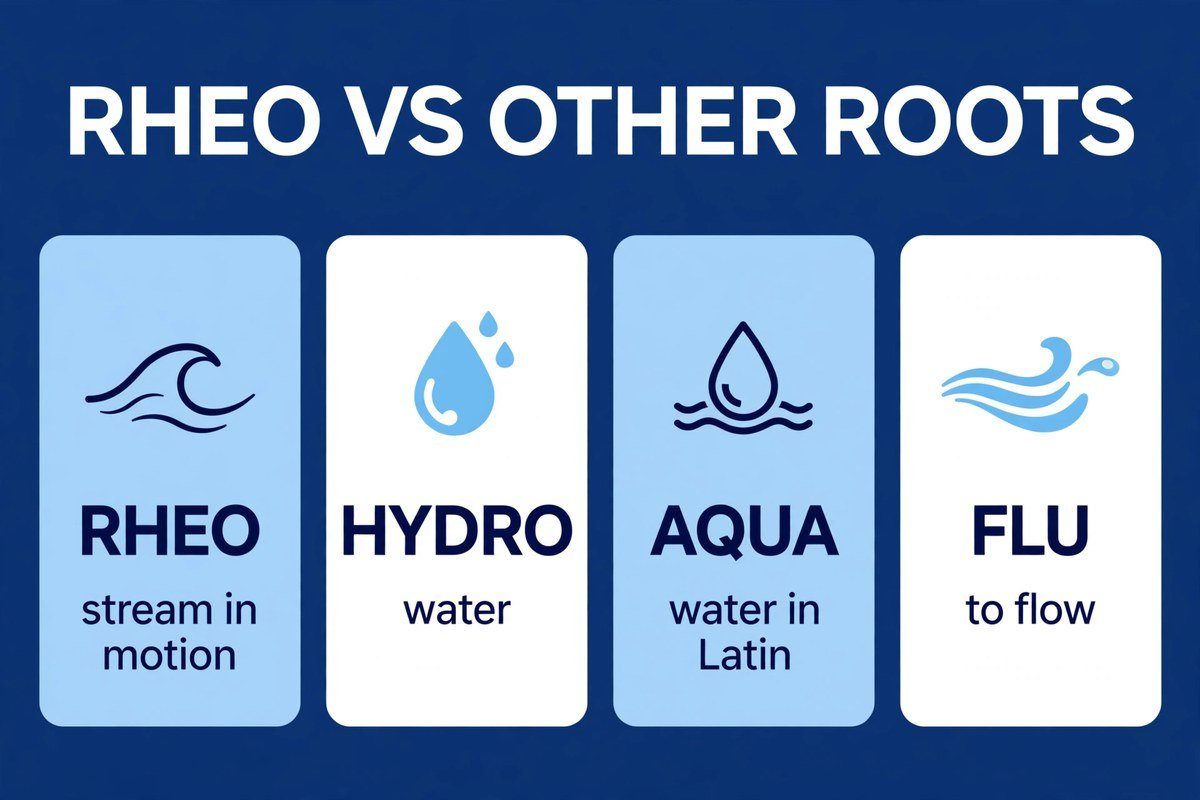
Rheo Meaning vs Related Roots
Several roots deal with water and motion, yet each one keeps its own flavor. Hydro comes from Greek and means water itself. Aqua comes from Latin and also means water. Flu comes from the Latin verb fluere, to flow, and it gives us fluid and fluent. Rheo, in contrast, highlights a stream or a current in motion. So, hydro names the water, while rheo watches it run.
One close cousin deserves a special note. The ending -rrhea also comes from the Greek flow family. You see it in diarrhea, which joins dia, meaning through, with a flowing idea. Doctors use that ending for a discharge or a heavy flow. Rheo stands at the start of words, while -rrhea closes them. Together, they bookend the same ancient stream. Our esoteric meaning guide shows another Greek root at work in daily English. For a deeper look at flow science, the Encyclopaedia Britannica page on rheology gives a clear expert overview.
Where You Will Meet Rheo Words Today
Rheo words pop up in more places than school books. A rheumatologist treats joint and tissue conditions in clinics every day. Physics classes still wire rheostats into simple circuits. Stream ecologists sort rheophiles from still-water species during field surveys. Crossword setters also love this root, since its spelling looks odd at first glance. Even product labels mention rheology when brands tune a cream or a sauce.
School subjects reveal the root again and again. Chemistry students meet rheology when they study thick polymers and gels. Biology students meet it in blood flow and stream habitats. Geography students meet it in rivers, tides, and ocean currents. Each field borrows the same Greek picture, yet each field bends it toward fresh questions. That flexibility explains why the root has survived for more than two thousand years.
You may also meet the root in older novels and letters. Writers once used rheum for watery discharge from the eyes or nose. Poets used rheumy for damp and chilly air. Those older senses feel distant now, yet they share the same flowing source. Language, like water, keeps old channels open for centuries.
Rheo Meaning in Example Sentences
Examples lock the root into memory. Read each sentence, then find the flowing idea inside it.
- The rheostat on the old radio let Grandpa soften the music with one slow turn.
- In rheology class, students timed how fast golden syrup slid down a tilted tray.
- Her grandfather called his winter aches rheumatism, just as his own father had.
- Trout and stonefly larvae count as rheophiles, since both thrive in fast, cold streams.
- The rheometer showed that the paint flowed smoothly under the brush.
- Once you know the rheo meaning, the word rheology stops looking scary.
Tips for Remembering the Rheo Meaning
Memory tricks make this root stick fast. First, picture a river every time you see rhe. Rivers run, streams slide, and currents pull. Next, link rheo with rhythm, its distant Greek cousin. Greek rhythmos described measured flow, like beats moving through a song. Finally, split every new rhe word into parts before you guess. The flow clue usually unlocks the rest.
Practise with words you already own. Take rheumatic: rheuma plus a state ending gives a flowing-humor condition. Take rheophile: rheo plus phile, meaning loving, gives a current lover. Each split takes seconds, yet it builds real vocabulary power. Soon, long Greek words will feel like friendly signposts instead of walls.
FAQ’s
Is rheo a full word on its own?
No. Rheo works as a combining form, so it builds words with other parts. You will meet it at the start of words like rheology and rheostat.
What does rheo mean in medical words?
In medical words, rheo points back to rheuma, the flowing humor of old medicine. That history explains rheumatism, rheumatic fever, and rheumatology today.
Is a rheostat still used today?
Yes. Labs, classrooms, and hobby benches still use rheostats to control current. Modern electronics often use digital controls instead, yet the simple rheostat remains a clear teaching tool.
What is the difference between rheology and hydraulics?
Rheology studies how all kinds of matter flow and deform. Hydraulics, in contrast, focuses on liquids under pressure in pipes and machines. The two fields overlap, yet rheology takes the wider view.
What animal name hides the rheo root?
The extinct frog genus Rheobatrachus hides it neatly. Its name joins rheo with batrachus, meaning frog, for a stream frog. Those Australian frogs once raised their young in the mother’s stomach.
How do you spot a rheo word quickly?
Look for rhe at the very start of the word. Then, check whether flowing, streaming, or current fits the sense. If it does, you have probably found the root.
Conclusion
The rheo meaning carries one clear picture: a stream on the move. From Greek rheos and rhein, the root flowed into rheology labs, rheostat dials, clinic terms, and stream ecology. Related roots like hydro and aqua name water itself, while rheo watches water run. Once you hold that picture, the whole word family turns easy to read and easy to remember.
Next time a long science word blocks your path, split it into parts and hunt for the flow. Often, rheo will greet you at the very first letters. Small roots reward patient readers, and this one repays you with a whole river of words.


Leave a Comment