

You have probably seen the word esoteric in a book review, a video essay, or a comment online. Perhaps someone called a joke esoteric, yet you nodded along without fully knowing why. The esoteric meaning is simpler than the word itself sounds. In short, esoteric describes knowledge, ideas, or humor that only a small group can truly follow. Overall, this guide explains the word in plain language, step by step. You will find its Greek origin, clear examples, and an easy contrast with its opposite, exoteric. You will also learn how writers and players actually use the word today.
Esoteric Meaning in Simple Words
In simple words, esoteric means made for a small, specialized group of people. The knowledge itself is, in fact, open in principle. Still, only a few people hold the background that the topic demands. For example, a research paper on quantum spin is esoteric for general readers. Trained physicists, by contrast, read it with ease. Meanwhile, a popular article on black holes takes the opposite path. Instead, it explains big ideas in everyday words for a wide audience. So the esoteric meaning turns on one simple question. How many people can follow this without special training? If the honest answer is “very few,” then the material is esoteric.
Indeed, dictionaries back up this plain reading. Merriam-Webster defines esoteric as “designed for or understood by the specially initiated alone.” You can check the full wording in the Merriam-Webster entry for esoteric. Notice the key idea in that definition. Clearly, the circle of readers stays deliberately small. Also, the same test works for hobbies, jokes, and theories alike. Keep it in mind whenever the word appears in your reading. In practice, writers reach for this word when a topic shuts most readers out. It then warns newcomers that homework comes first.
Where the Word Esoteric Comes From
Indeed, the word esoteric comes from Greek, and its roots explain its sense perfectly. The Greek word esoterikos means “inner” or “belonging to the inner circle.” That word grows from eso, which simply means “within.” In ancient schools, teachers divided lessons into two kinds. Meanwhile, inner lessons went to advanced students inside the circle. Outer lessons, in contrast, reached the general public outside it. Aristotle’s school offers the classic picture here. His advanced treatises, however, stayed inside the school for trained students. His popular dialogues, by contrast, traveled widely among general readers.
Over time, however, English borrowed the Greek word and softened its edges. Today the word, in fact, no longer demands a literal circle of students. Instead, it marks any knowledge that only insiders can follow. The history still shows in the modern sense, though. Overall, esoteric knowledge always has an inside and an outside. Modern readers still feel that pull toward the inner room. Indeed, the promise of hidden depth keeps the word alive today.
English adopted the word during the 1600s, mainly through scholarly writing. At first, writers used it mostly for ancient philosophy and hidden religious teaching. The word then spread into reviews, essays, and everyday criticism. Meanwhile, its meaning widened as it traveled. Eventually, a term for classroom teaching became a label for any insider material. Overall, that long journey explains its slightly bookish flavor today. Even casual speakers, in fact, sense that flavor when they choose the word.
Esoteric vs Exoteric: The Opposite Pair
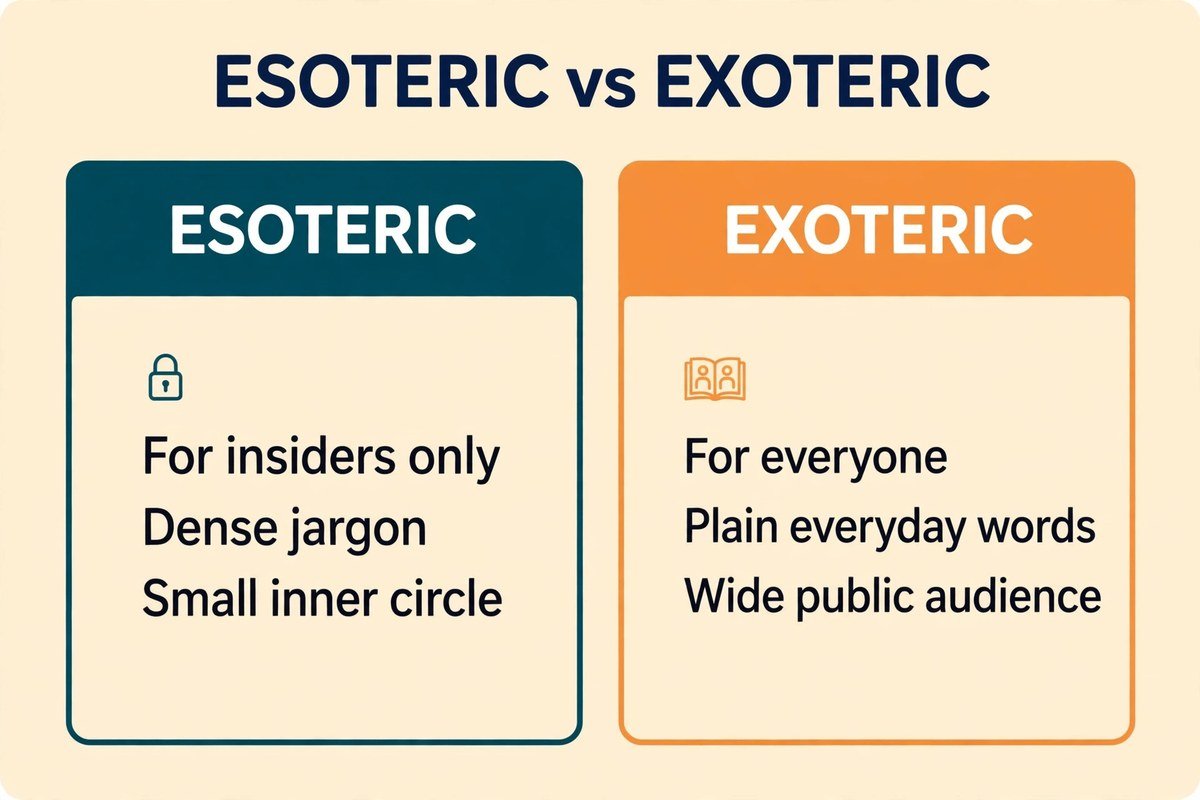
Every esoteric idea has a natural opposite, and that opposite is exoteric. Exoteric, in contrast, means made for the general public, in plain and open form. Overall, the pair works like a simple scale of audiences. Esoteric material speaks to insiders with shared training. Exoteric material speaks to everyone and assumes no training at all. Consider, for instance, a hospital as a quick example. Doctors, for example, discuss a case in dense medical shorthand during rounds. That discussion is esoteric, because only medical insiders follow it fully. A nurse then explains the same case to the patient in plain words. That explanation is exoteric, because anyone can follow it. In both talks, however, the facts stay the same. In fact, only the audience and the wording change.
Software, meanwhile, offers a second, everyday picture. Release notes for engineers mention kernel patches and deprecated functions without apology. That writing is esoteric, since only developers share the needed context. The public help page for the same update, however, speaks very differently. It says the app now starts faster and also keeps photos safer. In short, both texts describe one update honestly. Each one simply chooses a different circle of readers. Finally, a quick test helps in daily reading. If a text assumes years of shared background, then treat it as esoteric. If a text patiently builds background for strangers, then treat it as exoteric.
A Side-by-Side Summary
In short, readers often remember the pair through three quick contrasts.
- Audience: esoteric speaks to a small inner circle, while exoteric speaks to the public.
- Language: esoteric writing uses dense jargon, while exoteric writing uses plain words.
- Goal: esoteric work deepens expert knowledge, while exoteric work spreads basic knowledge.
In fact, neither side of the pair is better by itself. Deep fields need esoteric writing for precision among experts. The public still needs exoteric writing for access and trust. Overall, healthy fields keep both doors open at once.
Where You Meet the Esoteric Meaning in Daily Life
You meet this word in more places than you might expect. In fact, three settings show up again and again in books, games, and conversation. Each setting, meanwhile, shows the esoteric meaning at work in a fresh way.
Esoteric Knowledge
Overall, people most often pair the word with knowledge itself. In short, esoteric knowledge means knowledge that only trained or initiated readers can use. Advanced mathematics, for example, offers a clear case. A proof in algebraic geometry baffles even strong school students. Instead, years of prior study unlock it, step by step. Religious and philosophical traditions also use the phrase. Many traditions guard inner teachings for committed followers. Outsiders may read the public teachings freely, of course. The inner teachings, however, demand long preparation first. In both settings, though, the pattern stays the same. As a result, a small circle holds the keys, and everyone else stands outside.
Esoteric Jokes
Humor gives the word a lighter home. An esoteric joke, for example, lands only for listeners who share one specific reference. A programmer’s joke about recursion, for instance, delights programmers instantly. Everyone else in the room, meanwhile, simply waits for the next joke. The joke is not weak or badly told; instead, it simply needs a key that only insiders carry. Friends also often use the word with a smile here. In fact, calling a meme esoteric can even praise its cleverness. As a result, the humor rewards the small group that gets it.
Esoteric References in Games and Fandoms
Games and fandoms also love the word. Designers, for example, hide esoteric lore deep inside item descriptions and side quests. Only devoted players, however, piece those fragments together. A casual player, in contrast, finishes the story and misses the hidden layer entirely. Fandom wikis then collect and explain these buried details. Even there, however, some theories stay esoteric within the fandom itself. Only fans who study timelines and codexes can judge them. Writers of guides, in fact, use the word for such advanced material. In short, the word signals depth, patience, and serious insider status.
Esoteric References in Books and Films
Books and films hide such references with special delight. An author may, for example, quote an obscure poem without any explanation. Meanwhile, most readers glide past the line and enjoy the scene anyway. A few readers, however, catch the quotation and smile at the private nod. Directors also plant similar rewards in background details and set design. A poster, a book spine, or a license plate can carry the joke. Subsequently, fans catalog these finds in long online threads. The esoteric layer thus rewards a second reading or viewing.
How to Use Esoteric in a Sentence
Examples, in fact, teach the word faster than definitions do. Read each sentence, and notice the small insider group in every case.
- The professor’s lecture on medieval logic was so esoteric that half the class stopped taking notes.
- Her esoteric taste in music leads her to tiny bands that almost nobody streams.
- The novel hides an esoteric reference to alchemy in its second chapter.
- Only senior engineers understood his esoteric comments about the old codebase.
- That puzzle game rewards esoteric knowledge of chess endgames.
- He collects esoteric board games about railway history and obscure wars.
- Their esoteric debate about font kerning lasted the entire lunch break.
Overall, two habits make your own sentences sound natural. First, name or hint at the insider group nearby. Second, pair the word with knowledge, jokes, references, or interests. In practice, those pairings match the way native speakers actually use it. Writers also aim the word at their own work with self-aware humor. A blogger may, for example, warn readers before an especially esoteric post. As a result, that warning sets honest expectations and invites the right readers closer. Used this way, the word filters an audience kindly rather than proudly.
Common Mistakes to Avoid
Three mistakes appear again and again in student writing. First, writers use esoteric as a fancy synonym for strange. Strange things can be plain and public, though. Second, writers use it for illegal or forbidden secrets. Hidden by law is, in fact, a different idea, closer to classified or clandestine. Third, writers aim it at expensive or luxury goods. Price, however, says nothing about the size of the audience. Overall, keep the esoteric meaning tied to insider understanding, and your usage stays exact.
Esoteric Meaning and Its Synonyms
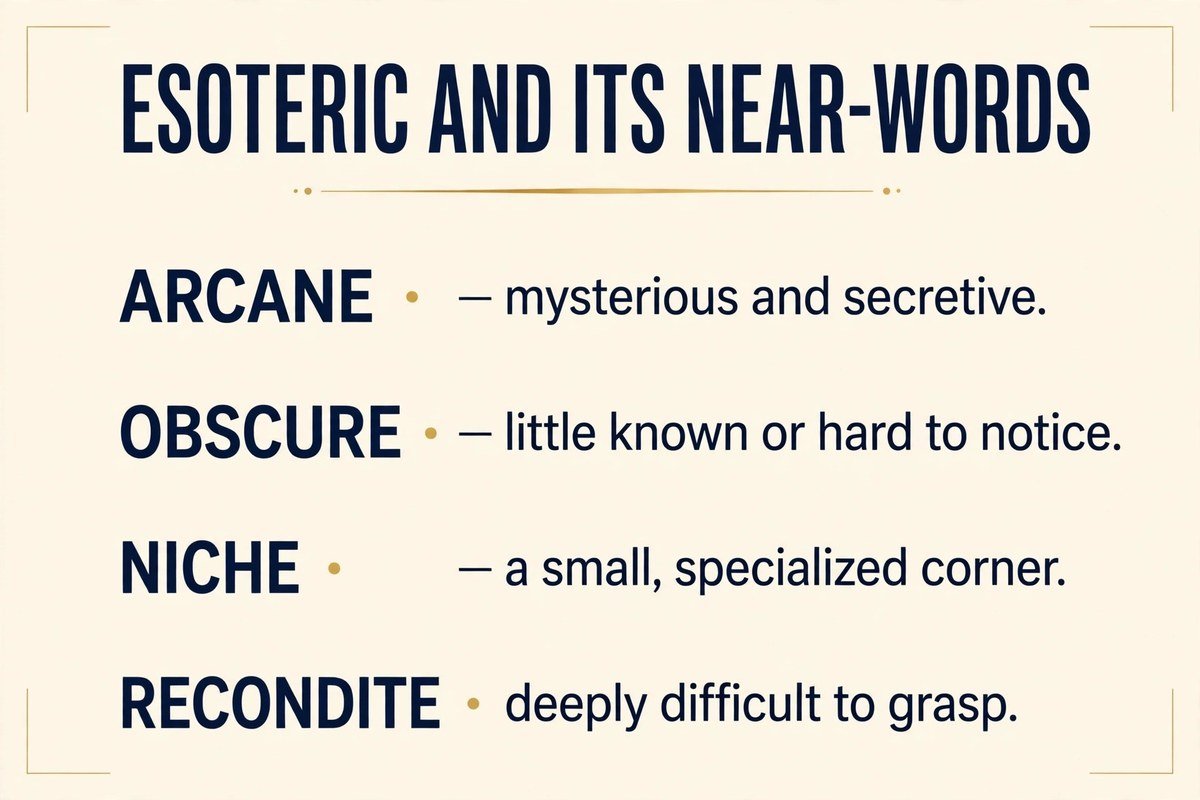
In fact, several near-words crowd around this one, and each carries its own shade. Arcane means mysterious and known by very few people. Arcane rules or rituals often feel old and secretive. An arcane card rule, for example, can confuse even loyal players for years. Obscure, meanwhile, simply means little known or hard to notice. An obscure poet has few readers, but the poems may be easy to read. Obscure facts, however, can still charm a curious reader. Niche, in contrast, describes a small, specialized corner of a market or hobby. A niche podcast, for example, serves a narrow audience with clear, simple episodes. The audience stays small, yet the episodes stay easy to follow.
Recondite, however, goes further and stresses deep difficulty. Scholars, in fact, call an argument recondite when even experts must work hard at it. Few casual readers, therefore, finish a recondite treatise without help. Overall, esoteric sits between these neighbors with its own focus. Instead, it stresses the insider circle, not just rarity or difficulty. Choose the word that matches your exact point. Indeed, small wording choices change the whole tone of a sentence. The same care applies to labels like pedantic, and our guide to the pedantic meaning explores that line in full.
Is Esoteric Praise, Criticism, or Neutral?
In fact, tone decides everything here. The word itself stays neutral in the dictionary. Speakers, however, bend it in both directions. As praise, for example, esoteric can signal depth and rare expertise. A fan might, indeed, praise a director’s esoteric references with real admiration. As criticism, however, the word can accuse a writer of showing off. A reviewer might call a paper needlessly esoteric, for instance. In that case, the word indeed means “closed to ordinary readers” as a fault.
Context and tone of voice, however, reveal the true intent. Dictionaries record the word, but conversations decide its charge. Read the charge before you repeat the remark to others. In particular, look at the words around it for clues. “Fascinatingly esoteric” sounds warm, while “needlessly esoteric” clearly complains. When you use the word yourself, therefore, add a clarifying word nearby. Your readers will then take the remark exactly as you meant it.
FAQ’s
How do you pronounce esoteric?
Say it as “es-uh-TAIR-ik,” with the stress on the second syllable. The word has four syllables in total. A slow first try, however, helps most learners. Then practice the rhythm once, and the word soon feels natural.
Can esoteric describe a person?
Strictly, the word describes knowledge, works, jokes, and interests. People still use it loosely for a person’s taste or humor. That loose use sounds playful rather than precise. A host with esoteric humor, for example, tells jokes that only old friends understand. In careful writing, therefore, attach the word to the work, not the person.
Does esoteric simply mean rare?
No, rarity alone does not make something esoteric. A rare stamp, for example, may be simple and easy to understand. Esoteric material also demands insider background from its audience. Rarity counts the objects; the esoteric meaning, instead, counts the people who can follow.
Can something stop being esoteric?
Yes, and history shows this pattern often. For example, computer programming once seemed esoteric to the general public. Eventually, free courses and videos opened the field to millions. As background knowledge spreads, however, the insider circle grows. The material then moves toward the exoteric side.
What is the difference between esoteric and esotericism?
Esoteric is an adjective that describes a work, idea, or joke. Esotericism, in contrast, is a noun for whole traditions of hidden or inner teaching. A single symbol, for example, can be esoteric on its own. A school of mystical thought counts as esotericism instead.
Which school subjects count as esoteric?
In fact, advanced and narrow subjects earn the label most often. Higher mathematics, ancient languages, and formal logic appear in examples again and again. The label says nothing about the subject’s value, though. Instead, it only reports how small the ready audience is. Even keen students, therefore, may need a guide through such material at first.
Conclusion
Esoteric describes knowledge meant for a small, prepared circle. The word itself stays neutral. Context decides whether it sounds like praise or criticism. Now you can spot it in reviews and essays, and use it precisely yourself.


Leave a Comment