

One small comment can sting for days, and tone usually delivers that sting. The condescending meaning, in fact, describes exactly that moment: someone talks to you as if they rank above you. In plain words, a condescending person treats you as less intelligent or less important than them. The words may sound polite, yet the ranking underneath feels unmistakable.
This guide unpacks the word in practical steps. First, it gives the plain definition, the word’s history, and clear signs to watch for. Next, it collects the phrases that carry the attitude in daily talk and in texts. Finally, it shows calm, firm ways to answer without starting a war.
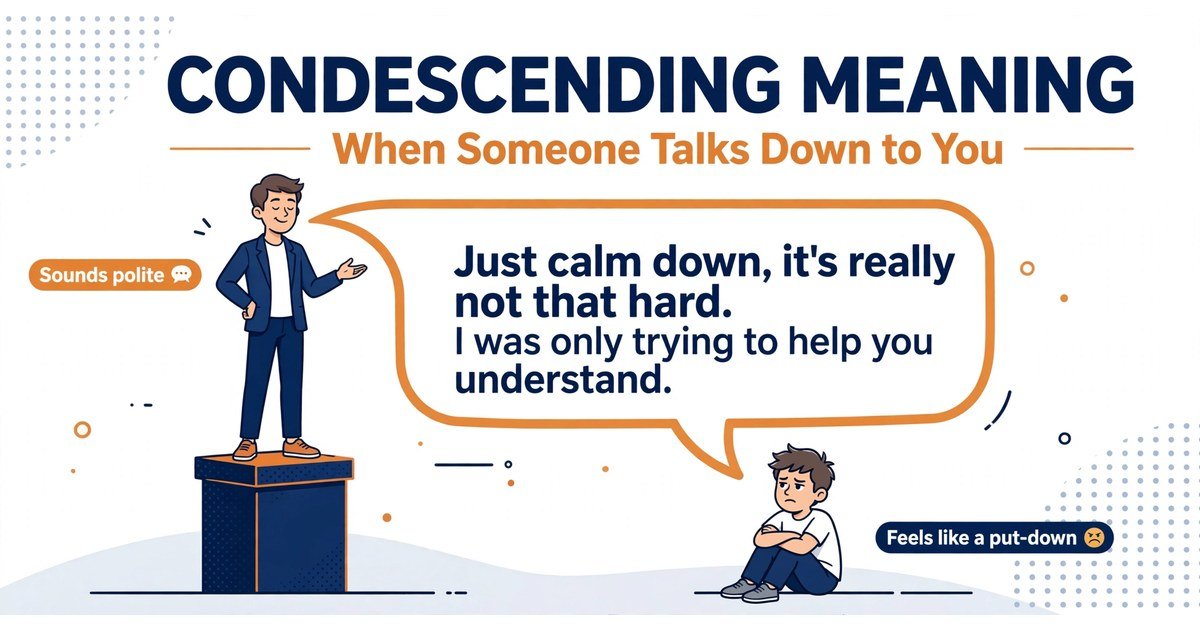
Condescending Meaning in Plain Words
Cambridge Dictionary defines condescending as treating someone as if you are more important or more intelligent than them. That single line captures the condescending meaning neatly. In other words, the speaker performs the role of a teacher who talks down to a slow pupil. The attitude, in fact, matters far more than any single rude word.
You hear the attitude in tone, word choice, and timing working together. A speaker might smile while they deliver the put-down. Similarly, they might wrap the insult inside exaggerated kindness. Either way, the message underneath stays constant: in this conversation, I rank above you.
- Word type: an adjective; the verb form is condescend
- Say it: kon-dee-SEN-ding
- Core idea: talking down to someone as an inferior
- Close cousins: patronizing, superior, snobbish
- Usual setting: workplaces, classrooms, families, and group chats
Where the Word Comes From
The word’s roots hold a small surprise for modern readers. Condescend joins the Latin prefix con-, meaning with, and descendere, meaning to climb down. In older English, therefore, a great lord “condescended” when he graciously lowered himself to chat with ordinary people. Writers of that era, in fact, used the verb as a compliment.
Over time, however, readers started hearing the insult inside the gesture. Nobody enjoys a favor that announces its own generosity. Today, as a result, dictionaries mark the word as disapproving, and speakers use it only as a criticism. The gracious stoop, in short, became the superior smirk.
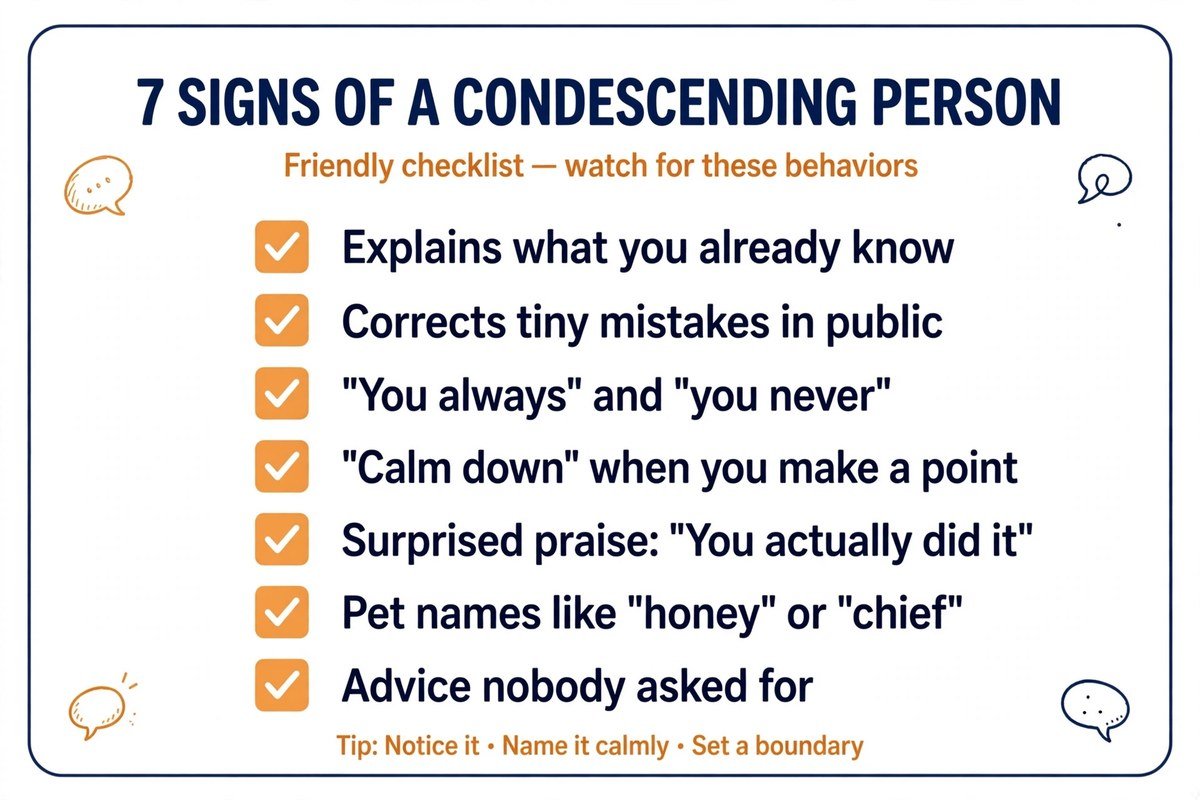
Signs of a Condescending Person
Certain habits reveal this attitude again and again. First, the person explains things that you already understand perfectly well. They also interrupt to correct tiny details, such as your pronunciation, purely to score a point. A close cousin of this habit is the pedantic correction of every small rule, and our pedantic meaning guide unpacks that word in full too. In meetings, in addition, the habit often hides behind helpful-sounding offers to “simplify” things for the room.
- Explains basics that you clearly understand already
- Corrects pronunciation or small errors in front of other people
- Uses “always” and “never” about your habits, as in “You never listen”
- Says “calm down” or “take it easy” when you raise a fair point
- Sounds surprised by your success: “You actually did well”
- Gives praise with a sting, like “Good, you finally got it”
- Uses pet names such as “honey” or “chief” to shrink you
- Offers advice that nobody requested, then repeats it twice
- Talks about you in the third person while you stand right there
One sign alone proves little, because anyone can misspeak on a tired day. A repeated pattern, however, tells the real story across weeks and months. Context matters too: a blunt friend differs greatly from a manager who belittles you every single week.
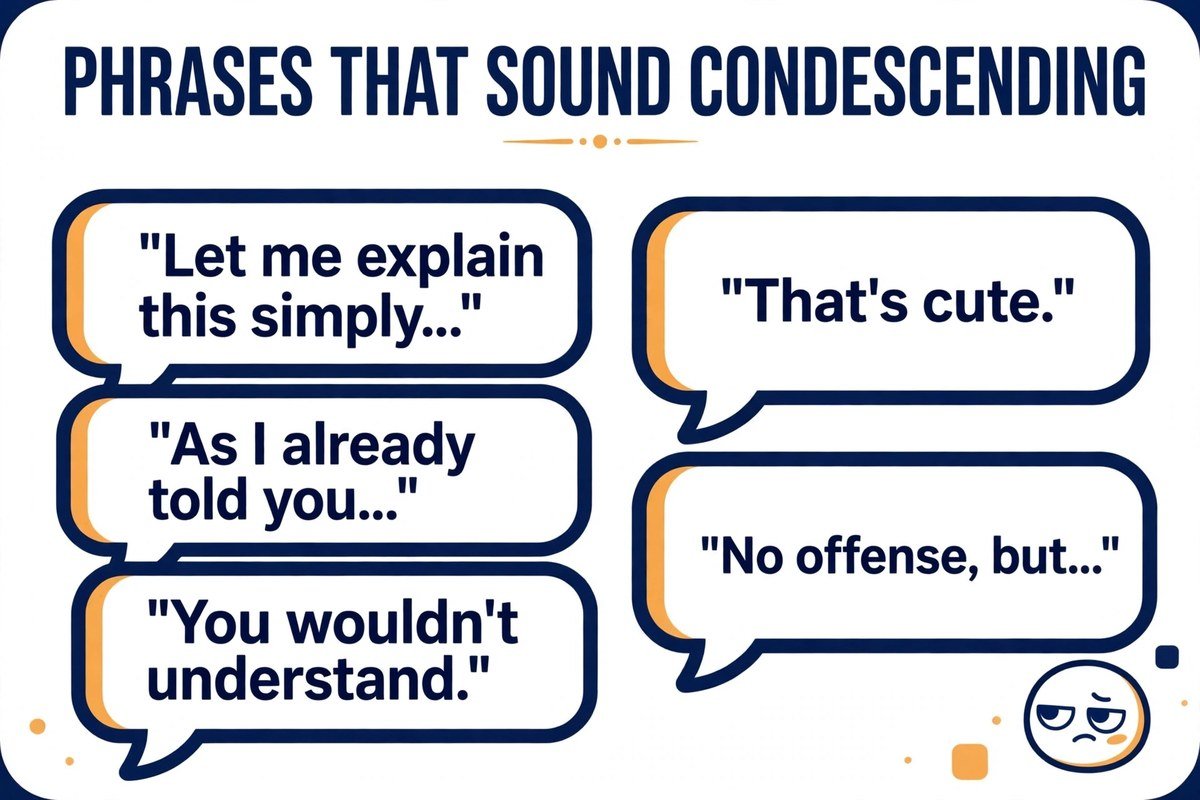
Condescending Phrases You Will Hear
Certain phrases, in fact, carry the attitude in concentrated form. Learn the main ones once; then, you will spot the pattern instantly in meetings, messages, and family dinners.
- “Let me explain this in simple terms.” — It implies that normal terms exceed you.
- “As I already told you…” — It frames you as slow to catch on.
- “You wouldn’t understand.” — It shuts you out and ranks the speaker above you.
- “That’s cute.” — It treats your idea like a child’s drawing.
- “Good for you, you finally managed it.” — The praise hides a low opinion.
- “No offense, but…” — A warning that an insult follows next.
- “Just relax, it is not a big deal.” — It dismisses your feelings entirely.
- “Actually, the correct way is…” — A correction that mainly displays the speaker.
Tone, of course, decides how each line lands in real life. A close friend can say “let me explain” with genuine warmth and zero ranking. A condescending speaker, by contrast, adds the sigh, the slow pace, and the raised eyebrow. Those small signals, together, turn plain words into a public ranking exercise. Repetition matters too, because one phrase a month reads very differently from five phrases a day.
Condescending Meaning vs Patronizing and Rude
Patronizing and condescending overlap so heavily that dictionaries define each word with the other. A slight shade, however, separates the two in daily use. Patronizing behavior wears a kind, helpful mask, much like an adult who praises a small child. The speaker, in other words, pretends to help while quietly ranking you as less capable.
Rude behavior drops the mask entirely and attacks in the open. A rude person insults you directly, talks over you, or ignores you on purpose. A condescending person, by contrast, can sound perfectly polite on the surface. That polite surface, in fact, makes the behavior harder to challenge in the moment.
Picture three circles that overlap a great deal. Rudeness attacks openly, patronizing fakes kindness, and condescension performs superiority. Real conversations, of course, often blend all three styles in a single exchange. Your job, therefore, is simply to notice which style dominates.
Condescending Meaning in Texts and Chats
Text strips away tone of voice, yet condescension still leaks through the screen. First, watch for spelling corrections that ignore the actual point of your message. Next, watch for long explainers that nobody requested, especially on topics you handle daily at work. A one-word “wow” or a slow “okay…” can also carry surprising weight in context.
Certain habits appear again and again in shared screenshots:
- “Per my last message…” sent to someone who clearly read that message
- A basic article link with the note “read this first, then reply”
- “lol” attached to a serious point that you raised
- Spaced-out replies that spell out the painfully obvious
- A bare “??” under a normal question, as if it made no sense
Screenshots, however, can mislead readers just as easily. A short reply might signal a busy afternoon rather than disrespect. So, judge the pattern across several chats before you label a friend or a colleague. In addition, ask yourself whether the same person also talks this way face to face. Sarcasm, in fact, flattens badly in plain text, so even friendly teasing can land as disrespect.
Why People Act Condescending
Habit explains part of the behavior; however, insecurity often drives the rest. Some people absorbed the tone at home and now repeat it without any thought. Others, in fact, use superiority as armor when they secretly feel unsure of themselves.
Deep expertise can feed the habit in quieter ways. A specialist explains the same basics every day, then forgets that adults dislike public lessons. Stress also sharpens wording and shortens patience very quickly. None of these causes, however, excuse the effect that the tone has on listeners. Awareness, in short, is the first step out of the pattern.
Setting can amplify the habit as well. Competitive workplaces reward quick put-downs that look like confidence. Family roles, in addition, can freeze old rankings in place for decades. An older sibling, for instance, may keep lecturing long after everyone involved has grown up.
How to Respond to a Condescending Person
Short, calm answers work best, because they deny the speaker a performance. Try these responses, in order, the next time the tone appears:
- Keep your voice even and your face relaxed; visible heat rewards the act
- Name the behavior plainly: “That sounded condescending to me”
- Ask one direct question: “What do you mean by that?”
- Set a clear boundary: “Explain the task, please, without the commentary”
- Correct the record calmly: “I know this process well, thanks”
- Leave the conversation when a repeat offender refuses to adjust
A calm question forces the speaker to own their words out loud. Most people, in practice, back down once somebody names the tone clearly. You also protect your own standing, because onlookers judge composure kindly.
At work, keep a private record of repeated incidents with dates and exact quotes. Then, raise the pattern with a manager or with HR if the behavior continues. Documentation, in short, turns a vague uneasy feeling into a clear, fair case.
Silence also works in some settings, especially group chats and public threads. A flat non-response, in fact, denies the ranking attempt any audience at all. Then, in private, you can still raise the pattern directly with the person later.
FAQ’s
What is the opposite of condescending?
The clearest opposites are respectful, humble, and approachable. A respectful speaker treats you as an equal and asks genuine questions. They also share knowledge without any performance of rank. In short, the opposite style makes you feel more capable, not less. Genuine questions, in addition, invite the other person to teach you something back.
Does condescending mean the same in British and American English?
Yes, both varieties use the word with the same disapproving sense. Only the pronunciation, in fact, shifts slightly between the two accents. Cambridge lists the British and American pronunciations side by side for the word. The insult, in other words, travels across the Atlantic without any translation.
How do you use condescending in a sentence?
Place the adjective before a noun like tone, attitude, remark, or smile. For example: “Her condescending tone ended the meeting early.” You can also write: “He gave a condescending smile and repeated the instructions slowly.” Both sentences, in practice, describe behavior that ranks one person above another.
Why does condescension hurt so much?
The sting lands because the insult targets your competence and your status together. Worse, the polite surface leaves you no clean way to object in the moment. You therefore replay the exchange later and doubt your own reaction. That slow burn, in fact, explains why small remarks linger for days.
Is mansplaining the same as being condescending?
Mansplaining names one specific form of the wider behavior. In that pattern, a man explains something to a woman while assuming she knows little about it. Condescension, by contrast, covers any speaker and any listener in any setting. So, every act of mansplaining is condescending, but most condescension has nothing to do with gender.
Conclusion
In summary, the condescending meaning describes a speaker who treats you as a lesser mind. The attitude hides inside explanations you never requested, praise with a sting, and phrases that sound polite while they rank you. Texts and chats carry the same signals once you learn to read patterns instead of single lines. Causes like habit, insecurity, and stress explain the behavior, yet they never excuse its effect on listeners.
Fortunately, you hold more power in these exchanges than the speaker expects. A calm voice, one direct question, and a clear boundary usually end the performance quickly. In addition, your own speech can model the opposite style: share knowledge generously and treat every listener as an equal. Keep that standard, and conversations around you grow noticeably kinder. In the end, respect always outlasts superiority.


Leave a Comment