

Three small letters can hide half a dozen different ideas. The tds meaning changes completely with the setting, which is why so many people search for it. On a water report, TDS measures what is dissolved in your water. On an Indian payslip, it is tax collected before you get paid. In a mortgage file, it is a debt ratio that lenders watch. This guide sorts every common tds meaning into plain words, one sense at a time.
First, a quick table shows each sense beside the place you will meet it. Next, the biggest senses get their own full sections. Then, a short section covers the rarer uses, including online slang. By the end, you will know which TDS you are looking at within seconds.
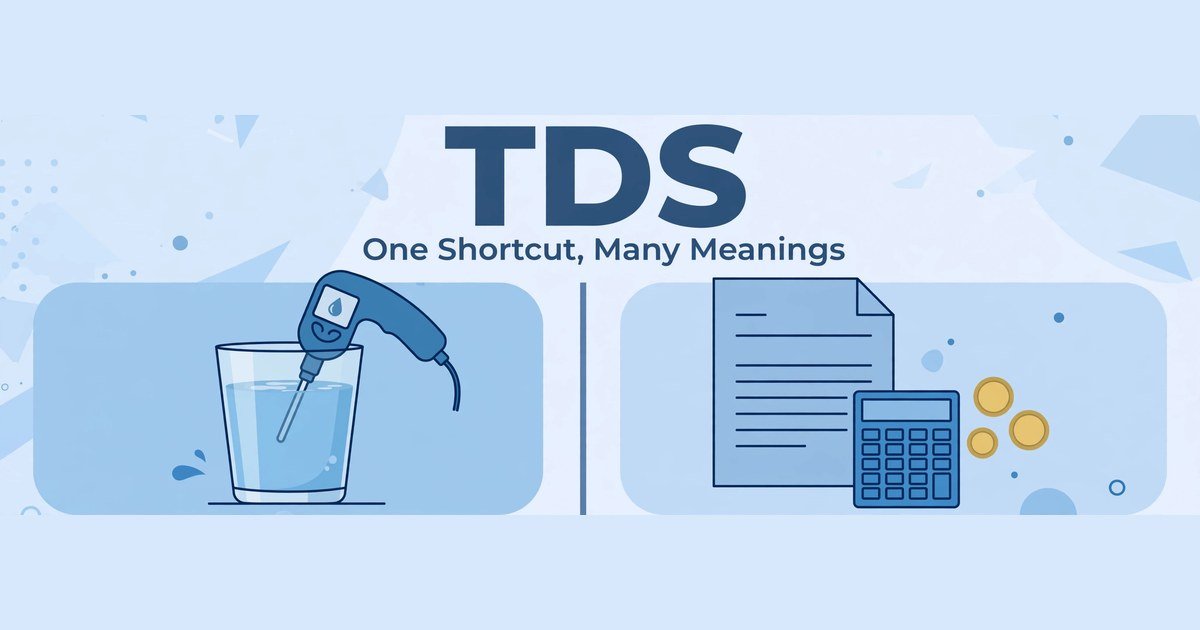
TDS Meaning at a Glance
In short, TDS is an abbreviation, and abbreviations borrow their meaning from their surroundings. The table below is the fastest way to decode it.
| Where you see TDS | What it almost always means |
|---|---|
| A water test, purifier display, or aquarium guide | Total Dissolved Solids |
| An Indian payslip, bank statement, or tax form | Tax Deducted at Source |
| A mortgage application, especially in Canada | Total Debt Service (ratio) |
| A paint, chemical, or building product document | Technical Data Sheet |
| US political talk online | Trump Derangement Syndrome (slang) |
Read the row that matches your situation first. Or read the whole guide for the complete picture. Either way, the sections below explain each sense with examples.
TDS Meaning in Water: Total Dissolved Solids
In water science, TDS means total dissolved solids. Specifically, it is the total amount of material dissolved in the water. That material, for example, includes minerals such as calcium and magnesium. It also includes salts, metals, and other tiny particles that pass through a normal filter. Scientists measure TDS in parts per million, written as ppm. One ppm, in practice, equals about one milligram per litre.
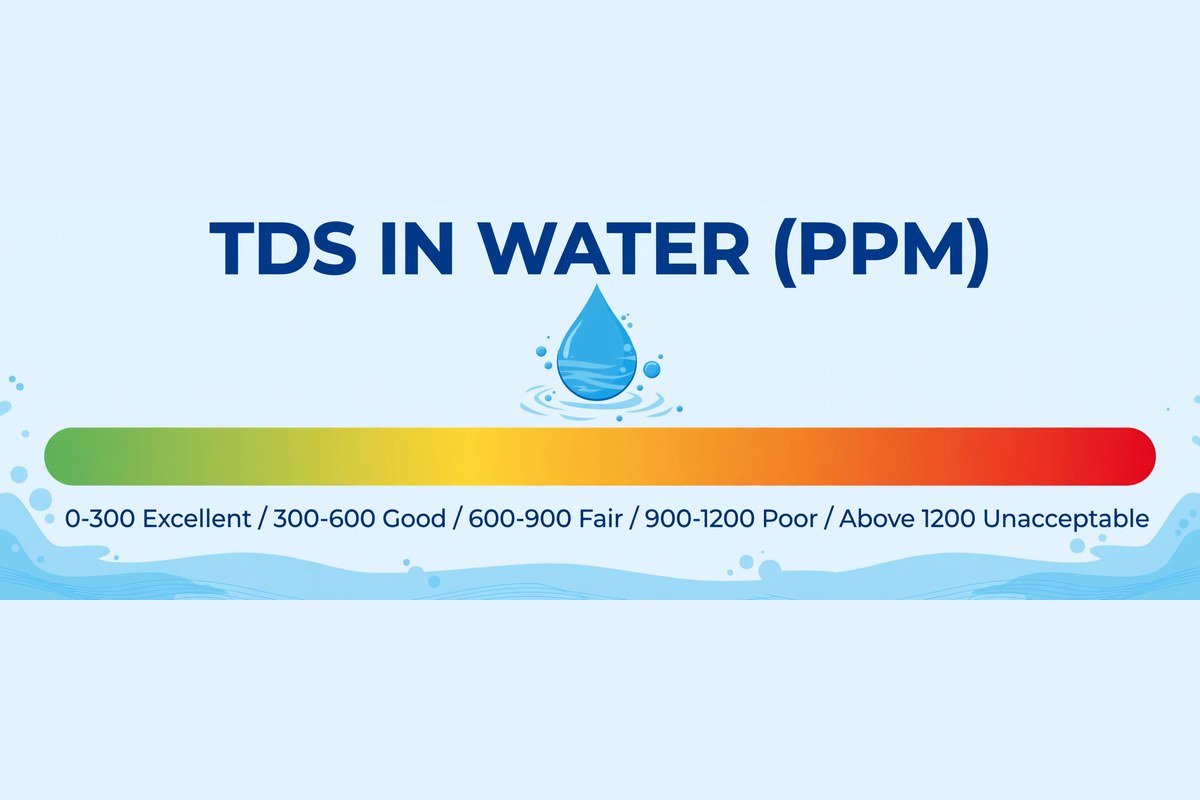
A small electronic TDS meter gives the reading in seconds. In reality, the meter measures how well the water conducts electricity. As a result, more dissolved material means stronger conduction and a higher reading. Rainwater, for instance, reads very low. Mineral water, in contrast, reads much higher because of its natural salts. You can explore the science further on the Wikipedia page on total dissolved solids.
Taste gives the reading a human meaning. A commonly used scale describes water below 300 ppm as excellent in taste. Between 300 and 600 ppm tastes good, and 600 to 900 tastes fair. From 900 to 1,200 the taste turns poor. Above roughly 1,200, most people find the water unpleasant to drink. Remember, however, that this scale judges taste, not safety.
What Changes the TDS of Your Water?
Several everyday factors push the number up or down. Groundwater, for instance, usually reads higher than rain-fed supplies, because it sits among rocks and soil for years. Old plumbing, in contrast, can add its own metals to the flow. Readings also shift with the seasons, since heavy rain dilutes the reservoirs. None of these changes, by itself, proves a problem. It simply shows why one reading deserves a calm look, not panic.
Does a TDS Reading Tell You If Water Is Safe?
That last point matters a great deal. A high TDS reading does not prove water is dangerous. A low reading, likewise, does not prove water is pure. TDS meters cannot detect bacteria, pesticides, or many chemicals at all. They simply total the dissolved load. Treat the number, therefore, as one useful clue among several. Finally, home reverse-osmosis purifiers lower TDS, which is why their displays show this number so proudly.
TDS Meaning in Tax: Tax Deducted at Source
In Indian finance, TDS means tax deducted at source. The idea, in fact, is simple. When certain payments are made, the payer first cuts a percentage as tax. The payer then deposits that amount with the government in the receiver’s name. The receiver later claims credit for it while filing a tax return.
Everyday examples, indeed, make the system clear. An employer, for instance, deducts TDS from salary before paying it. A bank may deduct TDS on interest once it crosses a set limit. Tenants paying high rent and clients paying professional fees can also fall under the rules. The exact percentage depends on the type of payment and current law.
That money, however, is not lost forever. The deducted tax counts as an advance payment of their total tax bill. If too much was deducted, the extra comes back as a refund after filing. Certificates and records, such as Form 16 from an employer, document each deduction. In short, TDS spreads tax collection across the year instead of one painful bill.
Checking your records is easier than most people expect. First, find your deductions in the annual tax statement, beside your other income details. Next, compare that statement with your payslips once a year. If a deduction is missing, tell the payer quickly, because corrections are simpler before filing season. This small habit, in practice, prevents refund delays and angry surprises later. If finance abbreviations trip you up often, our KPI meaning guide explains another workplace shortcut in plain words.
TDS Meaning in Loans: Total Debt Service
In lending, especially in Canada, TDS means total debt service. Here, TDS is a ratio instead, not a thing. It shows what share of your gross income goes towards housing costs and other debts. Lenders, in turn, use it to judge whether a borrower can safely carry a mortgage.
The maths is straightforward. First, add your monthly housing costs, such as mortgage payments, property tax, and heating. Next, add your other debt payments, like car loans and credit card minimums. Then, divide that total by your gross monthly income and multiply by one hundred. The result is your TDS ratio in percent. Lenders commonly look for a ratio under a set ceiling, often cited near 44 percent in Canada. A lower ratio, of course, makes approval easier.
For example, suppose your gross income is 4,000 a month. Your housing costs come to 1,200 a month. Your car and card payments, meanwhile, add 400 more. Together, those debts total 1,600 a month, or 40 percent of your income. Most lenders would call that load manageable. The final decision, however, always rests on your full file, not on one ratio alone. A ratio above the ceiling, in contrast, usually means a smaller loan or a longer wait.
TDS Meaning on Product Documents: Technical Data Sheet
In industry, a TDS is a technical data sheet. Notably, manufacturers publish one for paints, coatings, adhesives, chemicals, and building materials. Specifically, the sheet lists the product’s technical properties in a standard format. It may also cover thickness, drying time, coverage, strength, and safety notes.
Consequently, workers rely on these sheets before they apply or install a product. The sheet, in effect, is the product’s instruction and identity card combined. If a supplier hands you a file labelled TDS, this is almost certainly the sense involved. It has nothing to do with water, tax, or loans.
Reading one is simpler than it looks. First, find the product name and version at the top, because sheets update quietly over time. Next, scan the properties table for the numbers your job depends on. Safety notes, meanwhile, sit near the end and deserve a careful read. In short, two minutes with the sheet can prevent an expensive mistake on site.
TDS Meaning in Political Talk and Online Slang
Online, TDS can also appear in US political arguments. There, it is shorthand for Trump Derangement Syndrome. Supporters of Donald Trump use the label to mock what they see as extreme reactions to him. Critics, in turn, dislike the term and call it a dismissal of real concerns. The phrase is an insult in most contexts, so expect arguments wherever it appears.
You may also meet TDS as a casual short form for The Daily Show, the long-running comedy news programme. Entertainment posts use it when space is tight. Context separates the two easily. In short, a joke about last night’s episode points to the show, while a heated thread points to the slang. On chat apps and forums, meanwhile, lowercase “tds” appears in fan talk about the show’s episodes and hosts.
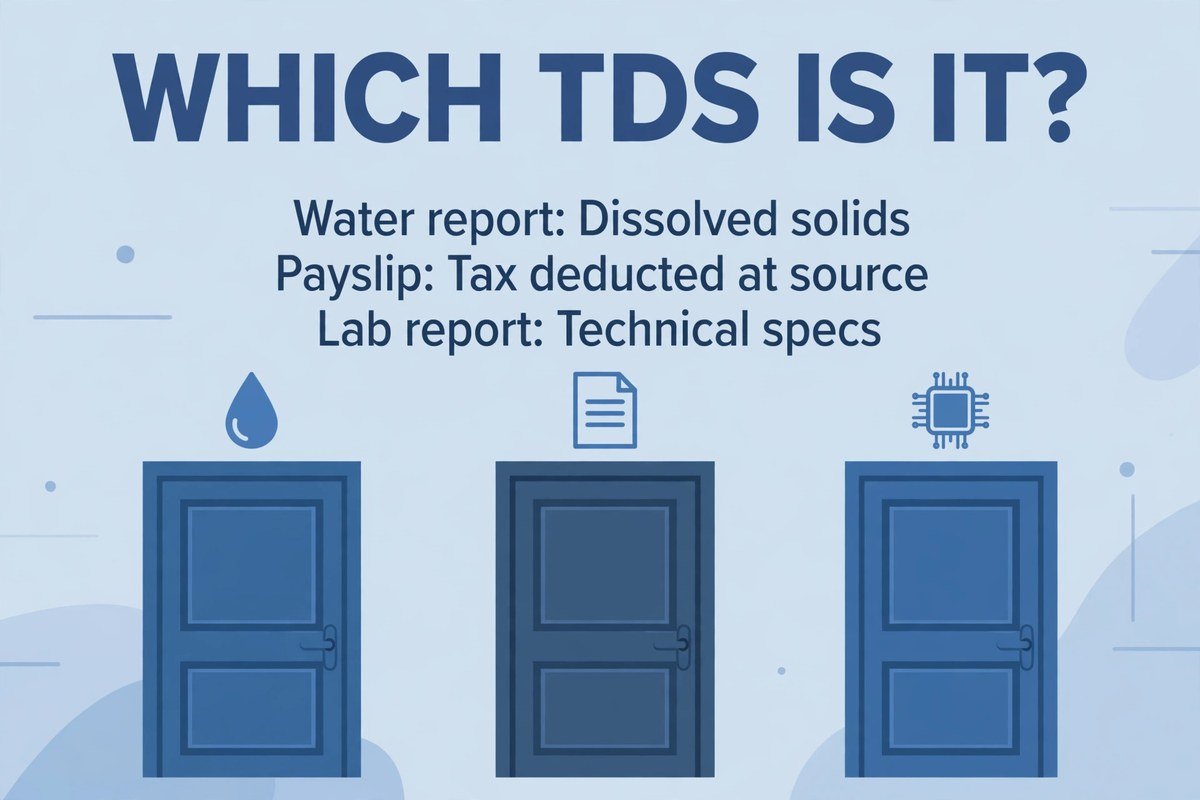
How to Tell Which TDS Meaning Fits
Three quick checks settle almost every case. First, look at the document type. A water report means dissolved solids, while a payslip means tax. Second, look at the country. The tax sense belongs mainly to India, and the debt-ratio sense is strongest in Canada. Third, look for numbers with units. A ppm figure signals water instantly, while a percentage near a loan signals the debt ratio.
Mixed cases do appear occasionally. A landlord in Toronto, for instance, might discuss TDS ratios while a tenant in Mumbai means the tax. Even a single email chain can hold two senses at once. When that happens, the surrounding words rescue you. Words like ppm, salary, and mortgage act as signposts, and each sense keeps its own companions.
Units, in fact, are the giveaway most people miss. Percentages belong to ratios and tax rates. Parts per million belong to water alone. Once you notice the unit, the mystery usually ends. Keep this guide bookmarked if the shortcut follows you between work and home.
If all else fails, ask the writer directly. A one-line question in a reply saves more time than an hour of guessing. People use abbreviations to save space, not to set traps. Almost everyone, in fact, is happy to expand the letters once you ask politely.
FAQ’s
Does boiling water reduce TDS?
No. Boiling kills germs, but it leaves dissolved solids behind. Some water also evaporates during boiling, so the remaining water can even read slightly higher. Use filtration or reverse osmosis instead if you want a lower reading. Boiling and TDS control are simply different jobs.
Why does my salary slip show a TDS deduction?
Your employer is collecting part of your yearly tax in advance. Indian rules require companies to deduct tax at source from salary and deposit it for you. The amount later counts towards your final tax bill. If extra was cut, filing your return brings the surplus back as a refund.
What does TDS stand for in chemistry?
In chemistry and water testing, TDS stands for total dissolved solids. It totals the minerals, salts, and metals dissolved in a liquid sample. Analysts report it in parts per million or milligrams per litre. It is one of the most basic water-quality measurements in any lab.
How often should you check your home water TDS?
A check every few months suits most homes. Test sooner if the taste changes suddenly or after purifier maintenance. Owners of aquariums and hydroponic setups, in contrast, often test weekly. Your meter’s manual may suggest a rhythm for your exact setup.
Is a higher TDS always bad?
Not always. Natural minerals such as calcium and magnesium raise TDS and also add taste. Very low water can even taste flat to many people. The problem starts at the extremes, where taste suffers badly. Judge the number together with proper safety testing, never alone.
Conclusion
The tds meaning, in the end, is a lesson in reading context. The same three letters measure minerals in water, collect tax in India, and test borrowers in Canada. They also label product documents and spice up political threads. No single definition can cover all of that. Each sense, in fact, turns simple once the setting is clear. The setting, the country, and the units always point to the right one.
So the next time TDS crosses your screen, pause for two seconds. Ask where you saw it and what numbers stand beside it. Those two clues will decode it almost every time. And if a friend stays puzzled, send them this page. Three letters should never cause this much homework again.


Leave a Comment