
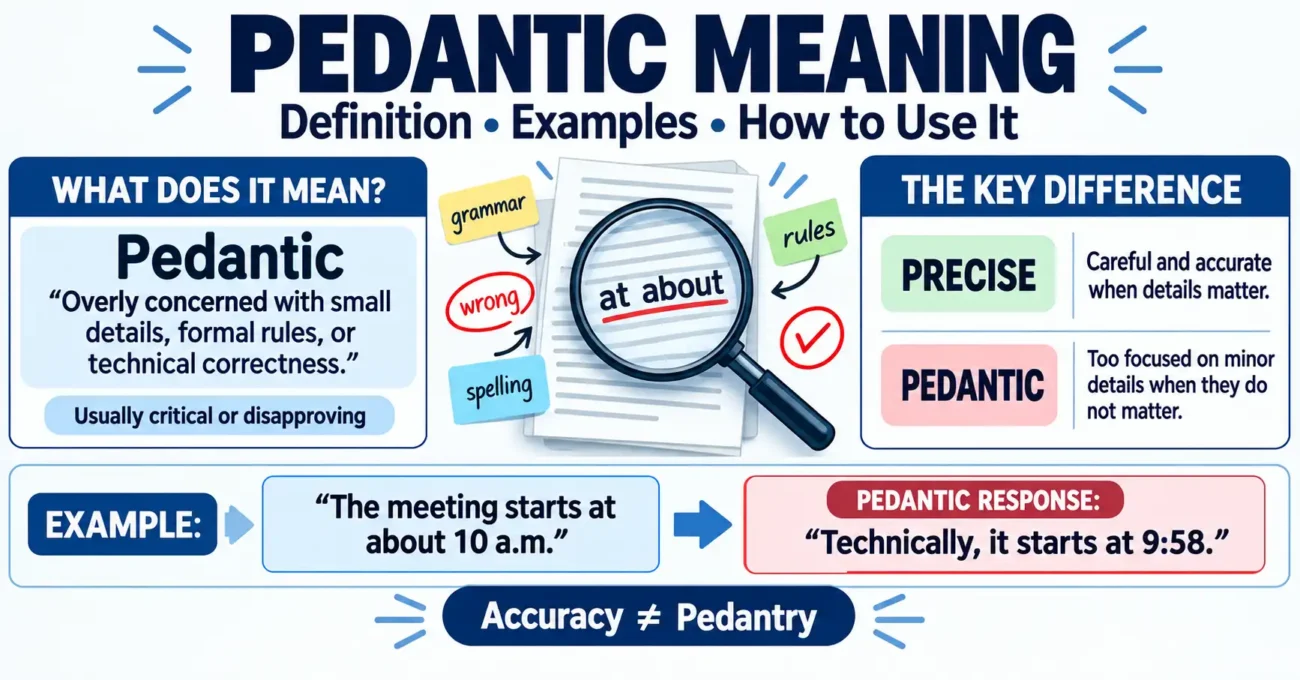
If you are searching for pedantic meaning, you probably want more than a dictionary definition. Pedantic means being overly concerned with small details and formal rules, especially when it is not important. The word is usually used in a critical way.
You may hear this word when someone keeps correcting minor mistakes, focuses too much on technical details, or insists on following a rule even when it does not matter. If you are also exploring common internet and texting terms, you can learn more about SMH meaning in text.
Understanding the difference between useful accuracy and unnecessary attention to tiny details makes the meaning much easier to recognize.
What Does Pedantic Meaning Refer To?
The pedantic meaning describes excessive concern with small details, formal rules, or technical correctness.
A person can be accurate without being pedantic. The word usually suggests that someone gives too much importance to details that do not really matter in the situation.
For example, imagine someone says:
“The meeting starts at about 10 a.m.”
Another person immediately replies:
“Technically, it starts at 9:58 a.m., not 10.”
The correction may be technically accurate. However, if the exact time does not matter, constantly focusing on it can seem pedantic.
In simple English, the meaning is close to:
Being too concerned with minor details or rules.
What Is Such a Person Like?
A person who behaves this way often focuses on correctness even when a small correction adds little value.
Correcting Small Mistakes
Someone may interrupt a conversation to correct a minor grammar mistake, pronunciation, spelling issue, or wording choice.
For example:
“You said ‘less people,’ but the traditional grammar rule is ‘fewer people.’”
The correction may be correct, but the context matters. If the conversation is informal and everyone understands the meaning, the correction may come across as unnecessary.
Focusing on Technical Details
Some people focus heavily on the exact technical meaning of a word or statement.
For example, someone might say:
“That happened yesterday.”
A person may respond:
“Technically, it happened 23 hours ago, so it wasn’t exactly a full day.”
The detail is accurate, but it may not contribute anything useful to the conversation.
Taking Rules Too Literally
A person can also appear pedantic by following a rule too literally.
Imagine a sign says:
“No food in the room.”
Someone brings a drink and argues that the rule does not specifically mention beverages.
The person may have found a technical distinction, but most people would understand the intention of the rule.
Pedantic Meaning in Everyday Examples
The easiest way to understand the pedantic meaning is to look at ordinary situations.
Grammar:
Someone corrects every small grammar mistake during a casual conversation, even when everyone understands what was meant.
Work:
A colleague spends several minutes explaining a tiny formatting issue instead of focusing on the main purpose of a report.
Academic discussion:
A student focuses on one minor wording difference instead of addressing the main idea being discussed.
Everyday conversation:
Someone corrects another person’s use of “around 5” by pointing out that the actual time was 4:57.
These examples show an important point: accuracy alone does not make someone pedantic. Excessive attention to a minor detail does.
Is Pedantic a Negative Word?
Yes, pedantic usually carries a negative or critical meaning.
When someone describes a person as pedantic, they often mean that the person pays too much attention to details, rules, or technical distinctions.
However, the word does not mean that the person is wrong.
Someone can make a completely correct statement and still communicate in a pedantic way. The issue is often the amount of attention given to a detail and whether that detail actually matters.
For example:
“The correct technical term is different.”
This statement is not automatically pedantic.
But if someone repeatedly interrupts an important discussion just to correct tiny wording differences, others may consider the behavior pedantic.
Can This Behavior Ever Be Useful?
Careful attention to details can be valuable.
Scientists, editors, lawyers, engineers, programmers, researchers, and other professionals often need to notice small differences. In these situations, precision can prevent mistakes.
The problem arises when someone treats every minor distinction as equally important.
A useful question is:
Does this detail actually matter here?
If the answer is yes, correcting it may be helpful. If the answer is no, focusing heavily on it may seem pedantic.
Pedantic Meaning vs. Precise, Meticulous, and Detail-Oriented

The pedantic meaning can seem similar to words such as precise, meticulous, and detail-oriented. However, these words do not have exactly the same tone.
| Word | Basic Meaning | Usual Tone |
|---|---|---|
| Pedantic | Too focused on minor details or rules | Usually negative |
| Precise | Exact and accurate | Usually positive or neutral |
| Meticulous | Very careful and thorough | Usually positive |
| Detail-oriented | Good at noticing and managing details | Usually positive |
| Picky | Difficult to satisfy; highly selective | Often negative |
| Nitpicky | Focused excessively on tiny faults | Negative |
Pedantic vs. Precise
Precise means exact or accurate.
Pedantic suggests excessive concern about exactness.
For example, a scientist who records measurements carefully is being precise. Someone who interrupts a casual conversation to correct an insignificant measurement may seem pedantic.
Pedantic vs. Meticulous
A meticulous person pays close attention to details because the details matter.
A pedantic person may focus on details even when they have little practical importance.
So, meticulousness can be useful, while pedantic behavior often creates frustration.
Pedantic vs. Detail-Oriented
Being detail-oriented is generally a positive quality.
A detail-oriented employee might notice an important error in a financial report before it causes a problem.
A pedantic employee might spend too much time correcting minor details that have no effect on the final result.
Pedantic vs. Picky and Nitpicky
Picky usually describes someone who is difficult to satisfy or very selective.
Nitpicky describes someone who focuses heavily on small faults or insignificant problems.
Nitpicky is especially close to the negative side of the pedantic meaning, although the two words are not always interchangeable.
How to Use Pedantic Correctly
Use pedantic when you want to describe excessive attention to minor details, technicalities, or formal rules.
Here are a few natural examples:
“His explanation became too pedantic for a simple question.”
“She sounded pedantic when she corrected every small mistake.”
“The article gives useful information without becoming overly pedantic.”
“I understand your point, but that distinction feels a little pedantic.”
When It Is the Right Word
The word works best when the detail itself is not necessarily wrong, but the amount of attention given to it feels unnecessary.
For example:
“His pedantic correction distracted everyone from the main issue.”
The sentence suggests that the correction may have been technically correct, but it was not helpful in that situation.
When “Precise” Is Better
Use precise when you want to praise accuracy rather than criticize excessive attention to detail.
For example:
“She gave a precise explanation of the process.”
This sentence presents accuracy as a positive quality.
Calling the explanation pedantic would suggest that the speaker thinks the explanation focused too heavily on minor technical points.
Pedant, Pedantry, and Pedantically
The word also has related forms that appear in English.
Pedant
A pedant is a person who focuses excessively on minor details, formal rules, or technical correctness.
Example:
“He is known as a pedant who corrects everyone’s grammar.”
Pedantry
Pedantry refers to the behavior or practice of being pedantic.
Example:
“The discussion was slowed down by unnecessary pedantry.”
Pedantically
Pedantically is the adverb form.
Example:
“Pedantically speaking, the two terms have slightly different meanings.”
These forms help you recognize the word in different contexts.
Is “Pendantic” the Correct Spelling?
No. The correct spelling is pedantic.
“Pendantic” is a common spelling mistake, possibly because people associate the word with “pendant” or simply add an extra “n.”
The correct forms are:
- pedantic
- pedant
- pedantry
- pedantically
“Pendant” is a different English word. It usually refers to an object that hangs from something, such as a piece of jewelry.
Frequently Asked Questions About Pedantic Meaning
Does pedantic mean intelligent?
Not necessarily. A person can be highly knowledgeable and still behave pedantically, but the word itself does not mean intelligent.
It describes someone’s approach to details, rules, or technical correctness.
Is being careful the same as being pedantic?
No.
Being careful can be a positive quality. The pedantic meaning usually involves going too far with attention to small details, especially when those details are not important.
Is pedantic the same as perfectionist?
Not exactly.
A perfectionist usually wants work or results to meet a very high standard. A pedantic person focuses more specifically on rules, technical details, or minor distinctions.
A person can be both, but the terms describe different ideas.
What is the noun form of pedantic?
The noun for a person is pedant.
The noun for the behavior or quality is pedantry.
What is the correct spelling?
The correct spelling is pedantic, not “pendantic.”
What is a simple definition of pedantic?
A simple definition is:
Too concerned with small details, rules, or technical correctness.
Conclusion
The pedantic meaning is easier to understand when you separate accuracy from excessive attention to detail.
A precise or detail-oriented person focuses on accuracy because it matters. A pedantic person may focus on tiny rules or technical distinctions even when they add little value to the situation.
The word usually has a negative or critical tone, but the underlying information may still be correct.
A simple way to remember it is:
Precise = careful about being correct.
Pedantic = overly concerned with being correct about minor details.


Leave a Comment