

Some jokes only work in their own language, and Spanish jokes in Spanish are the perfect proof. The punchlines hide inside Spanish sounds, so a translation alone would lose the magic. This page gives you both worlds: each classic chiste appears in Spanish first, with a plain English translation and a short note under it. Read the Spanish aloud, then check the note to see why it is funny.
First, animal jokes open the show, because Spanish playgrounds run on them. Home, school, and the famous colmo riddles follow. After that, number jokes, sports jokes, and a mixed finale close the set. By the end, you will own more than 40 spanish jokes in spanish that real Spanish speakers actually tell.
Spanish Jokes in Spanish About Animals
Animals, first of all, carry Spanish humour everywhere. Listen for the wordplay in each answer, because the animal names often hide the trick.
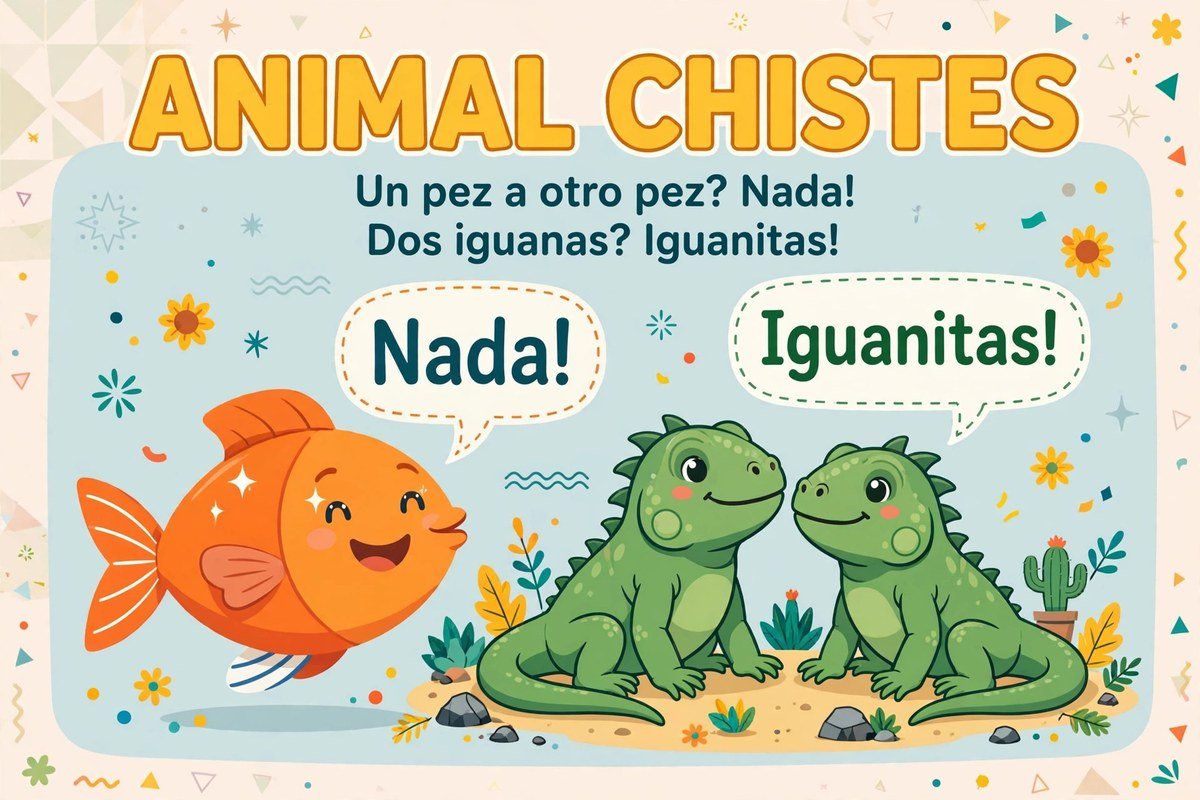
- Q: ¿Qué le dijo un pez a otro pez?
A: Nada.
In English: What did one fish say to another fish? “Nothing.” The trick: nada also means “he swims,” so the fish answers by swimming. - Q: ¿Qué le dijo una iguana a la otra?
A: Somos iguanitas.
In English: What did one iguana say to the other? “We are little iguanas.” The trick: iguanitas sounds like igualitas, “exactly alike.” - Q: ¿Qué hace una abeja en el gimnasio?
A: Zum-ba.
In English: What does a bee do at the gym? Zumba classes. The trick: zum copies the buzzing sound a bee makes. - Q: ¿Por qué la gallina está triste?
A: Porque necesita a-pollo.
In English: Why is the hen sad? She needs support. The trick: a-pollo sounds like apoyo, “support,” with a hen (pollo) inside.
More Animal Spanish Jokes in Spanish
Five more animal favourites follow. The elephant, in particular, has been avoiding computers for decades.
- Q: ¿Por qué los elefantes nunca usan la computadora?
A: Porque le tienen miedo al ratón.
In English: Why do elephants never use the computer? They are afraid of the mouse. Ratón means both the animal and the computer mouse. - Q: ¿Qué hace un perro con un taladro?
A: Está ta-ladrando.
In English: What is a dog doing with a drill? He is “drilling-barking.” Ta-ladrando splits taladrando (drilling) so it sounds like “está ladrando,” he is barking. - Q: ¿Qué le dijo el pollito a su mamá?
A: Cuando sea grande, seré caldo.
In English: The chick asks what he will be when he grows up, and his mother answers, “Soup.” A dark little classic told all over Spain. - Q: ¿Cuál es el animal más antiguo?
A: La cebra, porque está en blanco y negro.
In English: What is the oldest animal? The zebra, because it is still in black and white, like an old photograph. - Q: ¿Qué hace un pez payaso todo el día?
A: ¡Payasadas!
In English: What does a clownfish do all day? Clowning around. Payasadas means clown antics, and pez payaso is a clownfish. - Q: ¿Por qué los pájaros vuelan hacia el sur en invierno?
A: Porque caminando tardarían mucho.
In English: Why do birds fly south in winter? Because walking would take them far too long. A logic joke that needs no wordplay at all.
Spanish Jokes in Spanish at Home and School
Home and school jokes, in turn, star the objects around you. Brooms, books, and traffic lights all get speaking parts here.
- Q: ¿Por qué la escoba siempre está feliz?
A: Porque siempre está ba-riendo.
In English: Why is the broom always happy? It is always “sweeping-laughing.” Ba-riendo stretches barriendo (sweeping) so it sounds like “va riendo,” goes laughing. - Q: ¿Por qué el libro de matemáticas está triste?
A: Porque tiene muchos problemas.
In English: Why is the maths book sad? It has too many problems. Problemas means both maths problems and life troubles. - Q: ¿Qué le dijo una pared a la otra pared?
A: Nos vemos en la esquina.
In English: What did one wall say to the other wall? “See you at the corner.” Walls, of course, can only meet at corners. - Q: ¿Qué le dijo una taza a la otra taza?
A: ¿Qué taza-ciendo?
In English: What did one cup say to the other? “What are you cup-doing?” Taza-ciendo squashes “qué estás haciendo” (what are you doing) into a cup. - Q: ¿Qué le dijo el semáforo al coche?
A: ¡No me mires, me estoy cambiando!
In English: What did the traffic light say to the car? “Don’t look at me, I’m changing!” Cambiando means changing colour and getting changed.
More Home and School Spanish Jokes in Spanish
The Sun, the moon, and one very surprised tomato continue the lesson. Watch how often Spanish hides two meanings in a single everyday word.
- Q: ¿Por qué el Sol no necesita ir a la escuela?
A: Porque ya tiene millones de grados.
In English: Why does the Sun not need school? It already has millions of degrees. Grados means school grades and temperature degrees. - Q: ¿Por qué la luna no comió nada?
A: Porque estaba llena.
In English: Why did the moon eat nothing? Because it was full. Llena means a full moon and a full stomach at once. - Q: ¿Cómo se dice espejo en chino?
A: Aitoi.
In English: How do you say “mirror” in Chinese? “Aitoi” — it sounds like “ahí estoy,” “there I am,” which is what you see in a mirror. - Q: ¿Qué pasó cuando un tomate habló en la nevera?
A: El otro tomate gritó: “¡Un tomate que habla!”
In English: One tomato in the fridge says it is cold, and the other screams, “A talking tomato!” A beloved surprise-format chiste. - Q: ¿Qué le dijo un ojo al otro ojo?
A: Entre tú y yo, algo huele mal.
In English: What did one eye say to the other? “Between you and me, something smells bad.” The nose, of course, sits right between them.
Colmo Jokes: Spanish Jokes in Spanish About Bad Luck
Spain’s beloved colmo riddles get their own corner here. Each one names a job, then lands the worst possible luck for it.
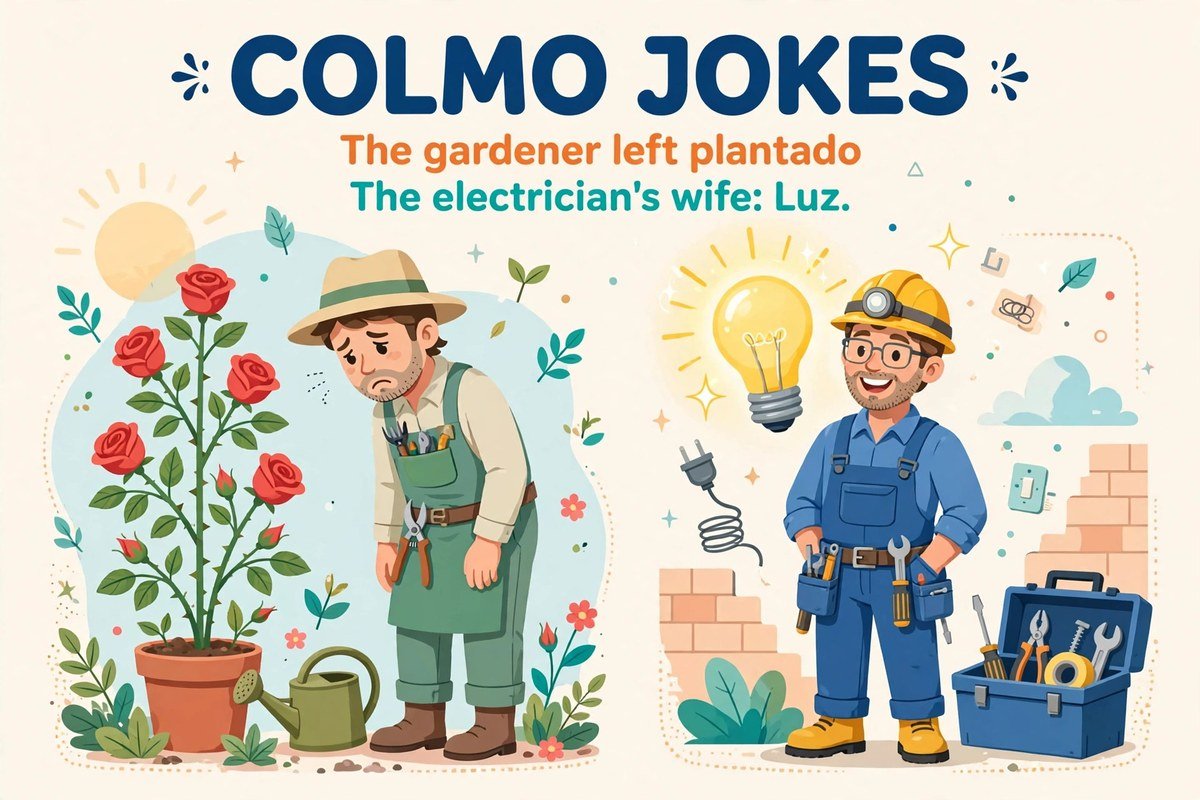
- Q: ¿Cuál es el colmo de un jardinero?
A: Que su hija se llame Rosa y lo deje plantado.
In English: The gardener’s worst luck: his daughter is called Rosa (Rose), and she leaves him plantado — stood up, but also “planted.” - Q: ¿Cuál es el colmo de un electricista?
A: Que su esposa se llame Luz y sus hijos le lleven la corriente.
In English: His wife is called Luz (Light), and his children carry his current — literally “go along with him,” with an electric twist. - Q: ¿Cuál es el colmo de un libro?
A: Que se le caigan las hojas en otoño.
In English: The book’s worst luck: its hojas fall in autumn. Hojas means both pages and leaves. - Q: ¿Cuál es el colmo de un calvo?
A: Tener ideas descabelladas.
In English: The bald man’s worst luck: having descabelladas ideas — wild ideas, built from cabello, hair he does not have. - Q: ¿Cuál es el colmo de un astronauta?
A: Quejarse de no tener espacio.
In English: The astronaut complains that he has no espacio — no space, in every sense of the word.
Spanish Jokes in Spanish About Numbers and Words
Numbers, meanwhile, hide jokes of their own. These five play with counting, names, and one very polite wave.
- Q: ¿Qué le dijo el cero al ocho?
A: ¡Bonito cinturón!
In English: What did zero say to eight? “Nice belt!” The 8 looks like a 0 wearing a belt around its middle. - Q: ¿Qué le dijo el uno al diez?
A: Para ser como yo, tienes que ser sincero.
In English: “To be like me, you must be sincero” — honest, but also sin cero, “without a zero,” which turns 10 into 1. - Q: ¿Qué le dijo un jaguar a otro jaguar?
A: ¡Jaguar you!
In English: One jaguar greets the other with “Jaguar you,” a furry version of “How are you?” told across Latin America. - Q: ¿Qué le dijo el mar a la ola?
A: ¡Hola!
In English: What did the sea say to the wave? “Hola!” The greeting hides inside ola, the wave itself. - Q: ¿Cómo se dice pañuelo en japonés?
A: Saca-moco.
In English: How do you say “handkerchief” in Japanese? “Saca-moco” — “takes out snot,” described in one honest compound word.
Spanish Jokes in Spanish About Sports and the Sea
Sports jokes, moreover, dive in happily. Divers, seals, and two Japanese champions fill this short set.
- Q: ¿Por qué los buzos se tiran hacia atrás?
A: Porque si se tiran hacia adelante, caen dentro del barco.
In English: Why do divers dive backwards? If they dove forwards, they would fall back into the boat. Pure logic, no wordplay. - Q: ¿Por qué las focas del circo miran siempre hacia arriba?
A: Porque es donde están los focos.
In English: Why do circus seals always look up? That is where the focos are — the spotlights, near-namesakes of the seals (focas). - Q: ¿Cómo se llama el campeón de buceo japonés?
A: Tokofondo.
In English: The Japanese diving champion is called Tokofondo — “toco fondo,” I touch the bottom, squeezed into one name. - Q: ¿Y cómo se llama el subcampeón?
A: Kasitoko.
In English: And the runner-up? Kasitoko — “casi toco,” I almost touch. The pair is one of Spain’s most repeated name jokes.
More Spanish Jokes in Spanish to Share
Finally, this mixed set collects the rest of the playground canon. Ghosts, spiders, and one very confident cousin all appear.
- Q: ¿Por qué la computadora fue al médico?
A: Porque tenía un virus.
In English: Why did the computer go to the doctor? It had a virus — the same word in both languages, sadly for the computer. - Q: ¿Por qué los pájaros no usan Facebook?
A: Porque ya tienen Twitter.
In English: Why don’t birds use Facebook? They already have Twitter, where tweeting is literally their own language. - Q: ¿Por qué el hombre tiró el reloj por la ventana?
A: Porque quería ver volar el tiempo.
In English: Why did the man throw the clock out of the window? He wanted to see time fly. - Q: ¿Qué le dijo una impresora a la otra?
A: ¿Esa hoja es tuya o es impresión mía?
In English: “Is that sheet yours, or is it just my impression?” Impresión means a printout and a vague feeling. - Q: ¿Por qué los esqueletos no pelean entre ellos?
A: Porque no tienen agallas.
In English: Why do skeletons never fight each other? They have no agallas — no guts, in body or in courage. - Q: ¿Por qué el fantasma fue a la fiesta?
A: Porque quería pasarlo de miedo.
In English: Why did the ghost go to the party? To have a scary-good time — pasarlo de miedo literally means having a fantastic time.
Even More Spanish Jokes in Spanish to Share
Five final favourites close the collection. The last one, fittingly, stars a clown who feels funny in both languages at once.
- Q: ¿Por qué el fantasma nunca miente?
A: Porque se le ve a través.
In English: Why does the ghost never lie? Because you can see right through him — honesty by transparency. - Q: ¿Por qué la araña es experta en internet?
A: Porque vive en la web.
In English: Why is the spider an internet expert? It lives on the web — its own web, long before ours existed. - Q: ¿Cómo se llama el primo vegetariano de Bruce Lee?
A: Broco-Li.
In English: Bruce Lee’s vegetarian cousin is called Broco-Li, half broccoli, half martial-arts legend. - Q: ¿Por qué el payaso fue al médico?
A: Porque se sentía un poco gracioso.
In English: Why did the clown go to the doctor? He was feeling a little gracioso — a little funny, in health and in humour.
Why Spanish Jokes in Spanish Help You Learn
A pun is a vocabulary lesson in disguise. To laugh at the fish joke, you must learn that nada means both nothing and swims. That single effort, in fact, fixes two words in memory at once. Teachers of Spanish use chistes for exactly this reason: the laugh rewards the learning instantly.
The format on this page helps as well. You meet the Spanish first, so your brain tries before the translation rescues it. Each attempt, moreover, builds the guessing muscle that real conversation needs. For family laughs in English after your Spanish workout, our mom jokes page is the natural next stop. And if you want the language itself explained, the history of the Spanish language is a rich read.
FAQ’s
Are these jokes suitable for Spanish beginners?
Yes, most of them use very simple Spanish. The vocabulary stays close to animals, family, school, and food words that beginners learn first. The translation under each joke, moreover, removes any pressure. Read the Spanish, guess the meaning, and then check yourself below.
Why do some Spanish jokes not translate word for word?
Because the humour lives in Spanish sounds, not in the ideas alone. A word like nada carries two meanings that English splits apart. Translators therefore explain the trick instead of replacing it. Once you hear the Spanish version aloud, the joke usually lands perfectly.
What does “colmo” mean in these jokes?
Un colmo is “the height of” something, usually bad luck. The classic format asks for the worst luck a person or thing could have. A gardener whose daughter leaves him planted, for example, suffers a perfect colmo. Spanish speakers have traded these riddles for generations.
Can I use these jokes in a Spanish class?
Yes, they are clean, short, and classroom-friendly. Teachers often read one aloud and let students spot the double meaning. The translation line, in turn, lets weaker students join the laugh quickly. Just be ready for the class to demand the next one immediately.
How should I pronounce the jokes if I am learning?
Read them slowly and stress the bold beats of each word, just as Spanish speakers do. The question marks at both ends, ¿ and ?, remind you to lift your voice like a real question. Practise the pair Tokofondo and Kasitoko aloud, for example. Name jokes only work when the rhythm lands.
Conclusion
Spanish jokes in Spanish offer two gifts at once. They hand you real laughter, the kind Spanish-speaking kids have shared for generations, and they teach the language from the inside. Every pun you understand marks a small victory: two meanings, one word, and your brain holding both. That is why chistes survive every schoolyard and family table they touch. They also give families a game they can play in two languages at once, passing the same small joke across the generations.
So pick three favourites and say them aloud today. Start with the fish who answers nada, because that tiny joke unlocks the whole style. Then lend the page to a friend who is learning, and trade jokes back and forth. Laughter, after all, is the fastest accent coach in the world.


Leave a Comment