

Three short letters still cause endless confusion online. ASL can also name a rich, living sign language. It can also open an old-school chat exchange. So the asl meaning depends fully on the setting. This guide then sorts both senses out, clearly and quickly. First, you will meet American Sign Language in depth. Next, you will see the chat slang version. By the end, you will spot the right sense at a glance.
Also, the two senses could hardly differ more. One belongs to classrooms, hospitals, and Deaf culture instead. The other, meanwhile, belongs to early chat rooms and gaming lobbies. Still, both stay common in daily online life. So this short word truly deserves a full guide. Keep this page nearby the next time the letters confuse you.
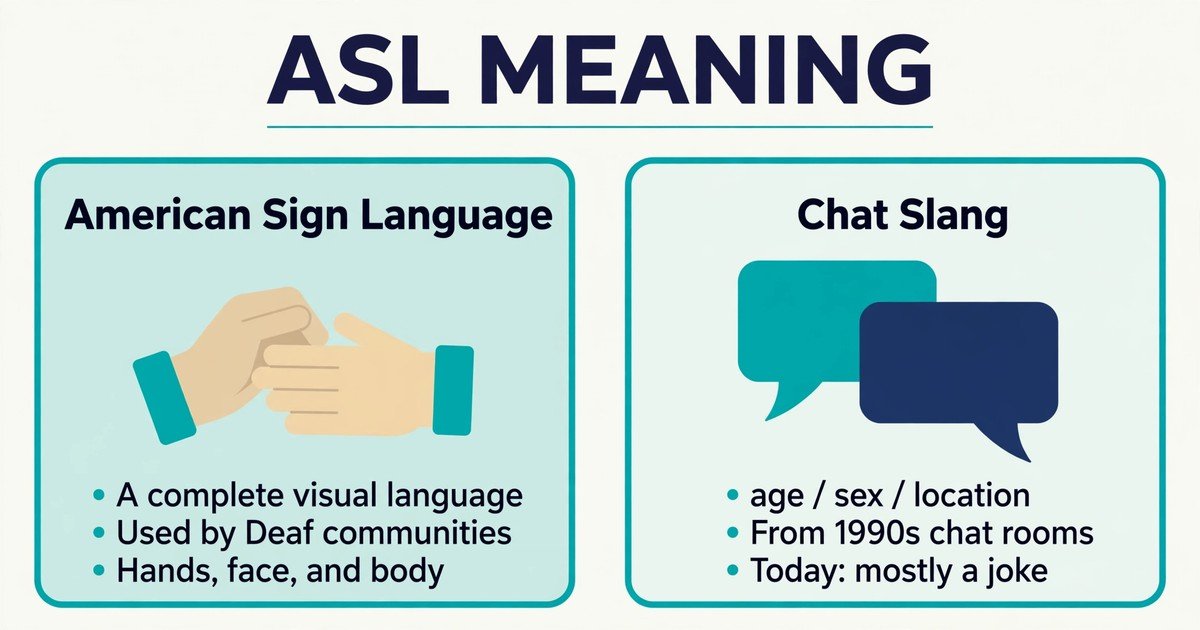
ASL Meaning at a Glance: Two Very Different Answers
In short, the asl meaning splits into two very different answers. One answer, for instance, names a complete visual language. The other answer, in contrast, asks three personal questions at once. Also, the two senses share nothing but the same three letters. In the end, context always reveals which sense fits. The table below gives you the fastest shortcut.
| Where you see ASL | What it almost always means |
|---|---|
| A school, hospital, or Deaf culture video | American Sign Language |
| A chat room, game lobby, or old forum post | age/sex/location |
| An anonymous message that reads “asl?” | age/sex/location |
Below, each sense gets its own full section. Read the half that matches your situation first. Or read both halves for the complete picture. Either way, you will leave with zero confusion.
Also, notice the tone around the word. Serious pages, in fact, use capital letters, ASL. Casual chats, meanwhile, often use lowercase, asl. That small clue helps, but context still decides. When the setting stays unclear, the sections below will rescue you. So bookmark this page if you meet the word often.
ASL Meaning 1: American Sign Language
First, here is the important and serious sense. ASL stands for American Sign Language. It is the main sign language of Deaf communities in the United States. Many people in Canada also use it. Signers communicate with their hands, face, and body together. Every movement can therefore carry meaning, much like a spoken word.
A Complete Language, Not Signed English
Many people guess that ASL simply mirrors English. In fact, ASL is a complete language of its own. It has its own grammar and, indeed, its own word order. Also, it has its own idioms, humor, and poetry. Through space and movement, a signer can also show time, place, and attitude. English words on the hands, by contrast, would miss all of that.
Linguists now classify ASL as a natural human language. It grew, instead, inside the Deaf community across generations. No lab or committee invented it at a desk. Deaf babies, too, can acquire it as a first language. With early exposure, they still learn it naturally and on schedule. That fact, in short, shows its full language status.
Also, ASL expresses grammar through the face and body. Raised eyebrows, for instance, can turn a statement into a question. A headshake, similarly, can carry the word not. The direction of movement can also show who did what to whom. Spoken languages, however, simply cannot copy these tools. Each tool thus adds meaning with elegant speed.
Who Uses ASL?
Deaf and hard-of-hearing people form the heart of the ASL world. However, they are far from the only signers. Hearing children of Deaf adults, meanwhile, often grow up fully bilingual. Teachers, interpreters, doctors, and nurses also learn it for work. Also, many parents teach simple signs to babies. Babies can even sign basic needs before they can speak clearly.
Partners, friends, and coworkers of Deaf people often learn too. Some students, for example, choose it to fulfill a language requirement. Others, in contrast, simply fall in love with its expressiveness. Even some workplaces now offer basic ASL training for staff. In short, ASL connects a wide and welcoming community. Still, anyone willing to learn can take part respectfully.
Fingerspelling: The ASL Alphabet
Sometimes a word has no ready-made sign. Then signers spell the word out by hand. Signers call this system fingerspelling. It also uses one hand and 26 distinct handshapes. Each handshape also stands for one letter of the English alphabet. People, indeed, fingerspell names, places, and brand-new words most often.
Beginners, meanwhile, usually learn the alphabet very early. It gives them, in short, a tool for any word at all. Skilled readers do not watch single letters, though. Instead, they catch the shape of the whole word. Fluent signers, by contrast, blend letters into one smooth, quick motion. With steady practice, your reading speed still climbs fast.
Also, fingerspelling appears inside everyday signing more than beginners expect. Signers also mix spelled words with full signs smoothly. Some English words even became signs through fingerspelling shortcuts. Practice a few letters daily, and the alphabet soon feels easy.
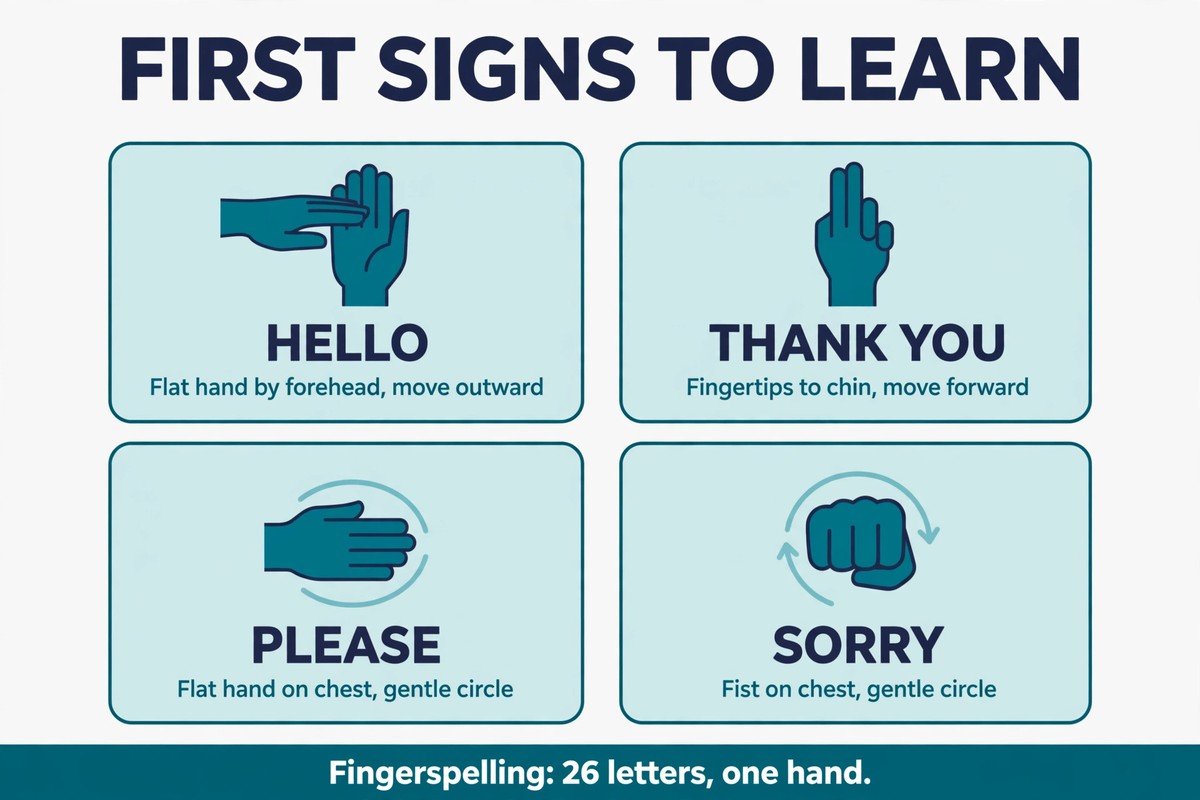
First Signs Most People Learn
Most beginners still start with friendly, everyday signs. Hello comes first in almost every lesson. Then you raise a flat hand near your forehead. Then you move it outward, like a small salute. Thank you, meanwhile, is another early favorite. You touch your fingertips to your chin. Next, you move your hand forward and down.
Please, in contrast, uses a flat hand against the chest. You rub the hand in a slow, gentle circle, too. Sorry uses a fist over the chest instead. It also moves in a circle. These four signs, in short, already let you greet people politely. They also show respect in Deaf spaces right away. Small efforts like these can mean a great deal. Learners often practice these first signs in front of a mirror.
Where You Can Learn ASL
The good news is simple: beginners now have more options than ever. Many community colleges, for instance, run ASL classes each term. Local Deaf organizations often host friendly courses too. Also, online lessons let you start learning at home today. The National Institute on Deafness and Other Communication Disorders, or NIDCD, runs a helpful site. Its American Sign Language page offers background and guidance for learners, too. Books and video dictionaries can also support your daily practice well.
Still, real conversation teaches more than any app. So practice with fluent signers whenever you get the chance. Mistakes are normal, and most signers still appreciate the effort. Many libraries also lend beginner-friendly ASL books for free. Be patient with yourself along the way. Fluency grows over months and years, not days. Steady, respectful practice always wins in the end.
Also, look for classes that welcome questions and practice time. A good teacher corrects your handshapes gently and early. Record yourself signing once a week, if you can. Watching your progress keeps motivation high on slow days. Small, steady steps, in the end, beat rare, long sessions.
ASL Meaning 2: Age, Sex, Location in Chat Slang
Now for the internet side of the asl meaning. In old chat rooms, asl worked as a quick question. It indeed asked three things at once: age, sex, and location. People then typed it as asl, a/s/l, or a quick asl?. It acted, in short, like a tiny introduction form. Strangers then used it to decide whether a chat seemed worth continuing.
Where the Chat Meaning Came From
Picture the internet of the 1990s for a moment. Chat rooms were busy, anonymous, and, indeed, very fast. Nobody, in fact, had profile photos, bios, or follower counts. Rooms scrolled so fast that long introductions died instantly. So strangers needed a fast way to place each other. ASL solved that problem in just three letters. One person typed asl?, then waited. The other then replied with something like 19/f/ohio.
That tiny exchange, in the end, set the scene for a conversation. It felt normal then, and even friendly. Speed, indeed, mattered more than privacy in those rooms. Nobody, meanwhile, thought twice about answering it honestly. Today, of course, it reads very differently. Modern safety advice has changed the habit completely. The same ritual played out in millions of first chats.
How People Use ASL in Chats Today
Modern apps already show names, photos, and bios. Because of that, the serious asl question has faded away. Most people now use it as a joke or a retro throwback. Friends, for example, drop it into group chats for old-internet humor. Gamers, similarly, type it in lobbies to earn a quick laugh. Nobody, in fact, expects a real answer anymore.
Many teens meet the chat asl meaning as a joke first. Short forms still fill modern chat apps, though. Our guide to ik meaning in chat explains another tiny phrase with a big job. Each short form also carries its own tone and history. Context still rules every single one of them. So read the room before you type any of them.
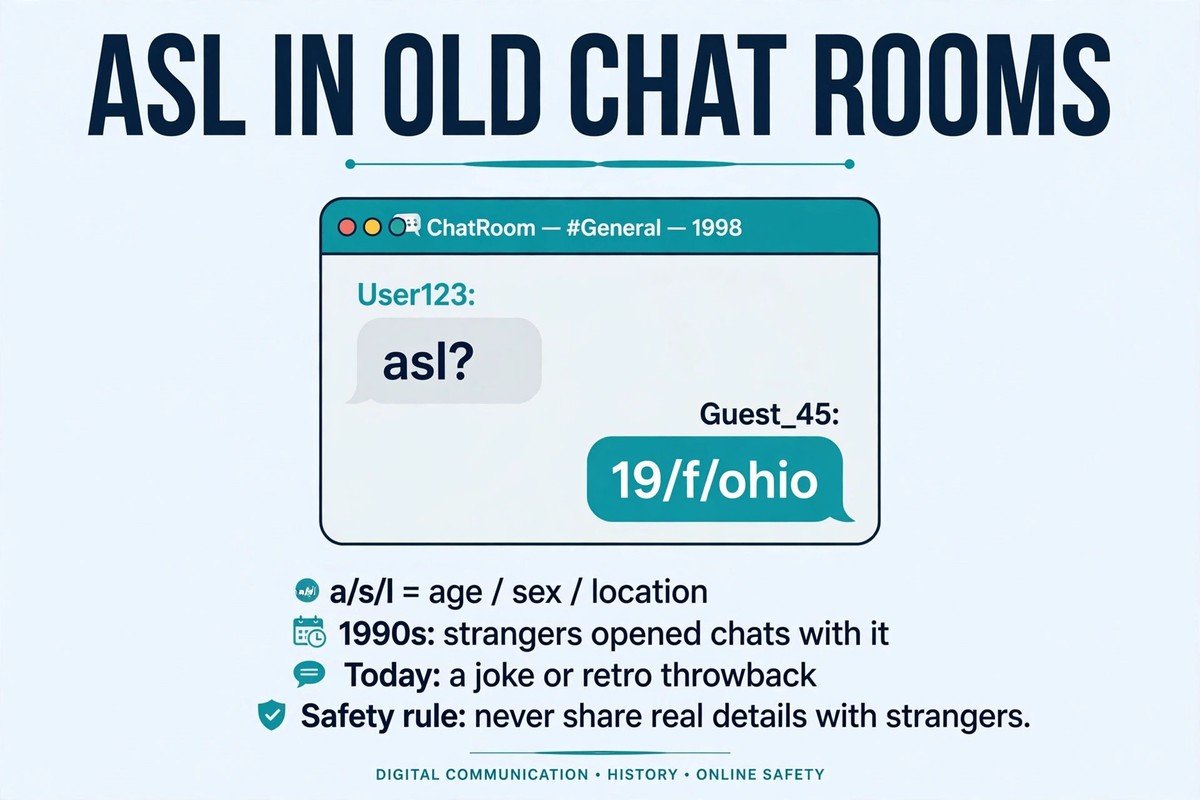
Stay Safe: Never Share the Real Answer
This part matters most, so read it slowly. Above all, never give your real age and location to strangers online. Scammers and predators can misuse even small details. An age plus a town name can, in fact, identify a young person fast. After all, that risk is simply never worth taking. Your safety, in short, always outranks a stranger’s curiosity.
Instead, skip the question or answer with a joke. You can also block and report pushy accounts at once. Parents, therefore, should teach this rule early and repeat it often. The old asl habit belongs to a different internet. Today’s internet demands much more care from everyone.
Teens, likewise, should loop a parent or trusted adult into odd chats. Save screenshots, instead, if a stranger keeps pressing for details. Most platforms, in fact, let you report such accounts in seconds. A quick report protects the next person too.
Which ASL Meaning Did They Mean?
Still unsure which asl meaning someone intended? Check the setting first, every time. A class, a clinic leaflet, or a video about Deaf culture points to sign language instead. A random message from a stranger points to the slang question. Textbooks and news segments point the same way. Also, check the company the word keeps. Words like Deaf, interpreter, or sign language point one way.
A bare asl? with a question mark, by contrast, points the other way. When in doubt, ask politely for clarity instead. Nobody, in fact, minds a quick, friendly clarification question. Put simply, the letters stay exactly the same. The world around them changes the meaning completely. Tone helps you decide even faster in most cases.
Finally, remember the golden rule of slang. The same letters can, indeed, hold totally different meanings. A quick context check, therefore, saves embarrassment every time. Now you can read asl anywhere with total confidence.
FAQ’s
Here are quick answers, in short, to the questions readers ask most.
Is ASL the same in every country?
No, it is not the same everywhere. Each country or region, in fact, has its own sign language. Britain uses British Sign Language, or BSL. Australia uses Auslan instead. These languages differ from ASL in signs and, indeed, in grammar. A signer from Texas, for example, may not follow a signer from London. Each language grew separately, so each evolved separately.
Why do people write it as a/s/l with slashes?
The slashes simply split the three questions apart. Each letter also stands for one question: age, sex, location. Early chatters, in fact, liked the tidy, clear look. Both forms mean the exact same thing, though. You will still see plain asl more often today. The slashed form, meanwhile, survives mostly in jokes and memes.
What should you reply when a stranger asks asl?
You owe strangers nothing, so reply on your own terms. A joke answer works well and closes the topic. You can also ignore the message completely and move on. In short, never send your real age or your real hometown. If the person keeps pushing, still block them without guilt. Silence, in the end, is always a complete and valid answer.
How long does it take to learn basic ASL?
Basic signs can arrive within a few weeks of practice. Simple conversations, in fact, often take a few months of steady work. Full fluency, in fact, takes much longer, like any language. Daily practice beats occasional weekend cramming every time. Learning with Deaf teachers, moreover, speeds things up a lot. Short, regular sessions, in short, build strong habits fastest.
Can hearing people learn and use ASL?
Yes, absolutely, and many hearing people do. They learn for family, for work, and, indeed, for friendship. Interpreters, in fact, build whole careers on their signing skill. Deaf communities, meanwhile, usually welcome respectful learners warmly. Still, learn the culture along with the signs. That respect, in fact, matters just as much as accuracy.
Conclusion
Two very different meanings hide behind three small letters. In a Deaf-community setting, ASL names a complete sign language. In an old-school chat window, it asks age, sex, and location. So read the setting first, and the letters explain themselves. When someone types asl in a game lobby today, they usually borrow that old greeting, often as a joke. And when the topic is signing, treat ASL with the respect a full language deserves.


Leave a Comment