

Three letters can carry a surprising amount of feeling, and IMY is the proof. If you have received this abbreviation and want the imy meaning, here is the answer up front: the imy meaning is I miss you. People send it to partners, friends, and family when distance or time has kept them apart. It works as a complete sentence on its own, and it says something warm in the fastest possible way. This guide explains how IMY is used in real conversations, how its tone changes with the relationship, how to reply, and the variations you will see built around it.
What Is the IMY Meaning in Texting?
IMY is an initialism: I, M, and Y are the first letters of “I miss you”. Unlike many abbreviations, it needs nothing around it to complete the thought. A message that is only “imy” is a full, clear sentence. The term grew up with instant messaging in the 2000s, on platforms like MSN Messenger and AIM, where feelings had to travel at typing speed. It surged again whenever people were kept apart, most recently during the pandemic years, when a quick text often replaced a visit.
The emotional core of the imy meaning is gentle. It does not demand anything. It simply tells someone they have been on your mind, and it leaves the next move to them. That softness explains its range. The same three letters can be romantic between partners, cosy between siblings, or purely friendly between two people who have not talked in months. Relationship and context set the temperature; the letters just deliver the message.
One small usage point is worth knowing: because IMY already contains the word “you”, writing “IMY you” repeats yourself. The standard forms are “IMY”, “IMY so much”, or “IMY already”. Keep that in mind and your messages will always read naturally.
How IMY Is Used in Text and Chat
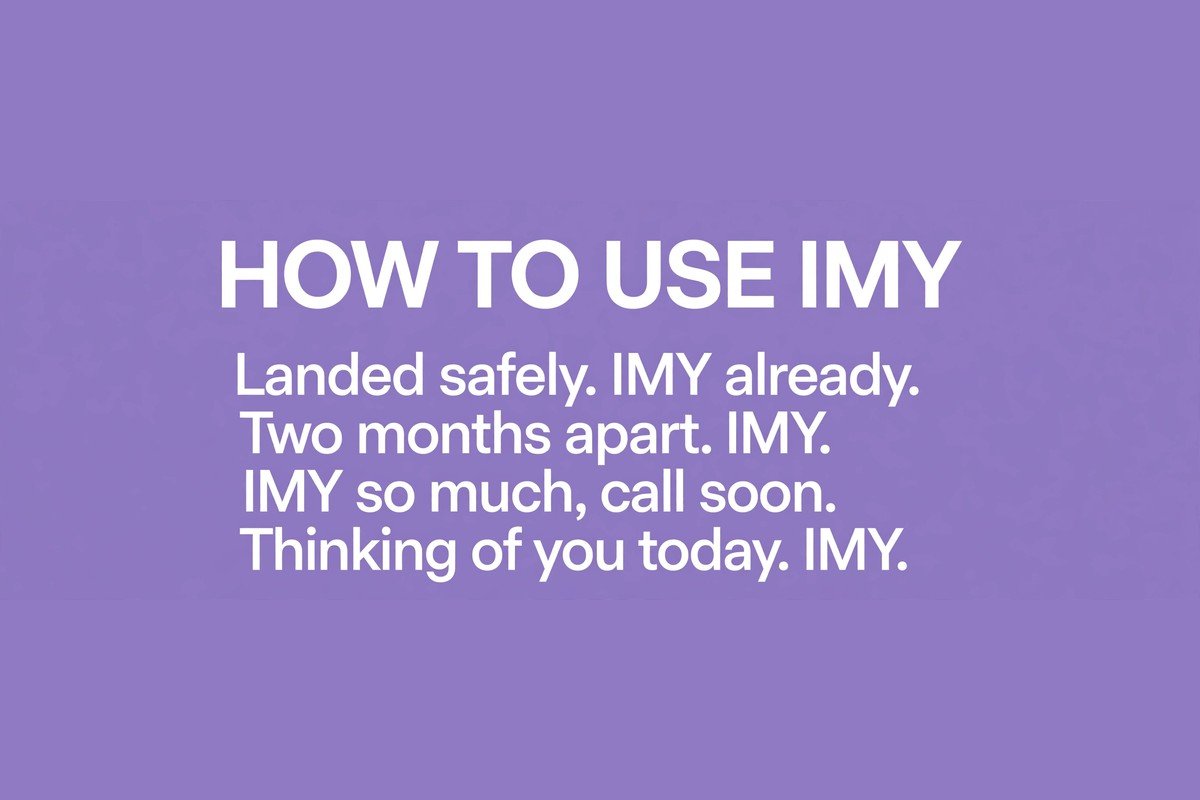
IMY appears in a few familiar situations. It opens reconnections after a silence. It closes a chat between people in different cities. And it slips into everyday messages as a small affection top-up, sometimes with no occasion at all. Here are example exchanges for the main settings:
- Partner A: Landed safely, just got to the hotel.
- Partner B: Good. IMY already.
- Friend 1: Cannot believe we have not hung out in two months.
- Friend 2: I know. IMY. Fix it this weekend?
- Sibling: I will be home for the holidays this year.
- You: Finally! IMY, it has been way too long.
- Old friend: Hey, how have you been?
- You: Good! It has been forever. IMY.
IMY also teams up with other abbreviations. A very common combination is “IMY, WYD later?”, which packs two thoughts into five words: I miss you, and what are you doing later? The first half supplies the feeling, and the second half opens the door to plans. Pairings like this show how fluent shorthand becomes between people who chat daily. Whole emotional moves (miss, invite, schedule) happen inside a single short line.
Notice that IMY often arrives with an invitation hidden inside it. “IMY, let us fix that” turns a feeling into a plan. Even without the plan, though, the message does its job: it reminds someone they matter to you. Interestingly, the abbreviation is usually typed in lowercase or sentence case in flowing chats, and in full capitals when someone wants the feeling to land with extra force. If heartfelt shorthand interests you, our limerence meaning guide explores a much more intense corner of the same emotional vocabulary.
Why IMY Feels Different From Writing It Out
You might wonder why anyone abbreviates a sentence with real feeling behind it. The answer is vulnerability. Saying “I miss you” in full can feel exposed, especially early in a relationship or after a long silence. The abbreviation lowers the stakes. It lets the sender test the water: the feeling is delivered, but lightly, so a lukewarm reply does not sting as much. That protective quality is a feature, not laziness.
There is also a rhythm argument. Long-distance relationships and busy friendships often live in short messages sent across a day. In that rhythm, a full emotional sentence can feel oddly heavy, like a speech in the middle of small talk. IMY matches the tempo. It keeps affection flowing inside ordinary chat instead of saving it for rare, formal moments. Many couples and friend groups maintain their bond exactly this way, in dozens of tiny exchanges rather than a few big ones.
IMY Meaning in Different Relationships
Between romantic partners, IMY is everyday tenderness. It appears during work trips, busy weeks, and long-distance stretches, and it can carry a flirty warmth when the relationship is new. On dating apps, an IMY after a few good conversations signals growing interest, though sending it very early can feel rushed. Timing, as always, is the difference between sweet and sudden.
IMY also does quiet repair work after friction. After an argument or a cold patch, a simple IMY can reopen a door that a long apology cannot. It says the relationship matters more than the disagreement. Many reconciliations begin with exactly those three letters, because they are easy to send and hard to misread.
Long-distance relationships lean on IMY hardest of all. When couples or close friends live in different time zones, their connection is built from short messages scattered across the day. A morning IMY from one side of the world and an answering IMYT from the other become a ritual, proof that the bond is being maintained on purpose. Relationship advisers often point to exactly this habit (frequent, small, affectionate contact) as the thing that keeps distance from turning into drift.
Between friends, IMY is about shared history. It usually means “I miss spending time with you” rather than anything romantic, and it often follows a memory, a photo, or a joke about how long it has been. Among family, it is simpler still: a small, sincere note from a sibling at university, a parent across the country, or a cousin you grew up with. The words never change. The relationship quietly rewrites them every time.
IMY in Captions, Posts, and Tributes
IMY also lives outside private chats. People caption photos with it when posting old pictures of friends, school days, or a place they used to live. In that public form, it means “I miss this” as much as “I miss you”, and followers understand it instantly. Musicians and fan communities use it the same way about eras, tours, and line-ups that are gone.
Most tenderly, IMY appears in tribute posts for loved ones who have died. A short “imy every day” under a memorial photo is a common, sincere form of public grieving. If you see the abbreviation there, read it with the seriousness it deserves and respond, if at all, with simple kindness. Context, as always, tells you which emotional register the three letters are playing in.
How to Reply to IMY
If you feel the same way, say so plainly. “IMY too” is the classic reply, and it is popular enough that it has its own shorthand forms, which the next section covers. Adding a next step makes the reply even better: “IMY too. Call this weekend?” turns warmth into contact. A playful escalation also works between close people: “Miss you more” is affectionate one-upmanship that nobody minds losing.
If you do not feel the same intensity, kindness still matters. A warm but lighter reply, like “That is sweet, hope you have been well”, acknowledges the message without promising feelings you do not have. What you should avoid is silence in reply to a sincere IMY from someone close, since the message is small and vulnerable by design. Even a short answer respects the gesture. Guides to texting etiquette, such as the TexaCodes IMY guide, give the same advice: match the honesty, then steer gently toward catching up.
One comfort for busy people: an IMY does not expire quickly. Because the message describes an ongoing feeling rather than asking a question, replying hours later is perfectly fine. In fact, a thoughtful late reply often lands better than a rushed instant one, since the sender mainly wanted the feeling registered, not a race won.
IMY Meaning Variations: IMYSM, IMYM, IMYT, and IMY2
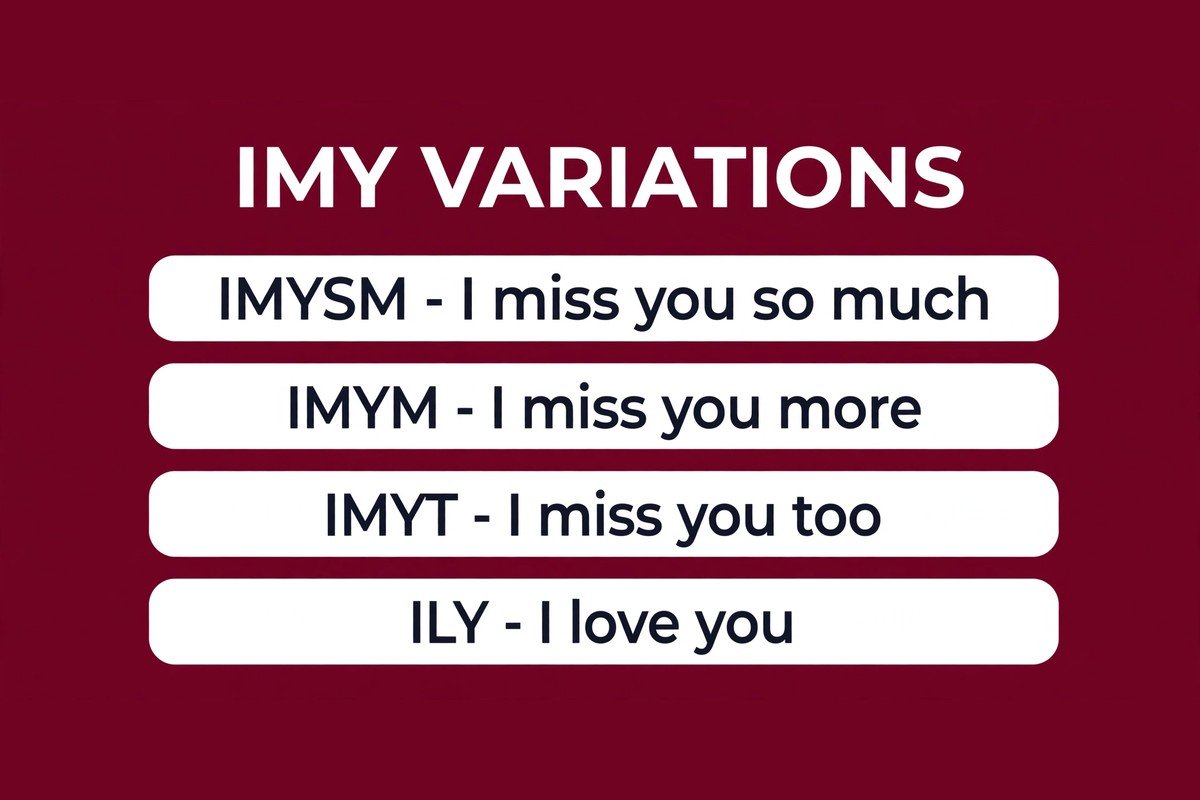
IMY has grown a small family of variations, and you will meet them in emotional chats. IMYSM means “I miss you so much”, the strongest standard form. IMYM means “I miss you more”, used as a reply in affectionate back-and-forth. IMYT and IMY2 both mean “I miss you too”, the standard warm response. Nearby sits ILY, “I love you”, which is a step deeper and should not be confused with IMY’s lighter longing.
Punctuation tunes the volume of all these forms. “IMY!” is bright and enthusiastic. “imy” in lowercase is soft and offhand. “IMY…” trails off, and it can read as sad or wistful, the version most likely to need a caring reply. None of this is written in any rulebook, but fluent texters read these signals instantly, the same way listeners read a voice.
These forms are handy because they let a whole exchange happen at shorthand speed: one person sends IMY, the other answers IMYM, and the conversation rolls on. As with the base term, none of them belongs in formal writing. They live in personal chats, where speed and feeling travel together.
FAQ’s
What does IMY mean from a girl or a guy?
It means “I miss you” from anyone. Whether it is romantic or friendly depends on your relationship and the conversation around it, not on who sent it. Between partners it is romantic; between friends it is about missing their company.
Is IMY stronger than ILY?
No, it is lighter. IMY expresses longing for someone’s presence. ILY, “I love you”, expresses love itself, which is a deeper statement. People often use IMY earlier in a relationship, before ILY feels right.
What does IMY mean on Snapchat and Instagram?
The meaning is the same: I miss you. On those apps it usually appears in direct messages or replies to stories, often after seeing a photo that reminded the sender of you or of time you spent together.
How do I reply to IMY if I do not miss them back?
Be warm but honest. Thank them, ask how they have been, and keep the tone friendly without echoing the feeling. A reply like “Good to hear from you, how is everything?” is kind without being misleading.
Does IMY always mean romantic interest?
No. IMY expresses missing someone, and people miss friends, siblings, and parents too. Romantic interest depends on the relationship and the wider conversation. If the sender is a friend, read it as friendship unless the context clearly says otherwise.
Can I use IMY in a work message?
It is best avoided in professional settings, because “I miss you” is personal in any form. With a close work friend it can be fine in a private chat, but for colleagues and managers, write the thought differently or not at all.
Conclusion
The imy meaning is as warm as slang gets: IMY says “I miss you” in three letters. It reconnects old friends, comforts distant partners, and reminds family that they are thought of, all without needing a long message. Its variations (IMYSM, IMYM, IMYT) let whole affectionate exchanges happen at texting speed, and its tone shifts naturally with every relationship it lands in.
Now that you know the imy meaning, you can both read it and send it with confidence. When someone crosses your mind, those three letters take two seconds to type and can genuinely make a person’s day. Few abbreviations offer a better return on investment than that.


Leave a Comment