

If you have ever spotted a small, shiny lizard slipping through garden leaves and wondered what it was called, you have probably met a skink. In simple terms, the skink meaning is a type of lizard that belongs to the family Scincidae, a huge group of smooth-scaled reptiles found almost all over the world. However, the word can feel confusing at first, because skinks look quite different from the lizards most people picture. Therefore, this guide explains the skink meaning in plain words, from pronunciation and body features to food, safety, and pet care. In addition, you will see how a skink compares with geckos and salamanders, so you can identify one with confidence.
Skink Meaning: The Short Definition
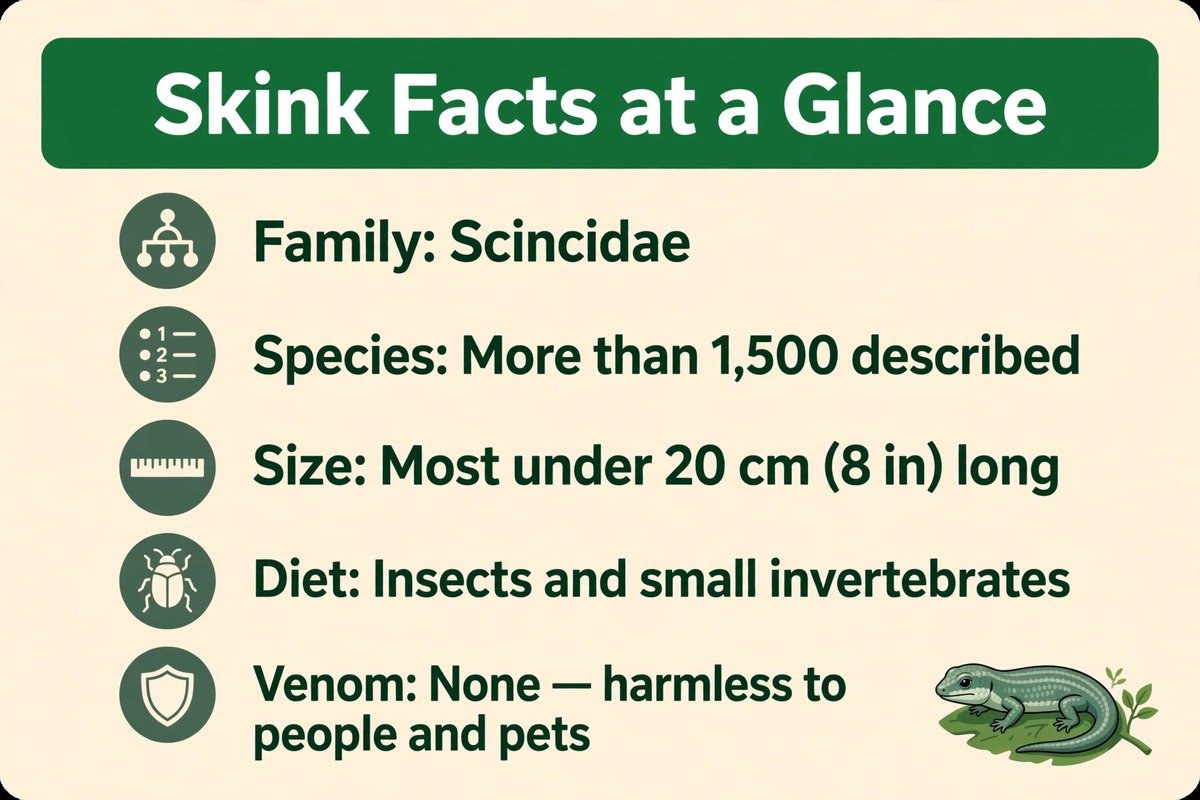
In short, a skink is a lizard. More precisely, skinks make up the family Scincidae, which is one of the largest and most diverse lizard families on Earth. In fact, scientists have described well over 1,500 skink species, and they live on every continent except Antarctica. Most skinks stay fairly small, and most measure less than 20 centimetres (about 8 inches) from nose to tail tip. Meanwhile, the largest species, the prehensile-tailed skink, can reach about 76 centimetres (30 inches), according to Britannica. Overall, the skink meaning points to a smooth, low-slung lizard that spends much of its life close to the ground. In everyday speech, meanwhile, people use the word loosely for almost any small, shiny lizard they see near the ground. Strictly speaking, though, the name belongs only to members of this one family, however similar other lizards may look at first glance.
Skink Meaning and Pronunciation: How to Say Skink
First, the pronunciation is refreshingly simple. You say skink almost exactly as it looks, with a short “i” sound, so it rhymes with “think” and “blink.” In phonetic spelling, the word is written /skɪŋk/. As a result, you do not need any special tongue tricks to say it correctly.
Where the Word Skink Came From
Interestingly, the word also has a very long history. English took in skink in the late 1500s, and it arrived through the Latin word scincus, which came from the Greek word skinkos, an old name for certain lizards. In other words, people have used almost the same word for these animals for thousands of years. Historically, the name referred to particular species at first, but over time it grew until it covered the whole family.
What Does a Skink Look Like? Key Features
Once you know the definition, the next step is recognition, because skinks share a clear set of body features.
Smooth, Shiny Scales
Above all, skinks are famous for their smooth, overlapping scales, which give the body a polished, almost glossy shine. Underneath those scales sit tiny bony plates called osteoderms, so the skin works a little like flexible armour. Because the scales overlap so neatly, a skink can glide through soil, sand, and leaf litter with very little friction.
Short Legs and Long Bodies
In addition, most skinks have a cylindrical body, a slightly cone-shaped head, and a long, tapering tail. Their legs, however, are noticeably shorter than the legs of typical lizards, which gives many species a low, snake-like profile. Remarkably, some skink groups have reduced their legs even further, and a few species have no legs at all. Instead of running, these legless skinks ripple through the ground cover in smooth, flowing waves.
Colours and Sizes
Moreover, skink colours vary a great deal between species. Many are brown, grey, or black with pale stripes running along the body, while some young skinks wear strikingly bright tails. For example, young five-lined skinks flash vivid stripes and blue tails that gradually fade as they grow older. Consequently, colour alone is not a reliable way to identify a skink, so body shape and scales matter much more.
Where Do Skinks Live?
Skinks are remarkably widespread. In fact, they live throughout the tropics and in many temperate regions, and they are only missing from cold arctic and subarctic areas. Australia, Southeast Asia, and Africa hold especially rich mixes of species, although North and South America have plenty of their own. Most skinks are ground-dwellers or burrowers, so they hide under rocks, logs, and fallen leaves during the day. Nevertheless, some species climb trees, and a few are semiaquatic, swimming well near streams and ponds. In gardens, meanwhile, the common garden skink often hunts quietly in sunny flower beds and along rock walls. Leaf litter, stone walls, and compost heaps all make perfect skink shelters, because they stay warm, sheltered, and full of insects. For that reason, a tidy garden with a few wild corners will usually host far more skinks than a spotless, closely mown lawn.
What Do Skinks Eat?
Most skinks are keen insect hunters. Typically, they eat insects and other small invertebrates, such as crickets, beetles, spiders, snails, slugs, and earthworms. Because of this diet, gardeners usually welcome skinks, since the lizards control pests without any chemicals at all. Larger skinks, on the other hand, often eat a much broader menu. Some bigger species add fruit and leafy plants to their meals, and the largest species feed mainly on plants. Most skinks hunt actively during the day, patrolling the ground in short, busy bursts as they search under leaves and stones. They swallow small prey whole, and they can tackle surprisingly feisty insects for their size. In short, the average skink is an insect-eater, while body size and habitat shape the exact menu.
Are Skinks Dangerous to Humans or Pets?
Happily, the answer is no. Skinks are not venomous, and they are not poisonous either, so they rank among the safest reptiles you will ever meet.
Safety Around People
Generally, a wild skink would much rather run away than confront you. If it is grabbed, it may give a quick, defensive bite, but the bite feels like a brief pinch and rarely causes any real harm. Even so, you should wash your hands after handling any wild reptile, because reptiles can carry germs such as Salmonella on their skin. Therefore, the safest approach is simple: watch the skink, enjoy it, and then let it carry on with its day.
Safety Around Dogs and Cats
Similarly, skinks are not poisonous to dogs or cats, so a pet that mouths one is very unlikely to be harmed by any toxins. However, hunting is still worth discouraging, mostly because the skink itself usually comes off worse in the encounter. In addition, a surprised pet may end up with a mild upset stomach after eating almost any wild creature. As a result, many vets suggest keeping cats indoors at dawn and dusk, when skinks are out hunting most actively.
Skinks as Pets: A General Care Overview
Because they are calm and hardy, some skinks have become popular pet reptiles. Nevertheless, a pet skink is still a serious, long-term responsibility, so careful research matters before you buy one. Before choosing one, it also helps to check your local rules, because a few wild species are protected or restricted in some areas.
Popular Pet Skinks
Most famously, the blue-tongued skink is widely recommended for beginners, because it is docile, sturdy, and generally tolerant of gentle handling. Other keepers, meanwhile, choose fire skinks for their bright colours or red-eyed crocodile skinks for their armoured look. Crucially, you should always choose a captive-bred animal from a responsible breeder rather than taking one from the wild.
Housing, Heat, and Light
In practice, a pet skink needs a secure enclosure with enough room to wander, hide, and dig. Most species appreciate a loose substrate they can burrow into, plus hiding spots at both the warm and the cool ends. Furthermore, skinks depend on correct temperatures, so keepers provide a warm basking area, a cooler retreat, and suitable lighting. Because every species has slightly different needs, you should always follow a care guide written for your exact species.
Feeding and Handling
At mealtimes, pet skinks generally eat a mix of insects, vegetables, and fruit, matched to whether the species is mainly an insect-eater or a plant-eater. Clean water, meanwhile, should always be available in a shallow dish. When it comes to handling, short and gentle sessions work best, and you should always support the whole body. Above all, never grab a skink by the tail, because many species can drop the tail as an escape trick and bolt away.
Skink Meaning vs Other Lizards: Gecko and Salamander Compared
Finally, comparisons make the skink meaning much clearer, because people often mix skinks up with two other small animals.
Skink vs Gecko
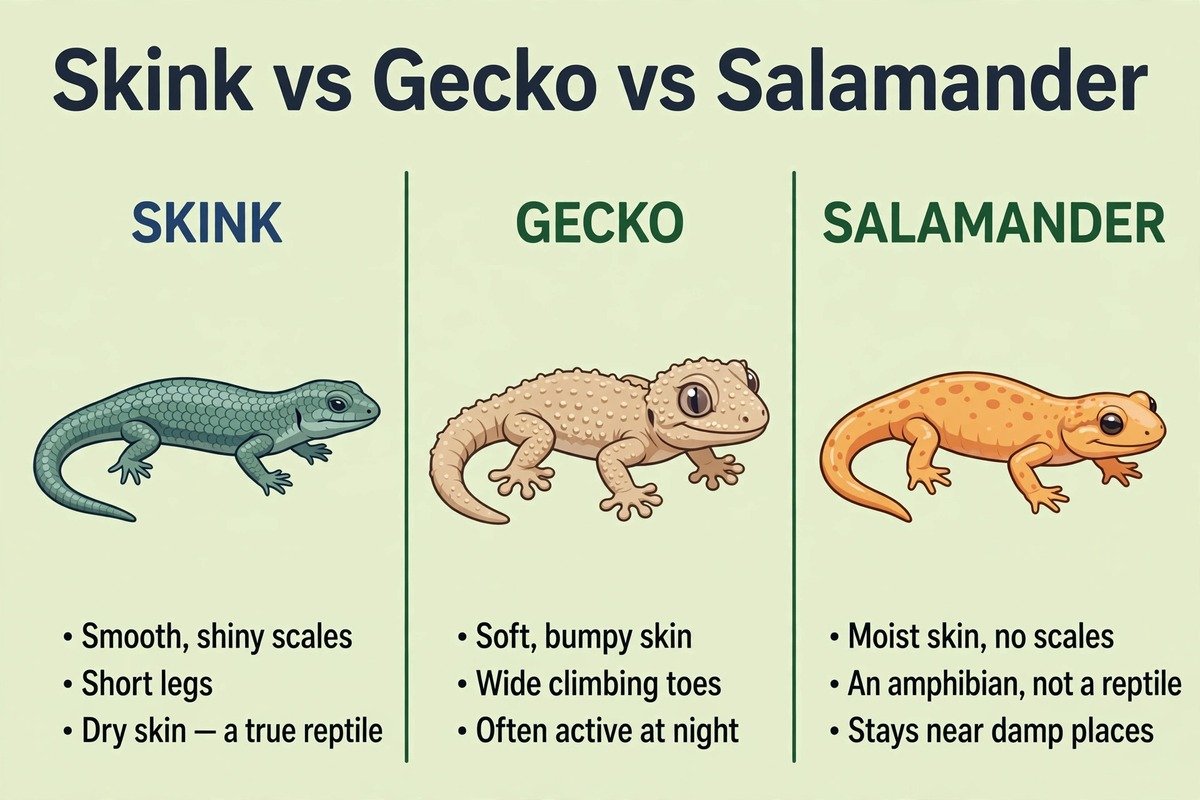
First, consider the gecko. Geckos usually have soft, bumpy skin, large eyes, and wide, padded toes that help many species climb smooth surfaces. Skinks, by contrast, have hard, shiny, overlapping scales, smaller eyes, and narrower toes. In addition, many geckos are active at night and can chirp or squeak, while most skinks hunt during the day and stay silent.
Skink vs Salamander
Next, consider the salamander, which causes the biggest mix-up of all. Despite the similar body shape, a salamander is not a reptile at all; it is an amphibian, just like a frog. Salamanders have smooth, moist skin with no scales, and they usually stay near water or damp ground. Skinks, meanwhile, are true reptiles with dry scales, and they can live happily in much drier places. In other words, scales are the quick giveaway: if the animal has scales, it cannot be a salamander.
Skink Meaning: Quick Facts at a Glance
For a faster recap, this panel gathers the essentials in one place, so you can check the key points in seconds.
- Family: Scincidae, one of the largest lizard families in the world
- Species: More than 1,500 described, spread across the globe
- Typical size: Most species measure under 20 cm (8 in) long
- Body: Smooth, shiny, overlapping scales with short legs
- Diet: Mainly insects and other small invertebrates
- Safety: Not venomous and not poisonous to people or pets
- Range: Tropics and temperate zones on almost every continent
- Look-alike warning: Legless species can closely resemble small snakes
FAQ’S
How long do skinks live?
Lifespans vary a great deal by species. Small garden skinks may live only a few years in the wild, while larger species often live much longer, and well-kept pet blue-tongued skinks commonly reach 15 to 20 years. In the wild, predators, food supply, and habitat quality all pull that number up or down.
Do skinks hibernate in winter?
In cooler regions, many skinks slow right down and shelter through the cold months in a reptile version of hibernation called brumation. During this time, they hide under logs, rocks, or soil and barely eat anything. When warm weather returns in spring, they emerge again and start hunting as normal.
Why does a skink keep flicking its tongue?
Like many other lizards, a skink tastes and smells the air with its tongue. Each flick collects scent particles and delivers them to a special sense organ in the roof of the mouth. So, frequent tongue-flicking simply means the skink is checking what is nearby, from hidden prey to possible danger.
What should you do if a skink gets into your house?
Above all, stay calm, because the animal is harmless and probably lost. Open an outside door first, then gently guide the skink towards it with a soft broom, or place an open box in its path and let it walk in. Afterwards, release it near shrubs outside, and check for small gaps under doors where it may have slipped in.
Do skinks lay eggs or give birth to live young?
Both happen inside this one family. Many skink species lay soft-shelled eggs in moist soil or leaf litter, while other species give birth to fully formed live young instead. Remarkably, this mix of both styles is one of the reasons scientists find the skink family so interesting to study.
Conclusion
To sum up, the skink meaning is simple once you see the animal clearly: a skink is a smooth-scaled, short-legged lizard from the family Scincidae. It is harmless to people and pets, helpful in the garden, and, in a few species, a rewarding and characterful pet. Hopefully, you can now say the word with confidence, recognise the animal at a glance, and tell it apart from geckos and salamanders. And if you enjoy learning what everyday words really mean, our explainer on integrity meaning is a natural next read.


Leave a Comment