
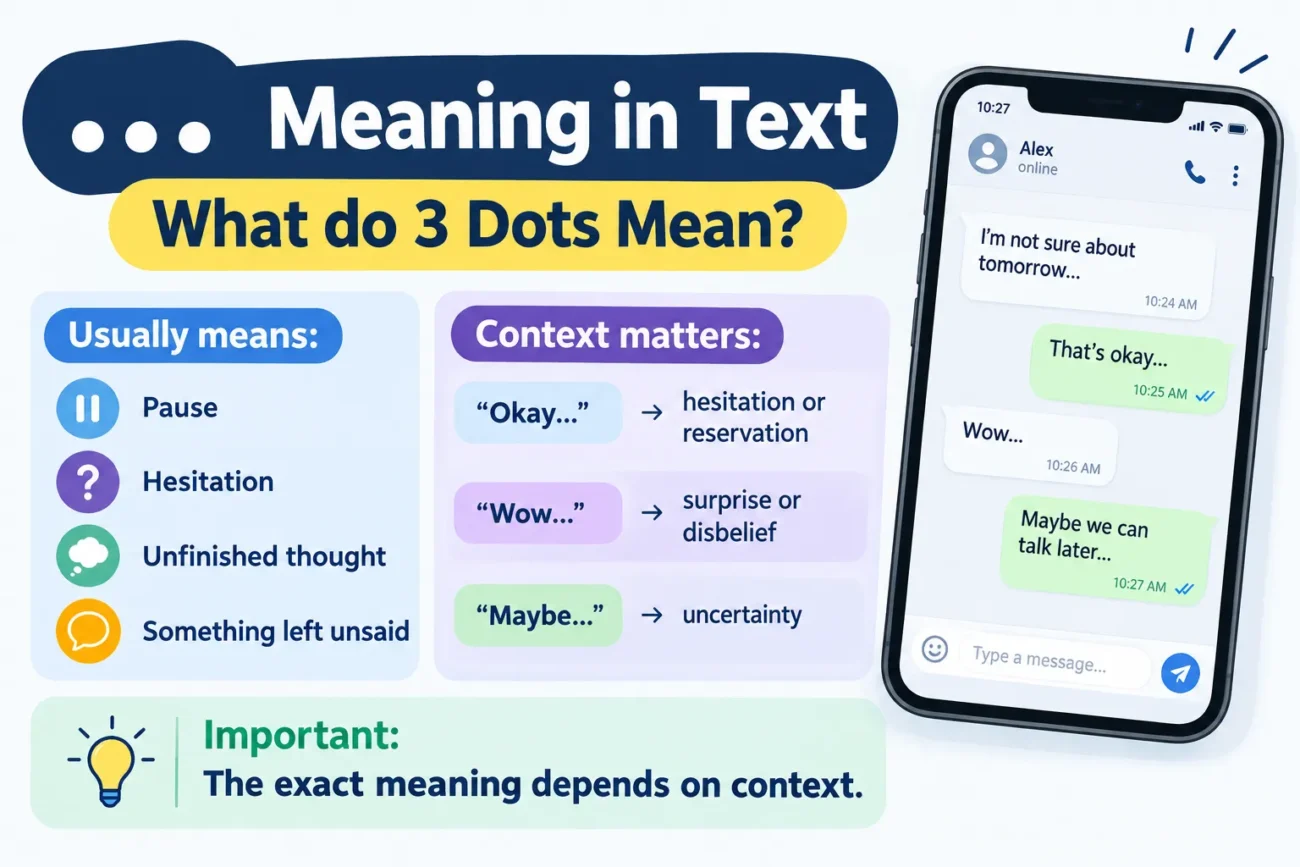
If someone sends you “…” in a text message, it usually means a pause, hesitation, unfinished thought, or something left unsaid. The three dots are called an ellipsis, but their meaning in texting can be more emotional than their traditional punctuation use.
The tricky part is that “…” does not have one fixed meaning. Depending on the message, the person sending it, and the situation, the same three dots can suggest uncertainty, awkwardness, annoyance, surprise, disappointment, suspense, or simply a pause while someone thinks.
So if you received a message ending in “…” and are wondering whether the person is upset, confused, interested, or waiting for you to respond, the dots alone are not enough to tell you. You need to look at the words around them and the situation.
What Does “…” Mean in Texting?
In everyday texting, “…” usually represents a pause or an unfinished thought.
Someone might use it because they are:
- Thinking about what to say
- Unsure how to respond
- Leaving something unsaid
- Creating suspense
- Showing awkwardness
- Expressing surprise or disbelief
- Making a message sound less direct
- Waiting for the other person to continue
For example:
“I don’t know…”
This could simply mean the person is uncertain and needs a moment to think.
Compare that with:
“I don’t know.”
The period makes the statement feel more complete and final. The ellipsis leaves the thought slightly open.
That difference is one reason “…” can feel more emotional in texting than it does in ordinary writing.
In formal writing, an ellipsis has established grammatical uses, including showing omitted words or a thought that trails off. In digital conversations, people also use it to represent pauses and subtle signals that would normally come from speech, facial expressions, or body language.
Why Do People Use Three Dots in Text Messages?
Texting removes many of the signals we normally use to understand another person’s tone.
When someone speaks to you face-to-face, you can hear whether they are joking, hesitant, annoyed, surprised, or uncomfortable. You can also see their facial expression and body language.
A text message does not give you those signals.
Punctuation therefore becomes part of the way people create tone.
For example:
“Wait…”
could feel like someone is thinking.
“Wait.”
sounds much more definite.
And:
“Wait!”
sounds urgent or excited.
The words are almost identical, but the punctuation changes how the message feels.
That is why an ellipsis can be useful in casual conversation. It creates a small pause and gives the reader room to interpret what might be happening behind the words.
However, this also makes “…” easy to misinterpret. One person may use it simply because that is their normal writing style, while another person may read it as annoyance or disapproval.
Does “…” Mean Someone Is Mad or Annoyed?
Not necessarily.
An ellipsis can sometimes make a message sound annoyed, disappointed, skeptical, or uncomfortable, but that is only one possible interpretation.
Consider:
“Okay…”
Depending on the conversation, this could mean:
- “I understand.”
- “I’m not sure about that.”
- “I don’t really agree.”
- “I don’t know what to say.”
- “Are you serious?”
- “There’s more I want to say.”
Now compare:
“Okay!”
This usually feels more energetic or positive.
And:
“Okay.”
This sounds more direct and final.
The ellipsis creates uncertainty about the speaker’s tone. The sender may be communicating more through the pause than through the word itself.
However, “Okay…” does not automatically mean the person is upset. Their usual texting style matters. Someone who frequently uses ellipses may use them without intending any negative emotion.
What Does “…” Mean When Someone Sends Only Three Dots?
A message containing only:
“…”
is more ambiguous than an ordinary sentence containing an ellipsis.
It may mean the person:
- Does not know what to say
- Is surprised
- Is uncomfortable
- Wants you to continue
- Is waiting for an explanation
- Is deliberately creating silence
- Is showing disbelief
- Has more to say but has not said it
For example:
You: “I accidentally sent the email to everyone.”
Them: “…”
Here, the three dots might communicate surprise or the feeling of “I don’t even know what to say.”
But consider another situation:
You: “So, what happened next?”
Them: “…”
Now the same symbol could suggest hesitation or that the person is reluctant to explain.
This is why there is no reliable one-word translation for a standalone “…”. The surrounding conversation provides the meaning.
What Does “Okay…” Mean in Text?
“Okay…” often signals that the sender is not giving a completely straightforward or enthusiastic “okay.”
For example:
You: “I’m going to invite my ex to the party.”
Friend: “Okay…”
The response could indicate hesitation, concern, surprise, or uncertainty.
Compare:
“Okay!”
Sounds enthusiastic.
“Okay.”
Sounds direct or final.
“Okay…”
Leaves something hanging.
That “something hanging” is important. The sender may be communicating more through the pause than through the word itself.
However, “Okay…” does not automatically mean the person is angry. Look at what happened immediately before the message and how that person normally texts.
What Does “I Guess…” or “Maybe…” Mean?
An ellipsis can make an uncertain statement sound even more hesitant.
For example:
“I guess…”
This may suggest that the person is not completely confident or has more to say.
Similarly:
“Maybe…”
can leave the answer open rather than giving a firm yes or no.
Compare:
“Maybe.”
with:
“Maybe…”
The first sounds like a simple answer. The second can feel as though the person is still thinking or deliberately leaving the conversation open.
The ellipsis does not change the literal meaning of the word. Instead, it can change the tone surrounding the word.
What Does “Wow…” Mean in a Text?
“Wow…” can communicate surprise, disbelief, admiration, disappointment, or even awkwardness.
For example:
“Wow… I didn’t expect that.”
Here, the dots create a pause before the person’s reaction.
But:
“Wow!”
usually communicates a much more immediate and energetic reaction.
And:
“Wow.”
can sound flatter or more restrained.
The key point is that the ellipsis does not have a dictionary-style emotional translation. It creates a pause, and the reader interprets that pause using the rest of the message and the surrounding context.
What Does “…” Mean From a Girl or Guy?
The meaning of “…” does not fundamentally change based on whether the sender is a girl or a guy.
What matters more is the person’s communication style and the situation.
For example, if someone replies:
“Really…”
the dots could indicate disbelief, curiosity, hesitation, or mild sarcasm.
If they say:
“You did that…”
they might be surprised, amused, disappointed, or simply emphasizing the statement.
Trying to determine the meaning based only on the sender’s gender can therefore lead to the wrong interpretation.
Instead, pay attention to the actual words, previous messages, and the person’s normal texting habits.
What Does “…” Mean From a Crush or in a Romantic Text?
In romantic conversations, an ellipsis can sometimes make a message feel more suggestive, hesitant, playful, or emotionally open.
For example:
“I was thinking about you…”
The unfinished feeling can make the message sound more intimate than:
“I was thinking about you.”
Similarly:
“Maybe we could meet later…”
could sound tentative or leave room for the other person to continue the conversation.
But an ellipsis is not automatically a flirting signal.
The same punctuation could simply indicate uncertainty or hesitation. If you’re trying to understand someone’s romantic interest, look at the broader pattern of their communication rather than treating three dots as proof of attraction.
What Does “…” Mean When Someone Is Sarcastic?
An ellipsis can contribute to a sarcastic tone because it creates a deliberate pause.
For example:
“That’s a great idea…”
Depending on the situation, this could be genuine approval or sarcasm.
If the person has just reacted to something obviously unreasonable, the pause may suggest that their literal words are not the whole message.
However, sarcasm depends heavily on context and relationship. The punctuation alone cannot establish that a message is sarcastic.
What Does “…” Mean After a Question?
When someone places an ellipsis after a question, it can make the question feel less direct or more uncertain.
For example:
“Are you coming…?”
This may suggest hesitation, impatience, uncertainty, or that the sender expects an answer.
Compare it with:
“Are you coming?”
The second is straightforward.
The ellipsis can make the first feel more emotionally loaded, but exactly what emotion is intended depends on the conversation.
What Is the Difference Between “…” and “..”?
The standard ellipsis consists of three dots: “…”.
Two dots, “..”, are not the standard ellipsis form, although people sometimes use them informally in texting.
In casual digital communication, punctuation does not always follow formal writing conventions. People may use one, two, three, or several dots simply because of their typing habits.
Therefore, you should not assume that:
- “..” has one specific hidden meaning
- “…” always has one emotional meaning
- “….” necessarily means something different
In informal texting, these variations are often stylistic rather than a fixed code.
What Does “….” Mean in Text?
Four dots can appear in casual messages, but they do not have one universally accepted texting meaning.
Someone might use:
“Well….”
to create a longer pause or emphasize hesitation.
Another person may simply have a habit of adding extra dots.
So if you’re trying to decode “….”, use the same approach as with “…”: read the surrounding message and consider the sender’s normal writing style.
What Should You Reply When Someone Sends “…”?
Your best response depends on what happened in the conversation.
If you think they’re confused, you can clarify:
“What do you mean?”
If they seem hesitant:
“Take your time.”
If they appear surprised:
“Haha, what?”
If you genuinely cannot tell what they mean:
“I’m not sure how to read that—what are you thinking?”
This is often better than immediately assuming they’re angry or offended.
When the meaning is genuinely unclear, asking for clarification is more reliable than trying to decode punctuation.
Should You Be Worried If Someone Texts “…”?

Usually, no.
Three dots by themselves are not enough evidence that something is wrong.
A person may use an ellipsis because they are:
- Thinking
- Pausing
- Unsure
- Leaving a thought unfinished
- Trying to sound conversational
- Reacting to something unexpected
- Following their normal texting style
It becomes more meaningful when the punctuation appears alongside an obvious change in the person’s behavior.
For example, if someone normally sends detailed, friendly messages but suddenly begins responding with:
“Okay…”
“Sure…”
“Fine…”
during an argument, the overall change in communication may be worth noticing.
Even then, the safest approach is to consider the conversation as a whole rather than assigning a fixed meaning to the dots.
How to Know What “…” Means in Your Conversation
When you’re trying to interpret an ellipsis, use this quick checklist:
1. Look at the words
Ask what the sentence literally says before interpreting the punctuation.
2. Look at the situation
Was the conversation serious, funny, romantic, awkward, or argumentative?
3. Look at the sender’s habits
Some people use ellipses frequently. For them, “…” may not carry much additional meaning.
4. Look for a change in tone
If the person normally uses exclamation marks but suddenly switches to short messages with ellipses, that change may provide useful context.
5. Ask when necessary
If the message matters and the meaning is unclear, simply ask.
This is particularly important in emotionally sensitive conversations because text removes many of the tone cues available in face-to-face communication.
Examples of “…” in Different Texting Situations
| Text | Possible interpretation |
|---|---|
| “I don’t know…” | Uncertainty or hesitation |
| “Wait…” | Pause, surprise, or need for clarification |
| “Okay…” | Reservation, uncertainty, or an unfinished reaction |
| “Wow…” | Surprise, disbelief, admiration, or disappointment |
| “Maybe…” | Uncertainty or reluctance to commit |
| “Really…” | Surprise, skepticism, or disbelief |
| “Fine…” | Possible reluctance or an unfinished emotional response |
| “I guess…” | Uncertainty or qualification |
| “So…” | A pause before continuing or changing the subject |
These are possible interpretations, not fixed translations.
The same phrase can mean something completely different in another conversation.
“…” Meaning in Text: The Main Takeaway
If you searched “… meaning in text”, the simplest answer is:
“…” usually represents a pause, hesitation, an unfinished thought, or something left open. Its exact emotional meaning depends on the context.
It can sometimes make a message sound uncertain, awkward, skeptical, disappointed, surprised, or suggestive, but three dots do not automatically mean that someone is angry, upset, flirting, or ignoring you.
The most accurate way to understand the message is to consider the words, the conversation, the sender’s usual style, and any change in their normal tone.
FAQ: “…” Meaning in Text
What is “…” called?
“…” is called an ellipsis. It is a punctuation mark consisting of three dots.
Does “…” mean silence in texting?
It can represent a pause or a moment of silence, especially when someone uses it as a standalone message or at the end of an unfinished thought.
Does “…” mean someone is mad?
Not necessarily. An ellipsis can sometimes contribute to an annoyed or disappointed tone, but it can also mean hesitation, uncertainty, surprise, or simply reflect someone’s writing style.
Does “…” mean flirting?
It can make a romantic message sound suggestive or tentative, but “…” alone is not evidence that someone is flirting. The surrounding conversation matters.
Why does “Okay…” sound different from “Okay”?
“Okay…” leaves the thought more open and can suggest hesitation, reservation, or something left unsaid. “Okay” is generally more direct.
What does a text with only “…” mean?
A standalone “…” can communicate that the sender does not know what to say, is surprised, is uncomfortable, is waiting for you to continue, or is deliberately leaving something unsaid. The exact meaning depends on the situation.
Is “..” the same as “…”?
Not formally. “…” is the standard three-dot ellipsis. Two dots are commonly used informally in texting but do not have one universally accepted meaning.
What should I do if I don’t understand why someone sent “…”?
Look at the conversation first. If the meaning is still unclear, ask the person directly rather than assuming that the dots indicate anger, sarcasm, or another specific emotion.
Final Takeaway
The meaning of “…” in text is less about the three dots themselves and more about the pause they create.
They can leave a sentence unfinished, show hesitation, create suspense, soften a response, or communicate an emotion that the sender does not state directly. But because texting does not provide facial expressions or vocal tone, the same three dots can be interpreted differently by different people.
So when you receive “…”, don’t automatically read it as a negative signal.
Read the message, consider the context, compare it with the person’s normal texting style, and ask for clarification if the meaning genuinely matters.
That approach gives you a much more reliable interpretation than trying to assign one fixed meaning to the ellipsis.


Leave a Comment