
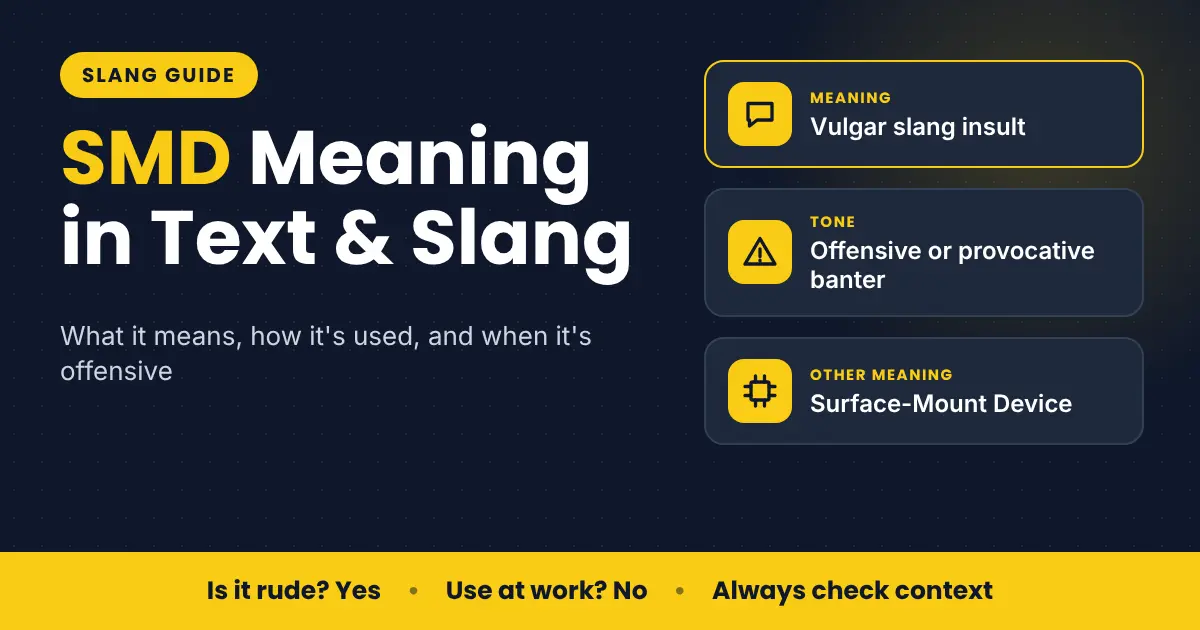
If you have seen SMD in a text, comment, or social media conversation, you may be wondering what the abbreviation means. In texting and online slang, SMD commonly stands for a vulgar expression directed at another person. Its exact tone depends on the context in which it appears.
That context matters because abbreviations can carry different meanings depending on who sent the message, what was said before it, and whether the conversation is serious, joking, or argumentative. Understanding those clues can help you avoid misreading a message or responding in the wrong way.
You may be trying to find out what SMD stands for, whether it is offensive, how people use it in text messages, or whether it can have another meaning. You may also come across SMH in similar online conversations and wonder about its meaning. This guide explains the abbreviation, shows how SMD appears in different conversations, and helps you work out what someone likely intended.
What Does SMD Mean
In texting and online slang, SMD commonly stands for “suck my dick,” a vulgar expression often used as an insult or dismissive response. Depending on the situation, it can communicate hostility, defiance, disrespect, or provocative humor.
The abbreviation is often used instead of writing the full expression in a chat, comment, gaming conversation, or social media post. Although shortening the phrase makes it quicker to type, it does not remove its vulgar meaning.
The intended tone can vary. Someone may use SMD aggressively during an argument, while another person might use it jokingly with friends who are comfortable with that kind of language. The surrounding conversation is important for understanding the sender’s intention.
What Does SMD Mean in Text and Slang?
When people search for SMD meaning in text or SMD meaning slang, they are usually trying to understand the abbreviation in an informal online conversation.
SMD is commonly used as a blunt, vulgar expression directed at another person. It may appear in private messages, social media comments, gaming chats, or arguments. Sometimes the sender intends to insult someone; in other situations, the expression may be part of provocative banter between friends.
For example, if two people are arguing and one responds with SMD, the message is likely intended to be hostile or dismissive. If close friends regularly tease one another using profanity, the same abbreviation might be intended as a joke.
However, a joking intention should not automatically be assumed. The relationship between the people, their previous messages, and the overall tone provide important clues.
How Is SMD Used in a Conversation?

The easiest way to understand how SMD is used is to examine the situation in which it appears. The abbreviation may communicate different shades of attitude, even though its underlying slang expansion remains the same.
Here are a few illustrative scenarios:
During an argument: If someone sends SMD immediately after a disagreement, it may be an aggressive or dismissive response. The sender may be expressing anger, rejecting criticism, or attempting to provoke the other person.
Among close friends: Friends who regularly use profanity may use SMD as exaggerated teasing or provocative banter. Whether it is acceptable depends on their relationship and individual boundaries.
In an online comment: If SMD is directed at a stranger, it can easily come across as insulting or disrespectful because there may be no shared understanding that the expression is meant as a joke.
These examples illustrate possible uses rather than proving what any particular sender intended. The surrounding conversation remains the best guide.
Is SMD Rude or Offensive?
Yes. SMD is generally considered vulgar and can be offensive, particularly when it is directed at someone during a disagreement or used to humiliate or provoke them.
Its tone depends on the situation. Close friends may use the expression jokingly, but the same words can sound hostile when directed at a stranger, coworker, or someone who does not appreciate profanity.
It is also useful to distinguish intention from impact. A sender might intend to joke, but the recipient may still feel insulted. An abbreviation does not automatically become harmless simply because it is common on social media.
Should You Use SMD in Professional Messages?
Generally, no. SMD is not suitable for professional emails, workplace communication, customer service, academic writing, or other formal situations.
Using it in these settings can appear disrespectful or unprofessional. If you want to disagree with someone, express frustration, or set a boundary, clear and respectful language is a better choice.
How Can You Tell What SMD Means in a Message?
If someone sends you SMD and you are unsure how seriously to take it, do not interpret the abbreviation in isolation. Instead, examine the surrounding conversation.
Use these steps to understand the likely intention:
- Read the messages before it. Check whether the conversation involves an argument, a joke, teasing, or a disagreement.
- Consider your relationship with the sender. A close friend may use slang differently from a stranger or coworker.
- Look at the overall tone. Sarcasm, insults, emojis, and other expressions may help clarify the message, although none is conclusive on its own.
- Consider the setting. A gaming chat, social media argument, and professional discussion can have very different communication styles.
- Ask if the meaning remains unclear. A direct question is often more reliable than assuming the sender was joking or being hostile.
For example, if someone sends SMD after you disagree with them, it may be intended as an insult or a way of dismissing your response. If a close friend sends it during familiar banter, the intention might be different.
These are contextual clues, not guarantees. If a message feels disrespectful, you do not need to accept it just because the sender claims it was a joke.
Can SMD Have Other Meanings?
Yes. SMD can represent other terms outside texting and slang. Abbreviations often have different meanings in technical, professional, scientific, and other specialized contexts.
For instance, in electronics, SMD commonly means “surface-mount device,” referring to an electronic component designed to be mounted directly onto a circuit board.
The subject matter helps distinguish this technical meaning from the slang meaning. If SMD appears in a conversation about circuit boards or electronic components, the technical interpretation is more relevant. If it appears in a personal message or an online argument, the slang interpretation may be more likely.
| Context | Likely interpretation |
|---|---|
| Text message or casual chat | Commonly the vulgar slang expression |
| Online argument | Potentially an insult or dismissive response |
| Banter between friends | May be intended as provocative humor |
| Electronics or circuit-board discussion | Surface-mount device |
| Unfamiliar or specialized context | Check the surrounding terminology |
Do not assume that every occurrence of SMD has the same meaning. Use the subject of the conversation to identify the most relevant interpretation.
Frequently Asked Questions About SMD
Is SMD considered slang?
Yes. In texting and online conversations, SMD is commonly used as vulgar slang. It is informal and can be offensive, so it should not be treated like a neutral abbreviation suitable for every audience.
Is SMD appropriate to use at work?
Generally, no. Because SMD is associated with a vulgar expression, using it in workplace communication may appear disrespectful or unprofessional. Clear, neutral language is a safer choice when communicating with colleagues, managers, customers, or clients.
Can SMD mean something different outside texting?
Yes. In electronics, SMD commonly stands for surface-mount device. Other specialized contexts may also use the same letters for different terms. The surrounding subject matter helps determine which meaning applies.
What should I do if someone sends me SMD?
Consider the preceding messages, your relationship with the sender, and the tone of the conversation. If the message appears hostile, you can choose not to engage or calmly ask what they meant. If the context is unclear, asking directly is more reliable than guessing.
Is SMD always meant as an insult?
Not necessarily. Although the expression is vulgar, the intended tone can vary from hostility and dismissal to provocative joking among friends. Context can help you judge the likely intention, but it cannot always establish what the sender meant with certainty.
The Bottom Line on SMD Meaning
SMD commonly means “suck my dick” in texting and online slang. It is a vulgar expression that may be used as an insult, a dismissive response, or provocative banter, depending on the situation.
If you encounter SMD in a message, consider the surrounding words, the relationship between the speakers, and the tone of the conversation before deciding what the sender intended. If you see it in a technical context, such as electronics, remember that it can have a completely different meaning.
When the context does not provide a clear answer, asking the sender directly is the most reliable way to resolve the confusion.


Leave a Comment