

If the word “gooning” has popped up in your TikTok comments or a Discord server lately, you are certainly not alone in wondering what it means. Put simply, the gooning meaning is a piece of adult internet slang: it describes the practice of “edging” — deliberately staying in a state of arousal for a long stretch without reaching climax — until the person drifts into a spaced-out, almost trance-like state. Because the term comes from adult online communities, this guide explains it in plain, dictionary-style language rather than graphic detail. Moreover, the word leads a double life online, since people also use it as a joke for anyone who is completely zoned out. Finally, its root word, “goon,” is far older than the internet, and it carries two everyday meanings of its own.
Below, you will find the definition in simple words, the story behind the “goon state,” and the related terms that travel with it. In addition, the guide covers the older dictionary meanings of “goon,” shows where the slang appears, and gives mild examples of how people actually use it. Most importantly, it explains why the word belongs in casual, adult company only.
Gooning Meaning in Simple Words
At its core, the gooning meaning points to a specific habit rather than a single moment. A person who is gooning spends an extended period — sometimes hours — keeping themselves in a heightened state, usually while viewing adult content, and repeatedly stopping short of climax. Over time, that drawn-out build-up is said to produce a hazy, hypnotic feeling that fans of the practice call “the goon” or “the goon state.” In other words, the goal is the trance itself, not the finish.
By contrast, ordinary edging is usually brief and goal-oriented, because the delay there is simply a short pause before the end. Gooning, however, stretches the delay out until it becomes the entire point of the session. As a result, the word describes both the activity and the glassy, single-minded mood that comes with it. Understandably, dictionaries and slang trackers file the term under adult slang, and it never appears in formal or professional writing.
The Goon State: The Trance Behind the Gooning Meaning
The phrase “goon state” explains a lot about the joke hidden inside the slang. Traditionally, a “goon” is a silly or foolish person, and the slang plays on exactly that image. After a long session, the person is described as looking blank, fixated, and completely absorbed, almost as if their brain has switched off. Consequently, memes about the goon state usually show someone staring at a screen with an empty expression.
Meanwhile, the state is also why the term gets used loosely for non-adult situations. When someone binge-watches a show for nine hours or stares at a game without blinking, friends may joke that they have “entered the goon state.” Strictly speaking, that is not the original sense of the word, but the comparison is easy to follow. After all, both situations involve the same spaced-out, single-track focus.
Related Terms: Gooner, Goon Cave, and Edging
A few companion words appear almost everywhere the slang does. First, a gooner is simply a person who goons, and people often apply the label to themselves as a self-deprecating joke. Second, edging is the underlying technique: repeatedly approaching climax and backing off, which is why the two terms are so often mentioned together. Unlike gooning, though, edging is a general word that also turns up in mainstream advice columns.
Third, a goon cave is the tongue-in-cheek name for a dedicated setup or room built for long sessions, usually involving several screens showing content at the same time. Photos of elaborate goon caves became a running joke on social media, partly because the setups look like gaming rooms taken to an extreme. In short, if you understand these three terms — gooner, edging, and goon cave — most posts using the slang will make sense.
Where the Word Came From
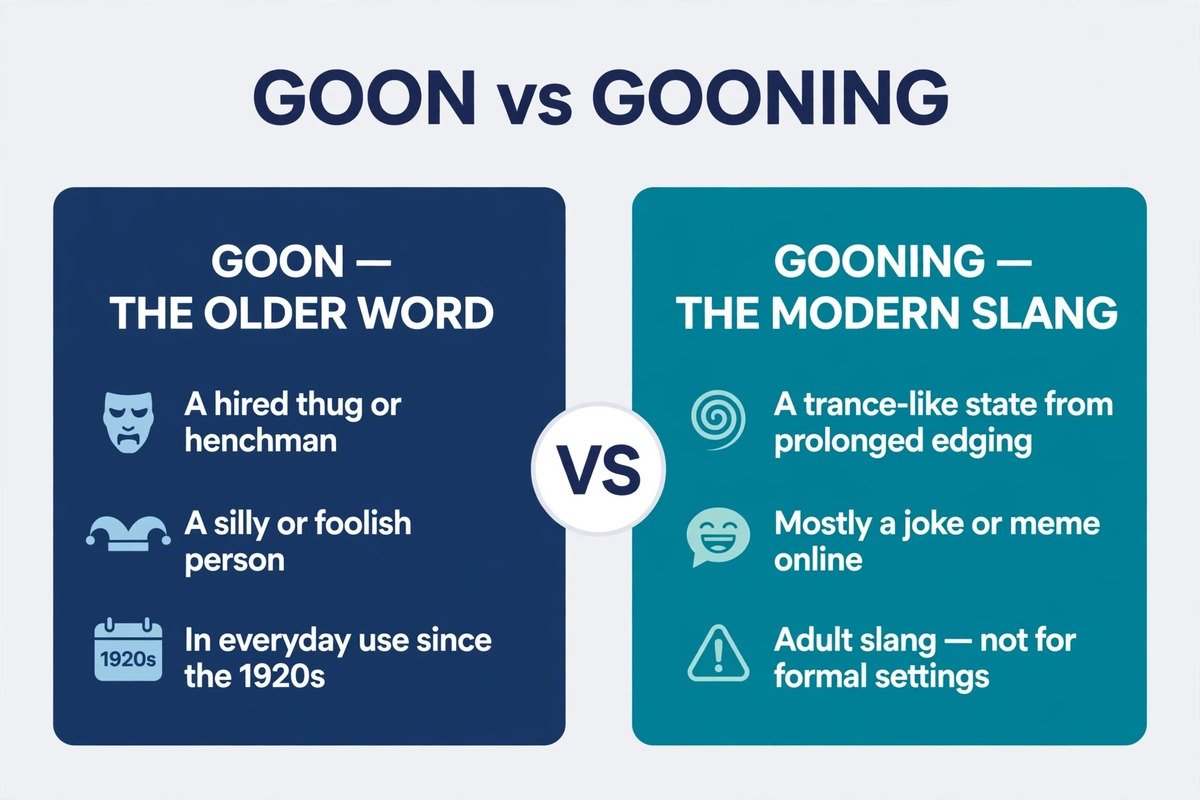
Although “goon” itself dates back to the 1920s, the slang sense of “gooning” is an internet creation. Early definitions appeared on Urban Dictionary as far back as 2005, when the term lived in small adult forums and chat rooms. For years, however, it stayed niche, and most internet users never encountered it.
Then, around 2019, dedicated communities on Reddit gave the subculture a more organized home, and the vocabulary spread outward from there. By late 2022, the words had broken into mainstream feeds on TikTok, X, and iFunny, where they were mostly used as memes rather than serious discussion. Since then, search interest has kept climbing, and younger users on newer platforms have stretched the definition even further. As a result, a word that once belonged to a tiny corner of the internet is now recognized by millions of casual scrollers.
The Older Meanings of “Goon”
Long before the slang existed, “goon” was already a busy little word. According to Dictionary.com, its first sense is a hired hoodlum or thug — the kind of heavy a movie villain sends to do the dirty work. That meaning grew out of early twentieth-century labor disputes, when hired strongmen were used to intimidate strikers.
The second classic sense is much lighter: a goon can also be a stupid, foolish, or awkward person. Indeed, this version was popularized by Alice the Goon, a character in the Popeye comic strip Thimble Theatre, whose simple-minded look helped fix the word in everyday speech. In North American sports, meanwhile, a “goon” is a hockey enforcer whose main job is fighting rather than scoring. Either way, none of these older senses has anything to do with the modern slang, which is precisely why context matters so much.
Gooning Meaning in Memes and Everyday Chat
Online, the gooning meaning has loosened considerably, and most casual uses are jokes rather than literal descriptions. In this broadened sense, “gooning” can describe anyone who is obsessively locked onto something — a celebrity photo, a new game, a sneaker drop, or even a study topic. For example, a fan who watches the same concert clip forty times might be teased for “gooning over” it. Much like chopped meaning slang, the phrase has drifted a long way from its original definition.
Nevertheless, the joke still leans on the adult original, which is why it lands best among friends who already know the reference. People also use it about themselves, since self-mockery softens the insult considerably. If someone calls themselves a gooner over a hobby, they are usually laughing at their own obsession. In contrast, using the word about a stranger can sound mocking, so tone and audience decide whether it plays as humor.
Where You Will See the Word
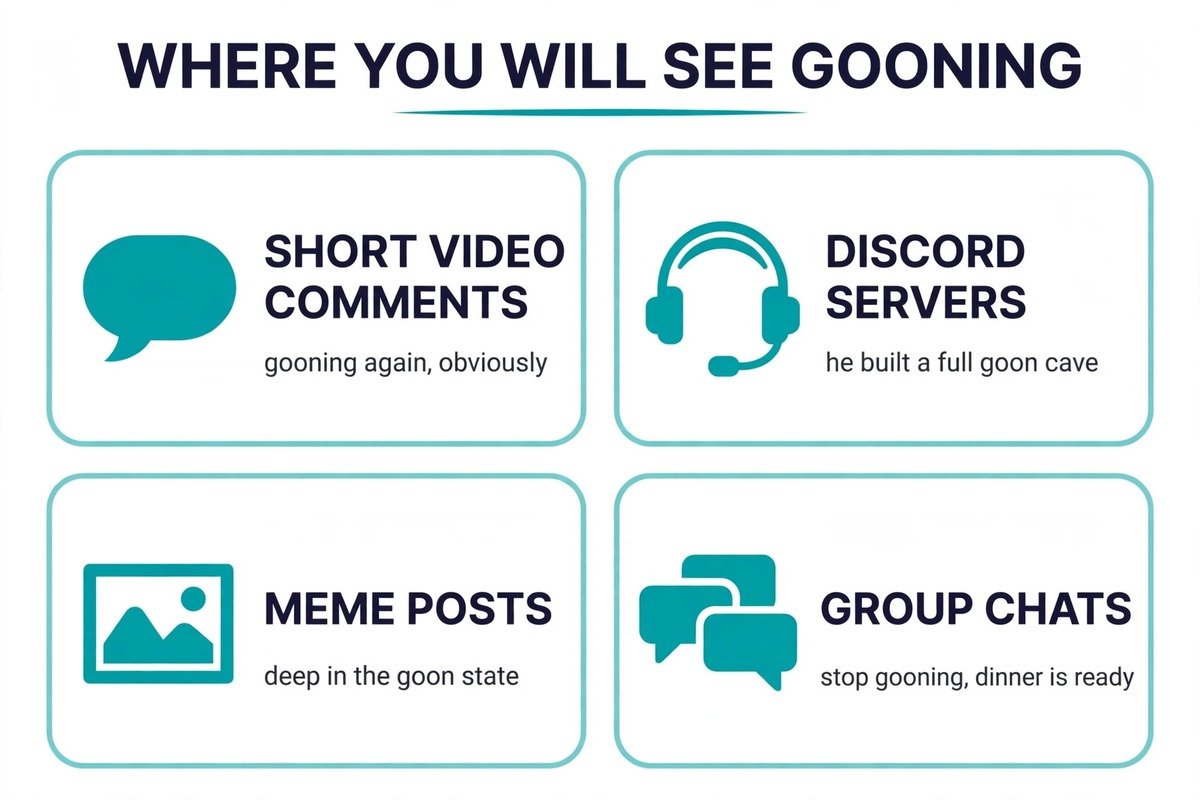
Most encounters with the slang happen in the same handful of places. On TikTok, it shows up in comments under viral clips and reaction videos, as well as in “brain rot” humor, often as a one-word reply. On Discord, it appears inside private servers and meme channels, where in-jokes travel fast and context is shared. Similarly, X and Reddit host the meme formats, setup photos, and vocabulary threads that keep the term circulating.
You may also spot it in Twitch chats and YouTube comments, especially during long gaming streams. Outside those spaces, however, the word is rare: news writing, schoolwork, and workplace chat almost never use it, except when reporting on the slang itself. Basically, if a space is young, informal, and meme-heavy, the word is likely to appear there sooner or later.
How People Use It in Sentences
Examples make the tone clearer than any definition, so here are a few mild, typical uses. Notice that most of them are playful rather than serious, and several rely on the broadened, joking sense.
- “He has been gooning over that game trailer all morning, so we have given up on getting a reply.”
- “Three monitors, LED lights, snacks within reach — that is a proper goon cave, honestly.”
- “She caught herself gooning over concert photos again and closed the app, laughing.”
- “Bro, stop gooning and come downstairs, dinner has been ready for ten minutes.”
As these examples show, the verb usually appears as “gooning,” while the person is a “gooner” and the place is a “goon cave.” Additionally, the phrase “goon state” works as shorthand for the zoned-out mood itself. When you read the word in the wild, the surrounding jokes about screens, time, and obsession are usually the biggest clue to which sense is meant.
A Short Note on Health and Habits
Because the original practice involves long, repetitive sessions, health writers occasionally raise it as a habits question rather than a moral one. Clinically speaking, any absorbing habit can become a problem when it starts crowding out sleep, work, relationships, or basic routines. Likewise, therapists who write about compulsive online behavior generally suggest the same remedies: clear limits, regular breaks, and honest self-checks.
None of this means the slang term itself is a diagnosis, and most online uses are pure humor. Still, if any habit begins to feel out of control, talking with a doctor or counselor is a sensible step. In short, the word is a joke in most feeds, but the underlying behavior is healthiest when it stays occasional and balanced.
When You Should Not Use the Word
Even in its joking form, gooning remains adult slang, so it does not belong in polite or professional settings. Avoid it at work, at school, in formal writing, and around children or anyone who might not share the reference. Because the original meaning is sexual, dropping it into the wrong conversation can embarrass you or offend someone else very quickly.
On the other hand, you will meet the older word “goon” in perfectly respectable places, such as classic films, sports pages, and novels, where it means a thug or a fool. Therefore, the safest habit is simple: read the room, check the context, and save the slang for casual chats with friends who already use it. If you are ever unsure which meaning a writer intends, the surrounding words will almost always tell you.
FAQ’s
What is “goonmaxxing”?
“Goonmaxxing” is a playful extension built with the internet suffix “-maxxing,” which means taking something to an extreme. People use it ironically to mean leaning into the gooner lifestyle as hard as possible, usually while showing off an elaborate goon cave setup. In practice, it is almost always a joke about obsession rather than a serious label.
Why do goon cave setup photos go viral?
Setup photos go viral because they look like ordinary gaming rooms pushed to an absurd extreme, with wall-to-wall screens and dramatic lighting. Viewers find the contrast funny: an enormous amount of effort and money arranged for a very lazy activity. As a result, the photos get shared as memes even by people who never use the slang themselves.
Is gooning only used about guys?
The slang grew up in communities that were mostly male, so older posts usually describe men. Nowadays, however, social media applies the word to anyone, and the broadened joking sense — being obsessed or zoned out — is completely gender-neutral. Consequently, you will see “gooner” used about fans of every kind in meme comments.
What should you say if a younger person asks what it means?
A calm, brief answer usually works best: explain that it is a rude slang word adults joke about online, and that it is not a polite word to repeat. You do not need to give details, and changing the subject afterward is perfectly fine. If the question comes from something they saw online, it can also be a good moment to talk about checking unknown words with a trusted adult first.
Conclusion
To sum up, the gooning meaning has two layers: an adult slang term for prolonged edging that ends in a trance-like “goon state,” and a newer meme sense for anyone who is happily zoned out over something. Its close relatives are “gooner” for the person and “goon cave” for the multi-screen setup, while the much older word “goon” simply means a hired thug or a foolish person. Above all, remember that the slang is informal and adult, so admire it from a safe distance — in memes, among friends, and nowhere near the office.


Leave a Comment