

Ask a room full of people what is the meaning of life, and you will probably hear a room full of different answers. Some will mention God or faith, others will talk about family and love, and a few will simply smile and say “42.” In truth, no single answer has ever won universal agreement, even after thousands of years of debate. Philosophers, religious teachers, and scientists have all approached the question from different directions, and each tradition offers its own response. This guide gathers those main answers in one place, in plain language. Along the way, it also explains why the question matters so much, and it closes with the practical ways ordinary people find meaning for themselves.
What Is the Meaning of Life? The Short Answer
In short, the honest short answer is that there is no single meaning of life that everyone accepts. Instead, the answer depends on where you look for it. Religious traditions generally teach that life has a purpose given by God or built into the universe itself. By contrast, many philosophers argue that meaning is not given at all, so each person must create it through choices and actions. Meanwhile, scientists describe what life does — it survives, adapts, and reproduces — rather than why it exists in a cosmic sense. Interestingly, these answers are not always rivals. For example, a person can accept the scientific account of how life works and still find deep personal meaning in faith, family, or work. Ultimately, then, the question works on two levels at once: the meaning of life in general, and the meaning of your own life in particular.
| Where you look | The typical answer |
|---|---|
| Philosophy | Meaning is debated: it may be found, made, or absent altogether |
| Religion | Meaning is given by God or by the deep order of reality |
| Science | Life has functions and effects, not a built-in cosmic purpose |
| Everyday experience | Meaning comes from relationships, work, and values |
Finally, one useful habit is to notice which of the two levels a given answer addresses. Answers about humanity as a whole rarely settle how one person should spend next Tuesday, and personal answers rarely explain the universe. Keeping the levels separate prevents a great deal of confusion later.
Why Do People Keep Asking This Question?
To begin with, the question appears in almost every culture and era on record. Ancient Egyptian and Greek texts already wrestle with it, and it survives today in songs, films, and late-night conversations. Psychologists suggest that human beings are wired to look for patterns and reasons, so a life without an obvious reason can feel unsettling. Moreover, the question rarely stays abstract for long. Instead, it tends to surface when everyday routines stop providing answers on their own.
Moments That Trigger the Question
Typically, people ask what is the meaning of life most urgently at turning points. For instance, the death of someone close forces a direct confrontation with mortality. Similarly, a lost job, a serious illness, or a milestone birthday can shake the routines that once felt sufficient. In addition, success itself can trigger the question, because achieving a long-held goal sometimes leaves an unexpected emptiness behind it. Writers often call this state an existential crisis, meaning a period when old answers stop working and new ones have not yet formed. Importantly, though, the question is not always gloomy. On the contrary, people also ask it in moments of wonder, such as holding a newborn child or standing under a vast night sky.
What Is the Meaning of Life According to Philosophy?
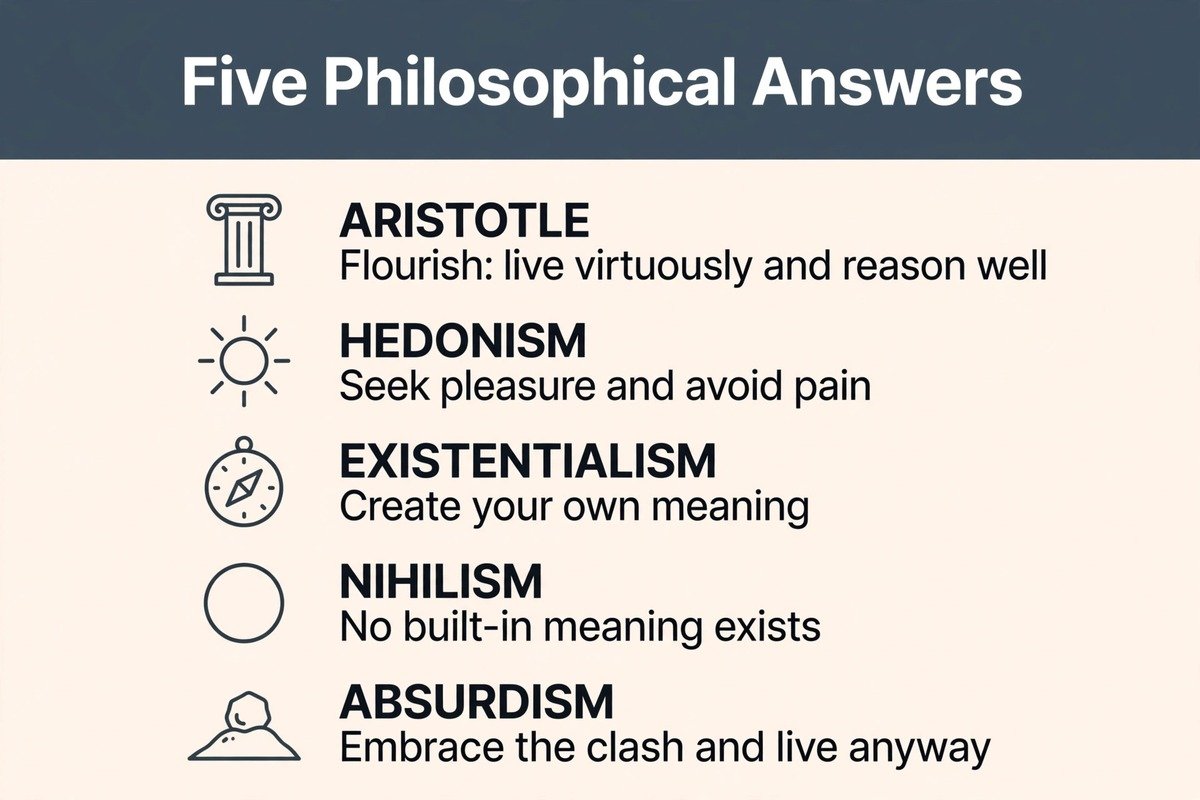
Philosophy offers the widest range of answers, precisely because philosophers disagree about the starting point. Some assume that a good life follows a built-in human purpose, while others deny that any purpose exists at all. The five views below cover the main positions, and readers who want the scholarly map of the debate can consult the Stanford Encyclopedia of Philosophy entry on the meaning of life.
Aristotle and Eudaimonia: Meaning Through Flourishing
Arguably, the most influential early answer comes from the Greek philosopher Aristotle, writing in the fourth century BCE. In his view, everything in nature has a function, and human beings flourish when they fulfil theirs: reasoning well and acting with virtue. He called this flourishing eudaimonia, a word usually translated as “happiness” or “living well.” Crucially, eudaimonia is not a passing pleasure or a lucky mood. Rather, Aristotle describes it as an activity, built over a whole lifetime through habits of courage, honesty, generosity, and practical wisdom. On this account, therefore, meaning is neither handed down from above nor invented freely. Instead, it grows out of living in line with the kind of creatures humans are.
Hedonism: Meaning as Pleasure
A simpler answer comes from hedonism, the view that pleasure is the highest good and pain the greatest evil. According to hedonists, a meaningful life is consequently a life that feels good. The Greek philosopher Epicurus gave this idea a careful form, arguing that the deepest pleasures are modest ones, such as friendship, conversation, and freedom from anxiety. Surprisingly, then, Epicurus advised against luxury and excess, because they usually bring trouble in their wake. Modern versions of the view likewise focus on enjoyment and the absence of suffering. Critics, however, object that pleasure alone feels thin, since most people also want their lives to matter beyond how they feel.
Existentialism: Create Your Own Meaning
Many centuries later, existentialist thinkers pushed the question in a new direction. Philosophers such as Søren Kierkegaard, Jean-Paul Sartre, and Simone de Beauvoir argued that human beings are not born with a ready-made purpose. Sartre summed this up in the famous phrase “existence precedes essence,” meaning that a person exists first and defines themselves afterwards. On this view, meaning is therefore something each individual must choose and build through commitments, projects, and honest action. Admittedly, that freedom comes with a price, because nobody else can be blamed for the result. Existentialists often describe the weight of that responsibility as part of the human condition. Nevertheless, many readers find the message encouraging rather than dark. After all, if meaning is made rather than found, then it is never too late to begin making it.
Nihilism: No Built-In Meaning at All
At the far end of the spectrum stands nihilism, the position that life has no inherent meaning, purpose, or value. The term became widely known in connection with thinkers such as Friedrich Nietzsche, although Nietzsche himself treated nihilism mainly as a cultural danger to be overcome. In a nihilistic picture, the universe simply does not care about human hopes, and moral values have no foundation outside human invention. Understandably, many people hear this as a counsel of despair. Yet not every nihilist draws that conclusion. Some argue, instead, that admitting there is no cosmic script can feel liberating, because it removes the pressure to discover one correct answer. Either way, nihilism matters to the debate, since the next view begins exactly where it leaves off.
Absurdism: Living With the Clash
Absurdism, developed by the French writer Albert Camus, begins with a tension it refuses to resolve. On one side, human beings deeply crave meaning and clarity; on the other side, the universe answers with silence. Camus called that collision “the absurd.” Unlike the nihilist, however, the absurdist does not stop at declaring life meaningless. Instead, Camus recommended a kind of revolt: keep living fully, create what you can, and enjoy the struggle without illusions. His favourite image was Sisyphus, the figure from Greek myth condemned to push a boulder uphill forever, only to watch it roll back down. Camus concluded his essay by insisting that “one must imagine Sisyphus happy.” In other words, a person can own their fate so completely that even a repetitive life becomes an act of defiance and, in its own way, a source of meaning.
What Is the Meaning of Life in Religion?
For most of human history, religion has supplied the most widely shared answers to the question. Although the details differ sharply between faiths, a common thread runs through them: life is not an accident, and it points beyond itself. The summaries below stay brief and descriptive, because each tradition contains whole libraries on the subject.
Christianity: A Relationship With the Creator
In Christian teaching, human beings are created by God and made in God’s image, so the meaning of life centres on a relationship with the Creator. Traditionally, Christians hold that people are called to love God and to love their neighbours, following the example and teachings of Jesus. Many Christian texts also frame earthly life as a preparation for eternal life beyond death. Consequently, purpose is received rather than invented: it flows from God’s intentions for creation. Within Christianity itself, of course, emphases differ between Catholic, Orthodox, and Protestant traditions.
Islam: Life as a Trust and a Test
In Islamic teaching, life is a trust and a test given by God, known in Arabic as Allah. The Qur’an presents human beings as God’s stewards on earth, responsible for worship, moral conduct, and care for others. Accordingly, the meaning of life involves devotion to God’s will — the word Islam itself is commonly explained as “submission” — practised together with justice and mercy. Muslims also believe in an afterlife and a day of judgement, which gives present choices lasting weight. As in other faiths, interpretation varies across communities and scholars.
Hinduism: Four Aims and Liberation
Hindu thought, which developed over thousands of years in India, describes several legitimate aims of human life rather than a single one. Traditionally, these aims include dharma (duty and righteous living), artha (prosperity), kama (pleasure and love), and moksha (liberation). Among them, moksha holds the highest place: release from samsara, the cycle of birth, death, and rebirth, and realisation of the self’s oneness with the divine reality, Brahman. Karma, the principle that actions have consequences across lives, ties the system together. Thus, in Hindu thought, meaning unfolds gradually, across many lifetimes rather than one.
Buddhism: The End of Suffering
Buddhist teaching approaches the question from a different angle, beginning with the observation that life involves suffering, or dukkha. According to the Buddha’s teaching, suffering arises from craving and ignorance, and it can end through awakening, called enlightenment or nirvana. The practical path towards that goal is the Noble Eightfold Path, covering ethical conduct, meditation, and wisdom. Notably, Buddhism does not ground meaning in a creator god; instead, it emphasises compassion for all beings and insight into the impermanent nature of things. For Buddhists, then, a meaningful life is one that moves towards awakening while reducing the suffering of others.
Judaism: Covenant, Commandment, and Repair
In Jewish tradition, life is a gift from God, and its meaning is worked out through covenant, community, and commandment. The Torah’s commandments, or mitzvot, give daily life a sacred structure, covering worship, charity, family, and honest dealing. Another central idea is tikkun olam, “repairing the world,” which frames human effort as a partnership with God in improving creation. Jewish teaching generally places more weight on actions in this life than on speculation about the next. Meaning, therefore, shows up in practice: in study, in justice, and in care for one’s community.
What Is the Meaning of Life According to Science?
Science answers a slightly different question from philosophy or religion. Rather than asking why life exists in a cosmic sense, scientists ask how it works and what it does. Even so, two scientific angles speak directly to the search for meaning.
The Biological Answer: Survive and Reproduce
From the standpoint of evolutionary biology, every living thing is the product of natural selection acting over immense spans of time. On that account, the observable “function” of life is straightforward to describe: organisms survive, grow, and pass their genes to the next generation. Bacteria, trees, and human beings all fit the same pattern, differing only in complexity. Strictly speaking, however, this is a description of behaviour, not a purpose handed down from anywhere. Biologists generally avoid claiming that evolution aims at anything, since the process has no foresight or plan. Still, the biological picture matters to the debate, because it helps explain why humans possess such a strong drive to ask about meaning in the first place: a questioning, planning brain proved highly useful for survival.
The Psychology of Purpose
Psychologists, meanwhile, study meaning as something people experience, and they examine its effects on well-being. The Austrian psychiatrist Viktor Frankl, who survived the Holocaust, argued in his book Man’s Search for Meaning that the drive to find meaning is a primary human motivation. His approach, called logotherapy, holds that people can find meaning even in suffering, through work, through love, or through the attitude they take towards unavoidable hardship. Later research in positive psychology has broadly supported the value of purpose. Studies associate a strong sense of purpose with greater life satisfaction and resilience, although researchers are careful to note that purpose is one factor among many, not a cure-all. In practice, psychologists often describe meaning as built from three ingredients: coherence, or life making sense; purpose, or having direction; and significance, or feeling that one’s life matters.
Why Do People Answer “42”?
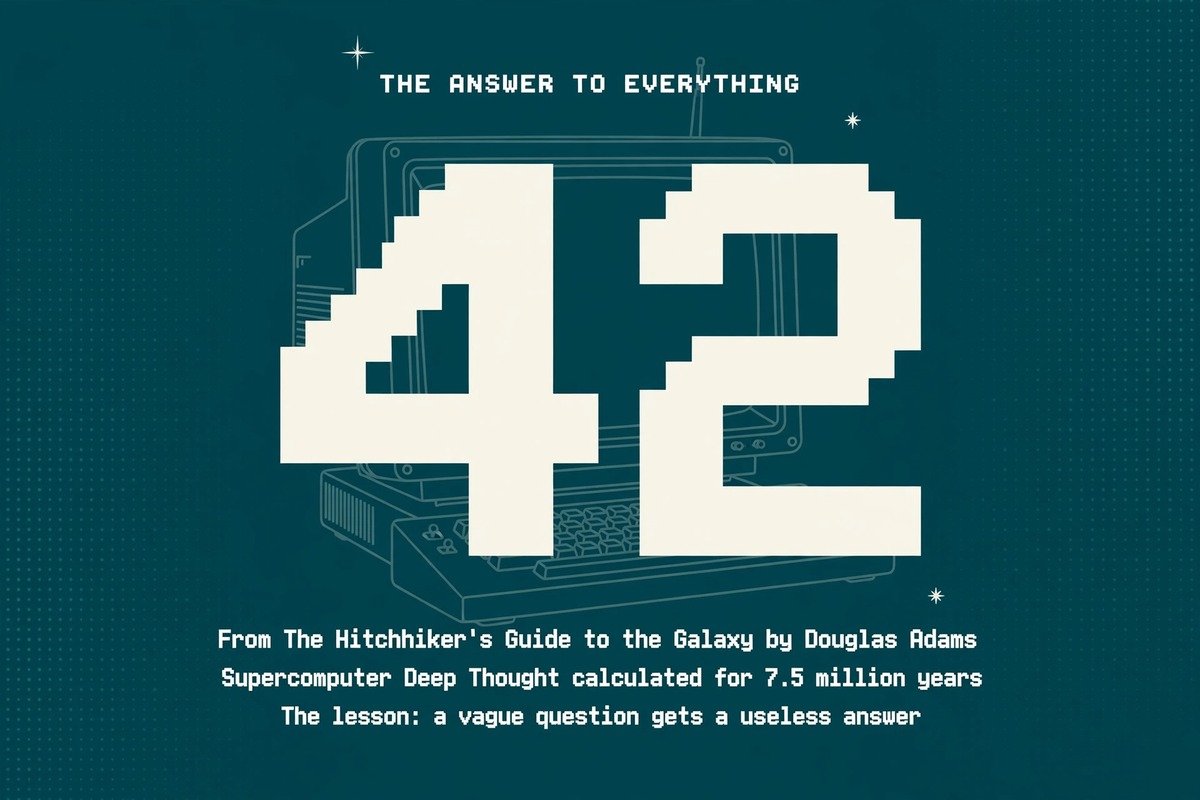
No discussion of this question is complete without the most famous joke answer in modern culture. In Douglas Adams’s comedy science-fiction series The Hitchhiker’s Guide to the Galaxy, first broadcast on radio in 1978, a supercomputer named Deep Thought is built to find the answer to “the Ultimate Question of Life, the Universe, and Everything.” After seven and a half million years of calculation, Deep Thought finally announces that the answer is 42. When its stunned audience complains, the computer points out the real problem: nobody actually knew what the precise question was. Adams’s joke carries a genuine point, which is why it has lasted. A vague question, however grand, can only produce a useless answer, however powerful the machine doing the calculating. Since then, 42 has become pop culture’s shorthand for the whole debate, quoted everywhere from exam papers to internet forums. So, the next time someone answers “42,” they are usually making a wry comment on the question itself: before demanding life’s answer, it pays to know exactly what you are asking.
How People Actually Find Meaning in Daily Life
Set the theories side by side, and a practical pattern emerges. Whatever their beliefs about the cosmos, most people report finding meaning in the same handful of places. Accordingly, this final section looks at the sources that come up again and again in ordinary lives.
Relationships and Love
Above all, people name their relationships. Partners, children, parents, and close friends give daily life an emotional centre, and caring for others reliably turns attention away from anxious self-questioning. Researchers who study adult development likewise keep returning to the same finding: warm, dependable relationships track closely with happiness and health in later years. Whether or not the universe has a grand purpose, being needed by specific people gives an individual life an unmistakable point.
Work and Contribution
Work supplies a second major source, especially when it visibly helps someone. Teachers, nurses, builders, and parents raising children at home all describe the same satisfaction: effort goes in, and a real difference comes out. Conversely, work that feels pointless is a common trigger for the meaning question at midlife. The lesson is not that everyone needs a prestigious career. Rather, contribution is what counts, and contribution can be as modest as maintaining a garden that the whole street enjoys.
Helping Others and Belonging to a Community
Closely related is service beyond one’s own circle. Volunteering, mentoring, charity, and religious or civic community all give people a role in something larger than themselves. Religious traditions have organised this impulse for millennia, while secular groups now offer similar structures. Either way, the mechanism is much the same: meaning grows when a person’s actions matter to others. Small acts count here as well, since a reputation for quiet reliability is itself a form of significance.
Experiences, Growth, and Faith
Finally, many people locate meaning in experience and growth: learning skills, travelling, making art, or deepening a spiritual practice. For believers, faith folds all the other sources into a single story, in which relationships, work, and service all express a God-given purpose. For non-believers, a similar wholeness can come from a chosen philosophy or a commitment to a cause. In both cases, the pattern is identical — a life feels meaningful when its parts connect to something the person genuinely values.
FAQs About What Is the Meaning of Life
What is the difference between meaning and purpose?
The two words overlap, yet writers on the subject usually separate them. Purpose points forward: it is a goal or direction that organises your plans. Meaning is broader, covering the sense that your life is significant and hangs together as a whole. As a result, a person can have clear purposes — finish a degree, raise a family — without feeling that life is deeply meaningful, and occasionally the reverse happens too. Scholars draw a related distinction between meaning “in” life, which concerns one person’s experience, and the meaning “of” life, which concerns humanity or the universe as a whole.
Who first asked what the meaning of life is?
People have pondered the point of existence for as long as records exist, including in ancient Egyptian and Greek writings. The exact English phrase, however, became popular much later. Writers often credit the Scottish author Thomas Carlyle with popularising it in the 1830s, through his philosophical novel Sartor Resartus. Later, the Russian novelist Leo Tolstoy carried the question to a worldwide audience in his spiritual memoir A Confession, where he described falling into a crisis of meaning at the very height of his fame and success.
What did Monty Python say the meaning of life is?
The British comedy group tackled the question in their 1983 film The Meaning of Life. At the very end, the meaning is read aloud from a sealed envelope, and it turns out to be deliberately ordinary advice: try to be nice to people, avoid eating fat, read a good book every now and then, get some walking in, and try to live in peace with people of all creeds and nations. The joke matches the film’s deeper point — after a whole movie of grand searching, the answer offered is modest, decent, everyday living.
Do other living things have a meaning of life?
That depends on the framework you use. Biologists describe other species in terms of survival and reproduction, without attributing purposes or reflections to them. Philosophers, meanwhile, debate whether meaning requires self-awareness, which would limit it to humans and perhaps a few other animals. Religious views differ as well: some traditions regard all creatures as part of a divine order, each with its own place in it, while others reserve a unique spiritual role for human beings. No experiment can settle the question, so each tradition answers from its own assumptions.
Is it normal to keep asking what the meaning of life is?
Yes — questioning the point of existence is a normal part of being human, and it often signals growth rather than a problem. Psychologists note that the question tends to return at life transitions, such as leaving school, changing careers, or losing someone close. Sometimes the questioning deepens into what writers call an existential crisis, a stretch of uncertainty while old answers are replaced by new ones. That said, if a persistent sense of emptiness starts to interfere with sleep, work, or relationships, talking with a doctor or counsellor is a sensible step. Asking the question itself, though, has driven philosophy, art, and religion for thousands of years — so you are in very good company.
Conclusion
So, what is the meaning of life? After surveying the main traditions, the fairest conclusion is that humanity has produced several serious answers rather than a single winner. Philosophy offers meanings that are discovered in our nature, chosen in freedom, or bravely lived without guarantees. Religion offers a meaning received from God or from the deep structure of reality. Science, for its part, explains how life persists and why a sense of purpose feels so valuable to the creatures who have it. Perhaps the healthiest way to hold the question is as an invitation rather than a puzzle with one solution. And if you enjoy questions with more than one answer, you can explore more word and slang meanings here on Jokeriddle — where, thankfully, every explanation is considerably shorter than seven and a half million years.


Leave a Comment