

OTP meaning depends entirely on where you come across it. In fandom spaces and group chats, OTP stands for One True Pairing, the fictional couple that a fan loves more than any other. Meanwhile, on banking apps and login screens, OTP means one-time password, the short security code sent to your phone. Because the same three letters answer two very different questions, confusion is completely normal. Fortunately, both meanings are easy to understand once you see them side by side.
This guide, therefore, explains both meanings in plain language. First, you will see a quick comparison table. Next, we will explore the fandom meaning in depth, including its origin, example sentences, and natural replies. After that, the tech meaning gets the same treatment, together with an important safety rule. Finally, a short context guide will help you decide which meaning fits any message you receive. If tiny abbreviations often leave you guessing, our explainer on IK meaning in chat is worth a look as well.
OTP Meaning at a Glance: The Two Meanings Compared
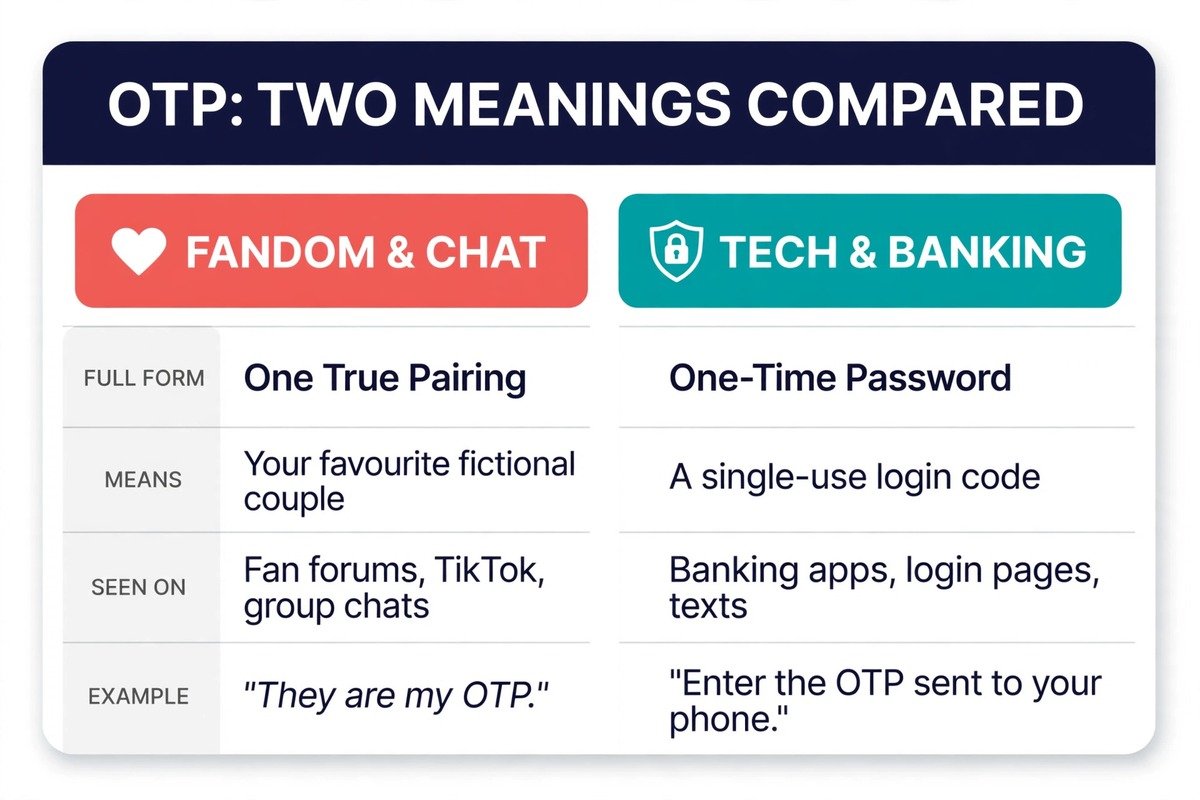
At first glance, the two meanings share nothing except the letters. One belongs to fan culture and feelings, whereas the other belongs to security systems and sign-ins. The table below, in other words, gives you the whole answer in about ten seconds.
| Aspect | Fandom and chat | Tech and banking |
|---|---|---|
| Full form | One True Pairing | One-Time Password |
| What it means | Your favourite fictional couple | A single-use login or payment code |
| Where you see it | Tumblr, TikTok, fan forums, group chats | Banking apps, login pages, verification texts |
| Example sentence | “Those two are my OTP.” | “Enter the OTP sent to your phone.” |
Notice, also, that the letters never change; only the world around them does. A fan forum and a banking app, therefore, can use the same abbreviation all day without ever meaning the same thing. In short, context is everything, and the following sections explain each side properly.
OTP Meaning in Fandom: One True Pairing
For most readers, the OTP meaning that matters is the fandom one. In fan communities, an OTP is the pairing you root for above every other pairing. Fans follow their OTP through every episode, chapter, or season. Moreover, they often create fan art and fanfiction to celebrate the couple. On fanfiction archives, readers even filter stories by OTP tags, so they can jump straight to their favourite couple.
Where the Fandom Meaning Comes From
To understand OTP, you first need the word “ship.” In the late 1990s, fans of The X-Files who wanted Mulder and Scully together called themselves “relationshippers.” Over time, that long word shrank to “R’shippers” and then simply “shippers.” As a result, a favourite relationship became a “ship,” and wanting two characters together became “to ship” them. Within that culture, one ship always ranked highest. Consequently, fans needed a label for the ship that beat all the others, and “One True Pairing” filled that gap. The abbreviation spread widely on LiveJournal and fan forums in the early 2000s. Later, Tumblr, Twitter, and TikTok carried it to a much bigger audience. Today, the term is standard slang across almost every fandom. In fact, the habit behind the label is older than the term itself, because fans were pairing up favourite characters in stories long before the abbreviation existed.
How Fans Use OTP in Everyday Chat
Nowadays, fans drop OTP into ordinary conversations in a few predictable ways. Most commonly, they use it to declare loyalty, as in “They are my OTP, end of story.” Similarly, fans use it while reacting to new episodes, trailers, or book chapters. A sweet scene, for instance, might trigger comments like “My OTP is finally canon.” Fans mention their OTP when a new season is announced, when a trailer drops, or when a reunion episode trends online. In addition, the word works as a compliment for any couple with great chemistry. Fans also build ship names by blending character names together, although that habit belongs to shipping generally rather than OTP alone. Importantly, the “one” in One True Pairing used to be strict, meaning one OTP per person. In practice, however, modern fans happily keep one OTP per fandom. People even collect several across different shows, games, and books.
Related Fandom Terms Worth Knowing: Ship, Canon Ship and NOTP
Because fandom slang travels in clusters, a few neighbouring terms will help you follow any OTP discussion. A “ship” is any pairing fans support, while a “shipper” is a fan who supports one. A “canon ship” is a pairing the story itself confirms, and fans sometimes call it a “sailed ship.” By contrast, a “sunk ship” is a pairing the story rules out completely. Then comes NOTP, the playful opposite of OTP, built from “no” plus OTP. A NOTP is simply a pairing you cannot stand. Finally, BrOTP celebrates a favourite platonic pairing, usually a beloved friendship rather than a romance. OT3, likewise, extends the idea to a favourite trio.
OTP Meaning Examples in Chat Sentences
Examples, of course, make the fandom meaning much easier to recognise. Read the following chat lines, and notice how each one treats OTP as a treasured couple.
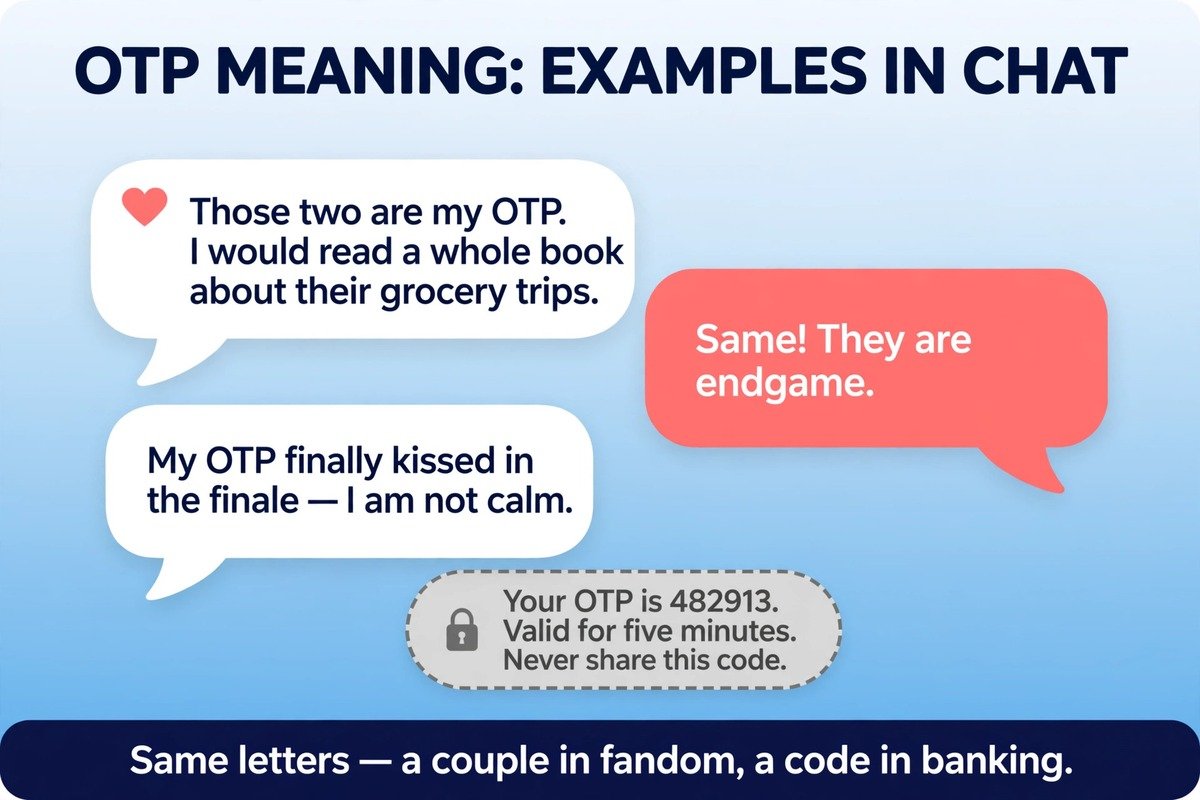
- “Those two are my OTP. I would honestly read a whole book about their grocery trips.”
- “Season finale spoilers: my OTP finally kissed, and I am not calm about it.”
- “She writes fanfiction about her OTP every weekend.”
- “Your OTP is cute, but mine has better chemistry.”
- “If the writers split up my OTP, I am cancelling my subscription, as a joke, mostly.”
Clearly, the tone in these lines is affectionate and playful rather than serious.
How to Reply When Someone Mentions Their OTP
Replying, fortunately, is easy once you know the meaning. If you agree, you can answer with cheerful support, such as “Same, they are endgame.” Alternatively, you might ask a friendly question, like “When did they become your OTP?” Questions, after all, keep fandom chats flowing. If you prefer a different pairing, honesty still works, provided you stay kind: “I respect it, although I ship her with the rival instead.” Above all, avoid mocking someone’s OTP, since shipping wars help nobody. A light joke, by comparison, is usually welcome.
OTP Meaning in Tech and Banking: One-Time Password
However, the second OTP meaning has nothing to do with romance. In technology and banking, OTP means one-time password. Specifically, it is a short code that works exactly once. Banks, apps, and websites send these codes to confirm that the person signing in is really you.
What a One-Time Password Actually Is
A one-time password is usually a string of four to eight digits, and six digits is the most common length. Typically, the code arrives by text message, email, or an authenticator app on your phone. Once you type it in, the code dies immediately. Alternatively, it expires on its own after a few minutes. Some systems generate codes from the current time, so a fresh code appears every thirty seconds or so. Others create a new code for each login attempt instead. Authenticator apps are especially popular because they keep working without mobile signal. Either way, the basic promise stays the same: the code proves you hold the trusted device or inbox. You may also see the code called a verification code or passcode, although OTP remains the common label. Wikipedia’s detailed overview of the one-time password explains the underlying technology further.
Why Sites and Banks Send You an OTP
Passwords alone, unfortunately, are weak protection. People reuse them, hackers steal them, and databases leak them. An OTP, therefore, adds a second check that a stolen password cannot pass. When you sign in, the site asks for something you know, your password, plus something you have, your phone. As a result, a stranger with only your password still cannot enter your account. Banks also send OTPs to approve payments and transfers. In those moments, the code confirms that you personally authorised the transaction. Similarly, apps use OTPs to verify new phone numbers during sign-up. This double check is often called two-factor authentication, and the OTP is usually the second factor.
The Golden Safety Rule: Never Share Your OTP Code
One rule, above all, protects your money: never share an OTP code with anyone. Legitimate banks and apps will never phone, text, or email you asking for the code. Scammers, in contrast, do exactly that. Typically, a fraudster pretends to be a bank officer and creates panic about a fake problem. Then, under time pressure, they ask you to read out the code that just arrived. If you share it, however, they can approve transactions in your name within seconds. Instead, hang up, open your banking app directly, and check for yourself. Likewise, ignore codes that arrive when you never requested one, and contact your bank through its official number.
Which OTP Meaning Is Right? A Quick Context Guide
By now, the difference should feel clearer, yet real messages can still be ambiguous. Luckily, the surrounding words almost always give the answer away. If the message mentions characters, episodes, ships, or a favourite show, the writer means One True Pairing. If, instead, the message mentions logging in, verifying, expiring, or a bank, it definitely means one-time password. Consider a friend texting “My OTP is official now” right after a season finale; clearly, that is fandom joy. By comparison, a text reading “Your OTP is 482913, valid for five minutes” is obviously a security code. A login page asking you to “enter the OTP” is never asking about your favourite couple, no matter how much you love them. A group chat reacting to a new episode, for example, will never be discussing login codes. In short, ask yourself one question: is this about love or about logging in? The answer, almost every time, settles the meaning instantly.
FAQs
Can OTP describe a real-life couple?
Yes, although fans use it playfully in that case. Friends sometimes call a real couple their OTP when the pair seems perfectly matched. Strictly speaking, however, the term grew up around fictional pairings. So the real-life use is a compliment and a joke, never a formal label.
What should you do if an OTP code never arrives?
First, wait a minute or two, because delivery can lag. Next, check your signal and confirm that the number or email on the account is current. If the code still does not appear, request a new one through the official app or site. Meanwhile, avoid requesting codes repeatedly in quick bursts, since many systems lock the account after too many attempts.
Is an OTP the same as a PIN?
No, the two codes work differently. A PIN is a fixed personal code that you choose and reuse until you change it. An OTP, by contrast, is generated for you, works only once, and then expires. Therefore, an OTP cannot replace your PIN; the two simply protect different moments.
Why do fans say OTP instead of just “favourite couple”?
Partly, the abbreviation is simply faster to type in busy chats. More importantly, OTP carries extra meaning: it signals the top-ranked ship, the one a fan defends above the rest. “Favourite couple,” in comparison, sounds casual. Fans, consequently, reserve OTP for pairings that feel personal.
Can OTP mean anything else in a text?
Occasionally, yes. In casual texting, some people use OTP to mean “on the phone,” as in “Can’t talk, I’m OTP with my mum.” This sense is far less common than the other two. Context, once again, will usually tell you which meaning the sender intends.
Conclusion
OTP meaning, ultimately, comes down to context. In fandom and chat, OTP means One True Pairing, your favourite fictional couple and the ship you defend happily. In tech and banking, in contrast, OTP means one-time password, the single-use code that guards your accounts. Both meanings are now part of everyday internet life. Share this guide with the friend who keeps mixing the two up, and you will save them a confused search. And if a friend throws the word into a chat, you can now reply with total confidence. So the next time those three letters appear, check the company they keep. Love story or login screen — once you know, you will never mix them up again.


Leave a Comment