
If you have seen “SMH” in a text message, comment, or social media post, you may be wondering what the person actually means. SMH is a common internet abbreviation, but its meaning can feel unclear when you see it without context.
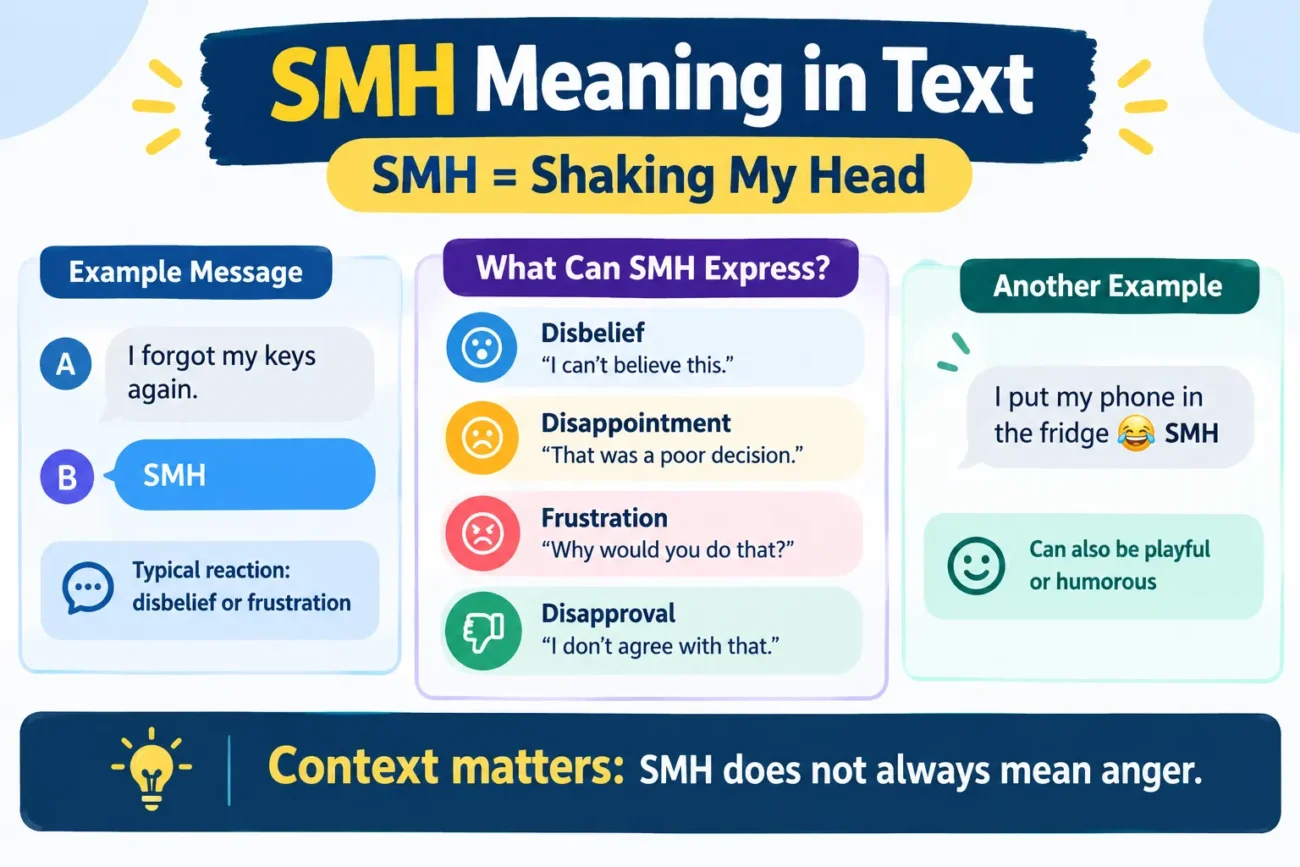
SMH usually means “shaking my head.” People use it to express disbelief, disappointment, frustration, annoyance, or disapproval about something that happened. The exact feeling depends on the situation and the relationship between the people talking.
If someone sent you “SMH” and you are trying to figure out whether they are joking, annoyed, or genuinely disappointed, the surrounding message matters. This guide explains the meaning, common uses, examples, and context so you can understand what the sender is trying to communicate.
What Does SMH Mean in Text?
SMH stands for “shaking my head.” In texting and online conversations, it is used as a quick reaction to something that seems ridiculous, disappointing, frustrating, or difficult to believe.
Think of it as the written version of physically shaking your head when you see or hear something you cannot quite believe.
For example:
“He forgot his wallet again. SMH.”
The sender is not necessarily angry. They are expressing a reaction similar to:
“I can’t believe he did that again.”
The abbreviation is informal, so you will usually see SMH in text messages, chats, comments, and social media rather than formal writing.
What feeling does SMH express?
The abbreviation can communicate several related emotions:
- Disbelief: “I can’t believe this happened.”
- Disappointment: “That was a poor decision.”
- Frustration: “Why would you do that?”
- Disapproval: “I don’t agree with what you did.”
- Amusement: “That was ridiculous, but kind of funny.”
This is why translating SMH into one exact emotion can be misleading. The basic meaning stays the same, but the tone changes with context.
What Does SMH Mean When Someone Sends It to You?
If someone sends you “SMH,” don’t automatically assume they are angry with you.
The better question is: What happened immediately before they said it?
For example, imagine you text your friend:
“I just walked into the kitchen and forgot why I went there. SMH.”
Here, SMH is directed at yourself. You are joking about your own forgetfulness.
Now consider:
“You told me you’d be here at 7, and it’s 8:30. SMH.”
This has a different tone. The sender is probably expressing frustration or disappointment.
And then there is a lighter example:
“I just put my phone in the fridge instead of the milk 😂 SMH.”
The person is most likely making fun of their own mistake rather than seriously criticizing themselves.
SMH does not automatically mean “I’m angry”
One of the easiest mistakes is to interpret every use of SMH as anger.
In reality, the abbreviation can range from lighthearted teasing to genuine frustration.
Look at:
- what happened before the message,
- who is being discussed,
- whether the sender uses laughing or smiling emojis,
- whether the conversation is serious or casual,
- and how the sender normally communicates.
A friend saying “SMH 😂” after a silly mistake is very different from someone saying “SMH” after a serious disagreement.
SMH can be directed at yourself
SMH is not only something you say about another person’s behavior.
You can use it when you make a mistake yourself:
“I left my keys inside the car again. SMH.”
The implied meaning is:
“I can’t believe I did that.”
This self-directed use is often humorous or mildly frustrated rather than hostile.
How Is SMH Used in Text Messages?
SMH is flexible enough to appear in different parts of a message. Its position does not completely change the definition, but it can affect how the message feels.
SMH by itself
Someone might simply reply:
“SMH”
This usually means something like:
“I can’t believe this.”
or:
“That’s ridiculous.”
The exact meaning depends heavily on what was said before it.
For example:
Person A: “He cancelled again five minutes before we were supposed to leave.”
Person B: “SMH.”
Person B is expressing disappointment or disbelief.
SMH at the end of a sentence
SMH can also be added to a statement:
“You really forgot your password again, SMH.”
Here, the abbreviation acts almost like a reaction at the end of the sentence. The sender is emphasizing their disbelief or frustration.
SMH at the beginning of a message
It can also appear at the beginning:
“SMH, I can’t believe you actually did that.”
This makes the reaction more obvious. The sender is essentially saying that they are shaking their head at what just happened.
SMH with emojis
Emojis can make the intended tone easier to understand.
For example:
“SMH 😂”
usually feels more playful than:
“SMH.”
The first may suggest joking or amusement, while the second could sound more serious or dismissive depending on the conversation.
That does not mean the period automatically makes SMH rude. It simply shows why context is more important than the abbreviation by itself.
SMH Examples With Their Plain-English Meaning
Here are some common situations where you might see SMH in a conversation:
Example 1: Forgetting something
“I forgot my homework at home again. SMH.”
Meaning:
“I can’t believe I forgot it again.”
This is self-directed frustration.
Example 2: Someone making the same mistake
“She forgot her appointment for the third time. SMH.”
Meaning:
“I can’t believe she did that again.”
This expresses disbelief or disapproval.
Example 3: Something ridiculous
“He tried to open the door with his car keys. SMH.”
Meaning:
“That was ridiculous.”
Depending on the relationship, this could be teasing rather than serious criticism.
Example 4: A funny mistake
“I spent ten minutes looking for my glasses and they were on my head. SMH 😂”
Meaning:
“I can’t believe I did something that silly.”
The laughing emoji makes the playful tone much clearer.
Example 5: Genuine frustration
“You said you would call me back, but you never did. SMH.”
Meaning:
“I’m disappointed or frustrated that you didn’t follow through.”
Here, SMH carries more emotional weight because of the situation around it.
A simple way to interpret SMH
When you see SMH, mentally replace it with:
“I can’t believe this.”
Then look at the surrounding conversation to determine whether that disbelief is funny, annoyed, disappointed, or critical.
That approach is more useful than assuming SMH always means one particular emotion.
Is SMH Rude or Disrespectful?
SMH is not automatically rude. Its tone depends on who says it, what happened, and how the rest of the message is written.
Between close friends, SMH can be a playful reaction to a silly mistake:
“You seriously forgot your own birthday plans? SMH 😂”
In this situation, the sender is probably teasing rather than trying to insult you.
However, SMH can feel more negative when it follows a serious disagreement or repeated mistake:
“I explained this three times and you still ignored it. GTS.”
Here, the abbreviation can communicate genuine frustration or disapproval.
When SMH is usually harmless
SMH is generally less likely to offend when:
- you are talking casually with friends,
- the situation is obviously humorous,
- the message includes a laughing or playful emoji,
- you are using it to make fun of your own mistake.
When SMH can sound dismissive
Be more careful when:
- the other person is already upset,
- you’re discussing a serious problem,
- you disagree with someone’s decision,
- the message could sound like you are judging them.
If you are unsure how your message will be received, writing out what you actually mean is usually clearer than relying on slang.
How Do You Reply to “SMH”?

There is no single correct response to “SMH.” Your reply should depend on the situation.
If the person is joking
You can respond in the same playful tone:
“I know 😂 What was I thinking?”
or:
“Don’t judge me lol.”
If you actually made a mistake
A simple acknowledgment works:
“Yeah, that’s on me. Sorry.”
This is better than becoming defensive when the sender is clearly frustrated.
If you don’t understand why they said SMH
Ask directly:
“What? 😂”
or:
“Why the SMH?”
That gives the other person a chance to explain their reaction instead of making you guess.
If the message feels disrespectful
You can address the issue calmly:
“If something bothered you, just tell me what happened.”
This is particularly useful when a short abbreviation is making the conversation unclear.
The main point is that you should respond to the situation, not just to the letters “SMH.”
Can You Use SMH at Work?
You can use SMH in an informal conversation with a coworker if you already communicate casually, but it is generally better to avoid it in formal professional communication.
For example, a message such as:
“SMH, I forgot to attach the file.”
may be understandable in a casual team chat.
But in a formal email, a clearer version would be:
“I apologize—I forgot to attach the file.”
The issue is not that SMH is inherently inappropriate. It is that informal abbreviations can make professional communication sound overly casual or ambiguous.
For formal emails, client communication, applications, reports, and other professional writing, use the full wording or explain the situation directly.
SMH vs. SMDH: What’s the Difference?
SMDH is commonly understood as “shaking my damn head.”
It works similarly to SMH but adds stronger emphasis.
| Abbreviation | Meaning | Typical tone |
|---|---|---|
| SMH | Shaking my head | Disbelief, disappointment, frustration |
| SMDH | Shaking my damn head | Stronger frustration or disbelief |
For example:
“You forgot your keys again. SMH.”
sounds relatively mild.
“You did that again? SMDH.”
can sound more strongly frustrated.
The exact tone still depends on the conversation. Friends may use either expression jokingly, while the same words can sound much harsher in a serious disagreement.
Can SMH Mean “Scratching My Head”?
You may occasionally see people interpret SMH as “scratching my head,” but “shaking my head” is the standard meaning in texting and online communication.
When you encounter SMH in an ordinary text, comment, or social-media conversation, you should normally understand it as:
Shaking My Head
The surrounding message can help confirm the intended meaning if the context is unusual or ambiguous.
Where Did SMH Come From?
SMH developed as part of internet and texting shorthand, where people began shortening common expressions to communicate reactions quickly.
The phrase “shaking my head” describes a familiar physical reaction to disbelief, disappointment, frustration, or disapproval. Online, SMH became a convenient way to express that reaction without having to write the full phrase.
You may see it written as:
- SMH
- smh
- Smh
Capitalization normally does not change the basic meaning.
The lowercase version is especially common in casual texting and social media.
FAQ About SMH
What does SMH mean in texting?
SMH usually means “shaking my head.” It expresses a reaction such as disbelief, disappointment, frustration, or disapproval.
What does SMH mean from a guy or girl?
The abbreviation itself does not have a special meaning based on whether the sender is a guy or a girl. You need to look at the conversation and context to understand the intended tone.
Does SMH mean someone is angry?
Not necessarily. SMH can express mild amusement, disbelief, disappointment, or frustration. It can be serious or playful depending on the situation.
What does SMH mean with a laughing emoji?
When someone writes “SMH 😂”, the laughing emoji often suggests that the reaction is playful or humorous. However, the full conversation still determines the exact tone.
What does SMH mean on social media?
On social media, SMH generally has the same meaning: “shaking my head.” People use it to react to something they find ridiculous, disappointing, surprising, or frustrating.
Is SMH an insult?
SMH is not inherently an insult. However, it can sound dismissive or judgmental when directed at someone during a serious disagreement.
What is the difference between SMH and SMDH?
SMH means “shaking my head,” while SMDH commonly means “shaking my damn head.” SMDH generally conveys stronger frustration or disbelief.
Final Takeaway
SMH means “shaking my head” in most texts, chats, and social-media conversations. It is a short way to express disbelief, disappointment, frustration, disapproval, or sometimes playful amusement.
The most important thing to remember is that SMH does not have one fixed emotional intensity. If a friend writes “SMH 😂” after making a silly mistake, it may simply be a joke. If someone writes “SMH” after a serious disagreement, it may communicate genuine frustration or disapproval.
So when you receive an SMH message, don’t judge the tone from the abbreviation alone. Look at what happened, what was said before it, who sent it, and whether other words or emojis provide additional context.
Once you understand that, SMH becomes much easier to interpret: the words tell you the basic reaction, while the context tells you how seriously the sender means it.


Leave a Comment