

Someone just replied to your message with two small letters, “ik”, and now you are wondering what they meant. In short, the ik meaning in chat is “I know”, and people use it when they want to confirm that they already understand something. However, those two letters can sound friendly, bored, or even a little annoyed, depending on the conversation around them. Therefore, the full picture matters more than the letters alone. In this guide, you will first learn what IK stands for, then see how people use it in real chats, and finally learn how to reply without sounding cold or confused.
IK Meaning in Chat: The Short Answer
Simply put, IK stands for “I know”. When a friend types “ik” in a message, they are telling you that the information is not new to them. For example, if you text “The test got moved to Friday”, a reply of “ik” means your friend already heard the news. In other words, IK works like a quick nod inside a text conversation.
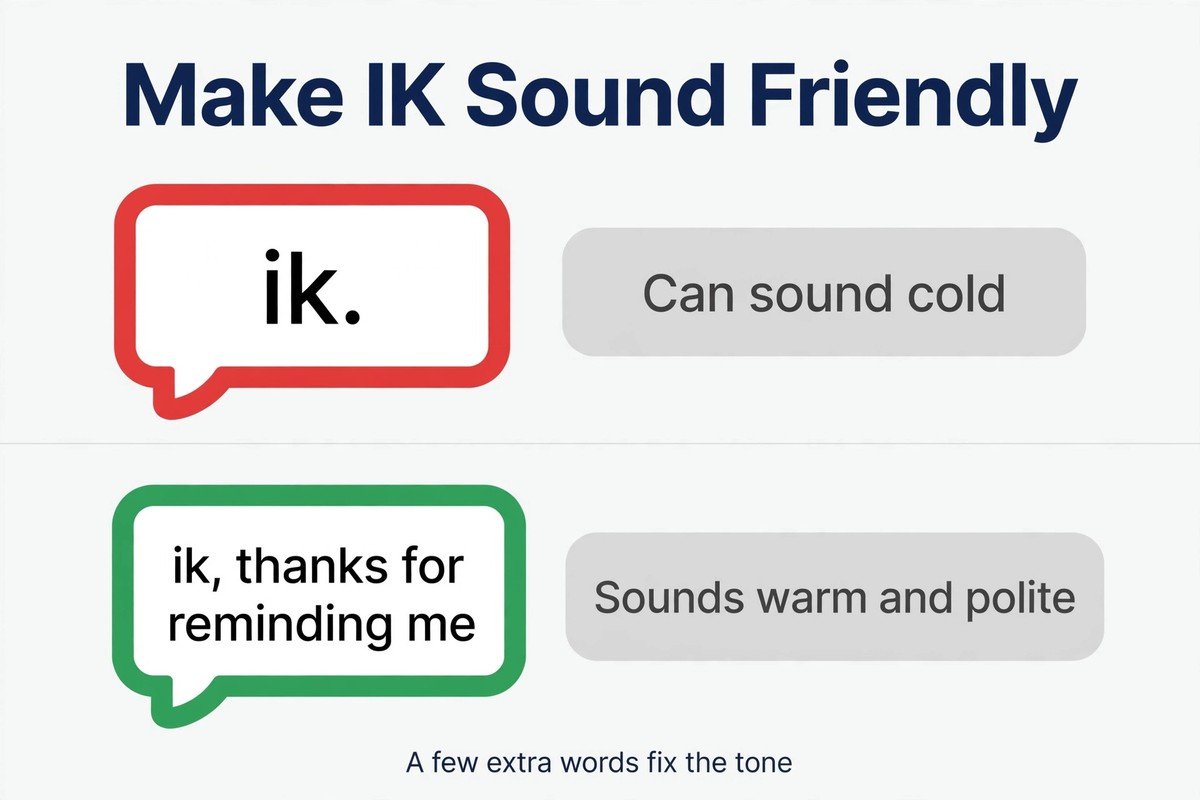
Moreover, the ik meaning in chat stays the same across almost every app. Whether the message appears on WhatsApp, Snapchat, or Instagram, the letters still carry the same basic message. Of course, context can add a second layer of feeling on top of that message. For instance, “ik, it is so unfair” shows agreement and frustration at the same time. By contrast, a plain “ik.” with a full stop can feel flat or dismissive. As a result, readers usually judge IK by the words and mood around it, not by the abbreviation itself.
Where IK Comes From
Interestingly, IK is one of the older pieces of internet slang still in daily use. According to How-To Geek’s guide to IK, the term appeared in early online chats at roughly the same time as its opposite, IDK. In fact, the first Urban Dictionary definition for IK was posted in October 2004, and it simply read “Used in IM. Means I Know.”
Back then, instant messaging and early texting rewarded short replies. Character limits were strict, typing on number pads was slow, and popular phrases quickly shrank into initials. Consequently, “I know” became IK, just as “I don’t know” became IDK. Later, smartphones removed most of those limits, yet the habit stayed. People kept using IK because it feels casual, and, in addition, it keeps fast conversations moving. Today, the abbreviation survives mostly in private messages between friends, rather than in public posts.
How People Use IK Meaning in Chat Every Day
In practice, the ik meaning in chat shows up in three main situations. First, people use it to acknowledge news they already have. Second, they use it to agree with an opinion. Third, they use it to answer reminders from family, friends, or group members. Each situation, however, gives the reply a slightly different flavour, so the examples below will help you read it correctly.
Using IK to Acknowledge News
News is the most common setting for this reply. For example:
- Friend: “The new season dropped today.”
- You: “ik, I watched the trailer last night.”
Here, IK confirms that you are already up to date. Then, the extra detail after it keeps the reply warm and gives your friend something to respond to. Similarly, in a group chat, several people might answer “ik” when one person shares a link everyone has already seen. In that setting, the word simply prevents five people from repeating the same explanation. Without it, in fact, group threads would fill up with duplicate information very quickly.
Using IK to Agree With Someone
Agreement is the second major use. When someone states an opinion you share, IK works like a verbal nod. For instance:
- Friend: “This homework is taking forever.”
- You: “ik, I have been stuck on question three for an hour.”
In this case, the reply says more than “I know the fact”. It actually means “I feel the same way”. As a result, IK often appears next to complaints, jokes, and everyday frustrations. People also extend it into “ikr”, short for “I know, right?”, when they want the agreement to sound stronger and warmer. That version, notably, almost never sounds rude.
Using IK to Answer a Reminder
Reminders create the third common situation. A parent, partner, or friend might write, “Do not forget your keys”, and the natural quick answer is “ik”. On the surface, that reply is efficient and reassuring. After all, it tells the sender that the job is already handled.
Nevertheless, this is also the situation where IK can accidentally sound annoyed. Because the reminder may feel unnecessary, a bare “ik” can read like “stop telling me”. Therefore, a small addition fixes the tone almost every time. For example, “ik, thanks for reminding me” sounds patient, while “ik.” on its own can sound like a door closing. In short, the shorter the reply, the colder it tends to feel.
Why Tone Changes the IK Meaning in Chat
Tone is the one thing that plain text cannot carry well. Consequently, the same two letters can land in very different ways. A lowercase “ik” in the middle of a lively chat usually feels relaxed and friendly. Meanwhile, a capital “IK” can look emphatic, as if the person is stressing that they really do know. Neither version is rude by itself, though. Instead, the surrounding messages decide the mood.
Several small signals, in particular, shape how readers interpret the reply. First, punctuation matters, because “ik!” feels upbeat while “ik.” feels final. Second, speed matters, because an instant “ik” can look like the person barely read your message. Third, length matters, because extra words almost always soften the tone. If you keep those three signals in mind, you will rarely misread the ik meaning in chat again.
When IK Can Sound Annoyed or Dismissive
Occasionally, IK does carry genuine irritation. This usually happens when someone explains something obvious, repeats old news, or talks down to the other person. For example, “You should try not to burn yourself” might earn an “IK” precisely because the advice was unnecessary. In that moment, the reply quietly says, “That was common sense.”
Even so, you should not assume the worst every time. Many people type short replies simply because they are busy, walking, or typing with one hand. If the tone feels unclear, then the safest move is to read the reply as neutral and continue the conversation normally. After a few more messages, the person’s real mood usually becomes obvious. In the end, one short abbreviation is weak evidence, and it should not start an argument on its own.
How to Reply When Someone Sends IK
Replying well starts with working out why the person said it. If they were acknowledging news, then you can simply move the conversation forward. If they were agreeing with you, then you can build on the shared feeling. And if they sounded annoyed, then a calmer, warmer reply can reset the tone. The options below cover the most common cases.
- Continue the topic: “ik” → “Good, then you also heard about Saturday, right?” Adding a new detail keeps the chat alive.
- Agree back: “ik, it is so annoying” → “Exactly, it happens every single week.” Mirroring the feeling shows that you understood both layers.
- Soften a sharp reply: “ik.” → “No worries, just wanted to make sure.” A patient answer prevents a small moment from growing.
- Ask what happens next: “ik” → “Great, so what time should we leave?” Turning knowledge into a plan is practical and friendly.
- End politely: “ik, thanks” → “Anytime.” A short close works well when the topic is finished.
Overall, you rarely need a clever comeback for IK. Because the word is mostly a confirmation, the conversation simply continues from whatever you were discussing. If anything, the reply tells you that explanations are no longer needed, so you can skip ahead. That, in turn, makes IK useful rather than awkward, as long as both people read it the same way.
IK vs IDK, IKR, and Other Similar Slang
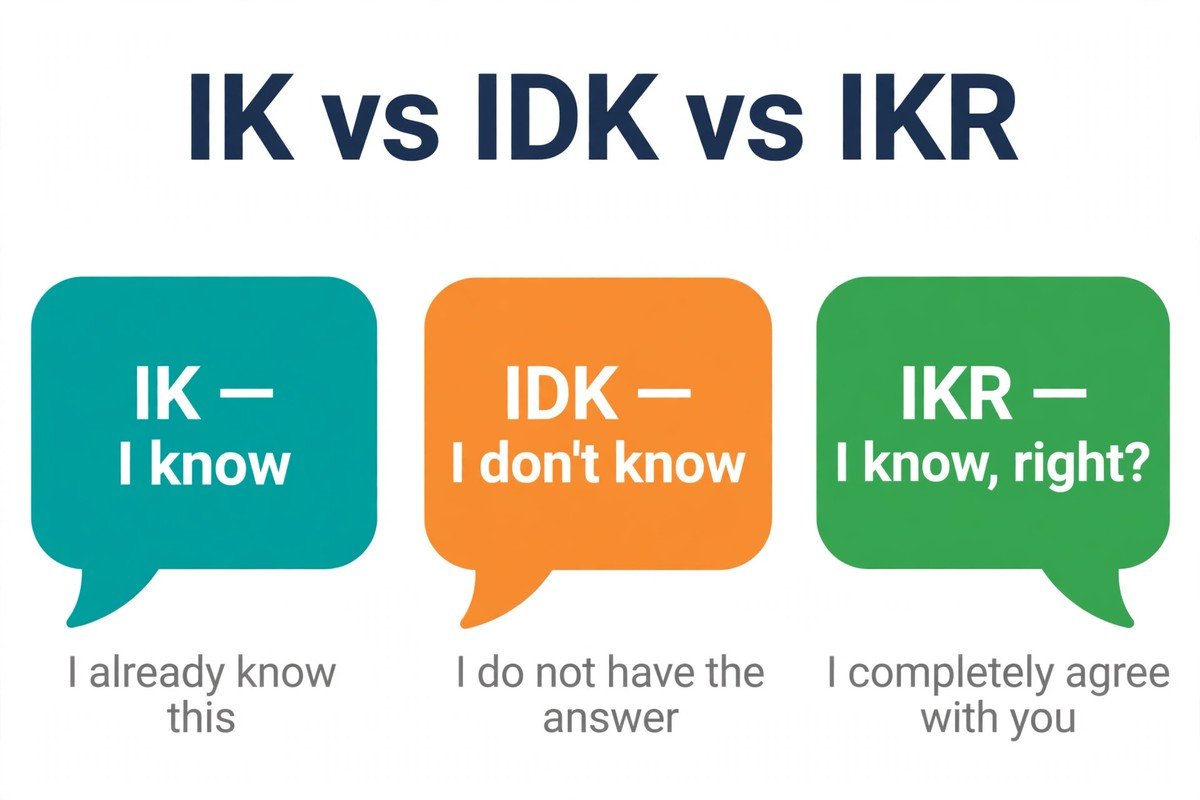
Confusion usually comes from the neighbours of IK, not from IK itself. Most importantly, IDK means the exact opposite: “I don’t know”. IKR, meanwhile, means “I know, right?” and adds agreement and warmth. IKTR goes one step further with “I know, that’s right”, a stronger and more playful form of agreement. Finally, AFAIK means “as far as I know”, which signals that the speaker is fairly sure but not completely certain.
| Slang | Full form | What it really says | Typical tone |
|---|---|---|---|
| IK | I know | I already know this | Neutral, sometimes blunt |
| IDK | I don’t know | I do not have the answer | Honest, casual |
| IKR | I know, right? | I completely agree with you | Warm, friendly |
| IKTR | I know, that’s right | Strong agreement | Playful, confident |
| IDC | I don’t care | This does not matter to me | Cold, often rude |
| AFAIK | As far as I know | I believe so, but I am not certain | Careful, polite |
| IKK | I know (stretched) | A playful spelling of IK | Light, casual |
Two of these deserve an extra warning. IDC, for example, looks similar to IDK, yet it sounds far colder, because it dismisses the topic instead of admitting ignorance. Likewise, replying “ik” when someone expected “ikr” can feel like a downgrade in enthusiasm. If you want to explore another two-letter reply with two very different meanings, our guide to OP meaning in texting shows how “OP” changes between chat and gaming. Taken together, these small forms reward readers who pay attention to context.
IK Meaning in Chat on Snapchat, TikTok, and Gaming Chats
The ik meaning in chat does not change between platforms, although the habits around it do. On Snapchat, for example, replies are often extremely short, so “ik” fits naturally beside streaks and quick snaps. TikTok works differently, because there IK appears mostly in comments, where it signals agreement with the video or with another commenter. On WhatsApp and iMessage, it shows up in private threads and family groups, usually as a fast confirmation.
Gaming chats add one more twist. Because players type under time pressure, short confirmations like “ik” help teams acknowledge a callout without stopping play. For instance, a teammate might warn “their sniper is on the roof”, and “ik” confirms that the warning landed. In that setting, brevity is a feature, not a flaw. Similarly, Discord servers and group chats reward quick acknowledgements, since long answers bury newer messages. Across all of these spaces, then, IK survives because it does one small job very efficiently.
When You Should Not Use IK
Despite its usefulness, IK has clear limits. Above all, you should avoid it in formal writing, work emails, school assignments, and job applications, where full sentences show respect and clarity. A manager who writes “Please send the report by noon” deserves “I know, I will send it by eleven”, not a bare “ik”. Otherwise, the reply can look careless, even when you mean it kindly.
You should also avoid IK when someone shares emotional news. If a friend writes “I failed my driving test”, then “ik” would be a strange and cold response, because the person wanted support, not confirmation. Instead, a sentence like “I heard, and I am sorry, that is rough” meets the moment properly. Likewise, avoid IK with people who may not know texting slang at all, such as older relatives or new acquaintances from other countries. For them, the full phrase “I know” costs you two seconds and prevents real confusion. In short, IK belongs in fast, casual chats between people who already share the same shorthand.
FAQs
What Does “ik” Mean in Dutch?
In Dutch, “ik” is not slang at all. It is simply the ordinary word for “I”, so a Dutch speaker writing “ik ben thuis” is saying “I am home” in a normal sentence. Therefore, if the rest of the message looks Dutch or German, you should read the word as part of that language, not as the English abbreviation.
Can IK Mean Something Else in a Username or Game Tag?
Yes, occasionally it can. In usernames, clan tags, and profile names, IK often works as someone’s initials rather than as a phrase. For example, a player called “IKShadow” is probably using the initials of a real name or a chosen alias. In those cases, context decides, because the letters sit inside a name instead of standing alone as a reply.
Is IK Considered Old or Outdated Slang?
Not really, although it is older than most people realise. Because IK grew up beside IDK in early instant messaging, it has survived several generations of apps without disappearing. Younger users still type it today, partly because it is short and partly because everyone already understands it. Unlike trend slang, which dates quickly, basic confirmations like IK tend to stay useful for decades.
Does a One-Word “ik” Mean the Conversation Is Over?
Usually, it does not. More often, it means the person had nothing to add to that particular point, so the topic can move on. Of course, if every reply in a long chat is one word, then the pattern suggests low interest rather than one abbreviation. In that situation, you can change the subject, ask an open question, or simply let the chat rest without taking offence.
Can You Say IK Out Loud in Spoken Conversation?
Technically, you can, but people rarely do. While “IDK” is commonly spoken letter by letter, “IK” sounds awkward aloud, because it collides with the normal phrase “I know”, which is just as fast to say. As a result, IK lives almost entirely in written chat. If you hear someone say the letters, they are usually joking or reading a message out to someone else.
Conclusion
In the end, the ik meaning in chat is reassuringly simple: IK means “I know”. People use it to confirm news, agree with opinions, and answer reminders in the fastest possible way. However, the reply carries tone as well as meaning, so punctuation, timing, and extra words all shape how it feels. If you add a few friendly words, your IK will sound warm instead of blunt. And if someone sends you a bare “ik”, you now know how to read it calmly and reply well. That small skill, in practice, makes everyday texting noticeably smoother for everyone involved.


Leave a Comment