
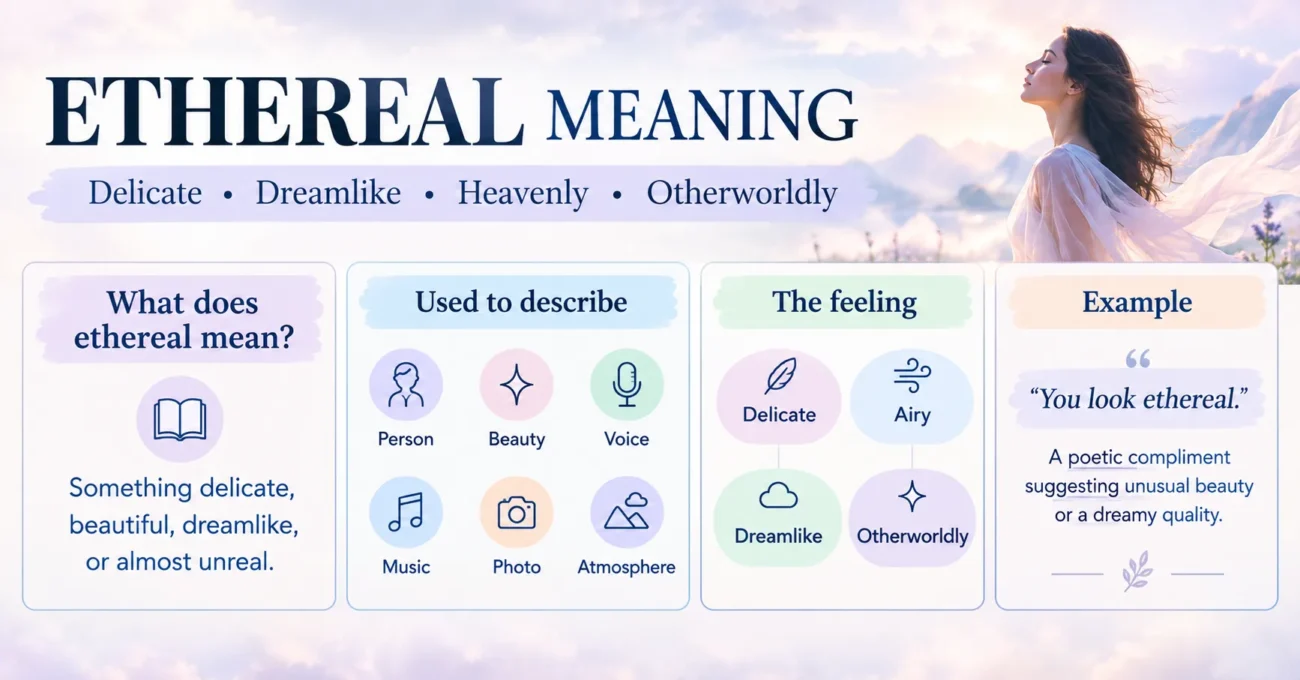
If you are wondering about the ethereal meaning, the word generally describes something extremely delicate, light, beautiful, or otherworldly. It can describe a person, appearance, voice, piece of music, image, or atmosphere that seems almost heavenly or unreal.
The confusing part is that “ethereal” does not simply mean “beautiful.” It adds a particular feeling of softness, lightness, dreaminess, or something that seems beyond the ordinary. The exact shade of meaning depends on what is being described and how the word is used.
Before You Continue: What Are You Probably Trying to Understand?
You may be asking:
- What does ethereal mean in simple English?
- What does it mean when someone calls a person ethereal?
- Is calling someone “DBA Meaning” a compliment?
- What does ethereal mean when it appears in a text, caption, or comment?
- How is ethereal different from similar words such as dreamlike, heavenly, or ephemeral?
This guide breaks those questions down one by one, so you can understand not only the definition of ethereal, but also what someone is actually communicating when they use it.
What Does “Ethereal” Mean in Simple English?
Ethereal is an adjective used for something that seems unusually delicate, light, beautiful, or otherworldly.
In simple terms, you can think of it as:
Something that feels so delicate, dreamlike, or heavenly that it seems almost unreal.
For example:
She had an ethereal beauty.
This does not simply mean that she was beautiful. It suggests that her appearance had a delicate, almost dreamlike or otherworldly quality.
Likewise:
The singer’s ethereal voice filled the room.
Here, ethereal suggests that the voice sounded unusually light, beautiful, airy, or almost unreal.
The word is normally used positively, especially when someone wants to describe a quality that feels difficult to explain with ordinary words such as pretty, beautiful, or nice.
What Feeling Does the Word “Ethereal” Convey?
Understanding the individual definition is useful, but the feeling behind the word is what makes ethereal different from many ordinary adjectives.
Depending on the context, ethereal can suggest several connected ideas:
- Delicate — something appears fine, fragile, or gentle.
- Light or airy — it may seem weightless rather than heavy or ordinary.
- Dreamlike — it gives the impression of something from a dream.
- Heavenly — it can suggest something celestial or almost divine.
- Otherworldly — it seems to belong somewhere beyond normal everyday experience.
These meanings often work together rather than separately.
For example, imagine a photograph of a person standing in soft light with flowing clothing and a misty background. Calling the photograph ethereal suggests more than simply saying it is attractive. The entire image may feel delicate, dreamy, peaceful, and almost unreal.
That is why ethereal is particularly common in descriptions of beauty, art, music, nature, photography, fashion, and atmosphere.
It is also worth remembering that ethereal does not automatically mean supernatural. In everyday English, it is often used figuratively to describe an ordinary person or thing that has an unusually delicate or otherworldly quality.
What Does Ethereal Mean When Describing a Person or Thing?
The meaning becomes much easier to understand when you look at what the word is describing.
Ethereal Beauty
When someone says:
She has an ethereal beauty.
they usually mean her beauty appears unusually delicate, graceful, dreamlike, or otherworldly.
It is a more poetic description than simply saying:
She is beautiful.
The word does not necessarily refer to one specific physical feature. It can describe the overall impression created by someone’s appearance.
An Ethereal Person
If someone calls a person ethereal, they may be describing the person’s overall presence or appearance as unusually delicate, graceful, dreamy, or almost unreal.
For example:
She looked ethereal in the soft evening light.
The sentence creates an impression rather than giving a precise physical description.
It does not mean the person literally belongs to another world. It is a figurative way of describing how they appear.
An Ethereal Voice or Song
Ethereal can also describe sound.
For example:
Her ethereal voice made the song feel almost dreamlike.
Here, the word can suggest a voice that sounds light, airy, hauntingly beautiful, or otherworldly.
Music can also be described as ethereal when its sound creates a floating, atmospheric, dreamy, or almost unreal feeling.
An Ethereal Photo, Dress, or Appearance
You may also see the word used in fashion and photography:
The photographer created an ethereal portrait.
or:
Her ethereal dress gave the scene a fairytale-like feeling.
In these examples, ethereal describes the overall visual impression rather than one specific technical feature.
Soft lighting, flowing materials, pale or delicate visual elements, mist, movement, or a dreamy composition can all contribute to something being described as ethereal.
An Ethereal Place or Atmosphere
The word can describe a setting as well:
The mountains looked ethereal through the morning fog.
The mountains are not literally supernatural. The fog and unusual light make them appear distant, delicate, mysterious, or almost unreal.
This is an important clue when interpreting the word: ethereal often describes the feeling an experience creates, not a literal physical property.
What Does Ethereal Mean in Text or Social Media?
When ethereal appears in a text, Instagram comment, caption, or social media post, it usually carries the same basic idea but in a more casual and expressive way.
Someone might write:
“You look ethereal.”
They are usually saying that you look exceptionally beautiful, delicate, graceful, dreamy, or almost unreal.
You might also see:
“This photo is ethereal.”
In that case, the person is reacting to the overall mood of the image. The lighting, colors, setting, expression, or composition may create a soft and dreamlike feeling.
Similarly:
“This song sounds so ethereal.”
Here, the word describes the atmosphere created by the music rather than suggesting that the song has a literal supernatural quality.
So, when you see ethereal online, don’t automatically interpret it as slang. Ethereal is a standard English adjective that is often used online as a poetic or expressive compliment.
Is “Ethereal” a Compliment?
Yes, in most everyday situations, calling someone or something “ethereal” is a compliment.
When someone describes a person’s appearance as ethereal, they are generally expressing admiration. They may be saying that the person looks exceptionally graceful, delicate, beautiful, dreamy, or otherworldly.
For example:
“You looked absolutely ethereal in that dress.”
This is clearly positive.
The exact tone can depend on the context. In a fashion or photography discussion, ethereal may focus mainly on someone’s visual appearance. In a romantic conversation, it can sound more personal or poetic. In an artistic conversation, it may describe the aesthetic effect rather than the person themselves.
So if someone calls you ethereal, there is normally no negative meaning hidden in the word. They are highlighting an unusual quality that they find beautiful or captivating.
What Are the Closest Synonyms for Ethereal?

There is no single synonym that always replaces ethereal perfectly because each similar word emphasizes something slightly different.
| Similar word | What it emphasizes |
|---|---|
| Delicate | Fine, gentle, or fragile qualities |
| Airy | Lightness and a lack of heaviness |
| Dreamlike | A quality that feels like a dream |
| Heavenly | Beauty or a connection with the heavens |
| Otherworldly | Something that seems beyond ordinary experience |
| Celestial | A stronger connection with the sky or heavens |
For example, delicate can describe a fragile object without suggesting anything dreamlike. Dreamlike focuses more directly on the feeling of a dream. Otherworldly emphasizes the sense that something seems beyond normal experience.
Ethereal can bring several of these qualities together.
That is why:
“Her ethereal appearance”
can communicate more than:
“Her delicate appearance.”
The first can suggest delicacy, beauty, dreaminess, and an almost unreal quality at the same time.
Ethereal vs. Ephemeral: What Is the Difference?
Ethereal and ephemeral are easy to confuse because they look and sound somewhat similar, but they describe completely different ideas.
- Ethereal means delicate, light, heavenly, dreamlike, or otherworldly.
- Ephemeral means lasting for only a short time.
Compare these examples:
The dancer had an ethereal quality.
This describes how the dancer appeared or felt.
The beauty of the sunset was ephemeral.
This means the sunset’s beauty did not last for long.
Something can actually be both ethereal and ephemeral, but for different reasons.
For example:
The ethereal glow of the sunset was ephemeral.
The glow was ethereal because it looked delicate and almost unreal, while it was ephemeral because it lasted only briefly.
Remember the distinction this way:
Ethereal = what something feels or looks like.
Ephemeral = how long it lasts.
How Do You Pronounce “Ethereal” and Use It in a Sentence?
Ethereal is commonly pronounced approximately:
ih-THEER-ee-uhl
The word is an adjective, so it normally comes before a noun or after a linking verb.
Examples before a noun
She wore an ethereal gown.
The painting has an ethereal quality.
We heard an ethereal voice in the background.
Examples after a linking verb
The landscape looked ethereal.
The entire scene seemed ethereal.
A useful pattern is:
ethereal + noun
Examples include:
- ethereal beauty
- ethereal voice
- ethereal music
- ethereal atmosphere
- ethereal light
- ethereal appearance
- ethereal quality
The word works particularly well when the writer wants to describe an overall impression rather than give a straightforward physical description.
Where Does the Word “Ethereal” Come From?
The history of ethereal helps explain why the word developed its heavenly or otherworldly sense.
The word is connected through Latin to the Greek aithēr, a term associated with the upper or purer air of the heavens. Over time, ethereal developed meanings connected with the heavens, the sky, and things considered extremely light or refined.
Modern English uses the word much more broadly. You do not have to be talking about the heavens to use it correctly.
For example:
The singer’s ethereal voice filled the room.
Here, ethereal is being used figuratively to communicate a particular quality of sound.
That figurative use is now one of the most useful ways to understand the word in everyday writing.
Frequently Asked Questions About Ethereal
Can you call a person ethereal?
Yes. Calling a person ethereal usually means their appearance, presence, or overall impression seems unusually delicate, graceful, beautiful, dreamy, or otherworldly. It is generally positive and often sounds more poetic than simply calling someone beautiful.
Is ethereal always a positive word?
In ordinary descriptions of people, art, music, fashion, and scenery, ethereal is usually positive. It often expresses admiration for something that seems unusually beautiful, delicate, dreamy, or otherworldly. However, the exact tone still depends on the surrounding sentence and context.
Can ethereal describe music?
Yes. An ethereal song or voice usually creates a light, dreamy, atmospheric, delicate, or otherworldly feeling. The word is especially useful when ordinary descriptions such as “beautiful” or “soft” do not fully capture the mood created by the sound.
Is ethereal a slang word?
No. Ethereal is a standard English adjective, not slang. People commonly use it in literature, everyday descriptions, art, fashion, music, photography, and social media. Online users may use it casually, but the word itself is not limited to internet language.
What does “you look ethereal” mean?
“You look ethereal” is normally a strong compliment. It suggests that you look exceptionally beautiful, delicate, graceful, dreamy, or almost unreal. Depending on the situation, it may have an artistic, romantic, or simply admiring tone.
Is ethereal the same as heavenly?
Not exactly. The two words can overlap when describing something beautiful or elevated, but heavenly more directly suggests heaven, divine beauty, or exceptional pleasure. Ethereal focuses more on delicacy, lightness, dreaminess, and an otherworldly quality.
Conclusion
Ethereal describes something that feels unusually delicate, light, beautiful, dreamy, heavenly, or beyond the ordinary. It can describe a person’s appearance, a voice, music, photography, clothing, scenery, or an entire atmosphere.
The key is to look at the feeling the word adds to the description. If someone says a person looks ethereal, they are usually giving a poetic compliment. If they call a song ethereal, they are describing its dreamy or otherworldly atmosphere. And if you see ethereal in a social media caption or text, it usually carries the same positive, expressive meaning.
The easiest way to remember it is:
Ethereal = delicate, beautiful, and almost unreal or otherworldly.
Once you understand that core idea, the word becomes much easier to recognize and use naturally.


Leave a Comment