
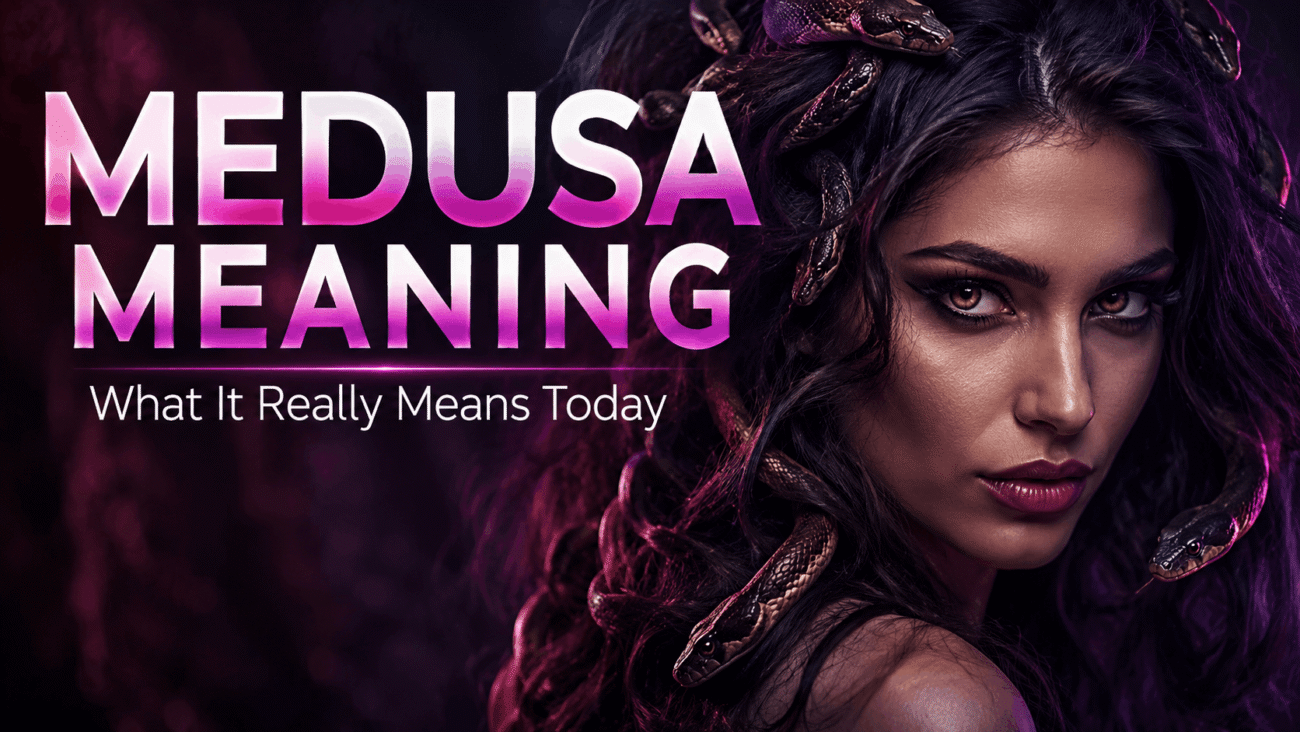
Medusa meaning, in short: Medusa is the mortal Gorgon from Greek mythology whose stare turned people to stone. Today the word also shows up online and in casual talk. People use it for someone with an intense, intimidating look or dramatic “don’t-mess-with-me” energy. It’s usually a compliment, not an insult.
Before we break that down, it helps to see how a mythological name drifts into modern slang. It follows the same pattern as IYKYK — a phrase that only lands if the listener already shares the reference. Calling someone “a whole Medusa” only works if they know the myth.
What Does Medusa Meaning Actually Cover?
At its root, Medusa isn’t slang at all. It’s a name from Greek mythology. Like a lot of mythological figures, her story eventually leaked into everyday language. Think “narcissist” from Narcissus, or “siren” from the Sirens. It became shorthand for a specific kind of energy. That’s the core of Medusa meaning in one line: an ancient myth turned modern shorthand.
The Greek Mythology Origin

In the original myth, Medusa was one of three Gorgon sisters. A curse transformed her into a monstrous figure with living snakes for hair. Anyone who looked directly into her eyes turned instantly to stone. The hero Perseus eventually killed her. He looked only at her reflection in a polished shield, avoiding her gaze entirely. It’s one of the most retold stories in Western mythology, and it still shows up constantly in art, film, and internet culture.
A few different versions explain how Medusa got her snake hair. The details change depending on which ancient source you read. In some tellings, she was born a monster — one of three Gorgon sisters who were never human. A later, more well-known version comes from the Roman poet Ovid. In his telling, she started out as a beautiful young woman. The gods punished and transformed her as a curse, rather than her being born that way. Most modern retellings, tattoos, and slang usage lean on that second version. It frames her as someone who was wronged. That lines up with how people use the word sympathetically today.
How Medusa Meaning Evolved Beyond the Myth
Outside the myth, Medusa meaning splits into a few overlapping uses in modern English:
- A person with an intense, stone-cold stare or resting expression. It’s often backhanded praise. “She’s giving Medusa” means she looks powerful, maybe a little scary, in a good way.
- A symbol of protection, strength, and reclaiming power. This shows up especially in tattoo culture and on social media. People now frame Medusa less as a monster and more as a survivor.
- A jellyfish life stage. Scientists call the free-swimming, bell-shaped form of a jellyfish a “medusa.” That’s a completely separate usage from the mythology-based one.
- A body piercing name. A “Medusa piercing” sits above the upper lip, in the philtrum area. It has nothing to do with mythology beyond the shared name.
- A meme or reaction shorthand. People use it jokingly for eye contact that feels dangerous or paralyzing — like locking eyes with your crush at the worst possible moment.
The mythological sense and the “intense stare” sense cover most of what people actually search for. This guide treats that as the primary Medusa meaning. Here’s the full breakdown at a glance:
Medusa Meaning at a Glance |
|---|
Medusa Meaning in Everyday Conversation
Context decides which Medusa meaning applies. The word covers a lot of ground at once. Tone, punctuation, and the relationship between the people talking all shift the reading — a period at the end feels different from a snake emoji at the end. Here’s how people actually use “Medusa” across texting, social media, and casual talk.
In texting, it’s usually shorthand for a look or a mood, not a literal myth reference.
“she walked in and gave me full Medusa eyes, I froze 💀”
On social media, especially in captions, people often self-apply it as a power statement.
Caption on a bold outfit photo: “Medusa energy only 🐍”
In casual talk with friends, it works as a warning or a joke about someone’s mood.
“Don’t talk to her right now, she’s in full Medusa mode after that meeting.”
In jokes and memes, the humor usually comes from applying the “turn to stone” bit to something mundane.
“Made eye contact with my ex at the gym and immediately turned to stone. Modern-day Medusa situation, no snakes required.”
Medusa in Everyday Use: Quick Examples |
|---|
Medusa Meaning in Memes, Jokes, and Chat Culture
JokeRiddle’s audience gets the most mileage out of this Medusa meaning. The “turn to stone” mechanic is basically a built-in punchline. It maps onto any moment where someone freezes up or loses their composure.
A few common joke formats built around Medusa:
- The eye-contact freeze joke. Someone locks eyes with a crush, an ex, or an authority figure and “turns to stone.” Translation: they panic and can’t speak.
- The intimidating-look compliment. Friends call each other “Medusa” when a look is sharp enough to stop an argument mid-sentence.
- The chaotic-energy caption. People pair a fierce photo with “Medusa” to signal main-character confidence. It’s similar in spirit to captioning something OFC energy — obviously true, non-negotiable.
- The group-chat roast. Friends jokingly warn each other not to “look directly” at someone in a bad mood, borrowing the myth’s danger as exaggerated comedy.
Here’s a quick sample exchange showing the tone:
Friend 1: bro why does the new manager look like she could turn someone to stone Friend 2: SMH don’t test her, full Medusa energy on day one
That kind of layered slang is exactly the “if you know, you know” texture that makes chat culture fun instead of flat.
Medusa in Pop Culture and Media

Medusa translates easily into slang for one big reason. Most people already meet her many times before they use the word casually. She’s an early antagonist in Percy Jackson — a scene that doubles as a tutorial for the myth. Clash of the Titans features her too. Countless video games cast her as a boss enemy with a stone-gaze attack. Fashion references her constantly; Versace famously uses a Medusa head as its logo, tying the name to glamour rather than horror.
That repeated exposure across movies, games, and fashion explains the jump from “ancient monster” to “modern compliment.” By the time someone sees “Medusa energy” in a caption, they’ve already absorbed the story — snakes, stone gaze, dangerous beauty. That’s part of what makes the term so easy to reuse.
This shared background also explains why the word travels so well across platforms without needing a caption explaining it. A snake emoji next to “Medusa” carries the whole story in two characters. No other mythological figure crosses over into slang quite this smoothly, mostly because her image is so visually distinct and so widely recognized already.
Medusa Tattoo Meaning: A Quick Symbolic Note
Medusa has become one of the more popular mythological tattoo choices in recent years. It’s worth a short mention here, since it’s a common reason people search this term. In tattoo culture, people usually choose Medusa to represent protection and resilience. It also signals reclaiming power after a hard chapter — a shift away from the “monster” framing toward a “survivor” framing. For a deeper dive purely on the tattoo symbolism side, MeaningSpot’s guide on Medusa tattoo meaning covers placement ideas, styles, and the psychology behind the design.
Medusa Meaning Across Regions and Platforms
“Medusa” doesn’t split along regional lines the way some slang does. It does shift a little by platform and generation, though:
- TikTok / Instagram Reels: Leans into “Medusa era” or “Medusa energy.” It’s usually tied to confidence or a bold aesthetic shift, often paired with the snake emoji (🐍).
- X (Twitter): Leans toward quick reactions — jokes about freezing up, intimidating stares, or petty callouts.
- Discord and gaming chats: Occasionally describes a devastatingly good play, or a player who “locks down” opponents. The idea borrowed here is “stops you in your tracks,” not the beauty angle.
- Older generations / general use: Sticks closer to the literal mythology reference — trivia, literature, or art discussions rather than slang.
None of these are hard rules, and plenty of overlap exists. Platform context beats region as a guide, if you’re trying to read the room.
There’s also a generational layer worth noting. Younger, terminally-online users treat “Medusa” as a flexible vibe word. It can describe a look, an outfit, or an attitude, much like “iconic” or “unbothered.” Older users or casual dictionary searchers more often type the term to confirm the actual myth or settle a trivia debate. Both groups search the same word for very different reasons. That’s exactly why a good explainer needs to cover the mythology and the slang side together.
Common Mistakes People Make With Medusa Meaning
A few mix-ups about Medusa meaning come up often enough to flag directly:
- Assuming it’s always an insult. In modern usage, calling someone “Medusa” is very often a compliment about their confidence or presence.
- Confusing the myth with the jellyfish term. “Medusa” as a jellyfish life stage is unrelated to biology vocabulary. It shares a name because early naturalists thought the tentacles resembled Medusa’s snake hair.
- Overcomplicating the tattoo symbolism. Not every Medusa tattoo tells a “trauma story.” Plenty of people simply like the mythology or the visual design.
- Thinking it’s a new slang word. The mythology is ancient. The modern casual usage only picked up real steam in the last several years.
- Using it as a standalone insult without context. On its own, “you’re such a Medusa” can read as a compliment or a jab. It depends entirely on tone, emoji, and the relationship between the people talking.
- Mixing up Medusa with other Gorgons. Medusa was one of three Gorgon sisters, alongside Stheno and Euryale. She’s the only one who was mortal — exactly why she’s the one everyone remembers by name.
- Treating every mention as slang. A dictionary or trivia context usually means someone wants the mythology answer, not the modern usage — worth checking before launching into a slang explanation nobody asked for.
How to Use “Medusa” in a Sentence
Want to use the word confidently instead of just recognizing it? Here are a few natural ways it fits into a sentence:
- As a description of presence: “She didn’t say a word, just gave everyone that Medusa look and the room went silent.”
- As a self-referential caption: “New hair, new attitude, full Medusa arc.”
- As a joke about freezing up: “Bro saw his ex across the room and went full Medusa victim, didn’t move for ten minutes.”
- As a compliment about confidence: “Not gonna lie, the way you shut that down was so Medusa of you.”
- As a warning to a friend: “Approach with caution, she’s in Medusa mode after that call.”
None of these require explaining the mythology first. That’s the sign of slang that has fully detached from its origin story. Once a word reaches that stage, people stop thinking about where it came from and just reach for it naturally, the same way nobody pauses to think about ancient Rome before calling someone a “narcissist.”
Related Meanings You Might Also Like
If you’re building your slang vocabulary, a few other JokeRiddle guides pair well with this one. Each covers a term that shifts meaning depending on tone and context, just like Medusa does:
- ETA meaning — a word that means something very literal in formal contexts but gets used loosely in casual chats.
- FWB meaning — a good example of a term whose meaning depends entirely on relationship context.
- WTW meaning — a quick texting shorthand worth knowing if you’re brushing up on chat abbreviations.
Medusa Meaning FAQs
Q: What does Medusa mean in slang? In slang, “Medusa” usually describes someone with an intense or intimidating look. It’s most often a compliment about confidence, not an insult.
Q: Do people mean it as a compliment when they call you Medusa? Generally, yes. If someone calls you “Medusa,” it usually means they find you striking, fierce, or hard to look away from — not literally monstrous.
Q: What does Medusa mean in Greek mythology? Medusa was a mortal Gorgon whose gaze turned anyone who looked at her to stone. Perseus eventually killed her, avoiding her gaze with his shield.
Q: What does a Medusa tattoo symbolize? Medusa tattoos commonly represent protection, strength, and personal transformation. Many people connect the design to resilience after hardship.
Q: Is “Medusa” the same as a jellyfish? Not exactly. “Medusa” is also the scientific name for a jellyfish’s free-swimming stage — a separate meaning that just shares the name.
Q: Where did the Medusa piercing get its name? A Medusa piercing sits just above the upper lip, in the center philtrum area. The mythological figure gives it its name simply because of the placement.
Q: Why do people call an intimidating stare “Medusa energy” instead of something else? Medusa is the most famous “gaze that stops you cold” figure in mythology, so her name became the default shorthand. It’s quicker to say “Medusa energy” than to describe the look every time, and everyone already knows the reference.
Wrapping Up: Medusa Meaning in a Nutshell
That’s the full Medusa meaning picture. It’s a story thousands of years old, still doing new work in group chats and captions today. Someone might use it for a killer stare, a meaningful tattoo, or just the literal myth from history class. The common thread stays the same: power. A gaze or an energy strong enough to stop people in their tracks. Next time it shows up in your feed, you’ll know exactly which version is in play.


Leave a Comment