
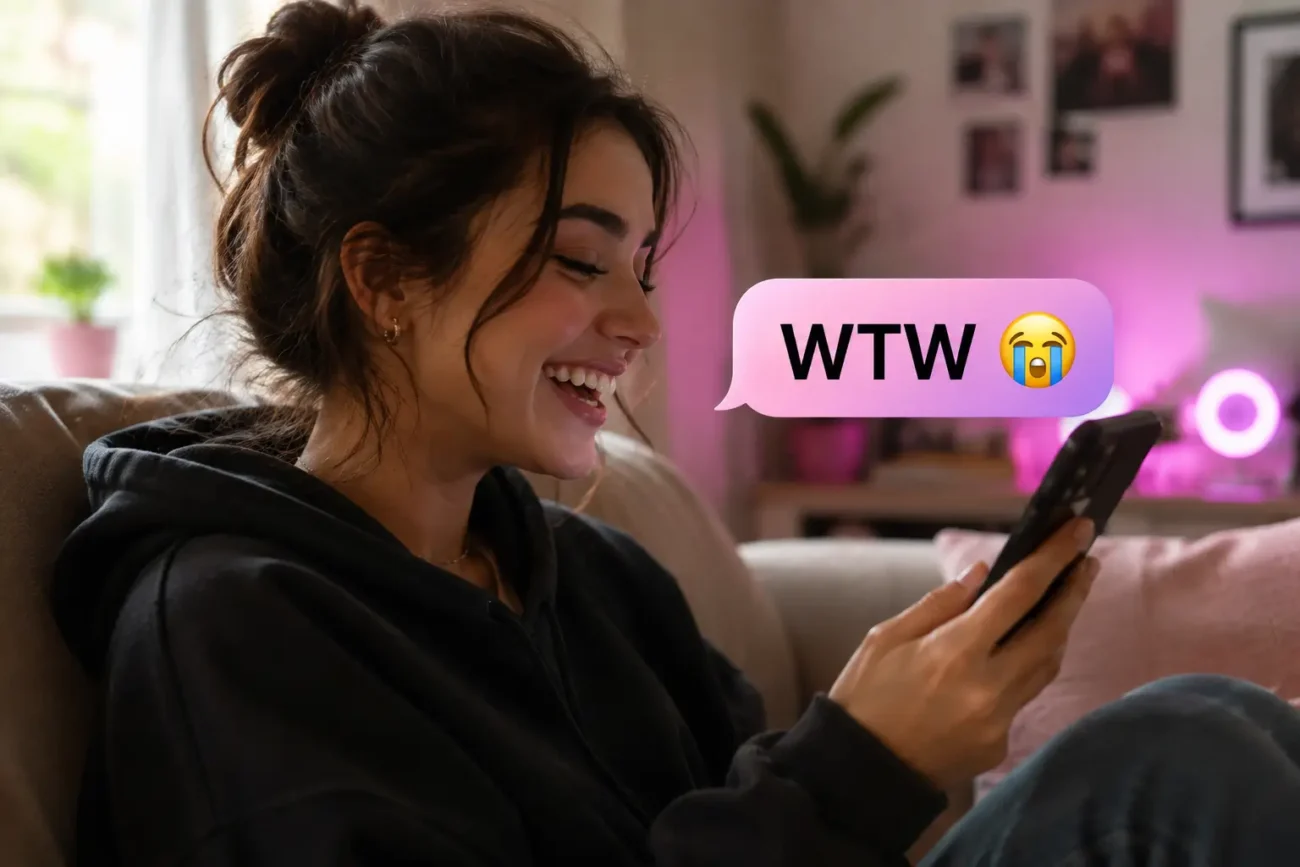
WTW meaning refers to the internet abbreviation for “What’s the Word?” It’s a casual way of asking what’s happening or what someone is up to. People use it to open a conversation or check in with a friend. Less often, it stands for “What’s the Wave?” or “What the What?” depending on tone and context.
If you’ve ever gotten a plain “WTW” text, you might have stared at your phone trying to decode it. You’re not alone. It’s one of those texts that looks simple but can mean three different things depending on who sent it. There’s a real difference between opening a chat with it and reacting to shock with it. Getting that distinction right is basically what this guide covers.
What Is the WTW Meaning?
In most chats, WTW stands for “What’s the Word?” It’s a low-effort way of saying “what’s up.” Think of it as the texting equivalent of a head nod: short, casual, and built to get a reply without sounding demanding.
That said, the WTW meaning isn’t fixed to one definition. Below is a quick snapshot of when each version gets used, so you can match the letters to the right situation:
| Meaning | Used When | Example |
|---|---|---|
| What’s the Word? | Starting a chat or checking in | “WTW, haven’t talked in a bit” |
| What’s up? | Casual greeting | “yo WTW” |
| What the What? | Reacting to something surprising | “wait WTW, run that back” |
| What to Wear? | Asking for outfit advice | “WTW for the party tonight?” |
| What to Watch? | Asking for a show/movie pick | “bored, WTW rn” |
The first two definitions cover roughly 90% of how you’ll see WTW used online. The other three only make sense in specific conversations. Usually you can tell which one someone means just from the line right before it.
Where Does the WTW Meaning Come From?
WTW didn’t start on TikTok. It’s older than that. The greeting version has roots in hip-hop and street slang, where “what’s good,” “what’s the word,” and “what’s up” have long worked as interchangeable conversation openers. Texting culture picked it up for the same reason people shortened “be right back” to BRB: three letters beat three words.
The “what the what” version works differently. It’s less an abbreviation and more a written stand-in for a spoken reaction, similar to typing “wait what” or “no way” out loud. Think of it as a softened, PG cousin of blunter reactions people already use. It lets someone show genuine shock without sounding harsh.
As texting became the default way people talk, both versions ended up sharing the same three letters. Context became the only thing that separates them. This is actually normal for internet slang — plenty of short acronyms carry two or three unrelated meanings. You just need to know who’s talking and what they’re replying to. WTW is simply one of the more common examples, since “what’s the word,” “what’s up,” and “what the what” all existed as spoken phrases long before texting compressed them.
What’s kept the WTW meaning relevant, instead of fading like a lot of early SMS slang, is that it never got tied to one app or trend. Unlike slang that blows up from a single viral video, WTW spread the old-fashioned way: through everyday texting between friends. That’s a big part of why it stuck around across multiple platforms.
WTW Meaning in Everyday Conversation
WTW shows up differently depending on where you see it. Here’s how it breaks down by platform and setting:
- Texting: Usually the opener, not the whole message — “WTW, you around later?” It’s rarely sent completely alone unless you’re already mid-conversation with that person.
- Social media comments (Instagram, TikTok, X): Often used to react, not greet. Someone drops “WTW 😭” under a wild post, closer to “what the what” than “what’s up.”
- Snapchat and DMs: A common check-in for someone you haven’t heard from — “WTW, you good?” Snapchat culture leans heavily on quick, low-pressure messages.
- Casual group chats: Doubles as small talk filler. People send it just to see who’s active and might want to make plans.
- Jokes and memes: In caption or reply form, WTW often carries the “what the what” tone. It’s a quick, exaggerated reaction to something absurd, usually paired with laughing emojis or all caps.
The short version: if WTW opens a message, read it as “what’s up.” If it reacts to something just said or posted, read it as “what the what.”
How Do You Use WTW in a Joke or Chat?
In jokes and chats specifically, WTW pulls double duty. It works as both a conversation starter and a punchline reaction. Here’s where you’ll typically catch it doing that:
- As a caption under a screenshot of something ridiculous: “WTW 💀 this can’t be real”
- As a reply to a joke that lands a little too well: “bro said WTW and I’m still not over it”
- As a low-key way to fish for gossip: “okay but WTW, spill”
If you’ve already got someone’s attention with a bit, a term people already recognize keeps the momentum going better than a full sentence would. That’s the same logic behind why other short slang terms stick around: they save typing without losing the tone of the conversation. If you’re building out your own slang vocabulary, the WYLL meaning breakdown is a good next stop. It covers a similarly quick check-in term.
WTW Meaning in Real Conversations
Here’s how the different meanings actually play out in context:
Opening a conversation:
Person A: “WTW” Person B: “nothing crazy, just got home, wbu?”
Checking in after a while:
Person A: “yo WTW, haven’t seen you post in weeks” Person B: “just been slammed with work, wbu”
Reacting to something wild:
Person A: “she showed up two hours late and acted like nothing happened” Person B: “WTW 😭😭 that’s insane”
Asking for plans:
Person A: “WTW tonight, anyone tryna do something?”
Outfit context:
Person A: “WTW for this thing tomorrow, help”
None of these examples would make sense if you swapped the definitions around. That’s exactly why context matters more than the letters themselves.
A couple more real-world patterns worth knowing:
Following up on a story someone half-told you:
Person A: “so we got into it and I just walked out mid-sentence” Person B: “hold on WTW, finish that story first”
Used as a light group-chat check-in:
Person A: “WTW everyone, we still on for Saturday?” Person B: “yeah I’m in” Person C: “same, what time”
That last example is a good reminder: WTW doesn’t always expect a deep answer. Sometimes it just confirms plans are still happening, closer to a “still good?” than an open-ended question.
Why Does the WTW Meaning Change So Often?
Three letters covering five different meanings might seem odd. But this is actually a common pattern in internet slang. Short acronyms get reused constantly, because brevity beats precision when you’re typing fast on a phone. People would rather reuse a familiar shortcut than invent a new one for every situation.
WTW pulls double duty because “what’s the word,” “what’s up,” and “what the what” share a similar rhythm and tone, even though they mean different things on paper. In practice, people rarely stay confused for long. The sentence around WTW, or the situation it replies to, almost always makes the intended meaning obvious within a message or two. The “what to wear” and “what to watch” versions show up less often — usually only when someone’s clearly asking for a recommendation, so they’re easy to rule out otherwise.
WTW Meaning vs Similar Slang Terms
WTW belongs to a family of short, question-style acronyms built to keep texting fast. It’s easy to mix them up if you’re not deep in chat culture, so here’s how a few compare:
- WTW vs SMH: WTW opens a conversation or reacts with surprise; SMH reacts with disappointment, not curiosity.
- WTW vs IYKYK: WTW invites a reply; IYKYK is a closed statement that assumes the reader already gets it.
- WTW vs OFC: These rarely overlap. OFC confirms something, while WTW asks for something.
- WTW vs FAFO: Different tone entirely. FAFO works as a warning, while WTW stays neutral or curious.
Knowing where WTW sits next to these terms makes it easier to reply naturally, instead of defaulting to a generic “lol” whenever someone drops an acronym you half-recognize.
Common Mistakes When Using WTW
A few ways people get the WTW meaning wrong:
- Treating it as always meaning “what’s up.” It’s the most common reading, but the wrong context can confuse people who read it as a shocked reaction instead.
- Using it in formal messages. WTW stays strictly casual. Using it in a work email, or with someone you don’t know well, tends to land as too informal.
- Assuming it means the same thing everywhere. Platform matters. A comment-section WTW usually leans “what the what,” while a DM-opener WTW usually leans “what’s up.”
- Confusing it with WTF. They look similar at a glance, but WTW stays softer and less aggressive than the blunt disbelief WTF carries.
- Sending it with no lead-in and expecting a specific answer. A cold, out-of-nowhere “WTW” can read as vague. Pair it with a bit more detail — “WTW, you still coming tonight?” — and it lands better.
- Overusing it in every message. Like most slang, WTW loses its charm if you use it constantly. It works best as an occasional opener or reaction, not a filler word.
Regional and Platform Variations of the WTW Meaning
The WTW meaning doesn’t stay exactly the same everywhere it shows up:
- TikTok comments: Leans toward the “what the what” reaction, often paired with skull or crying emojis.
- Snapchat: Leans toward the check-in and greeting use, since Snapchat conversations run on quick daily contact.
- Discord: Can go either way depending on the server. Gaming servers tend to use it as a reaction; friend-group servers tend to use it as a greeting.
- Generational split: Gen Z texters use WTW constantly and casually. Older users who see it for the first time often read it literally, since “what’s the word” isn’t an obvious phrase to shorten.
When it genuinely isn’t clear which one someone means, double-check. A short “wym?” (what do you mean) reads as completely normal and won’t make you look out of the loop.
Quick Way to Tell Which WTW Meaning Someone Intends
If you get a WTW and aren’t sure how to take it, run through this quick checklist:
- Did it come out of nowhere, with no prior message? → Probably “what’s up” — it’s an opener.
- Did it follow something surprising? → Probably “what the what” — it’s a reaction.
- Is the conversation already about clothes or getting ready for something? → Probably “what to wear.”
- Is the conversation about being bored or looking for something to do? → Probably “what to watch.”
- Still not sure? → A quick “haha what do you mean” clears it up fast.
This same logic works for most short, multi-meaning slang, not just WTW. Check what came before it, and the right meaning usually becomes obvious within a message or two.
Related Meanings
Still building your slang vocabulary? A few related terms worth checking next:
- Pookie meaning — the cute nickname trending across texts and comments
- Munch meaning — another slang term with a very different vibe than WTW
- FWB meaning — a common texting abbreviation worth knowing alongside WTW
FAQ: WTW Meaning
What does WTW mean in a text?
WTW most commonly means “What’s the Word?” — a casual way of asking what’s going on or starting a conversation.
What does WTW mean on Snapchat?
On Snapchat, people almost always send WTW as a check-in, similar to “what’s up” or “haven’t heard from you in a while.”
Is WTW the same as WTF?
No. WTW usually means “what’s the word” or “what the what.” WTF carries a stronger tone tied to “what the f***.” They’re not interchangeable.
How do you reply to WTW?
Something short like “just got home, wbu” or “chilling rn, you good?” works fine for the greeting version. For the surprised version, try “I know right” or an emoji reaction instead.
Does WTW always mean the same thing?
No — the WTW meaning depends on context. As an opener, it usually means “what’s up.” As a reaction, it usually means “what the what.”
Can WTW mean something other than slang?
Yes. Less commonly, people use it to mean “What to Wear?” or “What to Watch?” when asking for a quick suggestion.
Where did WTW come from?
It traces back to hip-hop and street slang phrases like “what’s good” and “what’s the word.” Texting culture later shortened both into WTW.
Is WTW mostly used by younger people?
It’s most common among Gen Z texters, though the greeting version has stuck around long enough that plenty of older users know and use it too.
A Quick Note on WTW Meaning and Tone
WTW almost never carries sarcasm or passive-aggression on its own. Unlike slang that can hide an edge depending on punctuation, WTW usually reads as neutral or curious. Extra letters, emojis, or punctuation are what shift the tone, not the acronym itself. A plain “WTW” reads as relaxed. “WTWWW??” or “WTW 😭😭” reads as more intense. Keeping that in mind makes it easier to judge how someone actually meant it, instead of second-guessing a short text longer than it deserves.
Conclusion
At its core, the WTW meaning comes down to context. It works as a check-in when it opens a conversation, and as a reaction when it follows something surprising. Once you can tell those two apart, replying feels automatic instead of confusing. No more staring at a blank text thread trying to figure out what someone wants from you. Like most internet slang, WTW isn’t complicated once you’ve seen it enough times — it’s just a shortcut people use to keep conversations moving.
Leave a Comment