
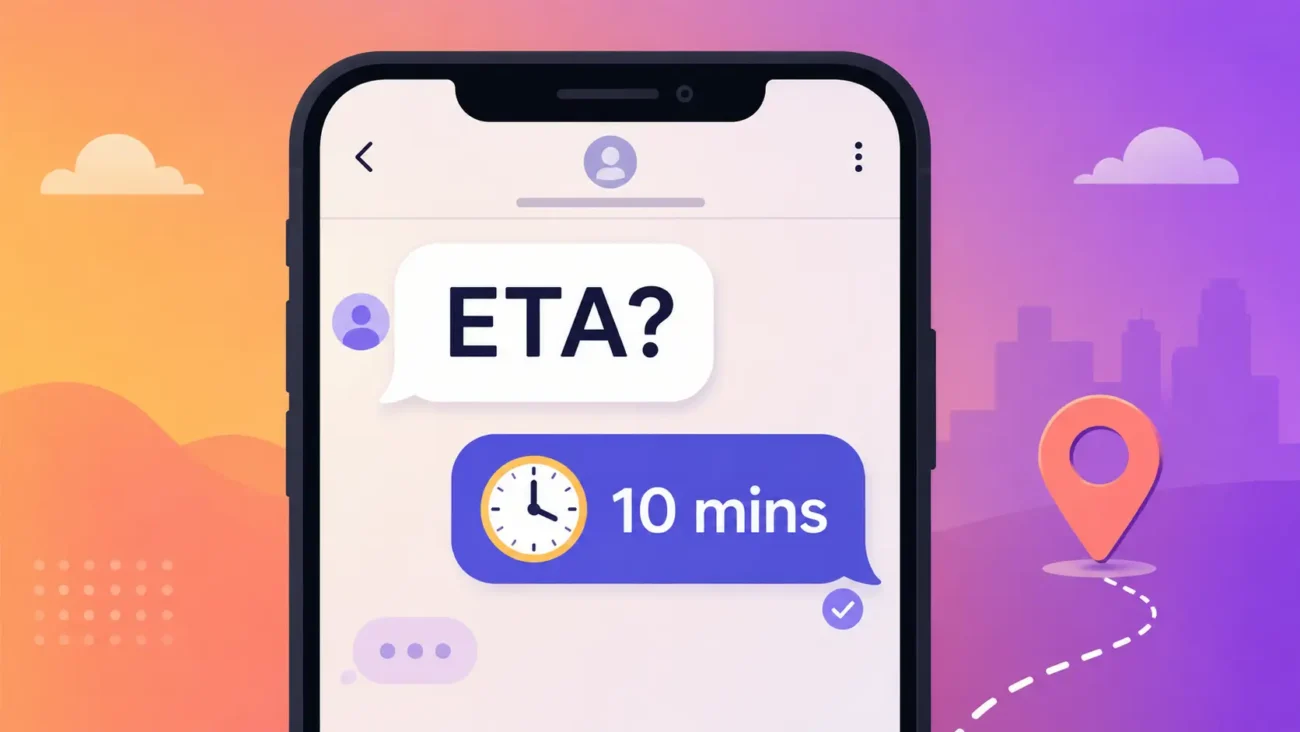
The ETA meaning is simple: ETA stands for “Estimated Time of Arrival.” It’s the short form people type when they want to say how long something will take — usually getting somewhere, but also finishing a task, replying to a message, or showing up to an event. In texts and DMs, “ETA?” is really just a faster way of asking, “When will you be here?”
Picture a friend group planning a hangout: one person types “leaving now,” and within seconds someone fires back “ETA?” instead of a full sentence. No confusion, no extra typing — just a fast answer everyone in the chat instantly reads correctly. This kind of shorthand isn’t a one-off; it’s part of a much bigger habit of compressing everyday questions into a handful of letters. WYLL follows the exact same pattern, swapping out a full sentence for a term the whole group already recognizes on sight.
What Is the ETA Meaning?
The ETA meaning boils down to Estimated Time of Arrival. It’s not a guarantee or a promise — it’s a best guess that reflects whatever information someone has at the moment. If your friend texts “ETA 20 mins,” they’re not signing a contract; they’re giving you a working number so you can plan around it.
The phrase works in two directions:
- As a question: “What’s your ETA?” (When will you get here?)
- As a statement: “ETA 6pm” (I’ll be there around 6pm.)
That two-way flexibility is a big part of why the term took off the way it did — a single three-letter word covers a question and its answer, and it reads the same whether a teenager types it while coordinating a hangout or a warehouse manager types it while updating a delivery route.
Where Does ETA Come From?
ETA didn’t start as internet slang — it started as working vocabulary in aviation, shipping, and logistics, where knowing exactly when a plane, ship, or truck would arrive mattered for scheduling, safety, and coordination. Airlines and freight companies have used “ETA” on tracking boards and manifests for decades, long before it ever showed up in a text thread.
What changed is the audience. As texting and group chats became the default way people coordinate plans, everyday users pulled that same practical shorthand straight out of logistics and dropped it into daily life. Nobody sat down and decided to make ETA a slang term — it just made too much sense to leave behind. That’s part of why the ETA meaning feels so natural today — logistics teams had already built it for speed and clarity long before texting existed. Asking “what’s your ETA” takes less effort than “what time do you think you’ll get here,” and in a fast-moving group chat, less effort wins.
How Is the ETA Meaning Used in Everyday Conversation?

ETA shows up differently depending on where you’re using it, but the core meaning never really changes. Here’s how it plays out across the situations you’ll actually run into.
Texting Friends and Family
Out of every context on this list, this is the one you’ll run into constantly. Someone asks where you are, or you send an unprompted update to save them the trouble of asking:
- “Leaving now, ETA 15 mins”
- “Traffic is bad, new ETA is 7:30”
- “You coming? What’s your ETA”
Group Chats and Event Planning
Picture a group chat with five people trying to sync up before dinner. Rather than each person typing out “when will you get here” one by one, someone just posts “ETA?” once, and everyone answers with a quick number or time — a format that’s easy to skim even when six replies land back to back.
ETA Meaning in Social Media Captions
On Instagram, TikTok, and X, ETA shows up loosely to mean “when is this coming,” not just physical arrival. A creator might caption a post “new video ETA: this weekend” or a comment section might fill with “ETA on part 2??” under a cliffhanger post. Here it’s less about a person showing up and more about content, a drop, or a reply showing up.
Work and Delivery Contexts
In more formal settings — work Slack messages, customer service chats, delivery tracking apps — ETA keeps its literal meaning but with a slightly more polished tone: “ETA on the report is Thursday,” or “Your package ETA is tomorrow by 8pm.” Same three letters, just dressed up for the office.
Jokes, Memes, and Chat Culture
Because ETA is so universally understood, it also gets used ironically or for comedic timing in jokes and memes — someone posts a photo of themselves clearly not ready to leave the house and captions it “ETA: 5 minutes” as a running joke about always being late. It’s become shorthand for a very specific, very relatable kind of humor: confidently lying about how close you are to being ready.
ETA Meaning in Context: A Quick Usage Table
| Platform / Setting | How ETA Is Typically Used | Example |
|---|---|---|
| WhatsApp / iMessage | Asking or giving arrival times for plans | “ETA?” / “ETA 10 mins” |
| Asking when new content drops | “ETA on the next post?” | |
| TikTok captions | Teasing an upcoming video or trend follow-up | “Part 2 ETA: tomorrow” |
| Discord | Coordinating when someone joins a call or game | “ETA on the lobby?” |
| Workplace chat (Slack/Teams) | Giving a time estimate on a task or delivery | “ETA on the file is 3pm” |
| Delivery/tracking apps | System-generated arrival estimate | “Your order ETA: 6:45pm” |
Across every one of these, the underlying idea stays identical: someone is giving or asking for a time estimate. Only the tone and formality shift.
Other ETA Meanings You Should Know
Most of the time, if you see “ETA” in a text or online, it means Estimated Time of Arrival — that covers the overwhelming majority of everyday usage. But the letters aren’t exclusive to texting slang, and it’s worth flagging the other contexts so you don’t mix them up:
- ETA as a historical/political term: In a completely different context, ETA (Euskadi Ta Askatasuna) was the name of a Basque separatist organization active for decades in Spain and France before it formally disbanded in 2018. This meaning has nothing to do with texting and only appears in news, history, or political discussions — context makes the difference obvious.
- ETA in gaming and esports: Some gaming communities loosely use “ETA” to ask when a teammate will be ready or when a match/queue is starting, which is really just the texting meaning applied to gaming lobbies rather than a separate definition.
- ETA as an acronym in other industries: Logistics and travel companies sometimes pair ETA with ETD (Estimated Time of Departure) on schedules, tickets, and tracking dashboards.
If you’re chatting online, texting, or scrolling social media, “Estimated Time of Arrival” is essentially always the correct read. The other meanings only surface in very specific, unrelated contexts.
Similar Texting Abbreviations Worth Knowing
ETA belongs to a whole family of short, practical acronyms that exist to save typing time. If you’re building your slang vocabulary, these tend to show up in the same conversations:
- OFC — people type it to confirm something quickly, similar in spirit to how ETA confirms timing
- IYKYK — another compressed phrase that relies entirely on shared context, the same way ETA relies on shared understanding of “arrival”
- SMH — a reaction shorthand that, like ETA, trades a full sentence for three letters
- FAFO — a longer phrase that people shrink the same way they shrink “when will you get here” into ETA
These all follow the same texting logic: compress a common phrase into something you can type in under two seconds.
How to Reply to an ETA Meaning Question

Replying to an ETA question doesn’t need to be complicated, but the tone can shift depending on who’s asking.
| Situation | Casual Reply | More Formal Reply |
|---|---|---|
| Friend asking where you are | “ETA 10, running late lol” | “I’m about 10 minutes out.” |
| Coworker asking about a task | “ETA end of day” | “I expect to have this finished by end of day.” |
| Delivery driver update | “5 mins away!” | “I’m approximately five minutes from the address.” |
| Uncertain timing | “No clue tbh, maybe 30?” | “I can’t give you a precise number yet, but I’d guess somewhere around half an hour.” |
The pattern is simple: give a number if you have one, and if you don’t, say so honestly rather than guessing wildly — nothing kills group-chat trust faster than three ETA updates in a row that were all wrong.
ETA in Jokes and Group-Chat Humor
Because everyone recognizes ETA instantly, it’s become a reliable setup for jokes, especially around the universal experience of running late. A few patterns show up again and again in captions, memes, and group chats:
- Posting a picture of an obviously messy room or an unfinished outfit captioned “ETA: 5 minutes” — the joke being that it’s clearly not five minutes.
- A friend group running a bit where everyone treats one member’s “ETA” as a punchline because they’re famously always the last to show up.
- Using “ETA: never” sarcastically when someone is clearly not coming or clearly procrastinating on something they promised to do.
It works as a joke format because everyone already knows the “rules” of ETA — the unwritten rule says you give an honest number — so breaking that expectation on purpose is what lands the laugh.
Common Mistakes People Make With the ETA Meaning
The ETA meaning itself is simple, but a few small mix-ups happen often enough to be worth clearing up:
- Treating it as exact, not estimated. The “E” stands for estimated — the term bakes in room for traffic, delays, and last-minute changes by design.
- Confusing it with ETD. ETD is Estimated Time of Departure (when you’re leaving), while ETA is Estimated Time of Arrival (when you’ll get there). Travel and shipping schedules often pair the two together, but they mean opposite ends of the trip.
- Assuming it always means “in person.” On social media, ETA is frequently about content or replies, not a physical person showing up somewhere.
- Overusing it in formal writing. ETA reads fine in a text or Slack message, but in a formal email or report, “expected arrival time” or “expected completion date” comes across as more polished.
Related Meanings
If you’re building out your slang vocabulary, these related terms are worth a look next:
FAQ: ETA Meaning
What’s the simple definition of ETA when someone texts it?
It’s shorthand for Estimated Time of Arrival, used to ask about or share a rough timeframe for when a person or thing should show up. That’s the ETA meaning in its simplest form.
Is ETA always about arriving somewhere in person?
No. While that’s the most common use, people also use ETA online to mean when new content, replies, or updates should arrive — like “ETA on part 2?”
What’s the difference between ETA and ETD?
ETA (Estimated Time of Arrival) is when you’ll get there; ETD (Estimated Time of Departure) is when you’re leaving. They’re opposite ends of the same trip.
Where did the term ETA come from?
It originated in aviation, shipping, and logistics, where knowing arrival times was essential for scheduling, before crossing over into everyday texting and chat culture.
Does ETA have any other meanings besides arrival time?
Yes — in a completely unrelated historical/political context, ETA also refers to a Basque separatist organization that disbanded in 2018. In texting and online chats, though, “Estimated Time of Arrival” is essentially always the correct meaning.
What’s the best way to respond to an ETA question?
Share whatever time estimate you actually have (like “ETA 10 mins”), and if you genuinely don’t know yet, say that plainly instead of throwing out a random guess.
Conclusion
At its core, ETA is one of the simplest, most useful pieces of shorthand in modern texting: three letters that replace an entire question about timing. Whether it’s a friend asking where you are, a coworker tracking a deadline, or a fan asking when the next post drops, “ETA” does the same job everywhere — it turns “when will this happen” into something you can type with one thumb. Now that you have a full grip on the ETA meaning — from group chats to delivery apps — you’ll never misread a “ETA?” text again.


Leave a Comment