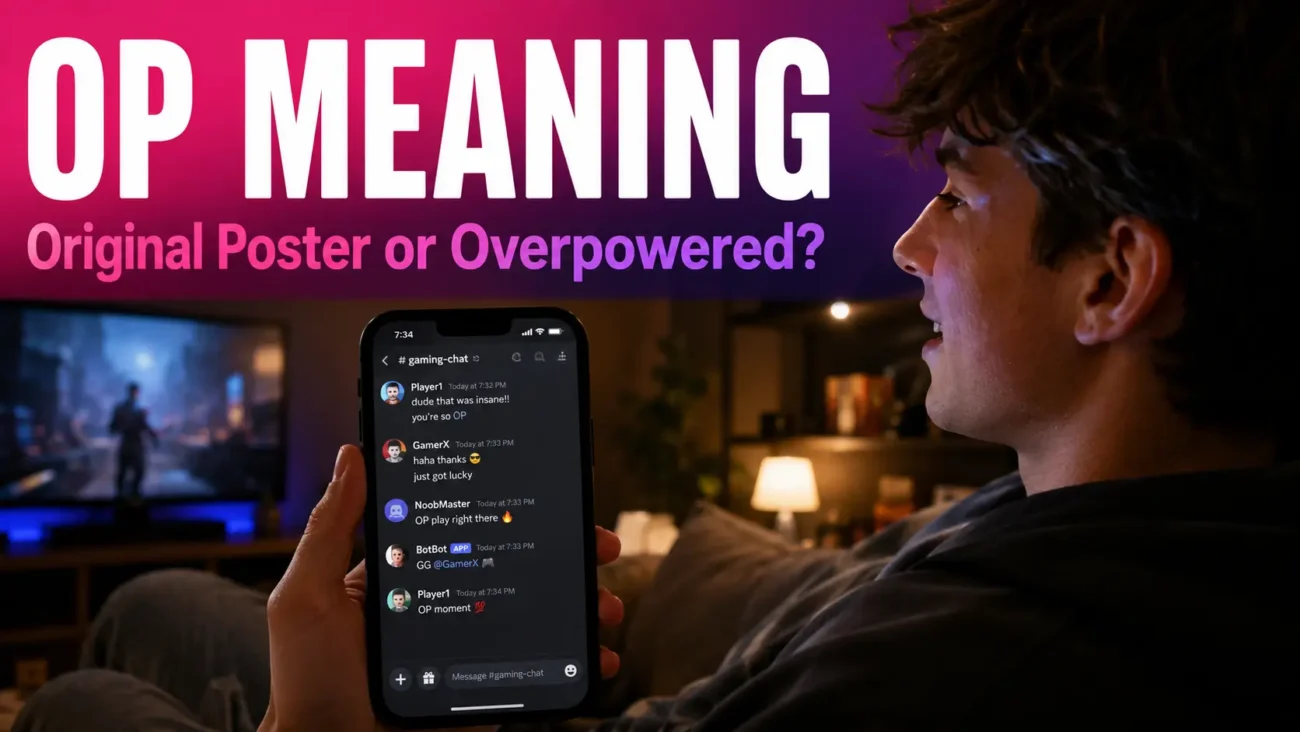
The OP meaning almost always comes down to one of two things: “Original Poster” (the person who started a thread or post) or “Overpowered” (something so strong it feels unfair). Which one applies depends entirely on where you’re reading it — a gaming chat and a Reddit thread use OP very differently, even though the letters look identical.
That two-meaning trick is exactly what makes slang like this fun to untangle — it’s the same energy as when someone types IYKYK and only half the group actually gets the joke. OP works the same way: say it in the wrong context, and you’ll confuse people; say it in the right one, and everyone nods instantly.
How the OP Meaning Changes in Everyday Conversation
Before breaking down each meaning, here’s the quick lay of the land — because the OP meaning shifts depending on where you type it:
- Texting: Usually shorthand for “Original Poster” when referencing something screenshotted from Reddit or a forum, or “Overpowered” when venting about a game.
- Social media (Reddit, X, TikTok comments): Almost always “Original Poster” — as in, “OP never responded” or “OP edited the post.”
- Gaming chats and Discord servers: Almost always “Overpowered” — describing a character, weapon, or strategy that’s too strong for the current game balance.
- Jokes and memes: Both meanings get flipped for comedy — people jokingly call an unbeatable friend “OP” the way you’d call someone a cheat code, or roast an OP who clearly didn’t read their own post before getting called out.
Context is the whole game here. Read one line above or below the word “OP,” and you’ll almost always know instantly which meaning is in play. It’s rare for both meanings to make sense in the same sentence, which is actually what keeps this slang from being confusing once you know the trick.
Where Did the OP Meaning Come From? A Quick History
OP didn’t start on TikTok, and it didn’t start with gaming either. It began on early internet forums and bulletin boards, long before social media existed in its current form. Threads needed a quick way to refer back to whoever asked the original question, and typing out a full username every reply was clunky. “OP” solved that instantly — short, neutral, and easy to type on a keyboard mid-conversation.
The “Overpowered” meaning came later, growing out of multiplayer gaming communities in the early 2000s. As online games introduced patches, updates, and balance changes, players needed a fast way to flag when something felt unfair. “OP” became the go-to label — quicker to type mid-match than “this weapon is unbalanced and needs a nerf.”
Reddit’s explosive growth in the 2010s cemented the “Original Poster” meaning for a mainstream audience far beyond gaming forums, while esports and streaming culture did the same for “Overpowered.” By the time both meanings hit TikTok and Discord in the 2020s, their original communities had already tested them for over a decade — which is part of why OP has stuck around instead of fading as so much internet slang does.
What Does OP Mean?
OP is a two-letter abbreviation with two mainstream definitions, plus one smaller offshoot that trips people up:
- Original Poster — the person who created a post, thread, or discussion.
- Overpowered — something (a character, weapon, item, or even a person) that’s excessively strong.
- Opp / Opposition — a separate, AAVE-rooted slang term meaning “enemy” or “rival,” which some younger users shorten in casual typing to just “op,” even though it’s technically a different word from OPP.
That third one matters because it’s where most explainer articles get sloppy — they either skip it entirely or blur it into the other two meanings. It isn’t. Let’s go through each one properly.
1. Original Poster (Forums, Reddit, X)

This older of the two mainstream meanings started on internet forums decades ago. Every thread has one person who wrote the first post — that person is “OP.” Instead of typing someone’s full username every time you reply, you just say “OP” and everyone knows who you mean.
Example: “OP said they already tried that, so this suggestion probably won’t help.”
Reddit is where this usage lives loudest today. Scroll any comment section, and you’ll see replies like “OP never came back to update us,” “OP, this happened to me too,” or “Not OP, but I ran into the same issue last year.” It’s less about slang and more about internet etiquette — it keeps threads readable when hundreds of people are replying to the same post.
You’ll also see people use it defensively or accusingly: “OP is leaving out details,” or “OP, why didn’t you mention that earlier?” In these cases, OP isn’t just a neutral label — it carries a slightly formal, almost moderator-like tone, which is part of why it feels natural in debate-heavy subreddits like AITA or relationship advice threads.
2. Overpowered (Gaming, Esports, App Reviews)

In gaming spaces, OP rarely means “Original Poster” — context makes that meaning irrelevant. Here, OP describes a character, weapon, item, or strategy that gives an unfair advantage, usually because a developer hasn’t balanced it yet.
Example: “This weapon feels ridiculously OP after the last patch — someone’s getting a nerf soon.”
This meaning stretches across genres. Shooters usually flag it on a weapon or attachment. Fighting games call out a combo that can’t be countered. Strategy games see it in a unit or build order that dominates every match, and mobile games often pin it on a character locked behind a paywall that suddenly feels mandatory to win.
This is also the meaning that leaks into casual, non-gaming conversation the most. Someone acing every test without studying? “Bro is OP.” A friend who never loses at Uno? Also OP. A coworker who somehow gets every project done early? People will call them OP too, half-joking, half-serious. It’s become a general-purpose compliment (or complaint) for anything that feels unbeatable, gaming context or not.
3. Opp / Opposition — Where People Get Confused
This is the one most guides skip entirely. “Opp” (sometimes written OPP) comes from African American Vernacular English, where it’s short for “opposition” or “opponent” — someone on the other side, a rival, sometimes even used semi-jokingly toward a parent, teacher, or authority figure whom people jokingly call out for being strict, even though they’re just doing their job.
Because “op” and “opp” sound identical when spoken, and people often type fast without the second P, they mix the two up constantly — especially outside the communities where the term originated. The key difference: OP describes a thing or a post; opp/OPP describes a person you’re at odds with. If someone calls you their “opp,” they don’t mean you’re overpowered — they mean you’re the rival, sometimes affectionately, sometimes not.
This distinction matters more on TikTok and Discord than it does on Reddit, where “opp” as a term barely appears. If you’re seeing it in a caption or comment about a rivalry or friendship dynamic, or friends playfully calling someone out, that’s the opp meaning — not the OP one.
How Do You Use the OP Meaning in a Joke or Chat?
Because OP already carries a light, informal tone, it fits naturally into jokes without needing much setup. A few patterns people actually use:
- The exaggeration joke: “My mom found my hidden snacks in 0.5 seconds, she’s OP.”
- The gaming roast: “Nerf this guy, he’s clearly OP.” (said about a real person dominating a game night)
- The Reddit callback: “OP asked for advice and then argued with everyone who gave it — classic.”
- The compliment flip: Calling a friend “OP” as a joke after they win three rounds in a row.
- The self-deprecating flip: “I’m the opposite of OP, I lose at literally everything.”
- The mock-serious patch note: Friends jokingly announcing a “nerf” for whoever’s winning too much at a party game — borrowing straight from gaming balance-patch language.
If you want a related term that lives in this exact “inside-joke slang” lane, SMH fits the same casual register — a reaction word that only really lands with the right context behind it. The same logic applies to timing-based slang like WYLL, which only makes sense once you know the situation someone’s describing.
Common Mistakes People Make With the OP Meaning
- Assuming OP always means “Overpowered.” In non-gaming spaces, especially Reddit and forums, it’s almost always “Original Poster.”
- Confusing OP with OPP. They’re different words with different origins — one describes a post, the other describes a person.
- Using OP in formal writing. It’s internet shorthand; it doesn’t belong in emails, resumes, or anything you’d hand to a teacher or boss.
- Missing the sarcasm. People often exaggerate “OP” as a compliment (“you’re so OP”) for comedy — it’s rarely a literal claim someone is unbeatable.
- Not checking the platform. A gaming Discord and a Reddit AITA thread will almost never use OP the same way — always read the surrounding context first.
- Overusing it outside its lane. Calling every strong opinion or every skilled person “OP” waters the term down — it lands best when there’s a clear comparison (this vs. everything else) backing it up.
- Assuming everyone knows both meanings. Someone new to gaming might only know “Original Poster,” and someone new to Reddit might only know “Overpowered” — don’t assume the joke will land without context.
Related Meanings
- IYKYK Meaning — another slang term that only makes sense with the right context.
- FAFO Meaning — for when someone tests an “OP” strategy and it backfires.
- WYLL Meaning — casual chat slang in the same texting-abbreviation family.
Curious where the “opp” side of this term first showed up? MeaningSpot’s OP breakdown covers the gaming and forum angle in more detail.
FAQ
Q. What does OP mean in texting?
A. Usually “Original Poster” when referencing something from Reddit or a forum, though it can mean “Overpowered” in gaming-related texts.
Q. What does OP mean in gaming?
A. Overpowered — a character, weapon, or strategy that’s too strong compared to everything else in the game, usually the first thing players flag for a balance patch.
Q. Is OP the same as opp?
A. No. OP refers to a post or something powerful; opp (or OPP) is separate slang meaning “enemy” or “rival,” rooted in AAVE.
Q. Can OP be used as a joke?
A. Yes — people often call a friend “OP” jokingly after they dominate a game, or use it sarcastically to exaggerate someone’s skill in everyday situations.
Q. Is OP still used in 2026?
A. Yes, it remains one of the most common internet abbreviations across Reddit, Discord, TikTok, and gaming communities, and shows no signs of fading.
Q. How do I know which meaning of OP is correct?
A. Check the context — a discussion or thread almost always means “Original Poster,” while gaming or competitive talk almost always means “Overpowered.” If it’s about a rivalry instead, you’re probably actually looking at “opp.”
Conclusion
OP is short, simple, and everywhere online — but it’s not a one-definition word. On Reddit and forums, it points to the person who started the conversation. In gaming and esports, it flags something too strong to be fair. And if you see “opp” nearby, that’s a different word entirely, tied to rivalry rather than posts or power. Once you know to check the context first, OP stops being confusing and starts being one of the easiest internet abbreviations to read at a glance.


Leave a Comment