

The integrity meaning is easy to grasp once you strip away the formal language: integrity is the quality of being honest and holding on to strong moral principles, even when doing so is difficult or costly. In other words, a person with integrity does the right thing not because someone is watching, but because the action matches their own values. Whether the word appears in a school essay, a job interview, or a character reference, it almost always points to this same idea of steady, trustworthy character.
However, integrity is slightly more than everyday honesty. After all, honesty can describe a single truthful moment, while integrity describes a whole pattern of behaviour. Consequently, people who understand the integrity meaning properly also understand why employers, teachers, and friends prize the quality so highly. This guide explains the word in plain language, shows real examples from daily life, school, and work, and finally separates integrity from honesty so the difference stays clear.
Integrity Meaning in Simple Words
In simple words, integrity means being honest and doing what is right, even when nobody would ever find out about the alternative. For example, if a cashier gives you too much change and you hand the extra money back, that small moment shows integrity. Similarly, if you finish a task properly even though a shortcut would go unnoticed, you are acting with integrity.
Dictionaries frame the definition in slightly more formal terms. According to the Merriam-Webster dictionary entry for integrity, the word means a firm adherence to a code of moral values. Meanwhile, simpler learner dictionaries describe it as being honest and firm in your moral principles. Both versions point in the same direction: integrity joins truthfulness with a steady set of principles that guide everyday choices.
Where the Word Comes From
Interestingly, the word itself carries a helpful clue. Integrity developed from the Latin word integer, which means whole or complete. Because of that origin, the integrity meaning includes a sense of wholeness: a person of integrity is not split into one character for public view and another for private moments. Instead, their words, values, and actions form one complete, consistent whole.
The Second Sense: Wholeness and Soundness
Beyond character, integrity can also describe things rather than people. In that second sense, it means the state of being complete, undivided, or undamaged. For instance, engineers check the structural integrity of a bridge, and computer specialists protect data integrity so files stay complete and unaltered. Although the context changes, the core idea of wholeness stays exactly the same.
Integrity Meaning as a Character Quality
As a character quality, integrity rests on two pillars that support each other. First, it requires honesty, because a person cannot claim strong principles while routinely bending the truth. Second, it requires moral principles that stay firm under pressure, because principles that collapse at the first temptation are not really principles at all.
Honesty at the Core
Honesty forms the visible surface of integrity. For example, a person with integrity answers questions truthfully, admits mistakes without being cornered, and refuses to spread stories they know are false. Moreover, they stay truthful when a lie would be easier, safer, or more profitable. As a result, the people around them learn that their words can be trusted at face value.
Principles That Do Not Bend
Meanwhile, the second pillar works quietly in the background. Strong moral principles give a person a fixed standard before difficult situations arrive. Therefore, when a tempting shortcut appears, the decision is already made: the standard decides, not the mood of the moment. In practice, this steadiness is what separates integrity from simple politeness or occasional good behaviour. A polite person may behave well when watched, whereas a person of integrity behaves the same way in every setting.
William Shakespeare captured a related idea in Hamlet, where Polonius advises, “To thine own self be true.” Although the line is centuries old, it still describes the inner consistency that integrity requires. A person who stays true to their own stated values rarely needs to hide, edit, or excuse their actions afterwards.
Integrity Meaning in Daily Life, School, and Work
Definitions become clearer with concrete situations. Therefore, this section walks through examples in three settings where the integrity meaning shows up most often.
Examples in Daily Life
In daily life, integrity usually appears in small, unglamorous moments. For instance, returning a lost wallet with the cash untouched is a classic example, because keeping it would be easy and almost impossible to detect. Likewise, keeping a promise to a friend even after a better invitation arrives shows the same quality. Additionally, owning up to a broken household item instead of quietly blaming someone else demonstrates integrity at home. Each case shares one feature: the honest choice costs something, yet the person chooses it anyway.
Examples at School
At school, the same quality takes an academic shape, often called academic integrity. For example, a student shows integrity by writing an essay in their own words instead of copying a classmate’s work. Similarly, admitting to a teacher that a homework excuse was invented reflects the integrity meaning in action. In group projects, moreover, a student with integrity finishes their share on time rather than letting others carry the load silently. Teachers notice this pattern quickly, and consequently such students earn trust that lasts far beyond one assignment.
Examples at Work
At work, integrity becomes a professional reputation. For instance, an employee who reports an error in a client’s bill, even when the error favours their own company, is displaying integrity in the workplace. Likewise, a manager who keeps a promise about a deadline or a bonus, even when circumstances change, builds lasting credibility. On the other hand, a worker who quietly takes credit for a colleague’s idea shows the opposite pattern. Employers value integrity because teams run smoothly when people can rely on each other’s word without constant checking.
Integrity vs Honesty: What Is the Difference?
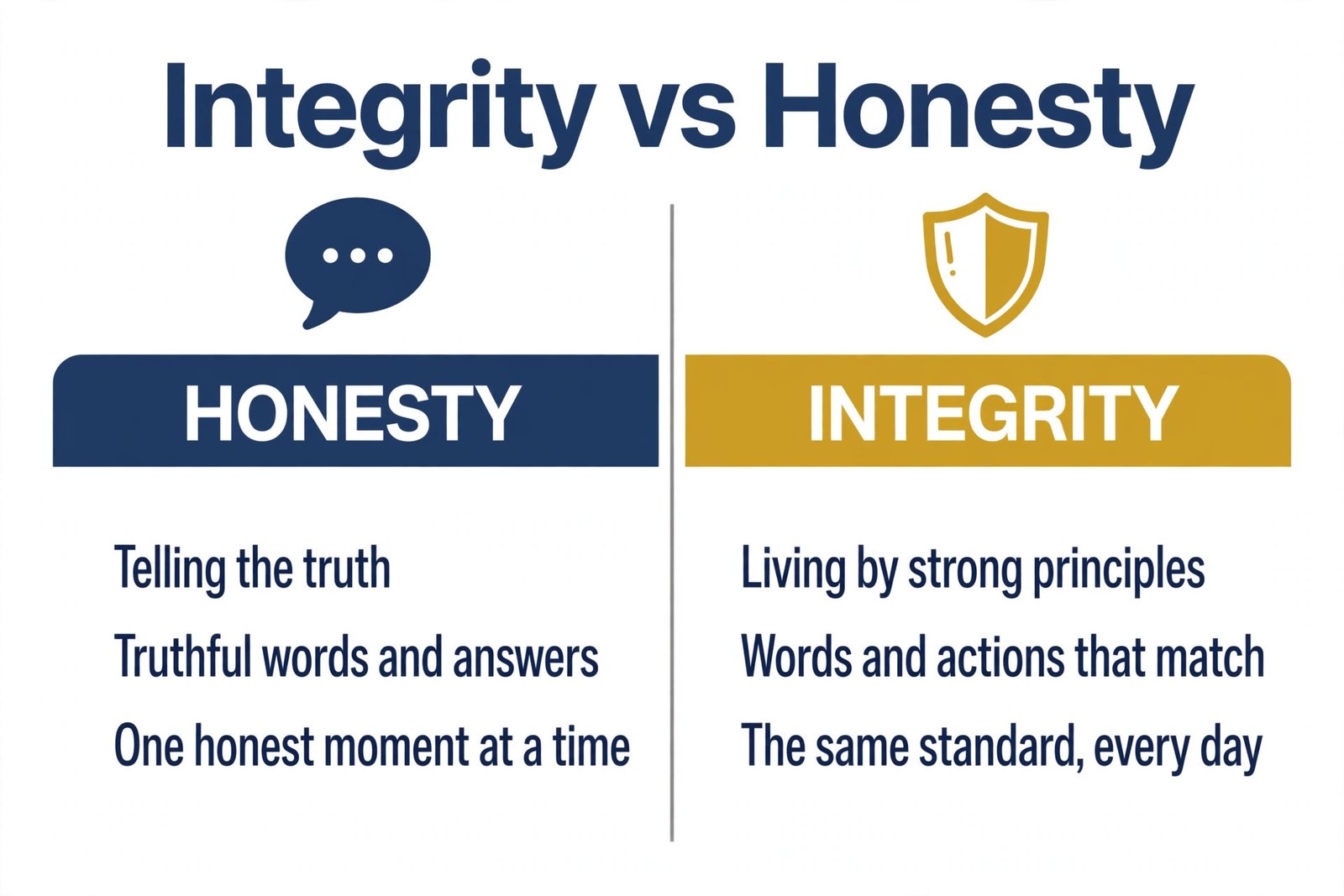
Many readers treat the two words as identical, yet the integrity meaning is wider than the meaning of honesty. Honesty is about telling the truth. Integrity includes honesty, but it also covers consistency, responsibility, and moral courage across every situation.
Consider a simple comparison. An honest employee admits, when asked directly, that a report contains a mistake. An employee with integrity goes further: they report the mistake before anyone asks, correct it, and adjust their process so it does not happen again. In short, honesty answers a question truthfully, while integrity acts on the truth without waiting to be questioned.
| Aspect | Honesty | Integrity |
|---|---|---|
| Main focus | Telling the truth | Living by strong moral principles |
| Scope | Individual words and answers | Whole character and behaviour |
| Timing | Often a single moment | A consistent pattern over time |
| Pressure test | Telling the truth when asked | Doing right when nobody is watching |
| Example | Admitting a mistake when confronted | Admitting and fixing a mistake unprompted |
Therefore, honesty is best understood as one essential part of integrity rather than a full substitute for it. A person can be honest in one conversation yet still lack integrity if their wider behaviour contradicts their stated values. Conversely, genuine integrity is almost impossible to imagine without honesty underneath it.
Signs of a Person with Integrity
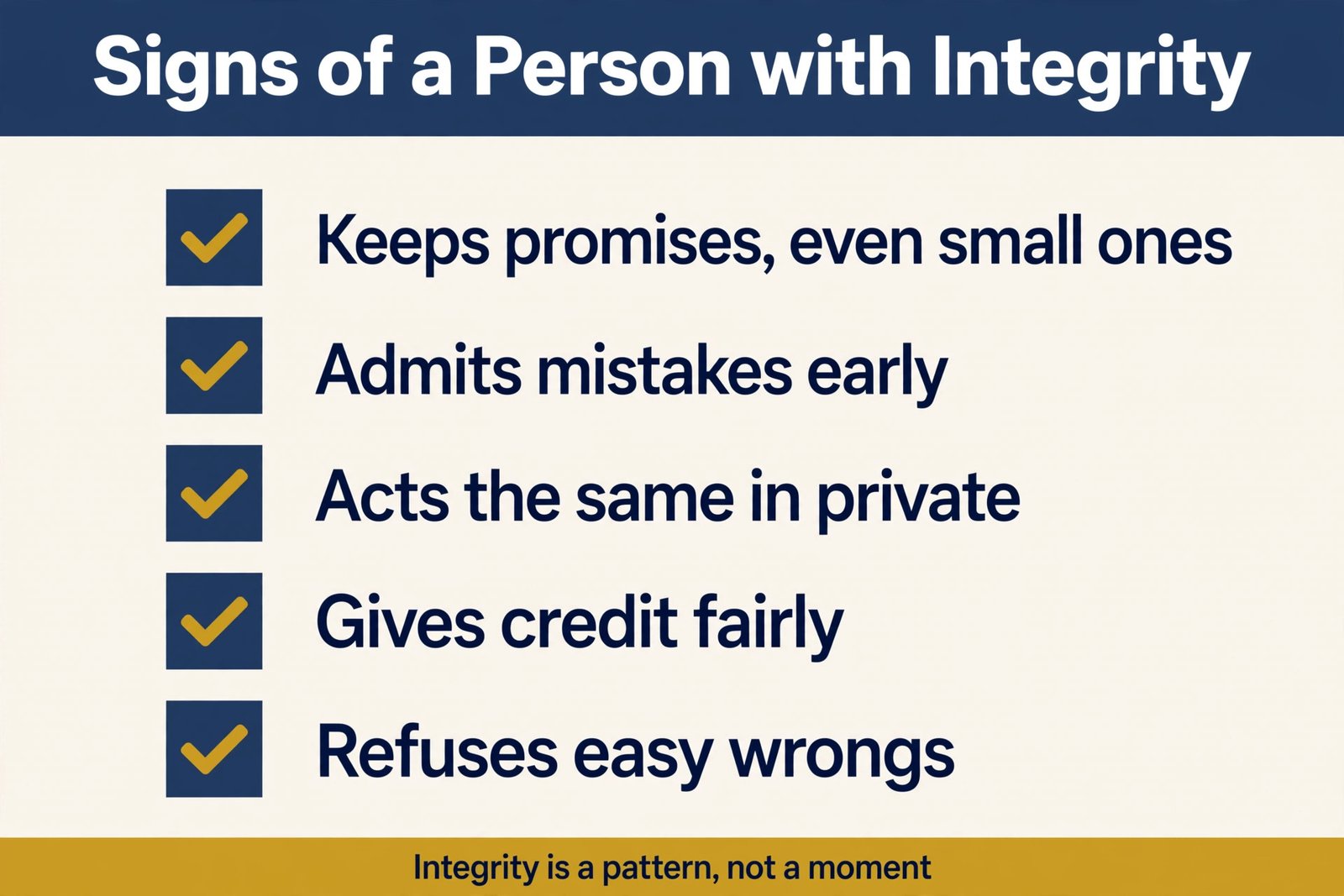
Certain habits reveal the quality long before a dramatic test arrives. If you want to recognise the integrity meaning in real behaviour, look for the following signs.
- They keep their word. When they promise something, the promise is treated as a commitment, not a suggestion.
- They admit mistakes early. Instead of hiding errors, they raise them quickly and help repair the damage.
- They act the same in private. Their behaviour does not change when an audience disappears, because the standard is internal.
- They give credit fairly. Rather than absorbing praise meant for others, they name the people who actually did the work.
- They refuse easy wrongs. Shortcuts that involve cheating, lying, or exploiting someone are rejected even when profitable.
- They treat everyone consistently. Junior staff, strangers, and senior leaders all receive the same basic respect.
- They accept responsibility. When something under their control fails, excuses are rare and explanations are honest.
None of these signs requires wealth, talent, or status. Instead, each one is a repeatable choice, which is precisely why integrity can be developed rather than merely admired.
How to Build Integrity: Practical Habits
Fortunately, integrity is not a fixed label handed out at birth. Because it is built from repeated choices, ordinary habits can strengthen it steadily over time.
Start with Small Promises
First, practise on commitments so small they seem trivial. Arrive when you said you would arrive. Send the message you said you would send. Consequently, your brain begins to treat your word as binding, and larger promises become easier to honour later.
Decide Your Standards in Advance
Next, write down the lines you will not cross, before a tempting situation tests them. For example, decide in advance that you will not copy work, pad expenses, or repeat unverified gossip. When the moment arrives, the earlier decision does most of the work, so willpower is not carrying the full load alone.
Admit and Repair Mistakes Quickly
Mistakes do not destroy integrity; hiding them does. Therefore, when you get something wrong, acknowledge it promptly, apologise where an apology is due, and repair what can be repaired. In practice, people usually trust someone more after an honest repair than they did before the mistake, because the repair proves the standard is real.
Check Your Private Behaviour
Finally, use the simplest test available: ask whether you would behave the same way if the action were public. If the honest answer is no, the behaviour probably conflicts with your principles. Regularly asking that question keeps private habits aligned with public values, which is the very heart of the integrity meaning.
Integrity Synonyms and Antonyms
Precise vocabulary helps writers describe the quality from different angles. The lists below gather the closest matches and clear opposites.
Synonyms for Integrity
Common synonyms include honesty, uprightness, probity, rectitude, honour, sincerity, trustworthiness, and moral strength. Each synonym highlights a slightly different shade. For instance, probity stresses proven honesty, while rectitude emphasises correct moral judgement. Nevertheless, integrity remains the broadest term, because it combines the shade of wholeness with all the others.
Antonyms for Integrity
On the opposite side stand dishonesty, deceit, corruption, hypocrisy, and duplicity. A hypocrite, in particular, represents the exact reverse of the integrity meaning: their public values and private behaviour point in opposite directions. Similarly, corruption describes integrity abandoned for personal gain, especially by someone in a position of trust.
How to Use Integrity in a Sentence
Seeing the word inside natural sentences fixes its usage firmly. The following examples cover personal, academic, professional, and structural contexts.
- The judge was respected across the country for her integrity and fairness.
- He showed real integrity when he returned the wallet with every note still inside.
- Our company protects the integrity of customer data with strict security checks.
- She refused the bribe, because her integrity mattered more to her than the money.
- Academic integrity requires students to submit work that is genuinely their own.
- After the storm, engineers inspected the bridge to confirm its structural integrity.
- A leader of integrity admits failure openly instead of blaming the team.
- They questioned his integrity after the documents were quietly changed.
Notice how the same word moves comfortably between character and condition. In the first, second, fourth, seventh, and eighth sentences, it describes a person’s moral quality. In the third and sixth, by contrast, it describes the completeness or soundness of data and of a structure.
FAQs
Is integrity something you are born with, or can it be learned?
Integrity is mainly learned and practised rather than inherited. Children absorb early lessons from the adults around them, and adults continue shaping the quality through repeated choices. Because every kept promise and honest admission strengthens the habit, the quality can grow at almost any age.
What does the phrase “a person of integrity” mean?
The phrase describes someone whose honesty and moral principles are so consistent that other people rely on them without hesitation. It is a compliment about character, not about skill or intelligence. When a reference letter calls an applicant a person of integrity, it signals that the applicant’s word and conduct can be trusted.
Can someone with integrity still lie to protect another person?
This question divides ethicists, because it sets two values against each other: truthfulness and protection. Most everyday definitions of integrity focus on consistency with your own considered principles rather than on one rigid rule. Therefore, a person who weighs the conflict honestly and accepts responsibility for the choice is usually judged differently from someone who lies for convenience or gain.
What is the difference between integrity and character?
Character is the wider term: it covers all of a person’s moral qualities, including kindness, courage, patience, and integrity. Integrity is one part of character, specifically the part concerned with honesty and consistency between values and actions. In other words, character is the whole picture, while integrity is the frame that holds it together.
Why do employers ask about integrity in interviews?
Employers ask because integrity predicts behaviour they cannot directly supervise. A worker who reports problems honestly, handles money carefully, and treats clients fairly protects the organisation every day. Consequently, interview questions about past mistakes or difficult choices are really tests of whether a candidate’s principles survive pressure.
Conclusion
In summary, the integrity meaning combines honesty with strong, steady moral principles: saying what is true, doing what is right, and staying consistent whether or not anyone is watching. From a returned wallet to a refused bribe, the examples share one pattern — values first, convenience second. Moreover, the quality is practical rather than abstract, because it can be recognised through clear signs and strengthened through small daily habits. For more plain-word explanations of everyday English, browse the Meanings section at jokeriddle.com and keep building a vocabulary that says exactly what you mean.


Leave a Comment