
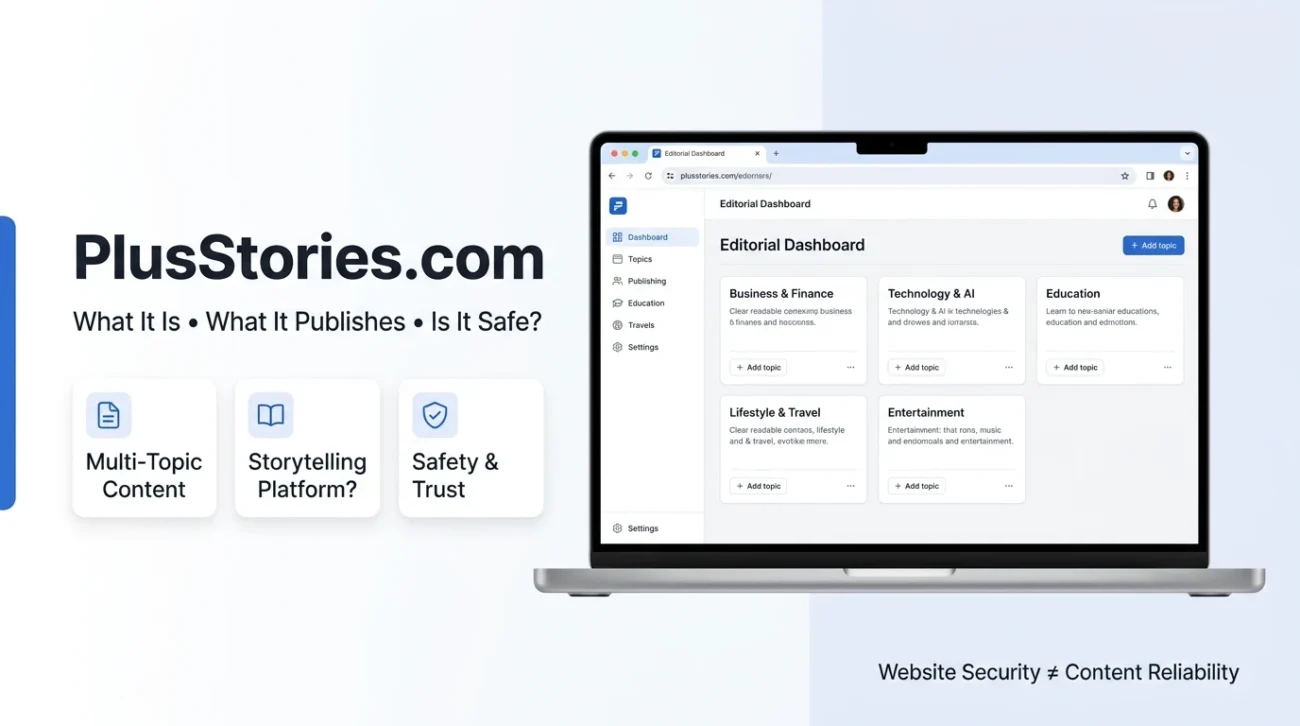
If you have come across PlusStories com, you may wonder whether it is a storytelling website, a general blog, or a broader content platform. The domain name suggests a focus on stories, but the site’s actual content gives a clearer picture of what it does.
This guide explains what PlusStories.com is, what topics it covers, how readers can use the site, and how to evaluate its security and content reliability.
What Is PlusStories.com?
PlusStories.com is a content-focused website that publishes articles across multiple subject areas rather than focusing only on traditional storytelling.
Its content can cover topics such as business, finance, technology, education, lifestyle, travel, and entertainment. Based on that broad scope, it is more useful to view PlusStories.com as a multi-topic content website than as a dedicated storytelling community.
The domain name can create a different expectation. “PlusStories” may sound like a platform for personal stories, fiction, or community submissions. However, a domain name does not necessarily describe every function a website provides.
The site’s current content, navigation, article formats, and publishing features provide better clues about its actual purpose.
What Is the Main Purpose of the Website?
The site appears to provide informational and editorial content across several areas of interest.
Instead of focusing on one narrow niche, a multi-topic publication can attract readers searching for information about business, technology, lifestyle, entertainment, and other subjects.
This broad approach also means readers should assess individual articles on their own merits.
One article may provide a useful introduction to a topic, while another may require additional verification. The site’s overall category does not automatically confirm the accuracy of every article it publishes.
What Does PlusStories.com Actually Publish?

PlusStories.com covers multiple topics rather than operating within one specific niche.
Its content can be grouped into several broad areas.
Business, Finance and Entrepreneurship
Business-related content can discuss companies, entrepreneurship, money, professional development, and broader business topics.
These articles may help general readers understand a subject without requiring specialist knowledge.
However, business and financial information can change quickly. Prices, regulations, company details, financial figures, and market conditions can become outdated.
When an article discusses time-sensitive information, check its publication or update date and verify important claims with authoritative sources.
Technology, AI and Education
Technology content can cover software, artificial intelligence, digital tools, online services, and emerging technologies.
Education-related articles may explain concepts, trends, tools, or general knowledge in an accessible format.
These subjects require particular attention to dates because technology changes rapidly. A product feature or AI service described accurately several months ago may no longer work in the same way.
For that reason, the publication date provides useful context when evaluating technology content.
Lifestyle, Travel and Entertainment
The site’s broader content approach can also include lifestyle, travel, entertainment, culture, and everyday interests.
These subjects often contain a mixture of factual information and editorial opinion.
For example, a travel recommendation represents a different type of information from a factual statement about a company or government policy.
Readers should therefore distinguish between verifiable facts, personal opinions, recommendations, and trend-based commentary.
Is PlusStories.com a Storytelling Platform?
The name PlusStories.com can make the site sound like a dedicated storytelling platform. However, the domain name alone cannot establish that.
A traditional storytelling platform usually offers features such as user-generated stories, author profiles, submission tools, reader communities, serialized fiction, comments, or other publishing functions.
A general publication can also use narrative writing without providing those community features.
The key question is therefore not what the name suggests, but what the website actually allows users to do.
Domain Name vs. Website Function
The word “Stories” in a domain can suggest several possibilities:
- Personal stories
- Fiction
- Community submissions
- Creative writing
- Author publishing
- Narrative articles
None of these functions should be assumed simply because the domain contains the word “Stories.”
Instead, check the site’s navigation, categories, article formats, author information, and publishing options.
If the website mainly presents editorial articles across business, technology, education, lifestyle, travel, and entertainment, its practical role is closer to a general content publication than a specialized storytelling community.
Can Users Publish Their Own Stories?
Publishing articles on a website does not automatically mean that ordinary visitors can submit their own content.
A user-generated storytelling platform usually provides some visible way for contributors to create accounts, submit stories, manage profiles, or publish content.
Therefore, readers should not assume that PlusStories.com accepts public story submissions simply because of its name.
If you want to contribute, check the site’s current contributor, submission, registration, or contact information.
How Does the Website Work for Readers?
The basic experience of a multi-topic content website is straightforward.
A visitor can start from a search result, homepage, or category and then open an article that matches their interests.
A typical path looks like this:
Search or homepage → category or article → article content → author and date → independent verification when needed
This experience differs from a community storytelling platform. On a community site, readers may spend more time following authors, submitting stories, commenting, or interacting with other users.
What Should You Check on an Article Page?
Before relying heavily on an article, look at several basic signals:
- Title: Does it accurately describe the article?
- Publication date: Is the information still current?
- Author: Does the page identify an author or editorial team?
- Sources: Does it support important factual claims?
- Claims: Can significant information be verified elsewhere?
- Purpose: Is the article informational, promotional, opinion-based, or entertainment-focused?
These checks become more important when an article discusses money, technology, legal matters, current events, or another subject where inaccurate information could have practical consequences.
A professional-looking page does not automatically make its information reliable. Readers still need to assess the content itself.
What the Site’s Content Tells Us
The main distinction is between what the website actually presents and what readers might assume from its name.
A website that publishes material across several subjects fits the broader category of a multi-topic content publication rather than a site dedicated exclusively to storytelling.
However, that classification does not answer every other question about the website.
It does not automatically establish the accuracy of every article, the site’s overall trustworthiness, or its current security status.
Those questions require separate checks.
Is PlusStories.com Safe and Trustworthy?

Safety and trustworthiness address different issues.
Website safety concerns technical risks that could affect visitors.
Content reliability concerns whether the information on a page is accurate, supported, and suitable for the reader’s purpose.
A website can have no obvious technical warning while an individual article still contains an unsupported claim. Likewise, a technical warning does not automatically prove that every page on a domain is dangerous.
For that reason, evaluate security and content quality separately.
What Do Security Scanners Check?
Security scanners and website-checking services can examine different technical and reputation signals associated with a domain.
Depending on the service, those checks may include:
- HTTPS configuration
- Malware indicators
- Suspicious redirects
- Potentially harmful scripts
- Domain reputation
- Third-party resources
- Other automated security signals
These tools can provide useful evidence, but they do not replace broader investigation.
A scanner may flag something because of a technical configuration, an automated detection, historical information, or another reputation signal.
The specific reason for the warning matters more than the existence of a warning alone.
Does a Security Warning Mean a Site Is Dangerous?
Not necessarily.
Different warnings can indicate very different situations.
For example, a technical certificate problem is not the same as a confirmed malware detection. A reputation-related warning also does not automatically prove that a page is actively distributing malicious software.
If a scanner flags PlusStories.com, identify the exact warning before drawing a conclusion.
What Should You Do If a Scanner Flags the Domain?
Use the warning as a reason to investigate.
A practical process is:
- Identify the exact warning.
- Check whether other independent security services report the same issue.
- Check the date of the scan or report.
- Determine whether the warning concerns the whole domain, one URL, or a third-party resource.
- Avoid entering sensitive information until you understand the issue.
- Keep your browser and security software updated.
This approach provides more useful information than simply asking whether a website has ever received a warning.
Safe to Visit vs. Reliable Information
This distinction is central to evaluating PlusStories.com.
Website security asks:
Is there evidence of a technical or security risk when accessing the website?
Content reliability asks:
Can the information published on the page be relied upon for a particular purpose?
These questions have different answers.
A website may use HTTPS and show no obvious malware warning while an article contains an unsupported claim.
Likewise, an article may contain useful information even when a technical issue affects part of the website.
A secure connection therefore does not automatically establish editorial credibility.
Why Does This Difference Matter?
Consider an article about finance.
Even if the page appears technically safe, you may still want to know:
- Who wrote it?
- When did the author publish it?
- What sources support the financial claims?
- Are the figures current?
- Does the article separate facts from opinions?
- Can you confirm important information elsewhere?
The same principle applies to technology, education, business, travel, and other subjects.
Security protects the browsing experience; source evaluation helps assess the information.
What Can the Available Evidence Prove?
Website evaluation becomes unreliable when readers treat one limited signal as proof of a much larger claim.
For example, a security scan can show that an automated system detected a particular technical or reputation signal.
It cannot automatically prove that every page on the website is malicious.
Similarly, an article can show that the publisher made a particular claim.
It cannot prove that the claim is accurate simply because the publisher included it.
Positive signals require the same caution. A clean automated scan does not establish that every article on a website is factually reliable.
The strongest assessment comes from combining several relevant pieces of evidence.
How Can You Check an Article’s Reliability?
After separating website security from content quality, evaluate the individual article.
Check the Author
Look for an identifiable author or editorial team.
An author name does not automatically prove expertise, but it gives readers useful context.
For specialized subjects, you can also check whether the author has relevant experience or whether the article clearly identifies itself as general editorial content.
Check the Publication Date
The date can affect how useful an article remains.
Technology, AI, finance, regulations, companies, and online services can change quickly. Even an article that was accurate when published may need an update later.
For evergreen topics, the date may matter less, but it still provides useful context.
Look for Sources
Check whether important factual claims have supporting evidence.
This matters especially when an article discusses statistics, research, government information, company announcements, scientific findings, or other verifiable facts.
If a major claim has no identifiable source, treat it as information that needs further verification.
Separate Facts From Opinions
Not every statement on a website represents an objective fact.
An author’s preference, interpretation, recommendation, or prediction differs from a factual statement about a company, product, regulation, event, or statistic.
Recognizing that difference helps readers avoid treating opinions as established facts.
Verify Important Claims Independently
For information that could affect financial, legal, security, educational, or professional decisions, independent verification is especially important.
Useful sources can include:
- Official government websites
- Company documentation
- Original research
- Recognized institutions
- Primary-source announcements
- Reputable specialist publications
The more important the decision, the less sensible it is to rely on a single general-purpose article.
PlusStories.com at a Glance
| Factor | What to Consider |
|---|---|
| Website type | Multi-topic content publication |
| Main topics | Business, finance, technology, education, lifestyle, travel, and entertainment |
| Storytelling identity | The name suggests stories, but the site’s actual content and features provide better evidence |
| Reader experience | Browse categories or articles and evaluate individual content |
| Security | Check current technical and security signals |
| Content reliability | Review the author, date, sources, and claims |
| Security vs. trust | Technical safety and editorial reliability are separate questions |
| Important information | Verify consequential claims with authoritative or primary sources |
Frequently Asked Questions
Is PlusStories.com a storytelling website?
The name suggests a storytelling focus, but the site’s actual content and features provide better evidence of its function. A website that publishes articles across several categories is better described as a multi-topic content site than as a dedicated storytelling community.
Is PlusStories.com safe to visit?
Check current technical and security signals rather than relying on the domain name or one automated score. If a security service raises a warning, investigate the specific issue and compare it with independent sources.
Is PlusStories.com trustworthy?
Trustworthiness depends on both technical signals and content quality. Check the article’s author, date, sources, and important claims instead of relying on a simple yes-or-no label.
Can I publish my own stories on PlusStories.com?
Do not assume that the site accepts public submissions because of its name. Check for a current contributor, submission, registration, or publishing system before concluding that visitors can publish their own stories.
Should I trust information from PlusStories.com?
Treat the site as a starting point for research when appropriate. For important claims, compare the information with authoritative or primary sources before relying on it.
Conclusion
PlusStories.com is easier to understand when you look at its actual content instead of relying on the expectations created by its domain name.
Its broad subject coverage makes it more comparable to a multi-topic content publication than a dedicated storytelling community.
Security and content reliability also require separate evaluation.
A security scanner can provide useful technical information, but one automated warning or rating does not provide a complete assessment of a website. Likewise, the absence of an obvious security warning does not prove that every article is accurate.
For readers, the practical approach is simple: check current security signals when needed, review the author and publication date, look for supporting sources, and independently verify important claims.
This gives you a more useful picture of PlusStories.com than either automatically trusting the site or dismissing it based on a single signal.


Leave a Comment