
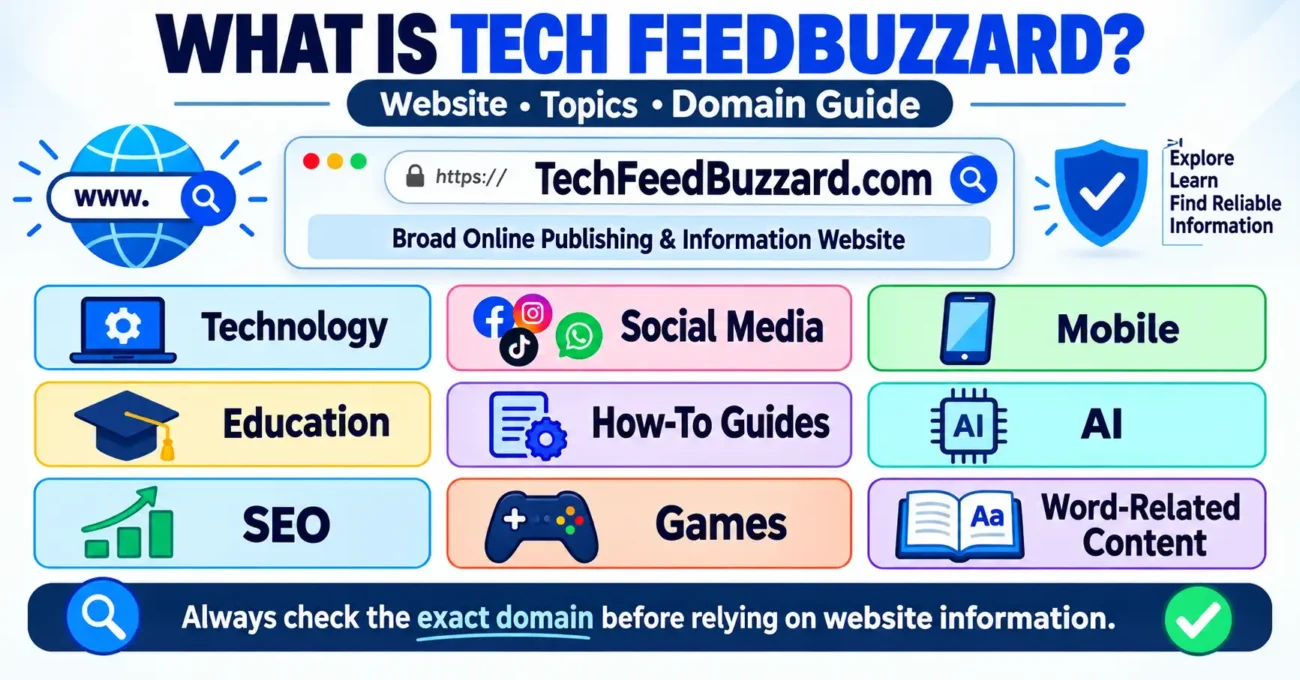
Tech FeedBuzzard is primarily associated with a broad online publishing website that covers technology, social media, mobile devices, education, how-to guides, AI, SEO, games, and other informational topics. If you searched for tech feedbuzzard, you may be trying to understand what the website is, what you can find there, and whether it is a technology platform, blog, or something else.
The easiest way to understand it is to look at the website’s current structure rather than relying on descriptions from third-party pages. Its visible navigation includes technology, social media, education, how-to, games, mobile, AI, SEO, and word-related content.
For a similar website-focused guide, you can also read this PlusStories.com overview to see how another domain is explained and evaluated. If you are confused about the site’s purpose, categories, or similarly named websites, this guide explains what the current website presents and how to evaluate the information you find there.
What Is Tech FeedBuzzard?
Tech FeedBuzzard is an online information and publishing website that provides articles and guides across several digital and general-interest subjects.
The website describes itself as a place for detailed guides covering different categories rather than as a narrowly focused technology service. Its current homepage includes articles about social media, mobile devices, technology, education, games, AI, SEO, and other topics.
This means the name can be slightly misleading if you expect a website devoted only to breaking technology news.
Instead, think of it as a multi-topic information website with a strong technology and digital-content focus.
What Kind of Website Is It?
The current site has the typical structure of an online publishing platform:
- Articles and guides
- Topic categories
- Search functionality
- Recent posts
- Author information
- Contact and policy pages
- Category archives
The homepage also shows dated articles and individual authors, which makes it function more like a content website than a standalone software application.
What Does the Website Cover?
The site’s current navigation gives a useful picture of the subjects readers can expect to find.
Technology
The technology section focuses on explanations, guides, and information about developments in the digital world.
This can be useful when you want a straightforward explanation rather than highly technical documentation.
For example, a reader who wants to understand a technology concept can use an explanatory article as a starting point before checking the original documentation or manufacturer information when necessary.
Social Media
Social media is another major part of the site’s current structure.
The navigation includes areas related to Facebook, Instagram, TikTok, and WhatsApp. Current articles also cover practical questions involving social-media features, settings, and terminology.
This makes the website useful for readers who are looking for simple explanations of social-media features.
However, social platforms frequently change their interfaces and policies. If an article gives instructions for a setting, check whether the instructions match the current version of the platform.
Mobile
The mobile category covers information about smartphones and mobile-related topics.
The current navigation includes brands such as OPPO, Infinix, iPhone, and Vivo.
This type of content can help readers compare information or understand a phone-related topic, but official manufacturer pages remain the better source for specifications, warranty details, software support, and other information that can change over time.
Education
The website also has an education category.
It is designed around guides related to educational tools, platforms, techniques, and learning methods. The site states that this area is intended for students, teachers, and parents.
How-To Guides
The How To section focuses on practical instructions.
This is one of the more useful categories for people who are searching because they have a specific problem to solve.
For example, instead of simply explaining what a platform does, a how-to article may focus on completing a particular task or changing a particular setting.
AI and SEO
The current navigation also includes separate AI and SEO categories.
These subjects change quickly, so readers should pay attention to article dates and verify important claims against current documentation.
Games and Word-Related Content
Games and word-related material are also part of the website’s broader category structure.
This reinforces the point that the site is not limited to traditional technology reporting.
Is Tech FeedBuzzard a Blog, App, or News Platform?
The current website is best understood as an online publishing and information platform.
Its visible structure consists of articles, categories, archives, authors, and guides. There is no need to treat it as a dedicated downloadable application simply because some content discusses apps or technology.
Is It an App?
The website itself is accessed through a web browser and is structured around published articles.
Therefore, calling it a dedicated app would not accurately describe its primary web presence.
Is It a News Aggregator?
The site should also not automatically be classified as a news aggregator.
A news aggregator generally collects or organizes content from multiple external publishers. The current website instead presents its own articles and category pages.
That distinction matters because readers may use the site for explanations and guides rather than expecting it to function like a personalized news-feed application.
Is It Only a Technology Blog?
No.
Technology is an important category, but the current navigation shows a wider range of subjects, including social media, education, how-to content, mobile, games, AI, SEO, and word lists.
Tech FeedBuzzard vs. Similarly Named Websites

Searches for this topic can sometimes produce similarly named domains. They should not automatically be treated as one organization or one website.
| Domain | Current public focus |
|---|---|
| TechFeedBuzzard.com | Multi-topic information and guide website covering technology, social media, mobile, education, how-to topics, AI, SEO, games, and more |
| TechFeedBuzzard.net | Presents itself as an educational technology platform focused on software, AI, cybersecurity, programming, gadgets, and emerging technology |
| FeedBuzzard.com | Presents technology, world technology, and wearable technology content |
The important lesson is simple: check the exact domain before assuming that information from one site applies to another. The similarly named websites have different public descriptions and content structures.
How Can You Tell What the Website Is About?
If you arrive at the site from a search engine, you do not need to guess what it does.
Use these quick checks.
1. Look at the Main Navigation
The navigation gives you an immediate picture of the website’s subject areas.
Here, the visible categories include technology, social media, education, how-to, games, mobile, AI, and SEO.
2. Look at Recent Articles
Recent posts can tell you what the site is actually publishing now.
This is more useful than relying only on an old description because websites can change their category structures and editorial focus.
3. Check the Article Category
Every article should be considered in the context of its category.
A social-media guide, for example, should not automatically be treated as evidence that the entire site specializes in social media.
4. Check the Date
Technology-related information can become outdated quickly.
An article explaining a social-media feature or software setting may be accurate when published but require an update after an interface or policy change.
5. Check the Author
The current site displays author information alongside articles.
Author information can help readers understand who published the material and gives them another point to investigate when an article makes an important technical claim.
Is the Information Useful?
That depends on what you are trying to accomplish.
For general research, explanations, definitions, how-to guidance, and introductory technology information, a publishing website can be a useful starting point.
For important technical decisions, however, it is better to use the article as one source rather than the only source.
For example:
- Software instructions: Check the developer’s documentation.
- Phone specifications: Check the manufacturer’s website.
- Social-media policies: Check the platform’s official help center.
- Security warnings: Check the software vendor or security organization.
- Important financial or legal information: Check the appropriate authoritative source.
This approach gives you useful context while reducing the chance of relying on outdated information.
How Should You Verify an Article Before Acting on It?
A simple verification process can prevent many common mistakes.
Check the Exact Claim
Do not verify only the article title.
Identify the specific statement you need to rely on.
For example, if an article says a certain setting exists, the useful question is whether that setting currently exists in the platform’s latest version.
Check the Date
Look for the publication or update date.
A recent date does not automatically guarantee accuracy, but an old date can be an important warning when the topic changes frequently.
Find the Primary Source
When possible, trace important information back to the organization that actually controls the product, service, platform, or policy.
This is particularly important for technical instructions and specifications.
Compare Conflicting Information
If two pages provide different instructions, do not simply choose the one that sounds more convincing.
Check the official source and determine whether one page is outdated or discussing a different version of the product.
Use Google’s Helpful-Content Guidance
Google recommends creating useful, reliable, people-first content and encourages creators to consider factors such as originality, completeness, sourcing, authorship, accuracy, and whether the page genuinely satisfies the reader’s goal.
You can read the full guidance here:
Google Search Central: Creating Helpful, Reliable, People-First Content
This is also a useful reference when evaluating the quality of informational websites in general.
What Should You Be Careful About?
The main issue is not simply whether a website contains useful information. The more important question is whether the specific information is current and appropriate for your situation.
Fast-Changing Technology
AI tools, apps, operating systems, social-media platforms, and software products can change frequently.
Instructions should therefore be checked against current information when the task is important.
Outdated Guides
An older article may still explain a concept correctly while showing an interface that no longer exists.
If the buttons or menus described in an article do not match what you see, check for an updated version.
Product Information
If you are using an article to research a smartphone, software product, or other technology purchase, verify specifications and availability through the manufacturer or official seller.
Security Information
Be particularly careful when an article asks you to install software, change account settings, disable security features, or provide personal information.
For security-sensitive actions, use official documentation whenever possible.
Similar Domain Names
This is another reason to check the address bar.
A similar name does not prove that two websites are operated by the same organization.
When Is This Website a Good Starting Point?
It can be useful when you need a readable explanation of a digital topic.
You may find it helpful for:
- Understanding unfamiliar technology terms
- Learning about social-media features
- Finding how-to information
- Exploring mobile-related topics
- Getting an introduction to AI or SEO
- Discovering related questions
- Reading general educational guides
The best approach is to use the content according to the importance of the decision.
For a basic question, an explanatory article may be enough.
For a high-impact decision, use the article as a starting point and confirm the details with the relevant primary source.
Frequently Asked Questions
What is tech feedbuzzard?
It refers to a technology-related search term associated with a broad online publishing website. The current site covers technology along with social media, mobile, education, how-to guides, AI, SEO, games, and other topics.
What topics does the website cover?
Its current navigation includes technology, social media, education, how-to content, games, mobile, AI, SEO, and word-related categories.
Is it an app?
The website’s primary presence is a browser-based publishing platform rather than a dedicated app.
Can beginners use the website?
Yes. Much of the site’s structure is based around guides and explanatory articles, making it suitable as a starting point for readers who want straightforward information.
Should I verify information before using it?
For ordinary educational reading, you can use the articles as a source of information. For important technical, security, purchasing, financial, or legal decisions, it is better to verify the relevant details through authoritative or primary sources.
Why do search results sometimes show similarly named websites?
Similar names can cause search engines and readers to encounter different domains. Always check the exact address before assuming that two sites are the same.
Final Takeaway
Tech FeedBuzzard is a broad online information and guide website rather than a narrowly focused technology-only service.
Its current structure covers technology, social media, mobile devices, education, how-to guides, games, AI, SEO, and other topics.
The most practical way to use the website is to start with the information you need, check the article’s date and author, and verify important claims against the appropriate primary source.
Most importantly, do not identify a website only by its name. When similarly named sites appear in search results, check the exact domain before attributing information to a particular publisher.
That simple habit helps you understand what you are actually reading and prevents information from one website from being incorrectly attributed to another.


Leave a Comment