
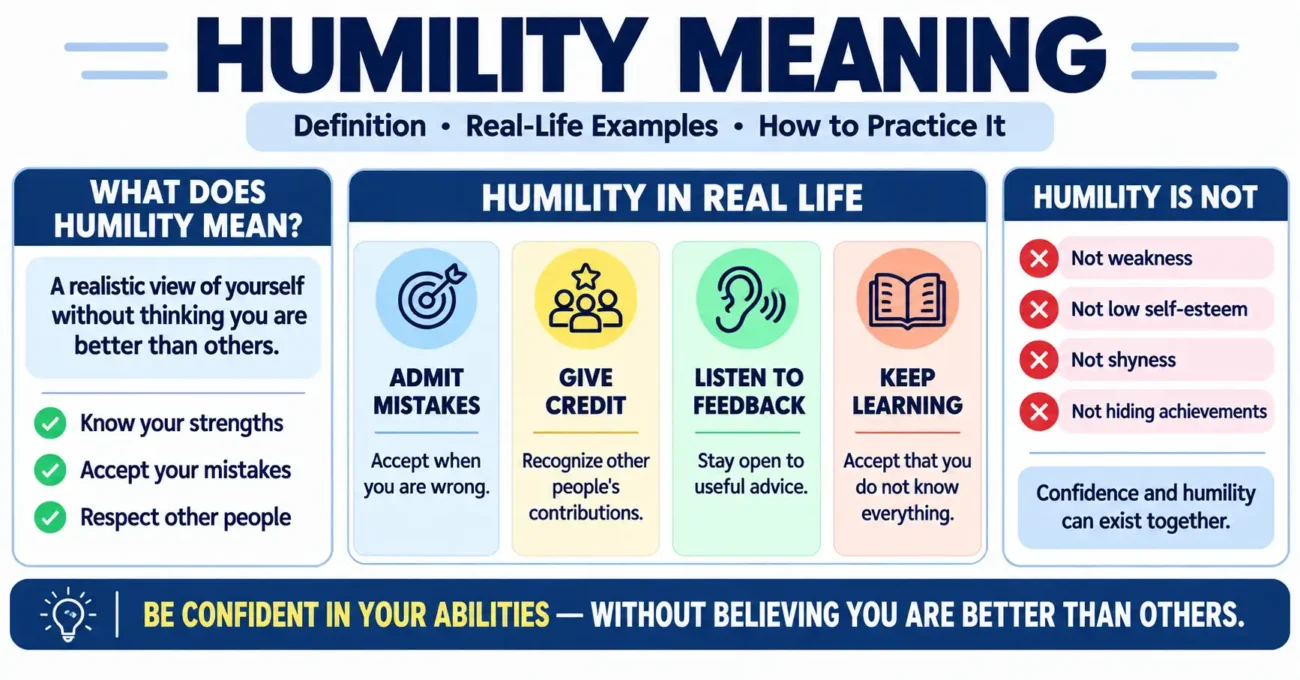
Humility meaning is having a realistic view of yourself without thinking you are better than other people. A humble person knows their strengths, accepts mistakes, listens to others, and gives credit where it belongs. Humility does not mean thinking you are worthless or hiding your abilities.
Many people confuse humility with weakness, shyness, or low self-esteem. However, a person can be confident, successful, and talented while still being humble. The difference is in how they see themselves and treat the people around them.
If you are exploring the meaning of personality-related words, you can also read our guide to pedantic meaning to understand how the word is used in everyday English.
What Is the Humility Meaning?
The humility meaning can be explained simply as having a balanced view of your own importance and abilities. You can recognize what you do well without believing that your skills make you more valuable than everyone else.
A humble person may be proud of an achievement while still recognizing that other people have useful ideas, experiences, and abilities.
Common signs of humility include:
- Admitting when you are wrong
- Listening to other people’s opinions
- Giving credit to people who helped
- Accepting useful feedback
- Asking for help when necessary
- Recognizing your strengths without bragging
- Treating people with respect
This balanced attitude is an important part of understanding the humility meaning in everyday life.
What Does Humility Look Like in Real Life?
The meaning of humility becomes easier to understand when you look at real situations.
Admitting Mistakes
A humble person can admit an error instead of making excuses or blaming someone else.
For example, if you give incorrect information at work, you can acknowledge the mistake, correct it, and move forward.
Giving Credit to Others
Suppose you complete a successful project with several coworkers. Instead of taking all the praise, you recognize the people who contributed.
This does not mean ignoring your own effort. It means recognizing that success can involve more than one person.
Listening to Feedback
A humble person does not automatically treat criticism as an attack.
They can listen to feedback, consider whether it is useful, and make changes when necessary.
Being Willing to Learn
Nobody knows everything. Someone with humility can learn from another person, even when they already have considerable experience.
Being willing to learn does not make you less capable. It shows that you understand there is always room to improve.
What the Humility Meaning Does Not Include
Understanding what humility is also requires understanding what it is not.
Humility Is Not Weakness
Being humble does not mean being passive or unable to stand up for yourself.
You can be confident, ambitious, assertive, and strong while maintaining a respectful attitude toward others.
Humility Is Not Low Self-Esteem
Low self-esteem involves having a negative view of yourself. Humility is different.
A humble person may think:
“I am good at this, but I still have more to learn.”
That is very different from:
“I am not good enough.”
Humility Is Not Shyness
Shyness and humility describe different things.
A shy person may avoid attention because social situations feel uncomfortable. A humble person may be comfortable speaking publicly but simply does not need to prove that they are superior.
Humility Does Not Mean Hiding Achievements
You do not need to pretend that your accomplishments do not exist.
You can acknowledge a promotion, qualification, award, or successful project without using it as proof that you are better than everyone else.
Humility Meaning vs. Modesty, Confidence, and Arrogance

The humility meaning becomes clearer when you compare it with related qualities.
- Humility: Having a realistic view of yourself while respecting others.
- Modesty: Avoiding excessive self-praise or attention.
- Confidence: Trusting your abilities or judgment.
- Arrogance: Acting as though you are superior or more important than others.
Humility and Confidence
Humility and confidence can exist together.
For example, a skilled employee can trust their abilities while still asking a colleague for advice. Confidence says, “I can handle this,” while humility recognizes, “I can still learn something from someone else.”
Humility and Modesty
Modesty and humility overlap, but they are not exactly the same.
Modesty often describes how someone presents their achievements or abilities. Humility involves a broader attitude toward personal importance and other people.
Humility and Arrogance
Arrogance involves an exaggerated sense of superiority. Humility moves in the opposite direction by allowing a person to recognize their abilities without looking down on others.
How Can You Practice Humility?
Knowing the humility meaning is useful, but applying it in daily life matters more.
Listen Before Responding
Give people a chance to explain their ideas before immediately defending your own position.
Admit When You Are Wrong
If you make a mistake, acknowledge it instead of creating unnecessary excuses.
Give Credit
When someone contributes to your success, recognize their effort.
Ask for Help
Asking for guidance does not make you incapable. It can show that you recognize an opportunity to learn.
Accept Useful Feedback
Not every opinion is correct, but useful feedback can help you identify areas for improvement.
Keep Success in Perspective
Celebrate your achievements without allowing them to become a reason to look down on other people.
Frequently Asked Questions About Humility
What is the simple humility meaning?
The simple humility meaning is having a realistic view of yourself without believing that you are better or more important than other people.
Can you be confident and humble?
Yes. Confidence and humility can exist together. You can trust your abilities while remaining open to learning from others.
Is humility the same as modesty?
No. Modesty often relates to how someone presents their achievements, while humility involves a broader attitude toward yourself and other people.
What is the opposite of humility?
Arrogance and excessive pride are commonly viewed as opposites because they involve an inflated sense of personal importance.
Does humility mean thinking less of yourself?
No. Humility does not mean believing that you are worthless. It means having an accurate view of both your strengths and limitations.
Conclusion
The humility meaning is best understood as having a balanced view of yourself. You can recognize your strengths, enjoy your achievements, and feel confident without believing that you are better than everyone else.
In everyday life, humility can appear through listening, admitting mistakes, giving credit, asking for help, and remaining willing to learn. It is not weakness, low self-esteem, or shyness.
When practiced properly, humility allows you to recognize your own value while respecting the value and contributions of other people. For a dictionary definition and pronunciation, see the Cambridge Dictionary guide to humility.


Leave a Comment