
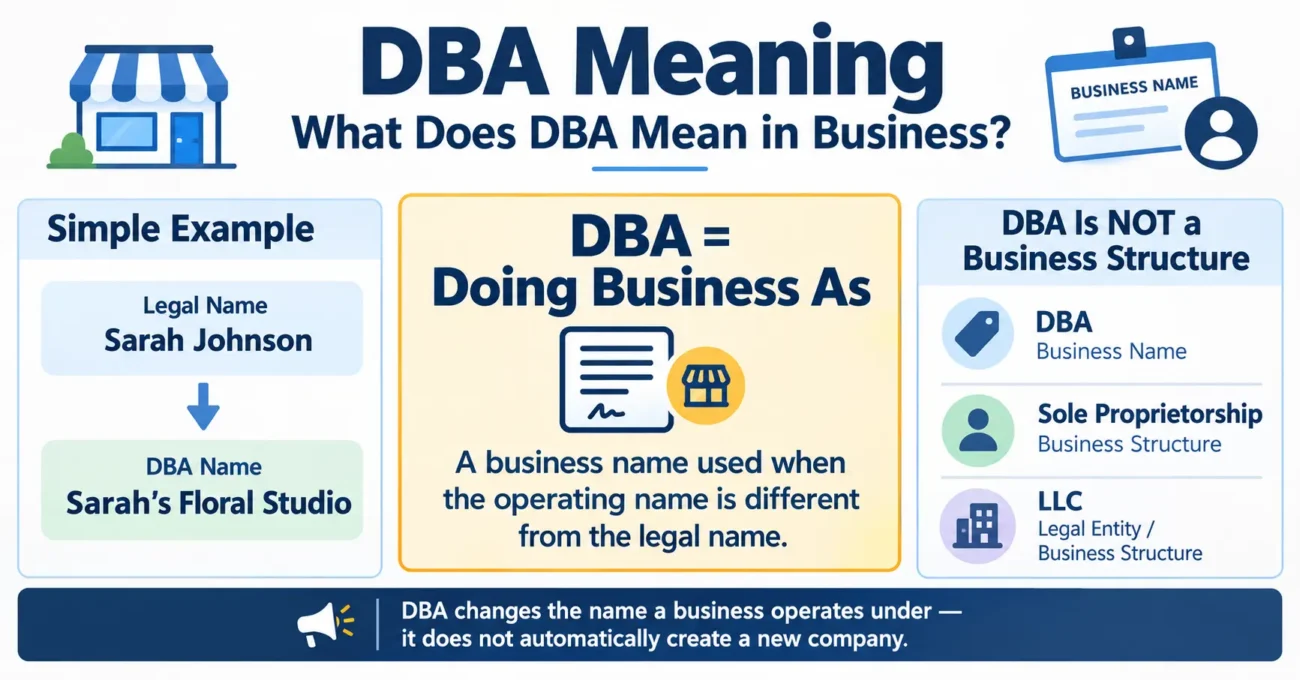
DBA means “doing business as.” In business, a DBA is generally a name that a person or business uses to operate publicly when that name is different from its legal name. In other words, a DBA can let a business use a name that customers see and recognize without necessarily changing the underlying business structure.
If you searched for DBA meaning, you may be trying to figure out more than what the abbreviation stands for. You may have seen a DBA name on a business document, wondered whether it is the same as the company’s legal name, or asked whether a sole proprietor can have a DBA. The key is understanding that a Disposition Meaning is primarily about the name a business operates under, not automatically about creating a new company.
Before going further, you may be asking:
- What exactly is a DBA name?
- Is a DBA the same as a legal business name?
- Can a sole proprietor use a DBA?
- Does having a DBA mean you have an LLC?
- Do you need to register a DBA?
- Does a DBA create a separate company?
This guide answers those questions step by step so you can understand what DBA means, how it works, and what it actually changes about a business.
What Does DBA Mean in Business?
DBA stands for “doing business as.” It refers to a business name used by a person or business when the name they operate under is different from their legal name.
For example, imagine that Sarah Johnson runs a small floral business. Her legal name is Sarah Johnson, but she wants customers to know the business as Sarah’s Floral Studio. If that name is properly used or registered as required in her jurisdiction, “Sarah’s Floral Studio” can be her DBA name.
The important point is that DBA describes the business name, not the business structure.
A DBA does not automatically mean that Sarah formed an LLC or corporation. She could be operating as a sole proprietor, an LLC, a corporation, or another type of business structure and use a DBA where the applicable rules allow it.
What does DBA mean on a business document?
You may also see the abbreviation written as “d/b/a.” It means the same thing: doing business as.
For example:
Sarah Johnson d/b/a Sarah’s Floral Studio
This tells you that Sarah Johnson is the person or legal business identity associated with the operation, while Sarah’s Floral Studio is the name being used to conduct business publicly.
That distinction is often the source of confusion. Seeing a different business name does not automatically mean that a completely separate legal company exists.
What Is a DBA Name?
A DBA name is the name a person or business uses to conduct business under a name that differs from its legal name.
Depending on the jurisdiction, similar concepts may be called an assumed name, trade name, fictitious business name, or fictitious name. The terminology and filing requirements can vary, so the exact legal treatment depends on where the business operates.
The easiest way to understand it is to think of two names serving different purposes:
- Legal name: identifies the person or legal business entity.
- DBA name: identifies the name under which the business operates publicly.
For example:
| Business information | Example |
|---|---|
| Owner | Sarah Johnson |
| Legal identity | Sarah Johnson |
| DBA name | Sarah’s Floral Studio |
| What customers see | Sarah’s Floral Studio |
The DBA gives the business a recognizable operating name, but the DBA itself does not automatically become a new legal entity.
Why would someone use a DBA name?
A business owner may want to operate under a name that is more suitable for customers than the owner’s personal or legal name.
For example, a sole proprietor could technically conduct business under their own name but prefer to present the business as “Bright Path Consulting.” A DBA can provide a way to use that business name where the applicable local rules permit and require it.
This is why understanding the difference between a business name and a business structure is so important. Choosing or registering a DBA does not by itself answer the separate question of whether the business is a sole proprietorship, LLC, corporation, or another structure.
DBA Example: Legal Name vs. DBA Name
A simple example makes the distinction clearer.
Suppose Michael Carter runs a small home-repair business.
He could operate using:
Legal name: Michael Carter
But he may want customers to know the business as:
DBA: Carter Home Repair
If the applicable jurisdiction allows and requires the use of that DBA, customers may interact with Carter Home Repair, while the underlying legal identity remains connected to Michael Carter or to whatever legal entity owns the business.
What changes when a DBA is used?
The main change is the name used to represent the business publicly.
Instead of presenting the business only under the owner’s or entity’s legal name, the business can operate under its registered or otherwise legally recognized DBA name.
That can affect how the business is presented to customers and how its business name appears on certain documents or accounts, depending on local requirements.
What does not automatically change?
A DBA does not automatically create an LLC, corporation, or other separate legal entity.
It also does not, by itself, answer questions about liability protection, taxation, ownership, or the underlying business structure.
That is why someone researching a DBA should avoid treating these terms as interchangeable:
DBA = business name arrangement
Sole proprietorship = business structure
LLC = legal entity/business structure
Keeping these concepts separate prevents one of the most common misunderstandings about DBA names.
Is a DBA a Business Structure?
No. A DBA is generally not a business structure. It is a name under which a person or business operates.
This distinction matters because a person can potentially use a DBA while operating under a particular business structure.
For example:
- A sole proprietor may use a DBA instead of operating only under their personal name.
- An LLC may use a DBA if the relevant jurisdiction permits it and the required steps are completed.
- A corporation may also operate under another business name where permitted.
So the question “Do I have a DBA?” is different from “What type of business am I?”
The first question concerns the name being used. The second concerns the legal or organizational structure of the business.
How Does a DBA Work for a Sole Proprietorship?
A sole proprietor can often use a DBA when they want to operate under a business name that is different from their personal legal name. The DBA gives the business a separate public-facing name, but it does not by itself turn the sole proprietorship into a separate legal entity.
For example, imagine David Miller provides graphic-design services as a sole proprietor. He could operate under his own name, but he may prefer to present the business to customers as Miller Creative Studio.
If the applicable jurisdiction requires registration of that name, David would need to follow the relevant DBA or assumed-name requirements.
The basic relationship would look like this:
Owner: David Miller
Business structure: Sole proprietorship
DBA name: Miller Creative Studio
The important distinction is that “Miller Creative Studio” is the business name being used, while “sole proprietorship” describes the underlying business structure.
Why would a sole proprietor use a DBA?
Using a DBA can make it easier to present a business under a professional or brand-specific name instead of the owner’s personal name.
For example:
Personal name: Emma Wilson
DBA: Wilson Photography
This can make the business name more recognizable to customers while allowing the owner to continue operating under the chosen business structure.
However, the DBA should not be confused with legal protection. Simply using a DBA does not automatically separate the owner’s personal assets from the business or provide the protections associated with forming a separate legal entity.
Why Do Businesses Use a DBA?
Businesses use DBAs for several practical reasons, especially when the name they want customers to see is different from their legal name.
One common reason is branding. An owner may want a memorable business name instead of using a personal name.
Another is customer recognition. A specialized business name can make it immediately clearer what the business offers.
For example:
- Legal identity: Robert Lee
- DBA: Lee Digital Marketing
The DBA makes the business activity more obvious to customers.
A business may also use a DBA when its existing legal entity wants to operate under another public-facing name, subject to the applicable rules.
The important point is that a DBA is primarily about how the business is named and presented, not about creating a new business structure.
What Is the Difference Between a Legal Name and a DBA?
The simplest distinction is this:
A legal name identifies the person or legal entity, while a DBA identifies an alternate name used to conduct business.
Consider this example:
| Legal Name | DBA Name | |
|---|---|---|
| Example | Michael Carter | Carter Home Repair |
| Main purpose | Identifies the person/entity | Identifies the operating business name |
| What customers may see | May not be the public-facing brand | Often used as the public-facing name |
| Creates a new entity? | Depends on the underlying structure | No, not by itself |
| Main concept | Legal identity | Business name |
The exact terminology and legal treatment can vary depending on the jurisdiction and business structure, but this distinction is useful when reading business records.
Why the difference matters
Suppose you see:
Michael Carter d/b/a Carter Home Repair
The phrase tells you that Carter Home Repair is the name under which Michael Carter is doing business.
It does not, by itself, tell you that Carter Home Repair is an LLC, corporation, or other separate legal entity.
To determine the actual legal structure, you would need to look at the relevant business records or registration information.
Do You Need to Register a DBA?
Whether you need to register a DBA depends on where the business operates, how it is structured, and the name being used.
There is no single worldwide rule saying that every business must register a DBA in exactly the same way. Different jurisdictions may use different terms and impose different filing requirements.
If you plan to operate under a name that differs from your legal name, check the requirements of the relevant state, county, municipality, or other government authority before using the name commercially.
A typical process may involve:
- Identifying the correct government authority.
- Checking whether the desired business name is subject to registration.
- Searching for name conflicts where required.
- Submitting the appropriate assumed-name or DBA filing.
- Paying any applicable filing fee.
- Following renewal or publication requirements if applicable.
These steps are general guidance rather than a universal legal procedure. The exact process can be different from one jurisdiction to another.
Does registering a DBA create a company?
No. Registering a DBA does not automatically create a new LLC, corporation, or other separate legal entity.
If a person operates as a sole proprietor and registers a DBA, the person generally remains a sole proprietor.
Likewise, an existing LLC may register or use a DBA without becoming a different type of business entity.
The key idea is:
A DBA changes the name under which a business operates; it does not automatically change the business’s underlying legal structure.
DBA vs. LLC vs. Sole Proprietorship
These terms are sometimes confused because they can appear together, but they describe different things.
| Term | What it means | Main purpose |
|---|---|---|
| DBA | Doing business as | Provides an alternate business name |
| Sole proprietorship | A business structure | Describes how a person operates a business |
| LLC | Limited liability company | A separate legal entity created under applicable law |
Think of it this way:
DBA → “What name am I using?”
Sole proprietorship → “What business structure am I operating under?”
LLC → “What legal entity have I formed?”
An LLC, for example, could operate under its legal name or potentially use a DBA. A sole proprietor can also potentially use a DBA. The DBA itself does not determine which structure the business has.
What Does d/b/a Mean?
d/b/a means “doing business as.”
It is simply another way of writing DBA and is commonly used when identifying the relationship between a legal name and an operating business name.
For example:
Jennifer Brown d/b/a Brown Design Studio
can be read as:
Jennifer Brown, doing business as Brown Design Studio.
The wording shows that Brown Design Studio is the name under which the business is operating. It does not automatically mean that Brown Design Studio is a separate corporation or LLC.
You may encounter d/b/a on contracts, business records, invoices, registrations, or other documents where both the legal identity and operating name need to be identified.
Is a DBA the Same as a Trademark?
No. A DBA and a trademark serve different purposes.
A DBA generally concerns the name under which a business operates in a particular jurisdiction. A trademark concerns legal protection for a name, phrase, symbol, design, or other identifier used to distinguish goods or services.
Registering a DBA should therefore not automatically be treated as trademark protection.
If a business wants to know whether its brand name has trademark protection, that is a separate legal question that requires separate research.
DBA Meaning: Common Questions People Still Ask
Does having a DBA mean I have an LLC?
No. Having a DBA does not automatically mean you have an LLC. A DBA is an alternate business name, while an LLC is a legal business entity. A sole proprietor, LLC, or another eligible business structure may potentially use a DBA depending on the applicable rules.
Can one person have a DBA without forming an LLC?
Yes, a person may be able to operate as a sole proprietor and use a DBA without forming an LLC. However, the specific registration requirements depend on the jurisdiction. A DBA should not be mistaken for the formation of a separate legal entity.
Can an LLC use a DBA name?
Yes, an LLC may be able to operate under a DBA or assumed business name where the applicable jurisdiction permits it. In that situation, the LLC remains the underlying legal entity, while the DBA is the alternate name used for business operations.
Does a DBA protect personal assets?
A DBA by itself generally does not provide the type of liability separation associated with forming a separate legal entity. If personal-asset protection is the concern, the question is about the underlying legal structure rather than simply whether the business has a DBA.
Is a DBA the same as a trademark?
No. A DBA identifies an operating business name, while a trademark can provide legal protection for qualifying brand identifiers. Registering a DBA does not automatically give the business trademark rights.
Can a DBA have a different name from the owner’s personal name?
Yes. That is one of the main reasons a DBA may be used by a sole proprietor. For example, Laura Green could potentially operate a business under the name Green Event Planning, subject to the applicable naming and registration requirements.
What DBA Means for Your Business
When you see the term DBA, the simplest interpretation is “doing business as.” It usually tells you that a person or business is operating under a name that is different from its legal name.
The most important thing is not to confuse the DBA with the underlying business structure. A DBA is about the name; a sole proprietorship or LLC is about the business structure or legal entity.
So if you are trying to understand a particular business, look at both pieces of information. First, identify the legal person or entity behind the business. Then determine whether the public-facing name is a DBA or another type of registered business name.
If you are planning to use a business name yourself, the next practical step is to check the DBA or assumed-name requirements in the jurisdiction where you operate. That will tell you whether the name needs to be registered and what rules apply to its use.


Leave a Comment