
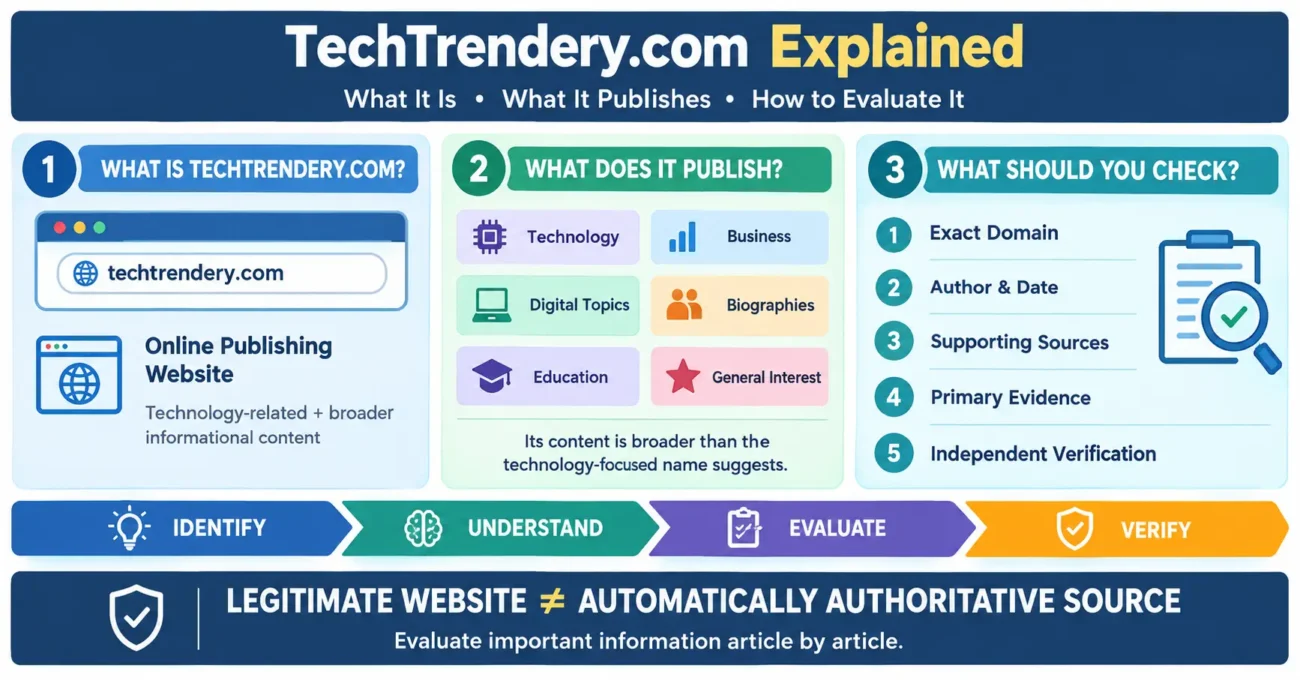
If you searched for techtrendery com, you may be trying to understand more than just what the name means. You may want to know what this website actually is, what kind of content it publishes, and whether it is the technology-focused publication its name seems to suggest.
That confusion is understandable. Tech FeedBuzzard has a strong technology-oriented name, but its public information and current content show a broader picture. The website also describes itself through biographies and stories about influential people, while its published material extends into several other subjects.
What are you likely trying to find out?
- Is TechTrendery.com actually a technology website?
- What topics does the site publish?
- Why does its content appear broader than its name?
- Does “TechTrendery.com USA” refer to a separate American website?
- Can the information published there be trusted?
The easiest way to answer these questions is to first identify the exact website, then look at what it actually publishes and what the site itself says about its purpose. From there, questions about location, legitimacy, and article reliability can be judged separately rather than treating them as one issue.
What Is TechTrendery.com?
TechTrendery.com is an active online publishing website that publishes informational articles across multiple subject areas, including technology-related topics. It is not presented on its official pages as a software product, technology tool, or standalone application.
The site’s own About page gives an interesting description of its identity. It says TechTrendery is focused on stories behind remarkable lives, including biographies of influential figures, historical icons, innovators, leaders, artists, and other people whose experiences may interest readers. It also describes its team as writers and researchers who work on these stories.
That description matters because the domain name alone can create a different expectation.
Someone seeing “TechTrendery” for the first time could reasonably expect a site dedicated to technology news, gadgets, software, artificial intelligence, or digital trends. But the site’s official description is broader and places significant emphasis on people, biographies, and life stories.
There is also a public Contact page where the site invites questions, suggestions, business inquiries, and collaboration requests. Its Terms and Conditions identify techtrendery.com as the website and state that its content is provided for informational purposes.
So, based on the information that can be directly verified, the safest description is:
TechTrendery.com is a multi-topic online publication with technology-related content, rather than assuming from its name alone that it is a dedicated technology-news organization.
That distinction becomes clearer when you look at the subjects it actually publishes.
What Does TechTrendery.com Actually Publish?
TechTrendery.com does publish technology-related material, but its editorial footprint is wider than technology alone.
Current third-party reviews of the live site describe content spanning technology, business, digital marketing, health, education, biographies, travel, entertainment, and other general-interest subjects.
This means there are two different things worth separating:
The domain name:
TechTrendery sounds strongly technology-focused.
The visible content:
The publication covers technology alongside a broader collection of subjects.
That does not necessarily mean anything is wrong with the website. Online publications can change their categories, add new subjects, or expand their editorial direction over time.
It does mean that describing TechTrendery.com simply as a technology-only website would be too narrow.
What the Official About Page Says
The official About page currently presents TechTrendery primarily as a platform for discovering the stories behind remarkable people. It specifically mentions biographies, influential figures, historical icons, innovators, leaders, artists, visionaries, and other individuals.
It also says the site covers people from different fields, including science and technology pioneers as well as cultural figures and activists.
This creates an important distinction between the site’s stated editorial mission and the broader material that appears in its current publishing activity.
The responsible way to describe that difference is not to assume why it happened. The available public information does not establish exactly when or why the site’s content direction expanded.
Instead, treat the evidence in two layers:
- Verified fact: The official About page describes a biography- and people-focused mission.
- Verified observation: Third-party reviews of the live site report a wider range of technology and general-interest topics.
- Interpretation: The site’s current editorial footprint appears broader than its official About-page description.
That approach is more accurate than forcing the website into a single category based only on its name.
Why the Name Can Be Misleading
The word “Tech” naturally makes visitors expect a technology publication.
If you are looking for an article about AI, software, web development, smart technology, or another digital subject, that expectation may be reasonable. But if you browse further, you may encounter content that has little direct connection to technology.
That is why the better question is not:
“Does TechTrendery sound like a technology site?”
The better question is:
“What does the exact domain actually publish?”
For evaluating a website, the second question is much more useful because it is based on observable content rather than branding.
Is TechTrendery.com Based in the USA?
The phrase “TechTrendery.com USA” creates another layer of confusion.
If you searched that exact phrase, you may be wondering whether TechTrendery.com has a separate U.S. edition, whether the company is headquartered in America, or whether “USA” is simply being added to the search because you want information relevant to American readers.
Based on the public information reviewed, there is no clear evidence establishing a separate official TechTrendery.com USA edition or a confirmed U.S. headquarters. Current third-party reviews also make this distinction rather than treating “USA” as the name of a separate website.
The domain itself does not prove an American location.
A .com Domain Does Not Mean “U.S.-Based”
A .com domain is not a country-code domain.
For example, a website using .com can serve readers in the United States, Pakistan, the United Kingdom, Canada, or many other countries. Therefore:
.com ≠ U.S. headquarters
The same principle applies to content.
A website can publish:
- U.S.-focused technology articles
- American product information
- content about U.S. businesses
- information relevant to American consumers
without that proving the publisher is physically headquartered in the United States.
So if you see “TechTrendery.com USA”, do not automatically interpret “USA” as proof of a separate company, branch, or American edition.
It is more accurate to treat it as a search phrase connected with the website and its relevance to U.S. readers unless the publisher provides stronger evidence of a dedicated U.S. operation.
What Can Actually Be Verified?
The official pages reviewed identify the website as TechTrendery and provide public site information, including its About, Contact, and Terms pages. However, those pages do not establish a separate U.S. edition or clearly verified U.S. headquarters.
That distinction is important because it prevents a common mistake: turning a search modifier into a business fact.
If your real question is whether an article on TechTrendery.com is reliable, the location question is only one small part of the answer. The more useful evaluation is to look at the individual article itself—who wrote it, when it was published, what evidence it provides, and whether important claims can be confirmed elsewhere.
Is TechTrendery.com Legit?
If by “legit” you mean whether TechTrendery.com appears to be a functioning online publication rather than simply an abandoned or nonexistent domain, there are several public signals worth checking.
The website has an active public presence, publishes articles, and maintains pages such as About Us, Contact Us, and Terms and Conditions. Its Terms page identifies TechTrendery.com as the website and explains that its content is intended for informational purposes.
Those are useful signs of an operating website, but they should not be stretched into a stronger conclusion than the evidence supports.
A functioning website does not automatically mean that every article is accurate, every author is an expert, or every claim has been independently verified.
That distinction is especially important when the site covers many different subjects.
What the Available Evidence Tells You
There is reasonable evidence that TechTrendery.com operates as an online publishing website:
- The domain has publicly accessible content.
- The website provides an About page describing its purpose.
- A Contact page is available for inquiries.
- Terms and Conditions are publicly available.
- Articles are published across multiple subject areas.
These points support the interpretation that the website is a functioning publication.
They do not, by themselves, establish that every piece of information on the site is authoritative.
That is why “legitimate website” and “reliable information source” should be evaluated separately.
Can You Trust Information Published on TechTrendery.com?

The better answer is article by article.
You do not need to automatically reject information because a website covers multiple subjects. At the same time, you should not automatically accept an article simply because it appears on an established-looking domain.
A useful reliability check starts with the article itself.
Check Who Wrote the Article
Look for a named author and, where available, information about that author’s expertise.
This matters because the level of expertise needed depends on the subject.
An article explaining a basic technology term does not require the same level of authority as an article making claims about medical treatment, financial decisions, legal rights, cybersecurity, or safety.
If an article makes an important claim but gives you no meaningful way to evaluate who produced it, treat that as a reason to investigate further.
Check the Publication or Update Date
Some information changes quickly.
Technology specifications, software features, pricing, regulations, security recommendations, and business information can become outdated even when an article was originally accurate.
Before relying on a TechTrendery.com article for a current decision, check when it was published or last updated.
A useful rule is simple:
The more time-sensitive the claim, the more important the date becomes.
Look for Supporting Sources
A strong informational article should make important claims reasonably easy to investigate.
Look for:
- links to primary sources
- official documentation
- research papers where relevant
- statements from named organizations
- credible supporting references
- evidence that allows you to check the original claim
If a statement sounds unusually specific but provides no supporting evidence, do not treat the wording itself as proof.
Separate Information From Promotion
A website article can be informative while also being commercially motivated.
Look for signs that an article is recommending:
- a product
- a service
- a company
- a website
- a software tool
- an affiliate offer
That does not automatically make the information false. It simply means you should understand the purpose of the content before treating its recommendations as neutral conclusions.
Be More Careful With High-Stakes Topics
The need for verification becomes much stronger when the article concerns something that could materially affect your health, finances, legal position, security, or safety.
For those subjects, TechTrendery.com—or any general publication—should not automatically be your only source.
Instead, use the article as a starting point and confirm important claims with the appropriate primary or authoritative source.
For example, a technology article can help you understand a concept, while official documentation can confirm how a particular product or service actually works.
The same principle applies across other subjects:
Useful information is not automatically authoritative evidence.
How Should You Verify a TechTrendery.com Article Before Relying on It?
If you find a TechTrendery.com article through Google or another search engine and want to know whether you should rely on it, use a simple verification process.
1. Check the Exact Article, Not Just the Domain
Start with the article’s title and URL.
Make sure you are looking at techtrendery.com, rather than a similarly named domain.
This matters because websites with similar names can easily be confused in search results.
Do not assume that two domains are operated by the same organization simply because their names look similar.
2. Check the Author and Date
Look for the author’s name and the publication or update date.
Then ask:
- Is the subject time-sensitive?
- Does the author appear qualified to discuss it?
- Could the information have changed since publication?
This takes only a few seconds and can prevent you from relying on outdated information.
3. Trace Important Claims to the Original Source
Suppose an article says that a company launched a product, a government introduced a rule, or a technology works in a particular way.
Instead of stopping at the article, look for the original evidence.
For technology, that might be:
- official product documentation
- the manufacturer’s announcement
- a developer’s documentation
- a company filing
- an official government source
The closer you can get to the primary source, the easier it becomes to judge whether the article has represented the information correctly.
4. Compare Important Information With Independent Sources
You do not need five websites for every simple fact.
But if a claim is important, controversial, unusually specific, or likely to affect a decision, compare it with another credible source.
Pay particular attention when different sources disagree.
Instead of asking:
“Which website sounds more convincing?”
ask:
“Which source provides the strongest evidence?”
That shift makes online research much more reliable.
5. Treat High-Stakes Claims Differently
For medical, financial, legal, security, or safety-related information, do not stop after reading one article.
Use the article to understand the issue, then verify the relevant details through an authoritative source or qualified professional where appropriate.
This is not specific to TechTrendery.com. It is a sensible standard for almost any general-interest publication.
When Is TechTrendery.com Useful—and When Should You Verify Further?
TechTrendery.com can be useful when you want to:
- discover a topic
- get a basic explanation
- find ideas for further research
- learn terminology
- explore technology or general-interest subjects
- identify questions that you want to investigate more deeply
You should verify further when:
- the information could have changed
- the article makes a major factual claim
- the article lacks useful supporting sources
- the subject is highly technical or specialized
- the information affects health, money, legal rights, privacy, or safety
- you are about to make an important decision based mainly on the article
The practical rule is straightforward:
Use a general publication to understand the topic, but use stronger primary or authoritative evidence when the accuracy of a specific claim really matters.
Frequently Asked Questions About TechTrendery.com
Is TechTrendery.com only a technology website?
No. Although the domain name sounds technology-focused and the website publishes technology-related material, its current content appears broader than technology alone. The official About page also describes the publication around biographies and stories about influential people.
Is TechTrendery.com a USA website?
There is not enough public evidence to treat “TechTrendery.com USA” as the name of a separate official U.S. edition. A .com domain also does not prove that a website is headquartered in the United States. If location matters, look for explicit company or contact information rather than inferring it from the domain.
Does TechTrendery.com have an app?
TechTrendery.com should be treated as a website unless an official page establishes a separate application. Do not assume that a website has an app simply because third-party pages or search results mention one. For this type of claim, the safest approach is to check the official domain for a direct app listing or announcement.
Are similarly named TechTrendery domains the same website?
Not necessarily. Similar names do not establish common ownership. If you encounter another domain using “TechTrendery,” check its exact URL, About page, contact information, and other identifying details before assuming it is connected to techtrendery.com.
Should you use TechTrendery.com as your only source?
For ordinary topic discovery, it can be one useful source. For important factual claims, especially information that changes frequently or affects health, finances, legal matters, security, or safety, verify the information against appropriate primary or authoritative sources rather than relying on one general publication.
The Bottom Line on TechTrendery.com
TechTrendery.com is best understood by looking beyond its technology-sounding name.
It operates as an online publishing website, publishes technology-related material, and also covers a broader range of subjects. Its official About page presents a particular editorial identity centered on biographies and influential people, while its wider visible publishing activity gives the site a broader footprint.
The important distinction is between a legitimate functioning website and a universally authoritative information source. The first can be assessed from the site’s public presence and pages; the second needs to be judged at the article level.
So if you find a TechTrendery.com article in search results, do not accept or reject it based only on the domain name. Check the exact article, author, date, supporting evidence, and original sources. If the claim is important, verify it independently.
That approach gives you a much more useful answer to the real question behind “techtrendery com”: not simply what the website is called, but whether the particular information you found is strong enough to rely on.


Leave a Comment