
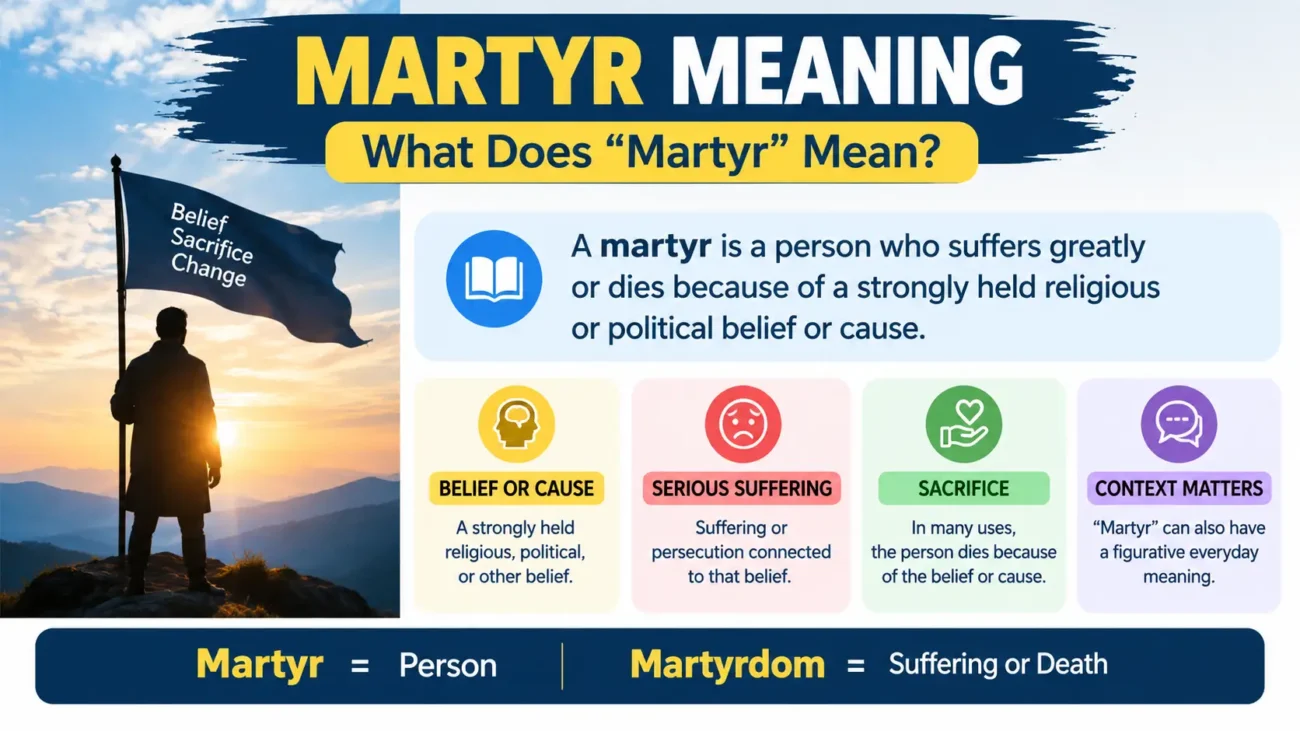
The word martyr is usually used for a person who suffers greatly or dies because of their religious or political beliefs. The word can also describe someone who is admired for making that sacrifice. In everyday English, however, martyr can have a different, figurative meaning when someone presents themselves as suffering in order to receive sympathy.
If you searched for martyr meaning, you may be trying to understand more than a dictionary definition. You may want to know what makes someone a martyr, how the word is used in religious contexts, what it means in ordinary conversation, or why someone might be described as “playing the martyr.” This guide explains those Pedantic meanings clearly so you can understand the word and recognize it when you see or hear it.
What Does Martyr Mean?
A martyr is a person who suffers greatly or is killed because of their religious or political beliefs. The word is often used when that person remains committed to a belief or cause despite serious suffering or death.
In simple terms, a martyr is someone who suffers or dies because of what they believe in.
The idea becomes clearer when you look at the elements usually associated with the word:
- A belief or cause: The person is connected to a religious, political, or other strongly held belief.
- Serious suffering: The person may experience severe punishment, persecution, or hardship because of that belief.
- Death or sacrifice: In many uses, the person is killed because of their beliefs. However, the word can also have broader uses involving great suffering.
- Recognition or admiration: A martyr may be remembered or admired because of the sacrifice they made.
For example, if a person is killed specifically because of their religious beliefs, that person may be described as a religious martyr. Similarly, someone who dies because of a political cause may be described as a martyr to that cause.
The important point is that martyr is not simply another word for someone who dies or suffers. The person’s beliefs or cause and the reason for their suffering are central to the meaning.
What Does Martyr Mean in Religion?
In a religious context, a martyr is generally someone who suffers or dies because of their faith or religious beliefs. The word is therefore often used when discussing people who remained committed to their religion despite persecution or the threat of death.
The religious meaning is especially important because martyrdom is associated with the idea that a person does not abandon their beliefs even when doing so could protect them from serious harm.
For example, a person who is killed because they refuse to renounce their religious beliefs may be described as a martyr. In this context, the word emphasizes both the person’s suffering and the belief for which they suffered.
Why Is Martyrdom Connected With Faith?
Martyrdom refers to the suffering or death of a martyr, particularly when it occurs because of religious or political beliefs.
This explains why the words martyr and martyrdom are closely connected:
- Martyr = the person
- Martyrdom = the suffering or death associated with being a martyr
The exact way martyrdom is understood can vary between religious traditions and historical contexts. For a general English-language meaning, however, the central idea is suffering or death connected to deeply held beliefs.
What Does Martyr Mean in Everyday Language?
The word martyr is not limited to religion or historical discussions. In everyday English, it can also be used figuratively.
In this sense, a person may be called a martyr when they repeatedly emphasize how much they suffer, how much work they do, or how much they sacrifice in order to receive sympathy from other people.
For example, imagine someone volunteers to take on extra work, even though nobody asked them to, and then repeatedly complains about how difficult their life has become because of that decision. Another person might say:
“She is playing the martyr again.”
Here, the speaker is not saying that the person is a religious or political martyr. Instead, “martyr” is being used figuratively to describe someone who appears to emphasize their own suffering to gain sympathy.
What Does “Playing the Martyr” Mean?
“Playing the martyr” means behaving as though you are suffering unfairly or sacrificing yourself, often in a way that is intended to make other people feel sympathy for you.
For example:
“He offered to handle the entire project, then spent the week playing the martyr because he had too much work.”
The phrase usually has a negative or critical tone. It suggests that the person may have chosen the situation themselves but is now presenting themselves as though they had no choice.
This everyday meaning should not be confused with the serious religious or political meaning of martyr. Context tells you which meaning is intended.
How Do You Pronounce Martyr?
Martyr is pronounced differently in British and American English, although the difference is relatively small.
- British English: /ˈmɑː.tər/
- American English: /ˈmɑːr.t̬ɚ/
A simple approximation is:
MAR-ter
The first part sounds like “mar”, followed by a short “ter” sound.
One reason pronunciation can seem confusing is that the spelling martyr does not immediately tell an English learner how the word sounds. Listening to the pronunciation alongside seeing the word written can make it easier to remember.
What Is the Difference Between a Martyr and a Victim?

A martyr and a victim can both experience suffering, but the two words do not mean the same thing.
A victim is generally someone who is harmed, injured, or affected by another person, event, or circumstance. A martyr, by contrast, is specifically associated with suffering or death because of a belief, principle, or cause.
The key difference is why the person suffered.
| Term | Basic meaning |
|---|---|
| Victim | Someone who suffers harm because of an event, action, or circumstance |
| Martyr | Someone who suffers or dies because of a strongly held belief or cause |
For example, a person injured in an accident can be called a victim of the accident. That does not automatically make the person a martyr.
On the other hand, someone who is killed because they refuse to abandon a religious or political belief may be described as a martyr, because their suffering is directly connected to that belief.
This distinction is useful because not every person who suffers is a martyr. The context and reason for the suffering matter.
What Do Martyrdom and Martyred Mean?
The words martyrdom and martyred come from the same word family as martyr, but they describe different things.
Understanding these related forms can make the meaning of the original word much easier to recognize when reading articles, history books, religious texts, or news reports.
What Does Martyrdom Mean?
Martyrdom refers to the experience, suffering, or death associated with being a martyr.
In particular, it can refer to suffering or being killed because of religious or political beliefs.
For example:
“The story describes his martyrdom.”
Here, martyrdom refers to the suffering or death that made the person a martyr.
A simple way to remember the difference is:
Martyr = person
Martyrdom = the suffering or death
What Does Martyred Mean?
Martyred is the past form of the verb martyr. It is generally used to say that someone was killed or made to suffer because of their beliefs or cause.
For example:
“He was martyred for his beliefs.”
In this sentence, martyred describes what happened to the person, while martyr describes the person.
These three forms are therefore connected:
- Martyr — the person
- Martyred — what happened to the person
- Martyrdom — the suffering or death associated with it
Keeping these differences in mind can prevent confusion when you encounter the words in different sentences.
Where Does the Word Martyr Come From?
The English word martyr has a long linguistic history. It comes through Latin from the Greek word martys, which originally meant “witness.” Over time, the word became closely associated with people who were witnesses to their faith and suffered or died because of their beliefs.
This history helps explain why the modern meaning is connected to both belief and sacrifice.
The original idea of a witness developed into the more specific concept of a person whose commitment to a belief was demonstrated through severe suffering or death.
You do not need to know the complete historical development of the word to use it correctly, but understanding its origin explains why martyr has such a strong connection with belief, testimony, and sacrifice.
How Do You Use Martyr in a Sentence?
The word martyr can be used in different contexts, depending on what you are describing.
Religious or Historical Context
“The community remembered him as a martyr for his faith.”
Here, martyr refers to someone who suffered or died because of religious belief.
Political or Cause-Related Context
“He was remembered as a martyr to the cause.”
Here, the word is connected to a cause rather than simply describing an ordinary death.
Everyday Figurative Context
“Stop playing the martyr and let someone else help you.”
In this sentence, martyr is being used figuratively. It does not mean that the person literally died or suffered persecution for a belief.
When Reading the Word in Context
- If you are unsure which meaning is intended, look at the words surrounding martyr.
- If the sentence discusses faith, persecution, death, or a cause, the serious or literal meaning is likely intended.
- If it discusses complaining, sacrifice, sympathy, or someone emphasizing how much they do for others, the figurative meaning may be intended.
This context-based approach is especially useful because the same word can have both a serious historical meaning and an everyday figurative meaning.
Frequently Asked Questions About Martyr Meaning
Does martyr always mean someone who dies?
No. The word is strongly associated with death, but it can also describe someone who suffers greatly because of religious or political beliefs. The exact meaning depends on the context.
Can a person be a martyr for a political cause?
Yes. Martyr can refer to someone who suffers or dies because of political beliefs or a political cause, not only religious beliefs.
Is martyr a positive or negative word?
It depends on how it is being used. In a religious or historical context, calling someone a martyr can express respect for their sacrifice. In everyday expressions such as “playing the martyr,” the word can have a negative or critical meaning.
What is the adjective related to martyr?
The word martyred is commonly used as a verb form or participle to describe someone who was killed or suffered because of their beliefs.
What is the plural of martyr?
The plural of martyr is martyrs.
For example:
“The memorial honors several martyrs.”
Conclusion
The simplest way to understand martyr meaning is to focus on the connection between a strongly held belief or cause and serious suffering.
A martyr is generally a person who suffers greatly or dies because of religious or political beliefs. The word can also be used figuratively in everyday English, especially in the expression “playing the martyr,” where someone presents themselves as suffering or sacrificing themselves to gain sympathy.
The related words are also useful to remember: martyr is the person, martyred describes what happened to the person, and martyrdom refers to the associated suffering or death.
So, when you see the word martyr, do not look only at the word itself. Check the context. It may describe a serious religious or political sacrifice, or it may be a figurative expression about someone emphasizing their own suffering.


Leave a Comment