
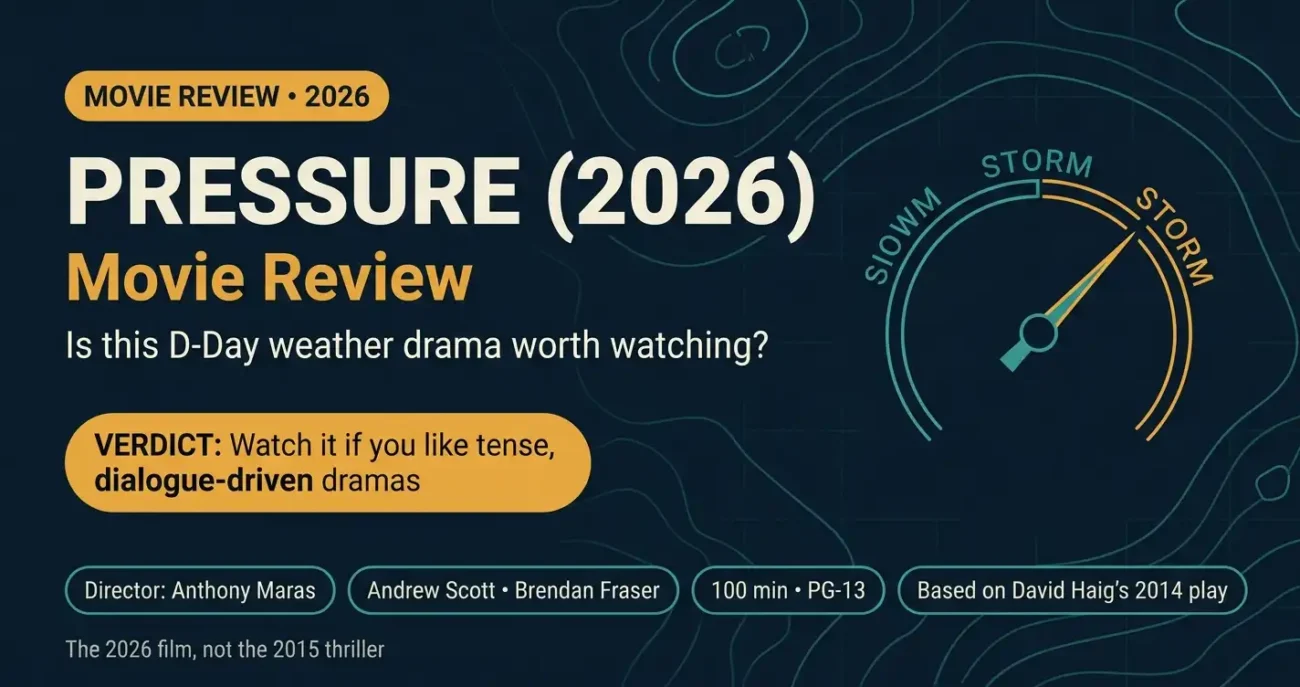
This Pressure movie review covers the 2026 WWII drama directed by Anthony Maras, not the 2015 thriller of the same name. The film spends almost no time on the beaches. Instead, it takes place inside Allied headquarters, where one question hung over D-Day: what will the weather do? It adapts David Haig’s 2014 play and stars Andrew Scott and Brendan Fraser.
If you searched for a Pressure movie review, you probably want to know whether the film deserves your 100 minutes. The marketing makes it look like a battlefield epic, but the reality differs. Knowing what you are signing up for helps before you press play.
Wondering whether this is a real war movie or mostly people talking in rooms? Not sure how much of it actually happened? Trying to decide if the performances justify the praise? This guide walks you through it step by step: what kind of film it is, what works, what doesn’t, how closely it follows history, and whether it suits your taste.
Pressure Movie Review: Quick Verdict
Short answer: yes, if you like tense, dialogue-driven historical dramas. Critics broadly describe it as a well-acted, efficient thriller, and they praise Andrew Scott most consistently. Variety calls it mostly a chamber piece and says the film belongs to Scott. Empire calls it a polished, tightly run WWII thriller anchored by Scott.
This Pressure movie review reflects critical consensus, not a claim of personal viewing.
| At a glance | |
|---|---|
| Director | Anthony Maras |
| Source | David Haig’s 2014 play (Haig co-wrote the screenplay) |
| Main cast | Andrew Scott (James Stagg), Brendan Fraser (Dwight D. Eisenhower), Kerry Condon (Kay Summersby), Chris Messina (Irving Krick), Damian Lewis (Bernard Montgomery) |
| Runtime and rating | 100 minutes, PG-13 (per RogerEbert.com) |
| Type | Historical drama / chamber thriller |
What Kind of Film Is the Pressure Movie?
Imagine you buy a ticket expecting landing craft and gunfire. You get generals, maps, and weather data instead. That is the most important thing to know before watching.
NPR reads the film less as a war story and more as a study of tolerating uncertainty when everyone demands decisiveness. The tension comes from waiting, arguing, and not knowing, not from combat. Empire jokes that anyone who dreads 100 minutes of weather talk should stay away, yet it also notes the film’s old-school pot-boiler energy, including a literal ticking clock.
The premise, without spoilers. The Exercise Tiger rehearsal ended in catastrophe, with more than 700 deaths. Afterwards, the Allied commanders want to control every detail. The biggest unknown is the weather. American meteorologist Irving Krick feels confident about clear skies. Newly arrived British meteorologist James Stagg says storms are likely but he can’t promise it. Eisenhower must decide whose forecast to trust.
Do you need to know D-Day history first? No. Most viewers already know how the invasion ended, and Ebert’s reviewer says the writing feels urgent enough that you almost forget. That is one critic’s view, so your experience may differ, but the film stands on its own.
Performances, Direction, and Script in the Pressure Movie
Andrew Scott, Brendan Fraser, and the Cast
Scott plays Stagg as reserved and stubborn rather than warm. Variety describes a dour chill paired with stoic integrity. Ebert’s reviewer sees a dedicated, supremely competent, decent man, and says Fraser’s expressive eyes add humanity to Eisenhower’s focus and decisiveness.
Chris Messina plays Krick as the counterweight. One reviewer highlights the clash of wills between Stagg and Krick, almost like enemy combatants. Kerry Condon, Damian Lewis, Robert Portal, and Con O’Neill fill out the supporting cast.
Direction, Cinematography, and Script
Maras co-wrote the screenplay with playwright David Haig, and Ebert’s reviewer calls it first-rate. Jamie Ramsay’s cinematography adds a muted hint of sepia. Variety also spots a streak of dry comedy that lifts the film. In a May 2026 interview, Maras said his team gained access to original 35mm footage from 80 years ago. Check for yourself how much of that footage reaches the final cut.
Where the Film Falls Short
Familiarity is the main complaint. One reviewer on Rotten Tomatoes says the film doesn’t depart much from the standard wartime-drama formula, with a businesslike score and wood-panelled rooms, yet still calls it solidly watchable. Because the drama stays verbal and confined to a few rooms, viewers hoping for surprise or scale may find it restrained.
Is the Pressure Movie Based on a True Story?

Yes, real events and real people drive the story. But “true story” on screen doesn’t mean every scene happened as shown. Here is how to separate solid fact from dramatization.
Verified
- Exercise Tiger was a real rehearsal disaster, and Ebert’s review puts the deaths at more than 700.
- James Stagg and Irving Krick were real figures in the D-Day forecasting. Historical records also show that Eisenhower delayed the invasion by a day over weather concerns.
Claim (made by the film)
- The film opens with the statement “This is a true story” and no “inspired by” hedge. That is the filmmakers’ framing, not proof that every scene is accurate.
Interpretation
- Because the film adapts a stage play, expect the writers to condense and dramatize conversations and rivalries. That is a reasonable expectation, and no review can confirm it scene by scene.
- Ebert’s reviewer notes that the film shows no sign of the rumored Eisenhower–Summersby romance. That suggests the writers avoided unproven claims.
Needs verification
- Krick presents the Gone with the Wind weather story as his own boast. Check whether it happened as he tells it.
- Stagg’s exact rank. Cast listings show “Captain”.
- Specific dialogue and the exact order of meetings.
Practical takeaway: treat the film as a faithful portrait of a real dispute, not a documentary. If accuracy matters to you, read historical accounts of the D-Day forecasting decision afterward.
Who Will Enjoy the Pressure Movie, and Who Should Skip It?

Not every good film suits every viewer. Use this Pressure movie review as a filter, not a rule.
You will probably enjoy it if you:
- like tense, dialogue-driven dramas where people, not armies, clash
- enjoy watching experts argue over incomplete data
- appreciate Andrew Scott’s quiet, controlled acting
- want a shorter historical drama that runs about 100 minutes
You may want to skip it if you:
- expect large-scale battle sequences, since critics describe a chamber piece
- find rooms full of maps and officers slow or repetitive
- want a surprising story, since everyone knows how D-Day ended and some critics call the film formulaic
A good middle path: if you are unsure, watch The Longest Day or Saving Private Ryan first. NPR places Pressure away from the beaches, so it works better as a companion to those films than a replacement.
Still choosing what to watch next? If you prefer a story about one person’s life over a room full of strategists, try our Michael movie review. If you want a period story driven by emotion instead of strategy, our Wuthering Heights movie review is a good place to start.
What Critics and Audiences Say
Critics lean positive, though enthusiasm varies. The Rotten Tomatoes critic summary calls the film a brainy war drama whose thrills come mostly from Scott’s simmering performance. Individual critics range from strong praise for the tension and acting to milder verdicts that call it solid but conventional. One quoted review gives three out of five and praises the lean runtime.
Audience reactions on the same page focus on the leads and the intensity of the historical moment. The pattern stays consistent: both groups praise the acting, and the main reservation is that the film plays it safe.
Needs verification before publishing: the exact Tomatometer and Popcornmeter percentages and review counts change over time. Check the live Rotten Tomatoes page on your publish date and add the current numbers here.
Where to Watch the Pressure Movie
Claim (from Rotten Tomatoes at the time of writing): Rotten Tomatoes lists the film on Peacock with a subscription, and for rent or purchase through Fandango at Home.
Needs verification: streaming rights change often and vary by country. A title on Peacock in the US may not stream on that service elsewhere. After reading this Pressure movie review, check a live tool such as JustWatch, or the platform’s own search, for your region before you pay. If the film doesn’t stream where you live, a digital rental is usually the next option.
Pressure Ending Explained (Spoilers Ahead)
Stop here if you haven’t watched the film.
Because everyone knows how D-Day ended, the “ending” isn’t a twist. It centers on Eisenhower’s decision. Historically, he delayed the invasion by one day, from June 5 to June 6, 1944, after Stagg’s forecast pointed to a short window of acceptable weather between storms.
Within the film, the whole story builds toward that choice: trust Krick’s confident analog prediction or Stagg’s cautious reading of live weather systems. Critics describe the film’s argument as this: Stagg’s honesty about uncertainty mattered more than false confidence. Variety’s reviewer reads it as a stand for planning, listening, and taking the sensible option.
Interpretation: the subplot with Stagg’s pregnant wife adds emotional weight to the countdown. This review doesn’t reveal how that thread resolves.
Needs verification: confirm exact scenes, dialogue, and the film’s handling of the final hours after you watch. Critic reviews avoid full spoilers, and the film’s dramatization may differ from the historical record in detail.
Frequently Asked Questions
What was the difference between Stagg’s and Krick’s forecasting methods?
Krick matched current conditions to similar patterns in past weather records, a method called analog forecasting. Stagg tracked live data from observation stations and followed active storms. Ebert’s review notes that Stagg pointed out Krick’s earlier successes came from North Africa, where the weather stays more stable than in Northern Europe.
Why is the film called Pressure?
The title works on two levels. It refers to the enormous strain on everyone planning the invasion, and to the barometric readings the meteorologists tracked, which led them to opposite conclusions.
Is the film graphic or too intense?
The film carries a PG-13 rating. It opens with a brief, harrowing image of a young soldier dying during the Exercise Tiger disaster, but critics describe the rest as tense conversation rather than combat.
What should I watch after Pressure?
NPR frames the film against The Longest Day (1962) and Saving Private Ryan (1998), so start there for the D-Day context. If you liked the style, look for other chamber-style historical dramas where characters decide everything in a few rooms.
Final Verdict: Is the Pressure Movie Worth Your Time?
Pressure won’t satisfy anyone looking for battlefield spectacle, and it doesn’t try to. It’s a compact, well-acted drama about a real disagreement between two forecasters and a general who had to choose between comfort and honesty. The clearest strengths are Andrew Scott’s performance, the tension of a ticking deadline, and the short runtime. The main weakness is that it follows a familiar wartime-drama pattern.
Practical takeaway: watch it if you want a thoughtful, tense, dialogue-driven drama and can accept a slower, room-bound story. Skip it if you want action. Either way, treat it as a strong portrait of a real dispute, not a scene-by-scene record of history. That is the bottom line of this Pressure movie review.


Leave a Comment