
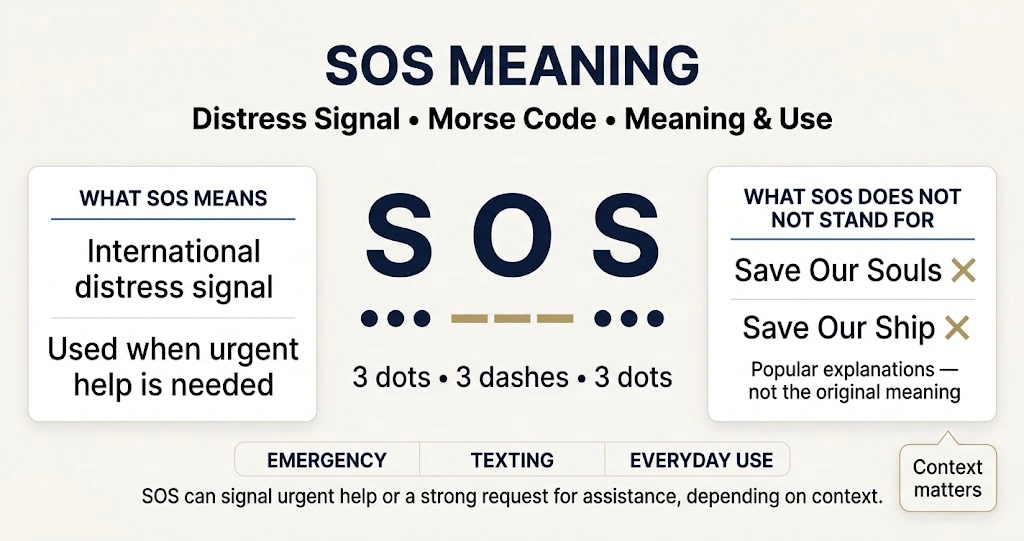
SOS meaning is simple: SOS is an international distress signal used when someone needs urgent help. In Morse code, the signal consists of three dots, three dashes, and three dots. It does not officially stand for “Save Our Souls” or “Save Our Ship.” Those phrases became popular ways to remember what the signal represents.
Today, people use SOS in emergency communication, texting, social media, and everyday conversation. However, its meaning can change slightly depending on the context.
If you enjoy learning the meanings of common abbreviations used in online conversations, you may also want to read our guide to SMH meaning to understand what this popular internet slang means and how people use it in texts and chats.
What Does SOS Mean?
The SOS meaning refers to a recognized distress signal that communicates a need for immediate assistance. Its strongest historical connection comes from maritime communication, where operators used the signal to indicate a serious emergency.
SOS does not function like a normal word or abbreviation. The signal comes from its distinctive Morse code sequence rather than from the first letters of an English phrase.
Because the sequence is simple and easy to recognize, SOS became a widely known symbol for emergencies.
Does SOS Stand for “Save Our Souls” or “Save Our Ship”?
A common question about the SOS meaning asks whether the letters officially represent “Save Our Souls” or “Save Our Ship.”
They do not.
Those phrases became popular explanations because they match the letters S-O-S and fit the signal’s emergency purpose. However, the original distress signal did not come from either phrase.
Does “Save Our Souls” Explain SOS?
“Save Our Souls” is a memorable interpretation of SOS. The phrase makes sense in an emergency because someone in serious danger may need immediate assistance.
However, it is not the official origin of the signal. People later connected the letters with this phrase because the wording was easy to remember.
Does “Save Our Ship” Explain SOS?
“Save Our Ship” is another popular explanation. It became especially associated with the maritime use of SOS.
Like “Save Our Souls,” though, this phrase does not explain where the original signal came from. SOS existed as a Morse-code distress signal independently of that phrase.
What Is the SOS Morse Code?
The SOS Morse code signal uses a very simple pattern:
... --- ...
That means:
- S = three dots
- O = three dashes
- S = three dots
The sequence has an important practical advantage: it is distinctive and relatively easy to recognize, even when communication conditions are difficult.
The pattern also works without spoken words. A person can transmit it through appropriate signaling methods, which helped make SOS useful across different forms of emergency communication.
Where Did SOS Come From?
The history of SOS goes back to the early development of wireless communication.
Before SOS became internationally recognized, different systems used different distress signals. Maritime communication needed a signal that operators could identify quickly and transmit reliably.
International agreements in the early 20th century helped establish SOS as a standard distress signal. Its simple Morse pattern made it practical for radio operators.
The signal therefore has a technical origin rather than an English phrase origin. “Save Our Souls” and “Save Our Ship” became memorable interpretations later.
What Does SOS Mean in Texting and Social Media?
In modern texting and social media, the SOS meaning can be more casual than its original emergency use.
Someone may write “SOS” when they need quick assistance with a problem, feel overwhelmed, or want a friend to respond immediately.
For example:
“SOS, I forgot about the deadline!”
Here, the person usually does not describe a life-threatening emergency. Instead, SOS adds urgency or humor to the message.
What If Someone Sends Only “SOS”?
When someone sends only “SOS,” the meaning depends on the surrounding situation.
It can indicate:
- A genuine request for urgent help
- A need for immediate advice
- A stressful situation
- A humorous or exaggerated request for assistance
If the context suggests real danger, treat the message seriously rather than assuming it is slang.
SOS vs. Help vs. Mayday

These terms can all communicate a need for assistance, but they do not have exactly the same role.
SOS
SOS is a standardized distress signal associated historically with Morse-code communication. Its recognizable pattern allows it to communicate distress without requiring a spoken phrase.
Help
“Help” is an ordinary English word. Anyone can use it in everyday conversation, texting, or an emergency situation.
For example, someone might shout “Help!” when they need immediate assistance. The word itself does not represent a specific international signaling code.
Mayday
Mayday serves as a spoken radiotelephony distress call. It is especially important in aviation and maritime voice communication.
So, while SOS meaning and Mayday both relate to serious distress, they belong to different communication methods. SOS is associated with a Morse-code signal, while Mayday functions as a spoken distress call.
Common Mistakes About SOS Meaning
Understanding the SOS meaning becomes easier when you avoid a few common misconceptions.
Mistake 1: Saying SOS Means “Save Our Souls”
This phrase explains a popular mnemonic, not the original creation of the signal.
Mistake 2: Saying SOS Means “Save Our Ship”
This phrase also became a popular interpretation because of the signal’s maritime history. It did not create the SOS signal.
Mistake 3: Assuming SOS Only Relates to Ships
SOS has strong maritime roots, but people now use the term in many contexts. You may see it in emergency communication, everyday speech, texting, and social media.
Mistake 4: Treating Every SOS Message as a Real Emergency
Context matters. Someone may use SOS seriously, while another person may use it jokingly to ask for help with a minor problem.
Mistake 5: Treating SOS and Mayday as Identical
Both signals communicate distress, but their communication methods differ. SOS relates to a Morse-code signal, while Mayday serves as a spoken distress call.
Frequently Asked Questions About SOS Meaning
What is the basic SOS meaning?
SOS is an internationally recognized distress signal used to communicate a serious need for assistance. Its Morse-code form consists of three dots, three dashes, and three dots.
Is SOS an abbreviation?
No. SOS was not originally created as an abbreviation for “Save Our Souls” or “Save Our Ship.” Those phrases became popular mnemonic explanations.
Why is SOS so easy to recognize?
Its Morse-code pattern is short, distinctive, and symmetrical. These characteristics made the signal practical for emergency communication.
Is SOS still used today?
The term remains widely recognized, although modern emergency communication systems now use many other technologies and procedures. People also use SOS informally in everyday communication.
What does SOS mean in a text message?
In texting, SOS usually means that someone urgently wants help, advice, or attention. The exact meaning depends on the context.
Conclusion
The SOS meaning comes from its role as a recognized distress signal, not from the phrases “Save Our Souls” or “Save Our Ship.” Its distinctive Morse-code pattern helped make it easy to identify and communicate.
Today, SOS has both a formal emergency meaning and an informal meaning in everyday language. Understanding the context helps you know whether someone is describing a genuine emergency or simply asking for quick help. For more details about international distress signals and maritime safety rules, see the International Maritime Organization’s information on distress signals.


Leave a Comment