
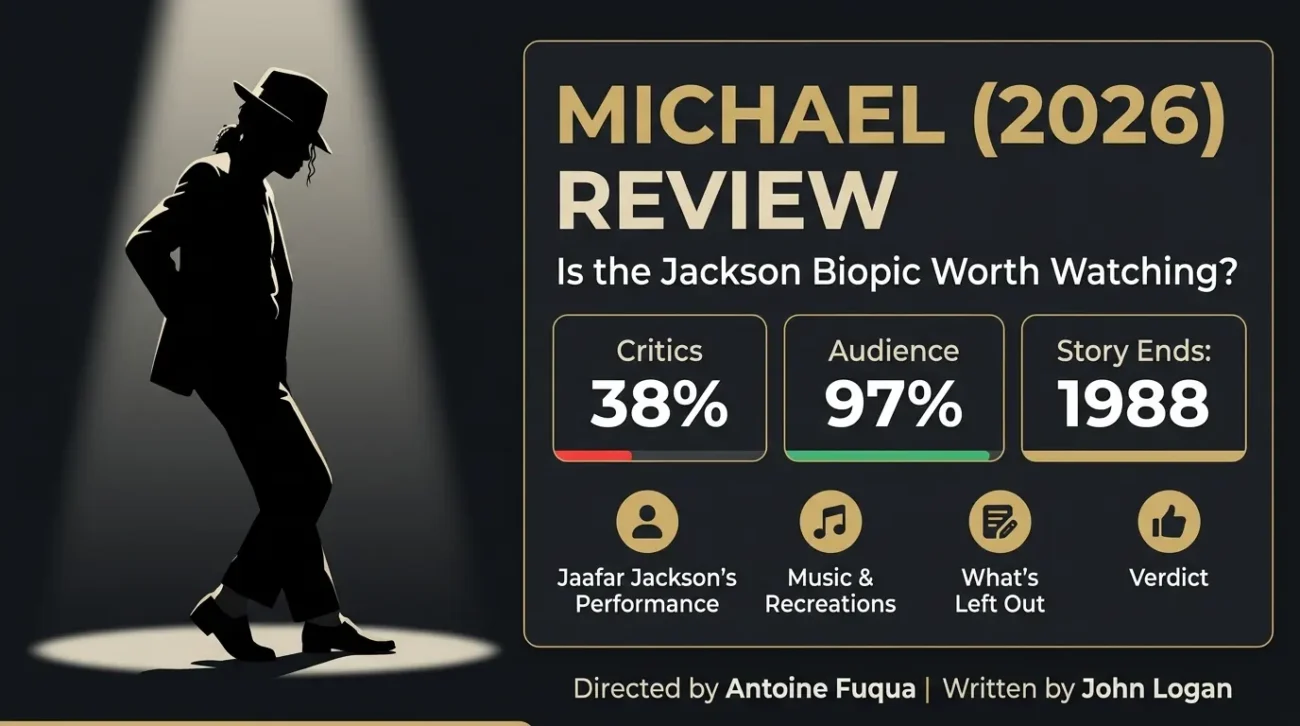
This Michael movie review answers the questions most viewers ask before buying a ticket. Does the 2026 Michael Jackson biopic tell a meaningful story? How convincing is Jaafar Jackson in the lead role? And is the film really worth your time?
Antoine Fuqua directed the film, and John Logan wrote it. Michael Jackson’s real-life nephew, Jaafar Jackson, plays the adult Michael. Juliano Krue Valdi plays him as a child. The story follows Jackson from his early years with the Jackson Five to his rise as a solo superstar. It ends around the 1988 Bad tour.
However, one point matters before you watch. Michael is not a complete biography. The film deliberately focuses on Jackson’s rise to fame and the earlier part of his career. That choice shapes everything in this Michael movie review, because it changes how the film should be judged as a biopic.
What Is Michael About?
Michael is a 2026 biographical music drama. It covers Jackson’s childhood, his family life, and his growth from a gifted Jackson Five member into one of the world’s biggest solo entertainers.
According to the official synopsis on Apple TV, the film explores Jackson’s life “beyond the music.” It starts with the discovery of his talent and follows his ambition to become the biggest entertainer in the world. It also promises both his off-stage life and recreations of famous performances.
As a result, the movie spends most of its time on the making of Michael Jackson the performer. You see the family’s early musical career and Michael’s difficult relationship with his father, Joe Jackson. You also see his growing independence and his move into global stardom.
The story eventually reaches the late 1980s and the Bad era. Critics at The Guardian and the Los Angeles Times both note that the narrative effectively ends around Jackson’s 1988 Wembley performance. It does not continue through the rest of his adult life.
The movie’s basic focus
Think of Michael as a story about how Michael Jackson became Michael Jackson. It is not an account of everything that happened afterward. Its strongest emphasis falls on:
- Jackson’s childhood and family
- The Jackson Five
- His relationship with Joe Jackson
- His development as a performer
- His transition to a solo career
- His major performances and worldwide fame
Because of this focus, the film feels very different depending on what you expect. If you want to watch Jackson’s rise and see famous performances recreated, the movie delivers. If you expect a full examination of his life, the limited scope becomes much more noticeable.
What Does Michael Cover and What Does It Leave Out?

This is the most important question to answer before watching. The film covers a significant period, but it stops before many events that later shaped public discussion of Jackson.
The story moves from the Jackson Five to his emergence as a solo artist. It then culminates around the 1988 Bad tour. The Guardian describes the film as ending when Jackson is about 30 years old. So you get the rise-to-fame chapter, not the full timeline.
What the movie spends time showing
The film gives real attention to Jackson’s development as an artist. That includes his childhood in the Jackson family, the pressure created by his father, and his growing confidence. It also recreates recognizable moments from his career. Promotional material shows that the filmmakers rebuilt elements of the Thriller video.
Where the story stops
The film does not continue through Jackson’s later decades. Viewers should not expect a detailed account of:
- His 1990s career
- The later controversies surrounding him
- His 2000s legal battles
- The final years of his life
- His 2009 death
This is not just a few missing scenes. The cutoff fundamentally shapes the kind of story Michael tells. The Los Angeles Times notes that the narrow timeframe lets the film focus on Jackson’s rise while avoiding the darker chapters that followed.
Why the limited scope matters
There are two ways to see this choice. On one hand, focusing on early life gives the film room to explore childhood, family pressure, and transformation. It does not have to squeeze five decades into two hours.
On the other hand, some critics say ending before the most controversial period makes the film feel incomplete. Rotten Tomatoes’ critics consensus says the film captures Jackson’s presence through Jaafar’s performance. However, it plays more like a “greatest hits” collection than a revealing portrait.
So the useful question is not just what the movie left out. The better question is whether the chosen period helps you understand Jackson as a person, or mainly as an entertainer.
Michael Movie Review: How Good Is Jaafar Jackson as Michael Jackson?
Jaafar Jackson is one of the main reasons Michael works as a visual recreation of the King of Pop. He is the son of Jermaine Jackson and the nephew of Michael Jackson. The film also marks his feature acting debut, which makes this an unusually demanding first major role.
The physical resemblance draws attention right away. Still, resemblance alone would not be enough. Jackson’s style was so distinctive that simply looking like him could have produced a shallow impersonation.
The resemblance helps, but the movement matters more
Michael Jackson had a very recognizable physical vocabulary. That includes his posture, hand movements, facial expressions, dancing, and timing on stage. Jaafar reportedly trained for the role and worked with an acting coach before filming.
The result is most effective in the musical sequences. Rotten Tomatoes’ critic roundup notes that several early reviews singled out his portrayal as one of the film’s strongest elements. The Guardian also acknowledges that Jaafar reproduces his uncle’s dancing and singing style with real flair. In addition, ETV Bharat’s report on the first reviews shows that critics widely praised the lead performance and the music scenes.
His strongest moments happen on stage
There is a difference between playing Michael Jackson and performing as Michael Jackson. Jaafar looks most natural in the second role. During performance scenes, the film can rely on the physical language audiences already associate with Jackson. The choreography, the music, and the visual recreation all support the resemblance.
That is also where the nostalgic appeal is strongest. For viewers who know Jackson’s music, familiar songs can create a powerful sense of recognition.
What about the dramatic performance?
This part is more complicated. The film asks Jaafar to play the superstar and also the private Michael: a son dealing with his father, a young performer facing fame, and an increasingly independent artist.
Some critics found this side less convincing than the musical material. The Guardian argues that the off-stage portrayal stays comparatively shallow. RogerEbert.com similarly criticizes the film for prioritizing performance over a deeper look at its subject.
In other words, the performance is often more convincing than the character study around it. Jaafar reproduces the image well, but the screenplay does not always give him enough dramatic material.
What Works Well in Michael

The clearest strength is the film’s connection to Jackson’s music and performance legacy. Even critics who disliked the storytelling acknowledged the power of the songs and Jaafar’s stage presence.
The musical recreations are the main attraction
If you mainly want to see Jackson’s performances on screen, the movie has obvious appeal. The filmmakers made a big effort to recreate recognizable material, including the Thriller music video. Concert and performance sequences are also a central selling point.
The rise of the performer is easy to follow
The film gives viewers a simple path through Jackson’s artistic growth:
child performer → Jackson Five star → emerging solo artist → global superstar
Because of this, the basic career journey stays accessible, even for viewers who do not know Jackson’s biography well.
The family story gives the film its foundation
The relationship between Michael and Joe Jackson provides much of the early conflict. Colman Domingo plays Joe, and Nia Long plays Katherine Jackson. The story uses Michael’s difficult childhood and his father’s demanding approach to explain his drive as a performer.
This part of the film tries to answer a bigger question: how did a child from the Jackson family become one of the world’s most recognizable entertainers? The film’s answer combines talent, family pressure, and ambition.
How Does Michael Handle Jackson’s Controversies?
This is the most important limitation if you are watching Michael as a serious biography rather than a music film. The finished movie ends in 1988. Therefore, it does not dramatize the major allegations and legal controversies of the 1990s and 2000s. Critics repeatedly call this absence a central weakness.
Reporting also explains why the final film differs from earlier versions. According to The Washington Post, the film originally contained material about the 1993 sexual-abuse allegations. Lionsgate confirmed that this material was removed during reshoots. The reason was concern about an earlier settlement agreement involving the Jackson estate and the family of accuser Jordan Chandler.
Variety reported something similar. The original version was planned to extend much further into Jackson’s later life, and a large part of the third act dealt with the 1993 allegations. The reshoots changed the structure and moved the ending back to 1988.
That distinction matters. Saying the finished movie does not cover the later controversies is one claim. Saying the filmmakers forgot about them is a very different claim. Available reporting suggests those events were considered during development but removed from the final cut.
What the movie actually presents
The film concentrates on Jackson’s childhood, his family, his rise, and his transformation into a global performer. As a result, the audience gets a version of his life weighted toward:
- His musical talent
- His childhood
- Family dynamics
- Professional ambition
- Famous performances
The harder questions about his later life stay outside the story. RogerEbert.com’s Robert Daniels describes the film as an estate-approved portrayal that leaves major parts of Jackson’s story outside the frame.
Why this changes the meaning of the movie
A biopic does not have to cover every event in a person’s life. A filmmaker can pick one period and build a whole movie around it. Here, however, the omitted material is not ordinary background. Jackson’s later controversies became a major part of how the public understands his legacy.
That does not mean everything shown is false. It means the film’s version of Jackson is incomplete by design and by circumstance.
Michael Movie Review: The Biggest Limitations
The limitations go beyond the missing later years. The central criticism is that Michael works better as a recreation of Jackson’s public image than as a study of the person behind it.
1. It prioritizes famous moments
The movie has plenty of recognizable material, and that makes it entertaining. However, the same approach can make the story feel like a list of career highlights instead of a developing character study. RogerEbert.com goes further and says the film works more like a filmed playlist.
2. Michael’s private personality gets less exploration
The film tries to show Michael away from the stage, especially his childhood and his relationship with his father. Still, several critics say the screenplay does not dig into his psychology or contradictions. The Guardian argues that it presents a relatively bland version of Jackson.
That matters because the film promises a story “beyond the music.” The music is clearly there. The “beyond” part is much less developed.
3. The story ends before the most difficult period
Ending around the Bad era lets the film show Jackson at the height of his artistic rise without dramatizing what followed. If you want the whole Michael Jackson story, this film cannot give you that.
4. The film can feel too safe
Time Out describes the film as avoiding the controversial parts of Jackson’s life. It is worth separating fact from interpretation here. We can confirm that the later controversies are absent. We can also confirm that earlier versions reportedly included the 1993 allegations. But calling the final film “safe” is a critical opinion, not an objective fact. Different reviewers have reached different conclusions.
Critics vs Audiences: The Score Gap Explained
Reception is split in a way that is hard to ignore. Rotten Tomatoes currently shows a 38% Tomatometer from 310 critic reviews. At the same time, it shows a 97% verified audience score from more than 25,000 ratings. Scores change over time, so check the site for the latest numbers.
This gap tells you something useful. Critics are judging Michael as a serious biographical drama. Audiences seem to be judging it as an entertaining music experience. Both groups can be right, because they are asking different questions of the same film.
Should You Watch Michael? Our Michael Movie Review Verdict
The answer depends on what you expect. Here is a quick guide for different viewers.
If you love Michael Jackson’s music: The film gives you plenty. Jaafar’s performance recreates many of his uncle’s physical traits, and the production puts heavy emphasis on famous musical moments.
If you want a complete biography: Adjust your expectations. Michael ends around 1988, so it cannot replace a full biography or documentary.
If you want the controversies examined seriously: The finished film does not do this. Reporting confirms that material about the 1993 allegations was removed. You will need other sources alongside the movie.
If you already know Jackson’s story: You may enjoy it more. You can treat it as a dramatized look at one period, and the performances become the main attraction.
If you are also looking for a very different kind of drama this year, our Wuthering Heights movie review is a good next read.
Michael Movie Review FAQs
Is Michael a complete Michael Jackson biopic?
No. The film focuses on Jackson’s childhood, the Jackson Five, his solo development, and his rise to superstardom. It ends around the 1988 Bad tour and does not cover his entire adult life.
Does Michael cover the allegations against Michael Jackson?
The finished movie does not substantially dramatize the later sexual-abuse allegations. The Washington Post and Variety report that earlier versions contained material about the 1993 allegations. That material was removed during reshoots.
Is Jaafar Jackson really Michael Jackson’s nephew?
Yes. Jaafar is the son of Jermaine Jackson and the nephew of Michael Jackson. He plays the adult Michael in the film.
Does Michael show the Thriller era?
Yes. The film recreates major moments from Jackson’s early solo career, including material connected with Thriller. Reviews and reports specifically mention the recreated Thriller video.
Why does Michael end in 1988?
The ending reflects the film’s final scope after major changes during production. Earlier versions were reportedly meant to cover later events. After reshoots, the story concluded around the 1988 Bad tour.
Is Michael more of a music movie than a biography?
That is a fair description of how some critics see it. The film has a lot of music and performance material. However, several critics argue that its portrait of Jackson as a complex person is comparatively shallow.
Final Takeaway From Our Michael Movie Review
Michael works best when it puts Michael Jackson the performer at the center. Jaafar Jackson brings recognizable movement, appearance, and stage presence, and the musical recreations supply much of the film’s energy. Audience reception has also been far more positive than the critical response.
Still, the film has a clear limit: it is not the complete Michael Jackson story. Its narrative ends around 1988, before the most controversial period of his life. Reporting also confirms that material about the 1993 allegations was removed during redevelopment.
So the fairest way to approach Michael is as a selective biographical film about Jackson’s rise and music. It is not a definitive account of his whole life. If you go in expecting the full story, important parts are missing. If you want the music and the performances, you will know exactly what the film offers. That is the main conclusion of this Michael movie review.


Leave a Comment