
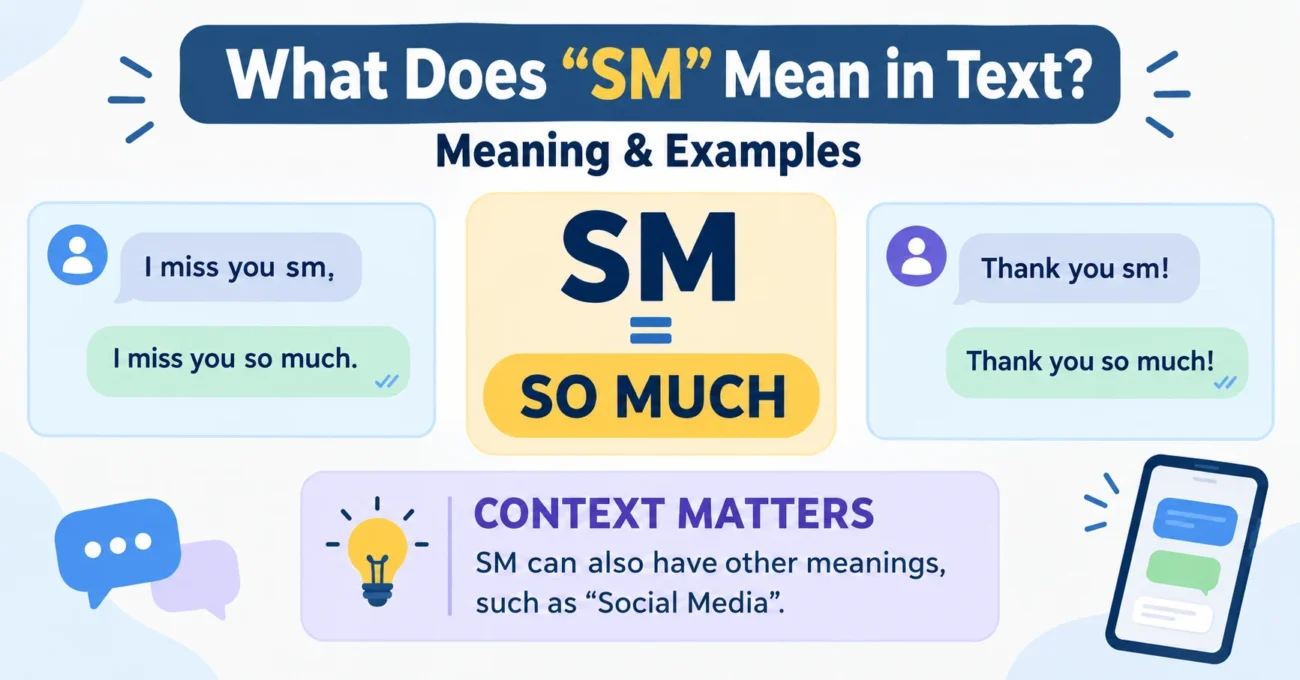
If you have seen “SM” in a text message, comment, or social media conversation, you may be wondering what the sender actually means. In casual texting, SM most commonly means “so much,” especially when it appears after an expression of emotion, appreciation, or preference.
However, abbreviations can have different meanings depending on the conversation. To understand what SM means in a particular message, look at the surrounding words and the topic being discussed rather than assuming there is only one definition.
What Does SM Mean in Text?
In casual texting, SM usually means “so much.” It is a shortened way of adding emphasis to a sentence without typing the full phrase.
For example:
- “I miss you sm.” means “I miss you so much.”
- “Thank you sm!” means “Thank you so much!”
- “I love this sm.” means “I love this so much.”
- “That helped me sm.” means “That helped me so much.”
You will most often see this abbreviation in informal conversations, including text messages, direct messages, comments, and chats with friends.
The important point is that SM does not automatically mean “so much” in every situation. The surrounding message helps you determine whether that interpretation makes sense.
How Can You Tell What SM Means in a Message?
When you are unsure about an abbreviation, do not look at “SM” by itself. Read the complete sentence and consider what the conversation is about.
Check the Words Around SM
The words immediately surrounding “SM” can make the intended meaning easier to understand.
For example:
“I miss you sm.”
Here, “so much” fits naturally:
“I miss you so much.”
Likewise:
“Thank you sm for helping me.”
becomes:
“Thank you so much for helping me.”
When SM follows an expression such as miss, love, thank, like, or appreciate, “so much” is a natural interpretation.
Consider the Conversation Topic
The subject of the conversation can also help you understand the abbreviation.
Imagine someone is talking about their feelings and writes:
“I love this song sm.”
The topic is personal and emotional, so “so much” fits naturally.
Now imagine a conversation about online marketing where someone writes:
“We need a better SM strategy.”
Here, interpreting SM as “so much” would not make sense. The topic suggests that another meaning may be intended.
This is why context is more useful than memorizing a single definition.
Compare the Possible Meanings
If two interpretations seem possible, replace “SM” with each meaning and see which one makes sense in the complete sentence.
For example:
“Thank you sm!”
Consider these possibilities:
- “Thank you so much!” — sounds natural.
- “Thank you social media!” — does not fit the sentence.
The first interpretation clearly works better.
This simple substitution test can help you understand many short forms without searching for every abbreviation separately.
Ask for Clarification When the Context Is Unclear
Sometimes the surrounding conversation does not provide enough information. In that case, it is better to ask what the sender means rather than confidently choosing the wrong interpretation.
You can simply say:
“What do you mean by SM here?”
This is especially useful when the conversation involves a technical, professional, or specialized topic where the abbreviation could have more than one established meaning.
Common Examples of SM Meaning “So Much”

Once you know that SM can be a short form of “so much,” common text messages become easier to understand.
“I Miss You SM”
If someone writes:
“I miss you sm.”
They normally mean:
“I miss you so much.”
Here, SM intensifies the feeling expressed by “I miss you.”
“Thank You SM”
A message such as:
“Thank you sm for helping me.”
normally means:
“Thank you so much for helping me.”
In this context, SM adds emphasis to the person’s gratitude.
“I Love This SM”
If someone says:
“I love this sm!”
the intended meaning is:
“I love this so much!”
The abbreviation works as an informal way to emphasize how strongly the person likes something.
“That Helped Me SM”
For example:
“That helped me sm.”
means:
“That helped me so much.”
Again, SM is being used informally to strengthen the statement.
The common pattern in these examples is important: SM is not the main message. It adds emphasis to the statement that comes before it.
Can SM Mean Something Other Than “So Much”?
Although “so much” is a common meaning of SM in casual texting, the abbreviation can have other meanings when the context changes. This is why you should not automatically interpret every instance of SM as “so much.”
SM Can Mean “Social Media”
In conversations about marketing, online content, websites, or digital communication, SM can refer to “social media.”
For example:
“We need to improve our SM strategy.”
Here, “so much” would not make sense. The conversation is about a strategy, so “social media” is a more natural interpretation.
The same principle applies when you see SM in a professional or business-related discussion. Instead of relying only on the abbreviation, look at the subject of the conversation.
Other Context-Dependent Uses
Abbreviations can have different meanings across communities, industries, and conversations. A meaning that makes sense in one context may be completely wrong in another.
You do not need to memorize every possible expansion of SM. For ordinary texting, start with the most natural interpretation and use the surrounding context to confirm it.
If “so much” makes the sentence sound natural, it is a likely interpretation. If it does not, consider the conversation topic and other possible meanings.
SM vs. Similar Texting Abbreviations
Short texting abbreviations can look similar, but they do not necessarily mean the same thing. Knowing the differences can prevent you from misunderstanding a message.
SM vs. SMH
SM and SMH are different abbreviations.
In casual texting, SM can mean “so much,” while SMH commonly means “shaking my head.”
For example:
“I miss you sm.”
means:
“I miss you so much.”
But:
“I can’t believe he did that smh.”
uses SMH to express disbelief, disappointment, or frustration.
The extra H changes the abbreviation completely.
SM vs. TYSM
TYSM is commonly used as a shortened form of “thank you so much.”
For example:
“TYSM for helping me!”
Here, the entire abbreviation represents the expression “thank you so much.”
By comparison:
“Thank you sm!”
uses SM to shorten only the “so much” part of the sentence.
SM vs. ILYSM
ILYSM is another texting abbreviation commonly understood as “I love you so much.”
For example:
“Goodnight, ILYSM.”
The important difference is that SM by itself does not mean “I love you so much.” The surrounding words determine what SM is modifying.
Both “I love you sm” and “ILYSM” can communicate a similar sentiment, but they use different abbreviation structures.
Is SM Appropriate for Formal Messages?
SM is mainly useful in informal communication. It can fit naturally in conversations with friends, casual chats, comments, and direct messages where abbreviations are already part of the communication style.
Formal communication is different.
If you are writing an email to a client, preparing a professional document, submitting an application, or communicating in another formal setting, writing “so much” instead of “sm” is generally clearer.
For example, in a casual message:
“Thank you sm!”
is easy to understand.
In a professional message, you would normally write:
“Thank you so much for your help.”
The main issue is not that SM cannot be understood. It is that formal writing generally benefits from complete words and clearer language.
Frequently Asked Questions About SM in Text
What does SM mean in a text from a girl?
The abbreviation itself does not indicate anything about the sender’s gender. If it appears in a sentence such as “I miss you sm,” it normally means “I miss you so much.” The meaning comes from the sentence and conversation context, not from who sent it.
What does “I love you SM” mean?
“I love you SM” normally means “I love you so much.” Here, SM emphasizes the phrase “I love you.”
Is SM a slang word or an abbreviation?
In texting, SM is used as an abbreviation or shortened form, particularly when it stands for “so much.” Because it is commonly used in informal digital communication, it can also be described as texting shorthand.
Does SM always mean “so much”?
No. Context matters. “So much” is a common interpretation in casual texting, but SM can have other meanings in different conversations. For example, in a digital marketing discussion, it may refer to “social media.”
Can SM mean social media?
Yes. In a conversation about digital marketing, online platforms, content, or marketing strategy, SM can be used to mean “social media.” The subject of the conversation helps distinguish this meaning from “so much.”
Is SM appropriate in formal writing?
It is generally better to use the complete phrase when writing formally. If you mean “so much,” writing those two words makes the sentence clearer and more appropriate for professional communication.
Conclusion
When you see SM in a text message, “so much” is one of the most common meanings to consider, especially when it follows expressions such as “I miss you,” “thank you,” or “I love this.”
However, the abbreviation should always be interpreted in context. If “so much” fits naturally into the sentence, that is a strong clue. If it does not, look at the topic of the conversation because SM can have other meanings, including “social media” in relevant contexts.
The simplest approach is to read the complete message, check the surrounding words, and consider what the conversation is about. Once you use that method, you can usually understand what SM means without guessing.


Leave a Comment