
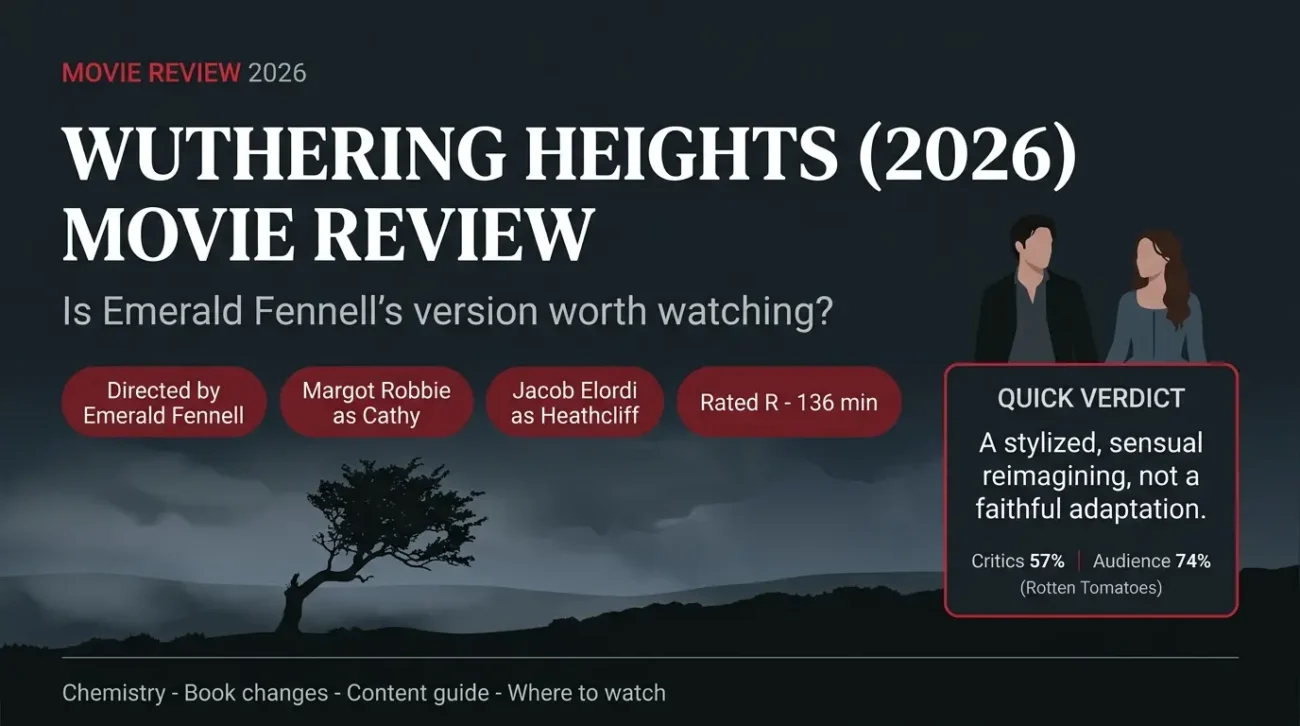
This Wuthering Heights movie review looks at Emerald Fennell’s bold, stylized take on Emily Brontë’s novel. It is not the quiet, muddy-boots adaptation many people picture. Reviews have split sharply, so this guide explains what the film is really like, how far it strays from the book, how the leads perform and what content to expect. That way, you can decide for yourself before pressing play.
Quick Review: What Is the 2026 Wuthering Heights Movie Really Like?
Fennell’s Wuthering Heights is a highly stylized, sensual reinterpretation of Emily Brontë’s novel, not a strictly faithful adaptation. Fennell wrote and directed the film, with Margot Robbie as Cathy and Jacob Elordi as Heathcliff.
Three things define it:
- Desire comes first. The film treats the central bond as a physical, obsessive love story, and it is far more overtly sexual than most earlier versions.
- Style is the point. Visual extravagance, modern touches and a heightened, melodramatic tone matter more than period realism.
- The departures are deliberate. Reviewers note that Fennell drops Hindley and cuts most of the second-generation storyline, so the film reimagines the book instead of translating it page by page.
Critics disagree on whether this approach works. Some see a daring, entertaining reinvention. Others see a film that looks striking but delivers little emotional weight. In short, this Wuthering Heights movie review lands on a split verdict: the film dazzles some viewers and leaves others cold.
What Is the 2026 Wuthering Heights Movie About?
Like the novel, the film centers on Cathy (Catherine Earnshaw) and Heathcliff, who form a bond on the Yorkshire moors. Their attachment collides with class, pride and social ambition. Cathy’s choices then set off years of longing, resentment and cruelty that shape everyone around them. Nelly Dean, the household’s observer, stays in the story.
The film keeps its attention tightly on the central pair. If you know the novel as a sprawling tale of two families across generations, expect something more compressed. Spoilers about how the story unfolds and ends appear only in the book-changes section and the FAQ, which carry warnings.
How Good Are Margot Robbie and Jacob Elordi as Cathy and Heathcliff?
This part of our Wuthering Heights movie review covers the two leads, because the film rests almost entirely on them. Robbie and Elordi joined the project in September 2024. Robbie also produced the film through her company LuckyChap, which previously backed Fennell’s Promising Young Woman and Saltburn. Elordi starred in Saltburn, so the three had worked together before.
Margot Robbie as Cathy
Robbie plays Cathy as a woman torn between passion and ambition, which suits the film’s melodramatic tone. Critics generally treat her as a strong presence, though they usually discuss her alongside her co-star. One review called her impressive but argued that Elordi is the real standout.
If you expect a restrained, psychologically detailed Cathy, adjust your expectations. The performance fits a stylized film, and it works best when you accept the film’s heightened world.
Jacob Elordi as Heathcliff
Elordi earns the most consistent praise. One critic describes his Heathcliff as a mix of irresistible allure and beastlike rage. That matches the film’s habit of treating danger as part of the attraction.
He is physically commanding and brooding, and the film uses him as a sensual figure as much as a tragic one. That suits Fennell’s approach. It also means this Heathcliff sits closer to a romantic-erotic lead than the bitter, vengeful outsider many readers remember.
Does Their Chemistry Work?
For most reviewers, the chemistry works. Early reactions were enthusiastic, and Rotten Tomatoes’ round-up of first reviews quoted critics calling the pair volatile, unsettling and electric. Another review noted that the connection feels hot but carries a looming sense of danger. That danger is the interesting part, because the bond is meant to feel obsessive and slightly threatening rather than gentle.
Not everyone agrees. A student columnist at the Indiana Daily Student found no romantic chemistry and felt uncomfortable with the intimate scenes, given the characters’ adoptive-sibling background. Another viewer felt the connection is strongest when the film slows down and lets the pair connect, instead of leaning into the overtly sexual side.
In practice, the chemistry is physical and charged. It lands if you respond to that kind of intensity. If you want a tender, emotionally deep romance, some viewers found it less convincing. That split explains much of the wider debate, which the critics section covers later.
Is the Movie Faithful to Emily Brontë’s Book?

No, and the film never pretends otherwise. Fennell keeps the emotional core of the story and rebuilds much of what surrounds it. Nearly every Wuthering Heights movie review from a book lover focuses on this gap. This section contains spoilers for the film’s plot changes.
What Fennell Keeps From the Novel
The central shape of the story survives. Catherine marries the wealthy Edgar Linton, and Heathcliff storms off. He returns years later with a fortune of his own and a desire to reclaim her or take revenge. To stir her jealousy, he courts Edgar’s young ward Isabella. The Yorkshire moors, Nelly, the class divide and the destructive nature of the central love all remain. As one review put it, the story unfolds much as earlier adaptations did, up to a point.
What Fennell Changes or Removes
The changes are substantial:
- Hindley disappears. The film has no brother character, and Mr. Earnshaw becomes a cruel, abusive figure toward both children, especially Heathcliff. In the novel, Hindley’s resentment drives much of Heathcliff’s thirst for revenge.
- Isabella changes. She is Edgar’s ward, not his sister, and SlashFilm notes that her personality shifts to a meek, submissive one.
- Cathy has a new reason to marry Edgar. Her family is broke in the film, which reframes the decision as a financial one.
- The narrators vanish. Without Lockwood’s framing and Nelly’s biased mediation, SlashFilm argues, the film makes it harder to see Cathy as an unreliable narrator.
- The story stops early. The novel continues with the next generation after Cathy’s death, while the film stops with her.
- A famous scene goes missing. According to SlashFilm, the most controversial change is the omission of the lovers’ deathbed confrontation, although fragments of its dialogue appear elsewhere.
Why Those Changes Matter
Removing Hindley and the second generation turns a multi-generational story about cruelty and its consequences into a compressed, adult love story. Some analyses argue that aging the lovers makes Cathy’s marriage feel like a calculated response to social pressure instead of teenage vanity. Critics like SlashFilm point to the trade-off: the film softens moral ambiguity and Heathcliff’s cruelty. Meanwhile, the novel closes on a gentler note, as the next generation finds compassion its elders lacked. The film has no equivalent.
How Does Fennell’s Style Shape the Film?
Style is what the film is really about, and it is what critics argue over most.
Visuals and costume. Reviewers singled out Linus Sandgren’s cinematography, Jacqueline Durran’s costumes and Suzie Davies’ production design. One critic wrote that whole essays could be written about how red moves through Cathy’s clothing. The look is deliberately artificial rather than muddy and naturalistic.
Music and anachronism. Original songs by Charli XCX form part of the film. RogerEbert.com describes the approach as modernizing the setting with anachronistic choices in music and design.
Tone. The film opens with a teasing scene that plays erotic suggestion against the image of a hanging, which sets up its mix of desire and menace. Reviewers describe the overall register as sexy, dramatic, melodramatic, occasionally comic and often swoonily romantic. Time Out, however, found the result as cold as it is visually decadent.
If you want a subtle, naturalistic Gothic drama, this is not it. If you enjoy bold, theatrical filmmaking, however, the style is the main attraction.
How Mature Is Wuthering Heights?
Because a Wuthering Heights movie review should help you decide, here is what to expect from the content. The MPA rated the film R in the US for sexual content, some violent content and language.
- Sexual content: This is the main reason for the rating. IMDb’s parents guide lists extensive sexual content, including BDSM elements, masturbation and voyeurism. Guides disagree on nudity: one says there is none, while another describes partial and full-frontal nudity. Check a detailed guide if this matters to you.
- Violence and cruelty: Kids-In-Mind lists a hanging, a pig slaughter, a child being whipped and a woman dying after a failed pregnancy.
- Language: The film uses the F-word at least five times.
- Themes: Reviewers describe the central relationship as obsessive and self-destructive. One parents’ review called it trauma bonding mixed with sexual obsession rather than a tragic love story.
This is not a film for children or younger teens, and it may be more intense than the marketing suggests.
Is It for You? Book Readers vs First-Time Viewers
If You’ve Read the Book
Adjust your expectations before you go in. The quotation marks around the title are deliberate. Fennell has explained that the earlier adaptations are wonderful, and hers is a loose take. Variety noted that literary purists may object, yet Fennell seizes on physical desire and power games that were always in the material.
Readers who value the novel’s structure, multiple narrators or second generation will find those elements missing. Readers open to a free reinterpretation, however, may enjoy seeing which themes Fennell chooses to emphasize.
If You Haven’t Read the Book
You don’t need the novel. The core story is simple: a childhood bond, a marriage across class lines, a return and a revenge. One student reviewer who had never read the book said she had no hang-ups about plot or accuracy, although she still disliked the leads’ chemistry. Newcomers also won’t miss what the film cut, because they have nothing to compare it to. Just keep five names straight: Cathy, Heathcliff, Edgar, Isabella and Nelly.
Why Are Critics and Viewers Divided?

Every Wuthering Heights movie review lands somewhere on the same divide: style and audacity on one side, fidelity and emotional depth on the other.
- The enthusiasts: The Telegraph gave five stars and treated the film’s unfaithfulness as the engine of something operatic. NME also embraced the modern, sexed-up approach.
- The skeptics: The Guardian gave two stars and called the film emotionally hollow and campy.
- The in-between: RogerEbert.com found the film intriguingly sizzling in its yearning but oddly cold once the lovers finally embrace.
Audience scores generally run higher than critic scores. At the time of research, Rotten Tomatoes showed about 57% from critics and 74% from audiences. However, the numbers move over time, so reception is not uniform.
Where Can You Watch Wuthering Heights?
After reading this Wuthering Heights movie review, you may want to see the film yourself:
- Streaming: The film began streaming on HBO Max on May 1.
- Digital: You can rent or buy it on Prime Video, Apple TV and Fandango at Home. Rental cost $19.99 and purchase $24.99 at the time of that report.
- Physical: 4K, Blu-ray and DVD releases arrived on May 5 with bonus features, including director commentary.
Availability and prices vary by region and change over time, so check current listings for your country. If you are planning a movie night, our Plugged In movie review may help you pick a second film.
FAQ About Wuthering Heights Movie Review
Does the movie have a different ending from the book? (Spoiler)
Yes. The film concludes with Catherine’s death and Heathcliff’s grief, which removes the next generation entirely.
How long is the movie?
It runs about 136 minutes.
Who plays young Cathy and young Heathcliff?
Charlotte Mellington plays young Cathy, and Owen Cooper plays young Heathcliff.
Was there controversy over Heathcliff’s casting?
Yes. The novel describes Heathcliff in terms that point to a dark-skinned outsider, and Elordi is white, which drew criticism. Fennell also cast actors of color elsewhere, including Hong Chau as Nelly and Shazad Latif as Edgar.
Final Takeaway: Wuthering Heights Movie Review
The best way to judge Emerald Fennell’s Wuthering Heights is as what it is: a stylized, sensual reinterpretation that borrows Emily Brontë’s characters and emotional core. It drops Hindley, cuts the second generation and strips away the narrators. In their place it puts extravagant visuals, anachronistic music and a love story that runs on physical desire. Robbie and Elordi carry it, and most critics found their chemistry charged, though not everyone did.
That is why reviews range from five stars to two. The film does not succeed or fail by one shared standard. It succeeds if you want spectacle, audacity and obsessive romance, and it disappoints if you want fidelity, restraint or emotional depth. In short, this Wuthering Heights movie review comes down to your taste.
It is likely to work for you if:
- you enjoy bold, theatrical filmmaking and accept that it treats the novel as inspiration
- you want a passionate, physical love story rather than a slow Gothic drama
- you are comfortable with an R-rated film with sexual content and some violence
It is less likely to work if:
- you want the novel’s structure, its multiple narrators or its next generation
- you expect a subtle, naturalistic period adaptation
- you need the romance to feel tender or emotionally deep rather than intense
If you are still unsure, use the film’s opening as a test: a provocative, stylized, deliberately teasing start. Anyone who finds it intriguing will enjoy the rest, which runs on the same instinct. Those who feel put off are unlikely to change their minds later. Either way, the film streams on HBO Max and is available to rent or buy digitally, so you can judge it yourself at home. For more picks after this one, our Peddi movie review is another good place to start.


Leave a Comment