

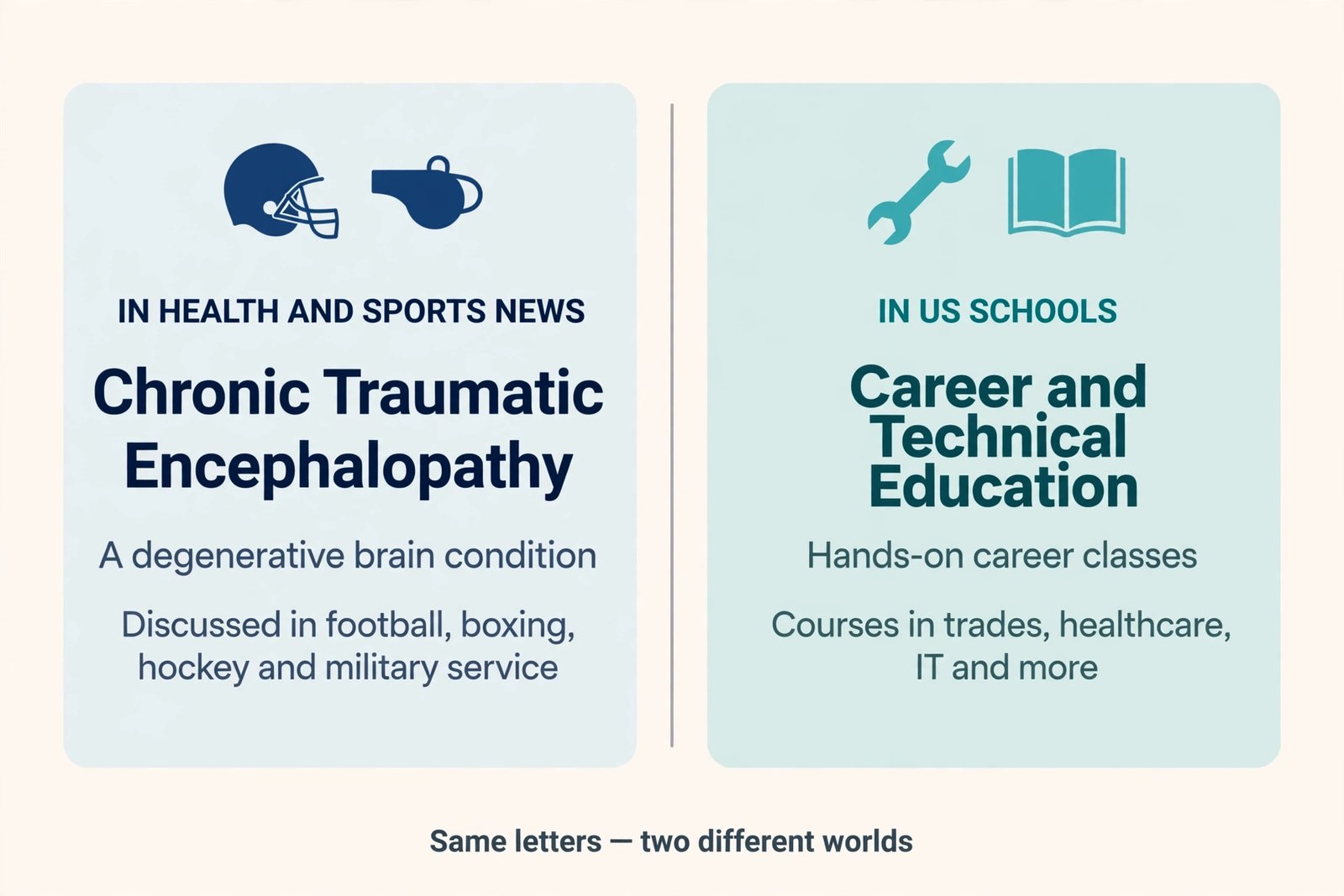
If you have seen the letters CTE in a sports headline, a health article or a school document, you may have wondered what they stand for. In short, the cte meaning most people are looking for is chronic traumatic encephalopathy, a degenerative brain condition that researchers have linked to repeated head injuries. However, the same three letters carry a second, completely different meaning in the United States, where CTE also stands for Career and Technical Education in schools. Because the two meanings belong to such different worlds, context matters a great deal here. In this guide, you will find both meanings explained in plain words, together with the signs researchers commonly report, the way the condition is studied, and a simple way to tell which meaning applies. One point deserves emphasis from the start: this article offers general information only, and it is not medical advice. Therefore, anyone who is worried about symptoms after head injuries should speak to a doctor rather than rely on any website.
CTE Meaning: What Does CTE Stand For?
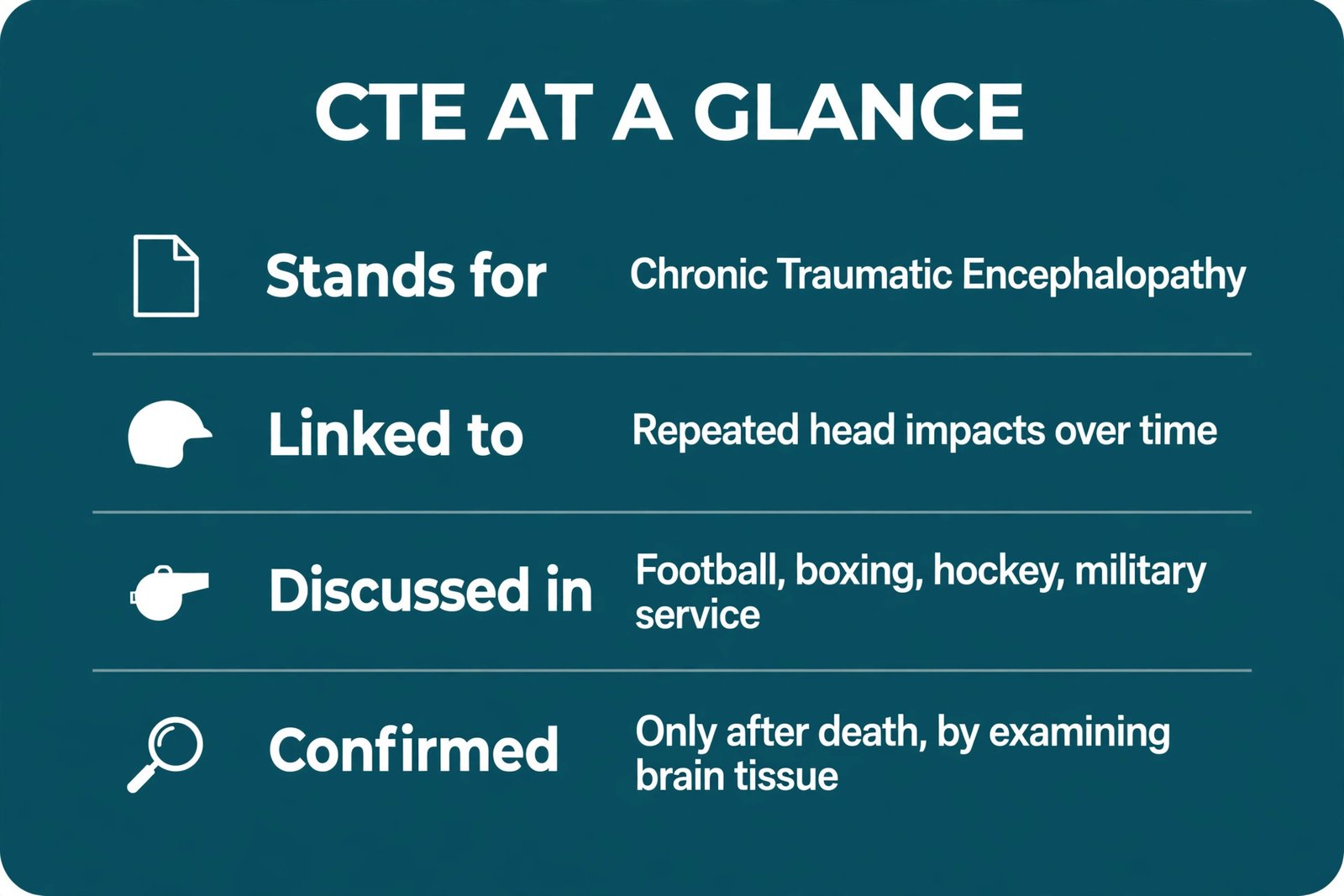
CTE is an abbreviation, so each part of the full name carries its own meaning. Chronic points to something that develops slowly and continues over a long period, rather than something sudden. Traumatic connects the condition to trauma, in this case physical injury involving the head. Encephalopathy, meanwhile, is a broad medical word for a disease or disorder that affects how the brain works. Put together, the name describes a long-lasting brain disorder connected to injury. Interestingly, the full name already tells the basic story, because it signals both the cause researchers focus on and the organ the condition affects. In most news reports, medical articles and sports discussions, this medical expansion is the intended one. By contrast, the education expansion appears mainly in school and college documents, as a later section explains in detail.
A Word-by-Word Breakdown
- Chronic — long-term; the condition develops gradually and worsens over time.
- Traumatic — related to trauma, here meaning physical impacts and injuries to the head.
- Encephalopathy — a medical term for a disorder that affects the structure or function of the brain.
CTE Meaning in Simple Words: The Brain Condition Explained
So, what is the condition itself, in everyday language? According to major medical centres such as the Mayo Clinic, CTE is a brain disease in which nerve cells gradually break down and die, a process doctors call degeneration. As a result, the brain slowly works less well over time. Researchers believe the process is connected to repeated impacts to the head over months or years. Crucially, these impacts include concussions, but they also include smaller blows that never caused obvious symptoms at the time. Over time, an abnormal form of a protein called tau is thought to build up in the brain and interfere with how brain cells function. Eventually, these changes can affect memory, mood, behaviour and movement. At the same time, experts openly stress that much about the condition remains uncertain. For example, they do not yet know exactly how much exposure is needed, and they cannot yet explain why some exposed people develop the condition while others do not.
Why a Single Blow Is Not the Focus
Importantly, CTE is not the name for the immediate effects of one knock to the head. A single concussion is an injury in its own right, and it needs proper care and recovery time. Nevertheless, the condition discussed here is tied specifically to repeated exposure over a longer period. Consequently, when scientists and doctors use the term CTE, they are describing the long-term pattern that follows repeated head trauma, not the result of one isolated accident.
Why CTE Is Talked About So Much
CTE receives a great deal of attention, largely because of where it has been studied most closely. News coverage usually follows research on well-known athletes, so the topic regularly returns to public debate.
The Connection With Contact Sports
Most confirmed cases described in research involve athletes from contact sports. For instance, the condition has been found in the brains of former American football players, boxers, ice hockey players and rugby players after their deaths. Soccer has also been discussed, mainly because of repeated heading of the ball. Because these sports are popular and widely televised, each new study tends to attract wide attention. In response, leagues, schools and governing bodies have changed some rules, equipment standards and return-to-play protocols over the years. At youth level, meanwhile, the discussion has led many schools and parents to ask when contact should begin, and how tackling, heading and sparring should be limited in training. Those debates continue, and policies still differ widely between sports and between countries.
Military Service and Other Settings
Athletes, however, are not the only group discussed in the research. In addition, scientists have reported the condition in some military veterans who were exposed to blast waves during service. It has also been discussed in other situations that involve repeated head impacts outside sport. For that reason, CTE is sometimes described more broadly as a condition linked to repeated head trauma, rather than as a sports problem only.
Signs and Symptoms Commonly Reported
Researchers and medical centres describe a pattern of changes that may appear years, or even decades, after the head impacts took place. The signs below are the ones most commonly reported in connection with CTE. However, they also occur in many other conditions, which is exactly why a proper medical evaluation matters so much.
Changes in Thinking and Memory
First, reports often mention trouble with memory, concentration and organisation. A person may struggle to plan tasks, follow conversations or make everyday decisions. Confusion and forgetfulness also appear frequently in medical descriptions of the condition.
Changes in Mood and Behaviour
Second, mood and behaviour changes are frequently described by researchers and families. These can include depression, irritability and impulsive behaviour. In some reports, aggression or a much shorter temper than before is also noted. Often, family members are the first people to notice that something has changed.
Physical Changes
Finally, physical difficulties may appear as the condition progresses. Descriptions mention problems with balance, speech and movement in some cases. Headaches and dizziness also appear in some accounts. Overall, the picture varies a great deal from person to person, so no single symptom, on its own, confirms or rules out the condition.
How CTE Is Studied and Diagnosed
Because CTE attracts so much attention, many people assume it can be tested for like other diseases. The reality, at least for now, is more limited.
Confirmation After Death
At present, CTE can only be confirmed after death. During an autopsy, specialists examine thin slices of brain tissue and look for the distinctive pattern of tau build-up that defines the condition. Most of what science knows about CTE therefore comes from brain banks, where donated brains are studied alongside each person’s history of head impacts and symptoms. Many brain banks run formal donation programmes, and some athletes arrange during life to donate their brains to this research after death. In this way, each studied case adds detail to what scientists know about the condition.
What Doctors Can Assess During Life
During life, doctors cannot yet make a definite CTE diagnosis, because no validated test currently exists. Instead, clinicians may use the term traumatic encephalopathy syndrome for a pattern of symptoms that appears together in someone with a history of repeated head impacts. Even then, other possible causes must be checked first, because the same symptoms can come from conditions that are treatable. Meanwhile, research teams are working on brain scans and on blood or spinal fluid markers that might one day allow diagnosis during life, although none has been validated for routine use yet.
The Other CTE Meaning: Career and Technical Education
In a school setting, the cte meaning changes completely. There, CTE stands for Career and Technical Education: organised courses that combine regular academic study with practical, job-related skills. Instead of preparing students through theory alone, these programmes teach them to perform real tasks used in real workplaces. As a result, the term appears constantly in American education, even though it has nothing to do with medicine.
What CTE Classes Look Like
For example, students in these programmes might train in healthcare support, computer networking, culinary arts, construction, automotive repair, design or business. Programmes often include workshops, laboratories and work placements with local employers. In many courses, students can also earn recognised certificates, industry credentials or even college credit while still at school. School districts run the programmes locally, and in the United States they receive support through federal education law.
Who Uses This Meaning
You will meet this expansion in course catalogues, school websites, timetables and education news. If a document talks about enrolment, careers, teachers or funding, it almost certainly means the education term rather than the brain condition. Similarly, a “CTE teacher” or a “CTE programme” in a school newsletter is about career classes, not about health. The term also appears in job-training and workforce documents, where colleges and employers may describe short, practical courses as CTE programmes. In every case, the education meaning is about learning skills for work.
Which CTE Meaning Applies? A Quick Check
Fortunately, the surrounding words usually reveal the intended meaning within seconds. The table below summarises the most common clues.
| Where you saw CTE | Likely meaning |
|---|---|
| Sports news, a health article or a doctor’s report | Chronic traumatic encephalopathy |
| A school website, course list or education policy | Career and Technical Education |
In other words, a headline about players, concussions or brain research points to the medical term. Conversely, a page about students, courses or careers points to the education term. If you keep those two settings in mind, the cte meaning in any document becomes easy to identify.
FAQs
Is there a cure for CTE?
Not at present. Because the changes in the brain are degenerative, care generally focuses on managing individual symptoms and supporting day-to-day life. Researchers continue to study the condition, but no treatment has been shown to cure or reverse it. Anyone who is living with such symptoms should seek medical help for those symptoms directly, because several possible causes can in fact be treated.
How is CTE different from Alzheimer’s disease?
The two conditions can look similar, because both can involve memory loss and changes in thinking. However, CTE is specifically linked to a history of repeated head impacts, whereas Alzheimer’s disease is not tied to head trauma in the same way. In addition, CTE is often described as affecting mood and behaviour earlier, while Alzheimer’s typically begins with memory problems.
What was CTE called in the past?
In the early twentieth century, a similar pattern in boxers was described with terms such as “punch-drunk syndrome” and “dementia pugilistica”. Those older labels came from boxing, which was the first setting where the pattern was widely noticed. The modern name, chronic traumatic encephalopathy, replaced them as research widened to other sports and settings.
Does everyone who plays contact sports develop CTE?
No. Many people who played contact sports for years never develop the condition, as far as researchers can tell. Scientists still do not know exactly who is at risk or how much exposure matters. For that reason, honest reporting treats CTE as a real risk under study, not as an inevitable outcome of playing sport.
What does CTE mean in texting or slang?
CTE has no widely recognised slang meaning in texting. In messages and social posts, it almost always refers to one of the two full forms explained above. In sports discussions it means the brain condition, while in school-related chats it refers to Career and Technical Education.
Conclusion
To sum up, the cte meaning depends on where you meet it. In health and sports contexts, CTE means chronic traumatic encephalopathy, a degenerative brain condition associated with repeated head trauma, which researchers are still working to understand fully. In American schools, by contrast, the same letters stand for Career and Technical Education, a practical route into skilled careers. Either way, the context around the abbreviation will tell you which reading is correct. Finally, a reminder worth repeating: this guide is general information, not medical advice, so anyone with symptoms or concerns about head injuries should consult a doctor. For more abbreviations and terms explained in plain words, browse the guides on the Jokeriddle homepage.


Leave a Comment