
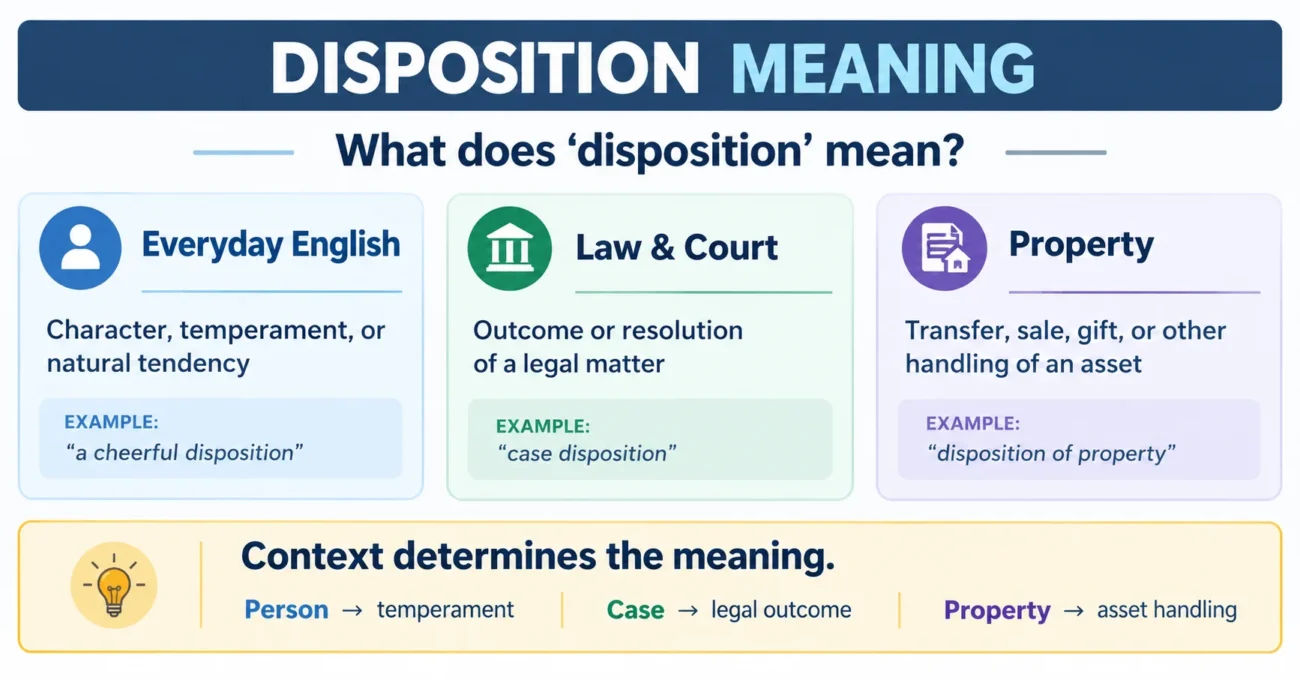
The meaning of disposition depends on the context in which you see the word. In everyday English, it usually describes a person’s natural character, mood, or tendency—for example, someone may have a cheerful or friendly disposition. In legal or court records, however, disposition usually refers to how a case, charge, or legal matter was resolved.
That difference is what makes the word confusing. If you searched for “disposition meaning” because you saw it on a court record, background check, case-status page, document, or in a psychology context, the correct meaning may be very different from the ordinary dictionary definition. The key is to look at what the word is describing and where it appears.
What Does Disposition Mean?
Disposition means a person’s usual character or tendency in ordinary English, while in legal contexts it commonly means the outcome or resolution of a legal matter. ” Huzz Meaning ”
For example:
- “She has a cheerful disposition.” → Her natural character or temperament is cheerful.
- “The disposition of the case was dismissal.” → The case ended with a dismissal.
- “Disposition of the property” → The property was transferred, sold, given away, or otherwise dealt with.
- “Disposition date” on a court record → This generally refers to the date associated with the case’s final resolution.
So, “disposition” does not have one universal meaning. The surrounding words tell you which sense applies.
The Three Common Meanings of Disposition
| Context | Meaning of disposition |
|---|---|
| Everyday English | A person’s character, temperament, or natural tendency |
| Law / court records | The final outcome or resolution of a legal matter |
| Property / assets | The act of transferring, selling, giving, or otherwise dealing with property |
This is why it is better to interpret the word from its context rather than assuming that every use of “disposition” refers to a court case.
What Does Disposition Mean in Law?
In law, disposition generally refers to the final determination or resolution of a legal matter. For a court case, it tells you what ultimately happened to the case, charge, motion, or proceeding.
A criminal case may end with a conviction, acquittal, dismissal, or another legally recognized outcome. A civil matter may end through a judgment, settlement, dismissal, or another final court action.
The important point is that “disposition” by itself does not tell you whether the result was good or bad for either side. It tells you that the matter reached a particular resolution; you need the actual disposition or case outcome to understand what happened.
What Does Disposition Mean in a Court Case?
When you see “disposition” on a court record, read it as a simple question:
How was this case or charge resolved?
For example, if a record shows:
Case status: Disposed
Disposition: Dismissed
the word “disposed” indicates that the case has reached a final action, while “dismissed” tells you what that action was.
That distinction matters because disposed does not automatically mean convicted. A case can be resolved in several different ways.
What Does “Disposed” Mean Compared With “Disposition”?
These two words are closely related, but they are not interchangeable in every sentence.
Disposition is the noun describing the outcome or resolution.
Disposed is commonly used to describe a case that has been resolved or received a final action.
For example:
- Disposition: Dismissed
- Status: Disposed
The first tells you the specific outcome, while the second indicates that the matter has received a final action.
A disposed case can have very different underlying outcomes. The word “disposed” alone does not tell you who won, whether someone was convicted, or whether the matter was dismissed. The actual case disposition provides that information.
What Does Disposition Date Mean?
A disposition date is the date associated with the resolution or final action on a case or legal matter.
If you are looking at a court record, the disposition date can help you determine when the case reached the recorded outcome. It should not automatically be interpreted as the date the original case was filed, the date of the alleged offense, or necessarily the date a sentence was completed.
For example:
Filing date: January 10
Court hearings: February–April
Disposition date: May 15
Disposition: Dismissed
Here, May 15 identifies the date associated with the recorded resolution, while “dismissed” explains what happened to the case.
The exact way a disposition date is displayed can vary between court systems, so if the record contains several dates, read the labels carefully instead of assuming they all refer to the same event.
Does a Disposition Mean the Case Is Over?
Usually, a recorded final disposition means the particular matter has reached a resolution, but the word alone does not explain every legal consequence.
A disposition could involve a dismissal, acquittal, conviction, settlement, judgment, or another final action depending on the type of proceeding and jurisdiction.
This is why two people can both have a case marked as “disposed” while having completely different outcomes.
If you are trying to understand your own record, the next thing to check is not simply whether it says disposed. Look for the specific disposition or outcome listed with the case.
What Does Disposition Mean on a Background Check?
On a background check, disposition usually refers to the final outcome of a criminal charge or court case. It helps distinguish an accusation or arrest from what actually happened afterward.
A charge appearing on a report does not, by itself, tell you that the person was convicted. The disposition provides the outcome associated with that case.
For example, a background check might show a charge followed by a disposition such as:
| Disposition | General meaning |
|---|---|
| Convicted / Guilty | The case resulted in a conviction or guilty finding |
| Dismissed | The case was dismissed rather than ending in a conviction |
| Acquitted | The person was found not guilty |
| Nolle prosequi | The prosecution chose not to continue the case |
| Pending | The matter has not reached a final resolution |
The exact terminology can vary by jurisdiction and reporting system, so a disposition code should be interpreted using the relevant court record or screening provider’s explanation.
Does “Disposition” on a Background Check Mean Convicted?
No. The word “disposition” does not itself mean that someone was convicted.
It is better understood as a field that tells you what happened to the case. The actual result could be a conviction, dismissal, acquittal, or another outcome.
This distinction is important because an arrest or charge is not the same thing as a conviction. If you are reviewing a background report, look at the specific disposition, not just the presence of the word “disposition.”
Common Types of Case Dispositions
The exact list of dispositions differs between courts, but several outcomes appear frequently in criminal and civil records.
Dismissed
A dismissed case means the charge or claim was dismissed rather than resulting in the particular case proceeding to a conviction or judgment.
The reason and legal effect can differ depending on the circumstances. A dismissal should therefore not automatically be treated as identical to an acquittal or as evidence that every possible legal consequence has disappeared.
Acquitted
An acquittal generally means the defendant was found not guilty after the relevant proceeding.
This is different from a dismissal because the case reached a determination of guilt or innocence through the applicable trial process.
Convicted or Guilty
A disposition showing guilty or convicted indicates that the case resulted in a conviction.
Depending on the jurisdiction and case, the record may also show a sentence, probation, fine, or another consequence.
Settled
In a civil matter, the parties may resolve the dispute through a settlement rather than continuing to a trial and judgment.
A settlement is therefore a type of resolution, but it does not carry the same meaning as a criminal conviction.
Pending
A pending matter has not reached its final disposition.
This is one reason it is important to distinguish case status from case disposition. A case can move through different statuses before a final outcome is recorded.
Disposition vs. Case Status: What Is the Difference?

Case status tells you where a matter currently stands; disposition tells you how the matter was resolved.
For example:
- Status: Pending → the case is still unresolved.
- Status: Disposed → the case has received a final action.
- Disposition: Dismissed → the specific recorded outcome was dismissal.
- Disposition: Convicted → the case resulted in a conviction.
The words are related, but they answer different questions. If you see both fields on a court or background-check record, do not assume that “disposed” tells you the exact outcome. You need the disposition itself to understand what happened.
What Does Disposition of Property Mean?
“Disposition” is not limited to court cases. In legal, financial, and property contexts, it can also refer to what is done with an asset or property, such as selling, transferring, gifting, or otherwise arranging for its ownership or control.
For example, if a document discusses the disposition of an asset, it may be asking how that asset was transferred or otherwise dealt with.
This is a different meaning from case disposition.
A useful shortcut is:
Case disposition = What happened to the legal case?
Property disposition = What happened to the property or asset?
Keeping those two meanings separate prevents a common misunderstanding when reading legal documents.
Why the Context Matters So Much
The biggest mistake when interpreting “disposition” is treating the word as if it has only one definition.
Compare these sentences:
“He has a calm disposition.”
Here, disposition describes his personality or temperament.
“The court entered a disposition in the case.”
Here, disposition refers to the resolution of a legal matter.
“The disposition of the property occurred through a sale.”
Here, disposition concerns the transfer or handling of property.
The spelling is identical, but the meaning changes because the context changes.
That is why a person searching “disposition meaning” may actually need one of several more specific answers: the ordinary English meaning, the legal meaning, the meaning on a court record, or the meaning of a disposition date.
Is Disposition the Same as Personality?
Not exactly, although the concepts can overlap.
When disposition is used to describe a person, it can refer to their characteristic mood, temperament, or tendency to behave in a particular way.
However, personality is a broader concept. Disposition can describe one characteristic or tendency within a person’s overall personality rather than being a complete synonym for personality.
So:
Disposition → a characteristic tendency or temperament
Personality → the broader pattern of characteristics, thoughts, emotions, and behaviors
The correct interpretation still depends on the sentence in which the word appears.
What Does Disposition Mean in Everyday Conversation?
In ordinary conversation, disposition often describes how someone naturally tends to behave or what their temperament is like.
Consider these examples:
- “He has a calm disposition.”
- “She has a cheerful disposition.”
- “The child has a curious disposition.”
- “His serious disposition makes him seem reserved.”
In each example, “disposition” describes a relatively characteristic way of being rather than a legal outcome.
This is the meaning you are most likely dealing with when the word appears in a sentence about someone’s personality or temperament.
What Is Dispositional Attribution?
In psychology, dispositional attribution means explaining someone’s behavior by referring to internal characteristics of that person, such as personality, attitudes, abilities, motives, or other personal factors.
For example, imagine that a person helps a stranger who has fallen.
You might explain the behavior by saying:
“That person is naturally kind.”
That explanation focuses on an internal characteristic—kindness. It is therefore a dispositional explanation.
A different explanation would focus on the situation:
“They helped because other people were watching and someone asked them to help.”
That explanation focuses more on external circumstances.
Dispositional Attribution vs. Situational Attribution
The difference can be summarized simply:
| Type | Focus | Example |
|---|---|---|
| Dispositional attribution | Internal characteristics | “She is patient.” |
| Situational attribution | External circumstances | “She was patient because the situation required it.” |
The important distinction is where you believe the cause of behavior comes from.
Dispositional attribution focuses on characteristics within the person, while situational attribution explains behavior through external circumstances.
What Does Disposition Mean in Modern or Gen Alpha Usage?
The core meaning of disposition has not changed simply because younger generations use the word differently. If you see “disposition” in content aimed at Gen Alpha, the surrounding sentence is still the best clue to its meaning.
For example, if someone uses the word to describe a person’s attitude, personality, or tendency, it is likely being used in its ordinary sense. If the word appears in a court-related post or discussion, the legal meaning may apply instead.
There is therefore no reliable basis for treating “disposition” as a special Gen Alpha definition without a specific phrase or usage to examine.
If your search came from a particular TikTok, social-media post, message, or slang expression, the exact sentence matters. A single word can carry its standard meaning while the surrounding slang changes the tone or implication.
How to Figure Out Which Meaning of Disposition You Need
When you encounter the word and are unsure what it means, use this simple three-step check.
Step 1: Look at the Surrounding Words
- Words such as case, court, charge, judgment, conviction, dismissed, docket, or background check strongly suggest a legal meaning.
- Words such as personality, character, temperament, cheerful, calm, or tendency usually point to the everyday meaning.
- Words such as behavior, attribution, personality, internal, or situational may indicate the psychology meaning.
Step 2: Identify What the Word Is Describing
Ask:
Is it describing a person, a legal case, or an asset?
- Person → character or temperament
- Legal case → outcome or resolution
- Property/asset → transfer or handling
- Behavior in psychology → possible dispositional attribution
Step 3: Check the Exact Phrase
The phrase surrounding “disposition” can completely change the answer.
For example:
Disposition date → date associated with a case’s resolution
Case disposition → outcome of a legal case
Dispositional attribution → explanation of behavior through internal characteristics
Cheerful disposition → pleasant or positive temperament
That is why searching only for the single word can produce an answer that seems contradictory. The meanings are not necessarily conflicting; they belong to different contexts.
Quick Examples of “Disposition” in Different Contexts
| Example | Meaning |
|---|---|
| “She has a friendly disposition.” | Friendly temperament or character |
| “The court recorded the disposition.” | Final legal outcome |
| “Check the disposition date.” | Date connected with the case resolution |
| “The background check lists a disposition.” | Recorded outcome of a charge or case |
| “The disposition of the property was completed.” | Property was transferred or otherwise dealt with |
| “He made a dispositional attribution.” | He explained behavior through internal personal characteristics |
The easiest way to remember the word is to focus on what is being dealt with.
- When the subject is a person’s character, disposition describes a tendency or temperament.
- When the subject is a legal case, it describes the outcome.
- When the subject is property, it describes what happened to the asset.
In psychology, dispositional attribution describes an explanation based on internal characteristics.
Frequently Asked Questions About Disposition Meaning
Does disposition always mean the final outcome?
No. In legal contexts, disposition commonly refers to the final outcome or resolution of a case, but the word has broader meanings. In everyday English, it can describe someone’s temperament or natural tendency. In property contexts, it can refer to transferring or otherwise dealing with an asset.
Is disposed the same as dismissed?
No. Disposed generally indicates that a case has received a final action, while dismissed describes one particular type of outcome. A case can be disposed through dismissal, but it can also be disposed through other outcomes such as conviction, acquittal, settlement, or another resolution.
Does a disposition date mean the date of conviction?
Not necessarily. A disposition date is the date associated with the recorded resolution of a legal matter. The actual disposition could be a dismissal, acquittal, conviction, settlement, or another outcome. You need to look at the specific disposition to determine what happened.
What does disposition mean on a criminal record?
On a criminal record or background check, disposition generally identifies how a criminal charge or case was resolved. It may show a conviction, dismissal, acquittal, or another outcome. The word itself does not mean that the person was convicted.
The Bottom Line
“Disposition” means different things in different contexts. If you are talking about someone’s personality, it usually means their character, temperament, or natural tendency. If you are looking at a court record or background check, it generally refers to the outcome or resolution of a legal matter. In psychology, dispositional attribution has a more specific meaning: explaining behavior through internal characteristics of a person.
So, when you see the word “disposition,” don’t interpret it in isolation. Check the context, identify what the word is describing, and then look at the specific phrase or outcome attached to it. That simple approach will usually tell you which meaning applies.


Leave a Comment