
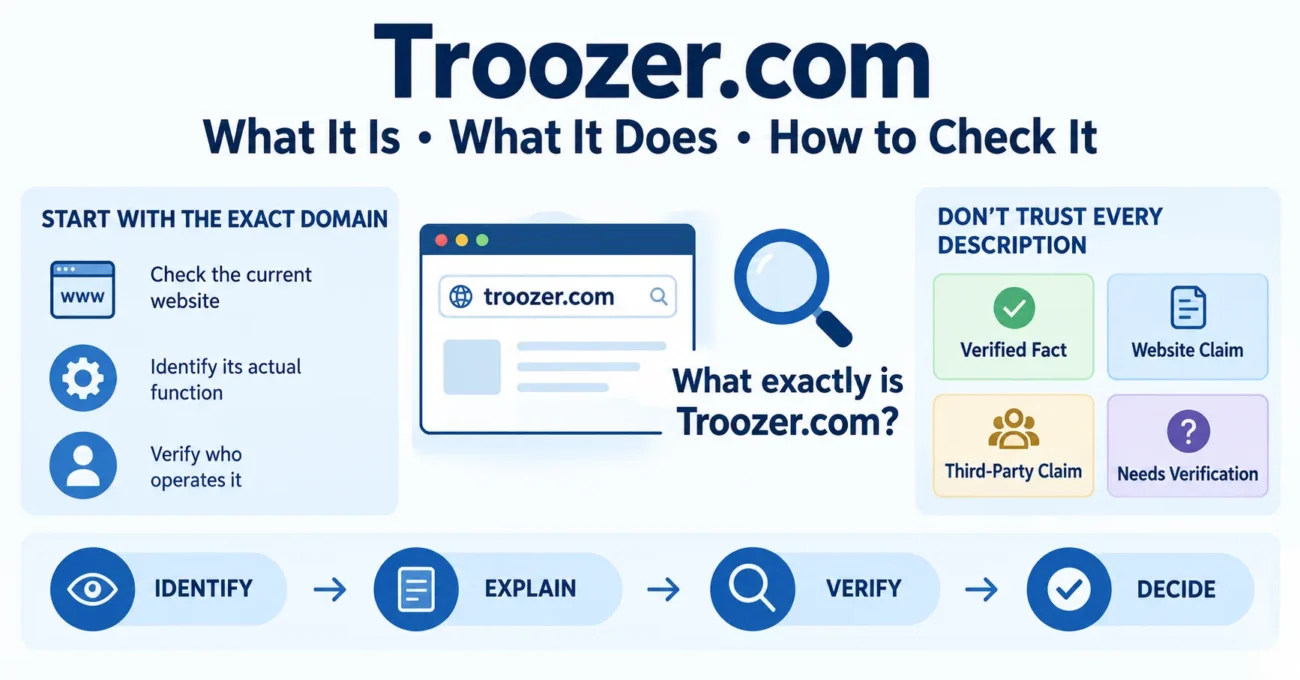
If you searched for Troozer com, you probably want a simple answer: what is this website, what does it actually do, and can you trust the information you find about it? The problem is that online descriptions of Troozer com are not consistent. Different pages associate the domain with different types of online services, which makes a straightforward answer harder to find.
That confusion is exactly why it helps to separate what can be observed from what is merely claimed. Rather than treating every third-party description as fact, this guide looks at PlusStories from the user’s point of view: what the domain appears to be, why descriptions differ, what the site actually presents, and what you should verify before taking a higher-risk action.
Before You Continue, Here Are the Questions That Matter
If you found Troozer.com through a search result, advertisement, social post, or another website, you may be wondering:
- What exactly is Troozer.com?
- Why do different websites describe it differently?
- What does the website actually offer?
- Is it a marketplace, an online tool, or a publishing website?
- Is Troozer.com safe enough to use or provide information to?
The easiest way to answer those questions is to start with the site’s identity, then separate the conflicting descriptions from what can actually be established.
What Is Troozer.com Actually?
Troozer.com is a website domain whose identity needs to be judged from the current site and reliable supporting evidence rather than from isolated descriptions on third-party pages.
Current search results show descriptions of Troozer.com that do not consistently agree with one another. Some sources describe it as a multi-category digital publishing website, while other pages associate it with more specialized functions such as marketplaces, productivity tools, AI-related services, or browser utilities.
That difference matters.
A website can be mentioned on a page as an example, affiliate destination, review subject, or supposed product without actually providing the service being described. Therefore, a third-party article saying that Troozer.com is an AI platform, marketplace, or another type of service is not, by itself, enough evidence to establish that identity.
The safer approach is to begin with the exact domain and ask three basic questions:
- What does the website currently display?
- What functions can a visitor actually use?
- Is there reliable information identifying the organization or people behind it?
Those questions are more useful than relying on a single review or a short description in search results.
What Can Be Established vs. What Still Needs Checking?
There is an important difference between an observable website feature and an interpretation about the business behind it.
For example, if the domain visibly publishes articles arranged into categories, that is something a visitor can observe. Calling the organization behind those pages a particular company, marketplace, software provider, or AI business requires stronger evidence.
This distinction becomes especially important with Troozer.com because the available descriptions are inconsistent.
So, for this article:
- Verified fact means information that can be supported by reliable evidence.
- Claim means something Troozer.com or another source says about the site.
- Interpretation means a reasonable conclusion drawn from observable evidence.
- Needs verification means something that cannot confidently be established from the available evidence.
Keeping those categories separate prevents a review from turning an assumption into a fact.
Why Is Troozer.com So Confusing?
The main source of confusion is that different online sources appear to assign different identities to the same domain.
One description may present Troozer.com as a digital publication or content-focused website. Another may describe it as a marketplace. A different page may discuss it as a productivity, AI, or browser-related service.
If you encounter these descriptions one after another, it is natural to wonder which one is correct.
The important point is that these descriptions should not automatically be combined into one large list of Troozer.com features. They may represent different interpretations, outdated information, third-party assumptions, or claims that were never independently established.
Why Third-Party Descriptions Can Be Misleading
Search engines can return pages that discuss a website without those pages being officially connected to the website.
For example, a review might say that a domain offers a particular service because that description appears elsewhere online. Another website may repeat the same description, creating the impression that several independent sources have confirmed it.
But repetition is not the same as verification.
If five websites repeat the same unsupported statement, you still need to find the original evidence behind that statement.
This is particularly important when the claim involves:
- payments,
- account creation,
- financial services,
- software downloads,
- personal information,
- business ownership,
- or claims about safety and legitimacy.
So Which Description Should You Trust?
Start with the current website itself, then look for independent evidence that supports important claims.
If Troozer.com visibly provides a particular feature, that is stronger evidence that the feature exists than a random article describing it.
If a third-party page makes a claim that cannot be confirmed on the domain or through reliable independent sources, treat it as unverified rather than automatically accepting it.
This does not prove that the claim is false. It simply means there is not enough evidence to present it as an established fact.
That distinction gives you a much more accurate picture of Troozer.com.
What Does Troozer.com Actually Do?

Once you separate the conflicting descriptions, the next question becomes more practical: what can a visitor actually find or do on Troozer.com?
The current search landscape points toward a website with content organized across multiple topics rather than providing enough reliable evidence to confidently describe it as one specific specialized product.
This means the site’s observable structure is more useful than labels attached to it elsewhere.
When evaluating the domain, look at the actual pages available to visitors:
- What categories are present?
- What type of content is being published?
- Are the pages primarily articles or interactive tools?
- Does the site clearly explain its purpose?
- Is there an identifiable organization or person responsible for it?
- Does it provide a clear contact method?
- Are there terms, privacy information, or other policy pages?
These checks help distinguish what the website actually presents from what other pages claim about it.
Why the Site’s Visible Function Matters
Suppose an external article calls a website a marketplace, but the domain itself mainly displays editorial content and does not provide a recognizable buying or selling system.
In that situation, calling the domain a marketplace without further evidence would be premature.
The same principle applies to claims that a website is an AI tool, software platform, financial service, or browser utility.
The label should follow the evidence—not the other way around.
For Troozer.com, that means the most useful description should be based on its current observable purpose and supported information, while conflicting descriptions should remain clearly identified as claims or interpretations until they can be independently verified.
A Simple Way to Think About Troozer.com
If you are trying to understand the domain for the first time, do not begin by asking:
“Which label does the internet give Troozer.com?”
Instead, ask:
“What does Troozer.com itself currently show, and what evidence supports the claims made about it?”
That change in approach removes much of the confusion.
It also gives you a better foundation for the next question: whether the domain is trustworthy enough for the type of interaction you are considering.
Is Troozer.com Legit or Safe?
Whether Troozer.com is safe depends on what you plan to do on the site. Visiting a website and giving it sensitive information are two different levels of risk, so a simple “safe” or “unsafe” label can be misleading without explaining the evidence behind it.
There is no single signal that proves a website is trustworthy. A working HTTPS connection, a professional-looking design, or a site appearing in search results can be useful signs, but none of them independently establishes who operates the website or whether every service or claim associated with it is reliable.
Look Beyond HTTPS
If Troozer.com uses HTTPS, your browser may show a secure connection when communicating with the site. That is useful for protecting data while it is transmitted, but HTTPS does not prove that the organization behind a website is legitimate.
The same principle applies to a padlock icon.
It tells you something about the connection. It does not tell you:
- who owns the domain,
- whether the business is trustworthy,
- whether the information published there is accurate,
- whether a product or service will be delivered,
- or whether you should provide sensitive information.
So HTTPS should be treated as a technical security signal, not as a complete legitimacy check.
Check Who Is Behind the Website
A stronger trust signal is transparency.
Look for an identifiable organization, business name, responsible person, physical or business contact information where appropriate, and clear ways to contact the operator.
Also check whether the site’s:
- About page explains who operates it,
- contact information is usable,
- privacy policy identifies the responsible entity,
- terms explain how the service works,
- and important claims are supported by evidence.
If these details are missing or difficult to verify, that does not automatically prove wrongdoing. It simply means you have less information on which to base a trust decision.
Be More Careful When Money or Sensitive Information Is Involved
The level of caution should increase if Troozer.com asks you to:
- create an account,
- enter payment details,
- upload identification,
- provide sensitive personal information,
- download unfamiliar software,
- or complete an unusual payment process.
A website does not need to be proven fraudulent before you decide not to provide sensitive information. If an important part of the service cannot be independently verified, waiting until you have better evidence is a reasonable choice.
How Can You Verify Troozer.com Before Using It?
The best way to evaluate Troozer.com is to use a short verification process rather than relying on a single review.
1. Confirm the Exact Domain
First, make sure you are actually looking at troozer.com.
A similar-looking domain, spelling variation, subdomain, advertisement, or redirected page could belong to something completely different.
This is especially important when a website name is being discussed across many third-party pages.
2. Check What the Website Actually Offers
Look at the pages that are currently available on the domain.
Do not rely solely on a search-result description. Check whether the site itself clearly presents the service that someone claims it provides.
For example, if an external page describes Troozer.com as a marketplace, look for an actual marketplace function on the domain. If another source describes it as a software or AI platform, look for evidence of that function on the site itself.
If the claimed function cannot be found, mark the description as needs verification rather than treating it as established fact.
3. Look for Responsible Ownership Information
Check the site’s About, Contact, Terms, and Privacy pages.
You are looking for enough information to answer:
“Who is responsible for this website?”
A transparent site should make it reasonably clear who operates it or which organization is responsible for its services and published material.
If ownership is unclear, that is not automatically proof of a scam. It is simply a reason to apply additional caution.
4. Read the Privacy and Terms Pages
If you are considering creating an account or providing information, find out how the website says your data will be handled.
Pay attention to:
- what information is collected,
- why it is collected,
- whether information is shared with third parties,
- how accounts can be closed,
- and which organization is identified as responsible for the service.
A privacy policy is not proof that a website is trustworthy, but it can reveal whether the site provides basic transparency about its data practices.
5. Examine Payment Requests Carefully
If a website asks for payment, slow down before entering card or financial information.
Check:
- what exactly you are paying for,
- whether the price and terms are clear,
- who is receiving the payment,
- whether the checkout process is consistent with the service,
- and whether there is a clear refund or cancellation policy where applicable.
Never treat a professional-looking checkout page as proof that a transaction is risk-free.
6. Compare Independent Evidence
Search for information about the domain from sources that are genuinely independent.
The goal is not to count how many websites mention Troozer.com. The goal is to determine whether important claims can be independently supported.
For example, several articles repeating the same description do not necessarily provide several independent confirmations if they appear to rely on one another.
7. Separate Website Claims From Verified Information
This is one of the most important checks.
If Troozer.com says that it provides a particular service, that is a claim made by the site.
It becomes stronger evidence when independent, reliable information supports that claim.
Likewise, if a review website makes a negative allegation, that allegation should not automatically be treated as fact simply because it appears in a detailed article.
The correct question is:
“What evidence supports this statement?”
Which Troozer.com Claims Can Actually Be Trusted?
Because information about Troozer.com varies between sources, it helps to classify statements before relying on them.
Verified Fact
A verified fact is something supported by reliable evidence that can be checked independently.
For example, the existence of a particular page or feature on the current domain can generally be observed directly.
Website or Company Claim
If the website describes itself in a certain way, that description is a claim from the website.
It is relevant, but it should still be distinguished from independent verification.
A company saying that it provides a particular service tells you what it claims to provide. It does not automatically prove the quality, reliability, or legitimacy of that service.
Third-Party Claim
A review, blog, social post, or other external page may make claims about Troozer.com.
Those claims can be useful leads for further investigation, but their presence does not automatically make them verified facts.
This is particularly important when a third-party page makes strong statements about ownership, business practices, safety, or alleged misconduct.
Interpretation
Sometimes the evidence supports a reasonable conclusion without proving every detail.
For example, if a domain consistently presents articles across multiple categories, it may reasonably be interpreted as a content-focused publication.
That is different from claiming that the site’s legal business structure or ownership has been independently established.
Needs Verification
Some statements simply cannot be confirmed confidently from the available evidence.
In those cases, the most accurate answer is not to guess.
Saying “this needs verification” is more useful than turning uncertainty into a definitive statement.
What Can You Conclude About Troozer.com Right Now?
The clearest conclusion is that Troozer.com should be evaluated from the evidence available on the exact domain rather than from conflicting labels found across third-party websites.
The search landscape contains different descriptions of what Troozer.com is supposed to be. That makes it particularly important to distinguish the site’s observable content and functions from external claims about its business identity.
If you are simply trying to understand the domain, start with what the current website actually presents.
If you are considering an account, payment, download, or disclosure of sensitive information, go further and verify ownership, policies, contact information, the exact service being offered, and the terms of the transaction.
In other words, uncertainty is not the same thing as proof of fraud—but uncertainty is also not a reason to assume everything is trustworthy.
Frequently Asked Questions About Troozer.com
Is Troozer.com a marketplace?
Some third-party descriptions associate Troozer.com with marketplace-style services, but that description should not automatically be treated as verified. Check the current domain for an actual buying, selling, or marketplace function before relying on that characterization.
Is Troozer.com an AI tool?
There are online descriptions that associate the domain with AI or productivity-related functions. However, a third-party description alone does not establish that identity. The appropriate way to verify the claim is to check whether the current Troozer.com site actually provides the described AI functionality.
Is Troozer.com safe to visit?
Simply visiting a website and providing sensitive information are different risks. Troozer.com’s safety should be evaluated using the exact domain, its current functionality, ownership transparency, policies, and the type of interaction you plan to have with it.
Should I enter payment information on Troozer.com?
Do not make that decision based only on a review or the presence of HTTPS. First verify what you are paying for, who operates the service, the payment process, relevant terms, and refund or cancellation conditions. If important information cannot be verified, avoid providing financial details until you have stronger evidence.
Why do websites describe Troozer.com differently?
Different descriptions may come from third-party interpretations, outdated information, repeated claims, or differences between what the website currently presents and what someone assumes it provides. That is why the domain itself and reliable supporting evidence should take priority.
How can I check whether information about Troozer.com is reliable?
Look at where the information originated and whether the claim can be independently confirmed. Give greater weight to observable facts and reliable primary sources, while treating unsupported reviews, repeated descriptions, and strong allegations as claims that may require further verification.
The Bottom Line on Troozer.com
If you searched for Troozer.com because you were unsure what the domain actually is, the most useful answer is not a rushed “safe” or “scam” label. The bigger issue is that descriptions of the domain vary, so you need to distinguish what can be observed from what third parties claim.
Start with the exact website, identify what it actually offers, check who is responsible for it, and review its policies before taking a higher-risk action. If a claim cannot be independently established, treat it as uncertain rather than as fact.
That approach gives you a much safer way to evaluate Troozer.com—and it works even when the information surrounding a website is inconsistent or incomplete.


Leave a Comment