
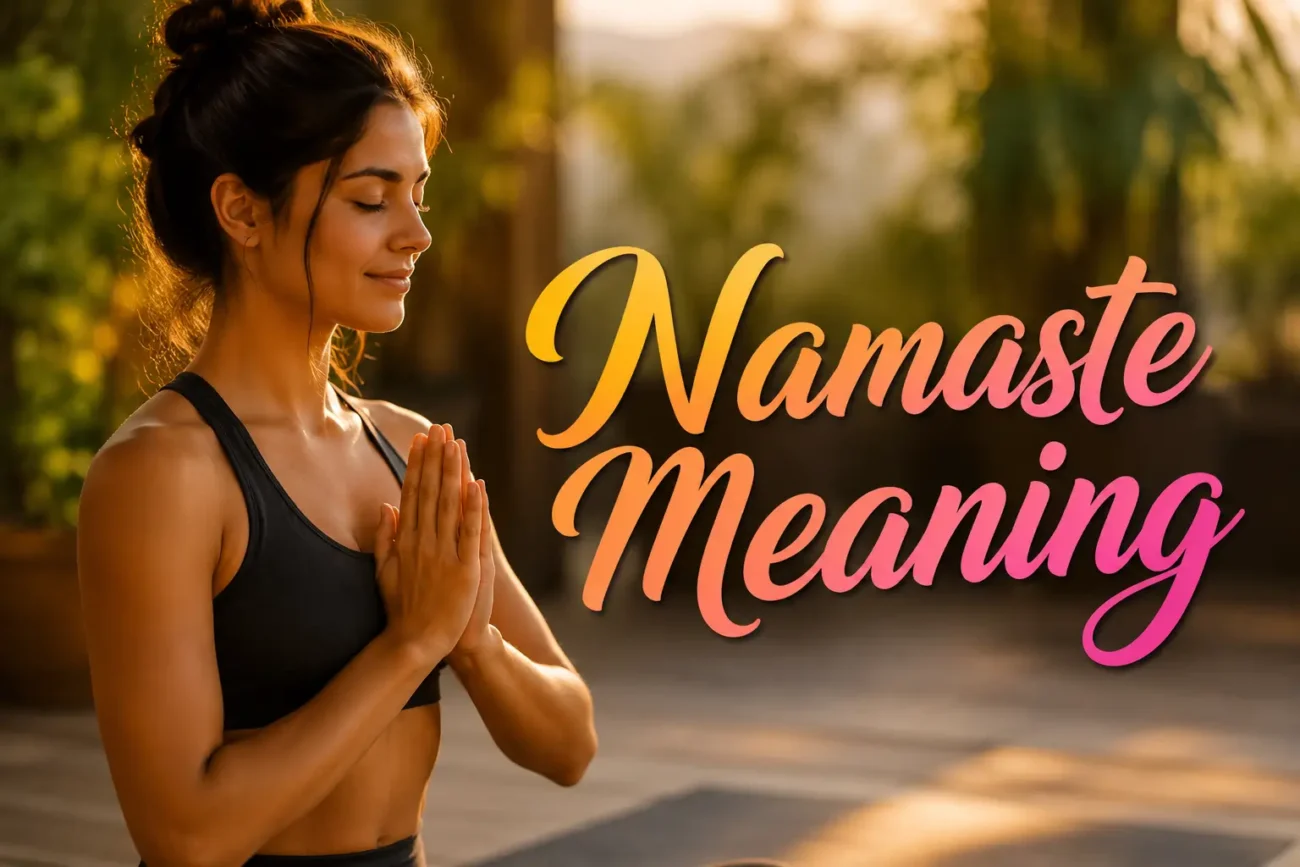
The Namaste meaning, at its simplest, is a respectful Sanskrit greeting. It literally translates to “I bow to you,” or more poetically, “the divine in me honors the divine in you.” People traditionally use it across India and Nepal as a hello or a goodbye. From there, it spread to yoga studios worldwide and, more recently, to texts, captions, and everyday chats, where people now use it as a warm, slightly cheeky way to say hi, thanks, or peace out.
If you’re already fluent in internet shorthand like OFC or IYKYK, namaste might feel like the opposite end of the spectrum — an ancient word instead of a freshly minted acronym. But it’s landed in the same casual texting and caption culture those terms live in. That’s exactly why it earns a spot in a meanings roundup next to modern slang, not just in a yoga glossary.
What Does the Namaste Meaning Break Down Into?
At its core, the Namaste meaning splits into two Sanskrit pieces: namah, meaning “bow,” “reverence,” or “salutation,” and te, meaning “to you.” Put together, namaste means “I bow to you.” It acknowledges another person with humility and respect, rather than just saying “hi.”
There’s a deeper layer that most casual users never learn. Sanskrit’s te is an intimate, familiar form of “you,” so some scholars translate the fuller sense of namaste as “salutations to the divine spark within you.” That’s where the popular yoga-class gloss — “the light in me honors the light in you” — comes from. It’s a beautiful interpretation, but it extends the word’s spirit rather than translating it literally.
You’ll also see namaste explained as na + ma, meaning “not mine.” This folk etymology ties into the idea of setting ego aside when greeting someone. Linguists generally treat the namah + te breakdown as the accurate one. Still, the “not mine” reading has stuck around because it fits the humility the greeting expresses.
Where Does the Namaste Meaning Come From?
Namaste isn’t a modern coinage. It shows up in Vedic literature dating back roughly 1500 to 1000 BCE, including the Rigveda and Atharvaveda, and later the Mahabharata. For thousands of years before it ever appeared in a yoga class, people used it as an everyday spoken greeting across the Indian subcontinent and Nepal. They usually paired it with palms pressed together at the chest — a gesture called Anjali Mudra — and a slight bow of the head.
That gesture matters as much as the word itself. In daily use across India and Nepal, namaste carries roughly the same weight as “hello.” It’s not automatically a spiritual statement every time someone says it, any more than “goodbye” carries religious weight in English just because it descends from “God be with you.” Context decides how much weight the word carries.
How Do People Use Namaste in Everyday Conversation?

The Namaste meaning shifts depending on the platform. It’s worth breaking down by context, since that’s usually what people want to know when they search for it.
In texting and DMs: People often use namaste as a lighthearted greeting or sign-off, especially if they’re into wellness, yoga, or mindfulness culture. A text like “namaste, see you at 6” reads as friendly and a little playful rather than formal.
On social media: Captions under yoga photos, meditation posts, or “good vibes only” content use namaste constantly, sometimes sincerely and sometimes as a knowing wink at wellness-influencer culture. It’s also become shorthand for closing out a post on a peaceful or grateful note, similar to ending a caption with a peace-sign emoji.
In casual talk: Friends drop namaste as a half-joking way to bow out of a conversation (“namaste, I’m out”), or to defuse tension with mock formality. Think of it as a funnier version of “I respectfully disagree.”
In jokes and memes: This is where namaste stretches furthest from its roots. Meme culture built jokes like “namaste in bed” (a pun on staying in bed) and “namaste away from crazy people,” both leaning entirely on wordplay rather than the word’s actual meaning. These jokes stay hugely popular online, but they’re puns, not translations — worth knowing if you want to use the word accurately elsewhere.
Does the Namaste Meaning Match Namaskar?

Not quite, though people often use them interchangeably. Namaskar comes from namas + kara (“doing” or “action”), and it traditionally works as a general-purpose salutation for a group. Namaste, with its singular “you,” technically greets one person at a time. In modern usage — especially outside India — that distinction has mostly blurred. Namaste is now the version most people recognize and use, whether they’re greeting one person or a whole room.
How Do You Use Namaste in a Joke or Chat?
The comedic use of namaste almost always relies on sound-alike wordplay rather than the actual definition. That’s part of what makes it fun. “Namastay in bed” and “namaste away from drama” are the two most recycled jokes. They work precisely because namaste sounds like “stay” tucked inside it. You’ll see these on mugs, tote bags, and increasingly as one-liners in group chats and captions.
Used this way, namaste functions less like a greeting and more like a punchline setup. It’s low-stakes, and most people understand it instantly. That’s exactly why it keeps resurfacing in meme formats years after it first went viral.
Regional and Platform Differences in the Namaste Meaning
A few variations are worth flagging so you don’t misuse the word:
- In India and Nepal, people use namaste sincerely and constantly as an everyday greeting across generations. They don’t treat it as a “spiritual” statement by default.
- In Western yoga and wellness spaces, instructors almost always use namaste at the end of a class or session. That’s a departure from its traditional use as a hello rather than a goodbye.
- On TikTok and Instagram, namaste shows up heavily in wellness, manifestation, and “soft life” content, often stylized with a folded-hands emoji (🙏) rather than the word alone.
- On X and in group chats, the pun-based usage (“namastay,” “namaste away”) dominates over the sincere greeting.
- Generationally, older or more traditional usage tends to reflect the word’s actual meaning, while younger, internet-native usage leans harder into the joke format.
Common Mistakes People Make With the Namaste Meaning
A few habits are worth cleaning up if you want to use the word accurately:
- Treating it as inherently religious. Namaste is a greeting first, not a prayer. It can carry spiritual weight, but it doesn’t automatically mean someone is invoking Hinduism every time they say it.
- Using it only as a goodbye. In its home context, namaste is typically a hello, not a class-ending sign-off. The Western yoga-studio habit of saving it for the end is a fairly recent shift.
- Assuming “namastay” jokes are the real translation. The pun leans on how namaste sounds, not on what it means. Keep that in mind if you’re using namaste in a serious context, like a caption for a trip to India or Nepal, versus a joke format.
- Mispronouncing it as “nah-mah-stay” with heavy stress on the last syllable. The more natural pronunciation spreads even weight across the syllables: nuh-muh-stay.
Related Meanings on JokeRiddle
If namaste sent you down a rabbit hole of words people say without fully knowing their origin, a few other JokeRiddle Meanings entries are worth a look:
- OFC meaning — a much more modern shorthand, but same idea of a word people use constantly without thinking about it
- IYKYK meaning — another phrase that carries more cultural context than its letters suggest
- SMH meaning — for the other end of the tone spectrum from namaste’s calm energy
For a more traditional, dictionary-style breakdown of the term, MeaningSpot’s namaste meaning article is also worth a read.
FAQ: Namaste Meaning
What does namaste literally mean?
Namaste literally translates to “I bow to you,” combining the Sanskrit words namah (“bow” or “salutation”) and te (“to you”).
Is namaste a hello or a goodbye?
Traditionally, people use it as a hello in India and Nepal. Saving it for the end of a session is mostly a Western yoga-class convention.
Do you have to be religious to say namaste?
No. In its home context, namaste functions as an everyday greeting, similar to “hello.” It doesn’t require any specific religious belief to use respectfully.
Why do people say “namastay in bed”?
It’s a pun that plays on the sound of namaste resembling the word “stay.” It’s a joke format, not an actual translation of the word.
Is it disrespectful to say namaste if you’re not from India or Nepal?
Most people don’t consider an accurate, respectful use of the word offensive. Some critics do point to Western wellness culture stripping the word of context or using it purely as an aesthetic. Understanding what it actually means, as this article covers, is the easiest way to use it respectfully.
What’s the correct way to pronounce namaste?
You pronounce namaste as nuh-muh-stay, with fairly even stress across the three syllables rather than heavy emphasis on the last one.
Final Thoughts on the Namaste Meaning
Namaste carries a lot more history than the punny “namastay in bed” captions suggest. That doesn’t mean the jokes are off-limits — it just means it’s worth knowing what you’re actually saying before you say it. Whether you use it as a sincere greeting, a caption sign-off, or a group-chat pun, the Namaste meaning boils down to one simple idea: a respectful nod to the person in front of you, wrapped in a word that’s done that job for thousands of years.


Leave a Comment