

Someone just ended a chat with “I’ll hyu later,” and now you are wondering what you actually agreed to. The hyu meaning in chat is simpler than it looks. In short, HYU stands for “hit you up,” and it means the sender plans to contact you later. So, rather than a long goodbye, the person is making a small promise: this conversation is paused, not finished. This guide, accordingly, breaks the hyu meaning in chat down in plain words. First, it explains what the term means and where it came from. Then, it shows real examples, natural replies, and the mistake almost everyone makes with this term — mixing HYU up with HMU. By the end, you will know how to read HYU, when to use it yourself, and when to leave it out completely.
What Is the HYU Meaning in Chat?
The hyu meaning in chat is, in fact, “hit you up.” In plain English, “hit you up” means to contact someone or to get in touch with them. For example, “I’ll hit you up later” simply means “I will message or call you later.” Therefore, whenever someone writes HYU, the contact points in one clear direction: from the sender to you. In other words, the sender is the one who will start the next conversation.
However, HYU almost never names a method. Instead, it stays flexible on purpose. The follow-up might arrive as a text, a call, a DM, or a voice note, depending on where the two of you normally talk. Meanwhile, the timing stays flexible too. After all, “later” can mean after class, after work, tonight, or sometime next week. Because of that flexibility, HYU works best as a friendly pause button. Basically, it tells the other person, “I want to continue this, just not right now.” Still, it remains a light promise, not a contract. Occasionally, people say HYU and then forget, so it is safer to read it as an intention rather than a guarantee.
One more point shapes how the term feels. In practice, HYU almost always sounds friendly, because it offers future contact instead of silence. A plain “ok” or no reply at all can leave the other person guessing; HYU, by contrast, gives them something to expect. At the same time, it keeps the commitment deliberately vague, so it suits early plans and casual chats far better than fixed arrangements.
The Full Form and Origin of HYU
HYU is an initialism, which means each letter stands for a single word: H for “hit,” Y for “you,” and U for “up.” As a result, you say it letter by letter — “aitch-why-you” — and you almost never hear it pronounced as one word. Slang dictionaries such as Cyber Definitions define HYU in exactly this way: “hit you up,” used as a promise to be in touch.
The phrase, meanwhile, is much older than the shortcut. Long before smartphones, “hit you up” already circulated in everyday spoken slang, with roots in African American Vernacular English, and music and pop culture eventually carried it into the mainstream. Later, early texting rewarded short forms, because messages were slow to type and space was limited. Consequently, familiar phrases were trimmed down to their initials, and HYU settled in beside dozens of similar shortcuts. Today, you will usually see it in lowercase as “hyu” in casual chats, although the capital version appears just as often in posts and captions. Either way, the meaning stays exactly the same. Interestingly, that stability is unusual for slang, because many shortcuts fade within a few years; HYU has instead stayed useful wherever quick, casual messaging dominates.
How and When to Use HYU
Generally, you use HYU when you want to end a chat warmly without closing the door. For instance, you might be heading into a meeting, sitting in class, or about to drive, yet you still want the other person to feel properly answered. In that moment, HYU does two jobs at once: it explains the pause, and it promises the follow-up. Even so, the term works best between people who already talk casually. Friends, siblings, classmates, and close teammates will read it instantly. By contrast, a brand-new contact may have to guess at it, so a full sentence is kinder in that case. Put simply, reach for HYU when the relationship is casual, the pause is temporary, and the follow-up genuinely matters to you. Used that way, it protects the conversation instead of ending it.
HYU Meaning in Chat Examples You Can Copy
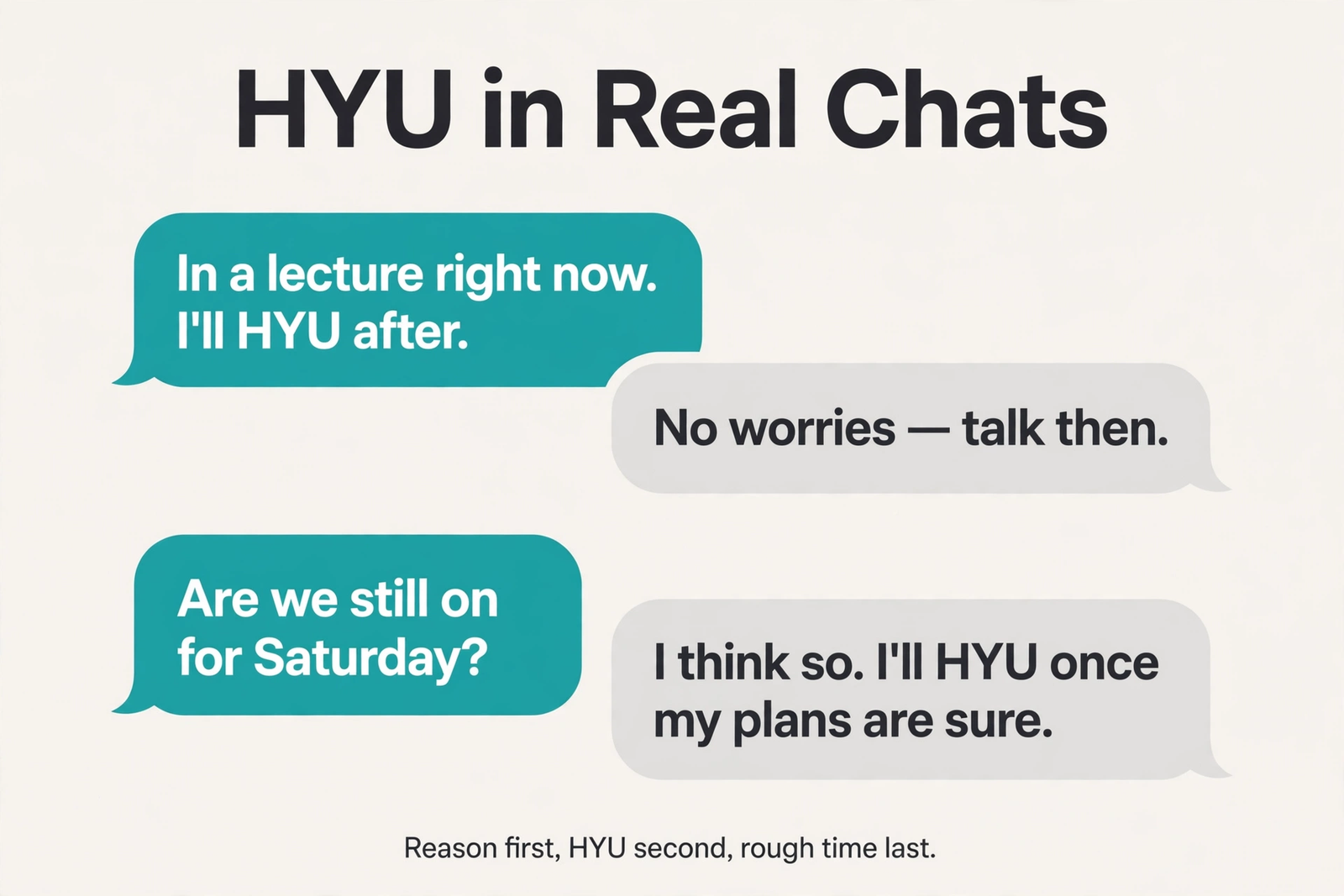
Real examples, in fact, make the pattern obvious. In most cases, HYU sits near the end of a short message, right after the reason for the pause:
- “In a lecture right now — will HYU after.”
- “Driving — HYU when I get home.”
- “Shifts first — I’ll HYU tonight.”
Conversations show the same pattern even more clearly:
- A: “Are we still on for Saturday?” B: “I think so. HYU once my plans are sure.”
- A: “Can you send me the class notes?” B: “Sure — I’ll HYU in an hour.”
Notice the structure: a reason first, HYU second, and a rough time last. Adding even a rough time makes the promise feel real. Without one, however, the same message can sound like a polite brush-off, especially when it happens again and again.
One more detail is worth copying: match the other person’s energy. If a friend keeps messages short and casual, a short HYU fits naturally. If the chat has been long and detailed, on the other hand, add a few words around it, such as a reason or a quick apology. That small effort, in practice, is what separates a warm pause from a cold one.
The HYU Meaning in Chat on Snapchat, Instagram, WhatsApp and TikTok
Across apps, the meaning does not change, although the setting shifts a little. Snapchat chats, for example, move fast, so HYU usually appears in quick replies when a conversation needs to pause mid-flow. Meanwhile, on Instagram it turns up in DMs and story replies, mostly around plans, meetups, and casual collaborations. WhatsApp works similarly: it fits one-to-one chats and small groups alike, politely parking a discussion until later. Finally, TikTok comments and DMs use it around gaming, meeting up, or continuing a joke. In every case, though, the direction stays the same: the person who writes HYU is the person who will reach out.
How to Reply When Someone Says HYU
Fortunately, replying to HYU is easy, because the message asks for patience rather than an answer. If you are happy to wait, keep your reply short and warm. For example, “Sounds good, talk then” works perfectly. Similarly, “No worries, I’ll be around” keeps the tone light. Alternatively, “Okay, I’ll wait for your message” makes your expectation clear without adding any pressure.
Sometimes, however, you genuinely need an answer sooner. In that case, simply say so: “Could you let me know by six? I need to book the tickets.” If the matter is urgent, on the other hand, skip the slang entirely and call the person. And if someone keeps saying HYU but never follows up, you can name it gently: “You keep saying that — is tonight actually good for you?” Honest and light, in short, almost always beats silent frustration.
There is also a matching move worth knowing: you can answer an HYU with an HYU of your own. For example, “All good — I’ll HYU after my exam too” keeps both sides equal and relaxed. Just remember, though, that two vague promises can drift into no conversation at all, so one of you should eventually attach a real time.
HYU vs HMU: The Difference That Matters
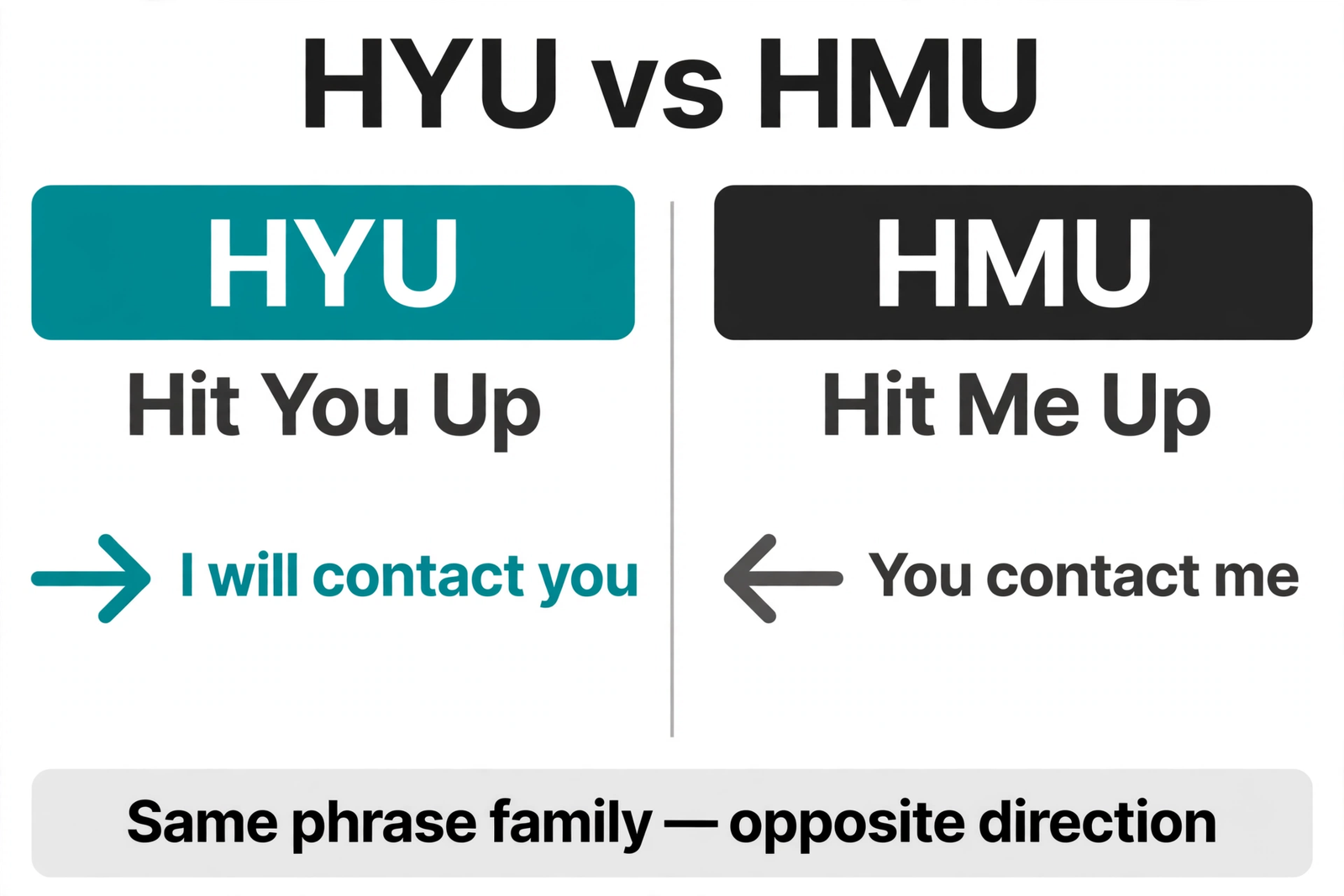
The most common confusion is HYU versus HMU, and the difference is simply direction. HMU means “hit me up.” When you write HMU, you are asking the other person to contact you. When you write HYU, by contrast, you are promising to contact them. So the two phrases share nearly the same words, yet they point in opposite directions. A simple memory trick helps here: in HYU, the “Y” stands for “you,” the person who will receive the message; in HMU, the “M” stands for “me,” the person waiting for it.
| Slang | Full form | Who contacts whom |
|---|---|---|
| HYU | Hit you up | I will contact you |
| HMU | Hit me up | You contact me |
| TTYL | Talk to you later | Either of us, at a later time |
| BRB | Be right back | Nobody — it marks a short pause |
| LMK | Let me know | You reply to me with information |
Beyond that pair, a few neighbours are worth knowing as well. TTYL, meaning “talk to you later,” also closes a chat, but it focuses on resuming the conversation rather than on who restarts it. BRB, or “be right back,” signals a pause of minutes instead of hours. LMK, meaning “let me know,” asks for information rather than contact. WYD, short for “what you doing,” does the opposite job entirely, because it opens a conversation instead of closing one. If short forms like these keep tripping you up, our guide to what SM means in text shows the same pattern at work in another everyday abbreviation. Overall, then, the whole family works on one principle: the shorter the form, the more the direction and the timing matter, so read those two things first.
When Not to Use HYU
HYU is friendly, but it is not universal. First, keep it out of formal writing, because job applications, official emails, and messages to clients or teachers deserve full sentences. Second, avoid it with people who may not know texting slang, such as older relatives or new professional contacts, since a confused reader helps nobody. Third, never use HYU to deliver serious or time-sensitive news; an emergency needs a phone call, not a three-letter promise. Finally, never use it as an escape hatch you do not intend to honour. If you say HYU every day and never follow up, the people around you will quickly start reading it as “goodbye forever.”
One further case deserves care: group chats for work or class projects. Even there, where the tone may be relaxed, HYU can look careless next to a clear sentence, because colleagues and classmates may read it as dodging the task. A full reply takes only seconds longer, and it removes every doubt.
HYU Meaning in Chat: Quick Questions, Straight Answers
Can HYU Mean “How Are You”?
Occasionally, it can look that way. A lone “hyu” at the very start of a conversation is sometimes typed loosely as a greeting, in the same spirit as “how are you.” However, slang dictionaries define HYU as “hit you up,” and most readers will understand it that way, especially mid-conversation or right after “I’ll.” If you actually want to ask how someone is, HRU — “how are you” — is the clearer shortcut. Context settles it in the end: a greeting opens a conversation, while a promise follows plans.
What Does HYU Mean From a Guy or a Girl?
The meaning itself, in fact, does not change at all. Whoever sends it, HYU still means “I will contact you later.” Nevertheless, the tone around it can shift with the relationship. Between close friends, it usually sounds purely practical. In a dating context, by contrast, it can feel warmer, simply because the person is promising more of their time and attention. Even then, it stays casual rather than romantic on its own. So read the relationship and the conversation, not just the three letters.
Is “Huu” the Same as HYU?
Yes, in short, it is. “Huu” is a looser spelling of the same phrase, “hit you up,” and it pops up in messages from time to time. HYU, however, is the cleaner initialism, because its letters match the phrase exactly: H, Y, U. In practice, both spellings carry the same promise, and both belong in the same casual settings. If you are writing it yourself, HYU is the safer choice, simply because more readers will recognise it at a glance.
Does HYU Only Mean Messaging, or Can It Mean Meeting Up Too?
In short, HYU only promises contact. The follow-up itself might be a text, a call, or a message on any app. Sometimes, of course, that contact then leads to meeting in person, especially when the chat was about making plans. But the word itself never promises the meetup; it only promises the reach-out. If meeting is the real goal, say so plainly as well, for example: “I’ll HYU tonight so we can fix a plan for Saturday.”
Conclusion
Overall, HYU is a small term with a clear job. It means “hit you up”: I will contact you later. Keep the direction straight — HYU sends the next message from you, while HMU asks for it from them — and everything else falls into place. Use it with friends, add a rough time whenever you can, and always follow through. For formal messages, though, write the full sentence instead. Above all, follow through when you use it yourself, because the word is only as friendly as the message that eventually arrives. From now on, whenever “I’ll hyu” lands in your chat, you will read it in a second, and you will know exactly how to answer it.


Leave a Comment