
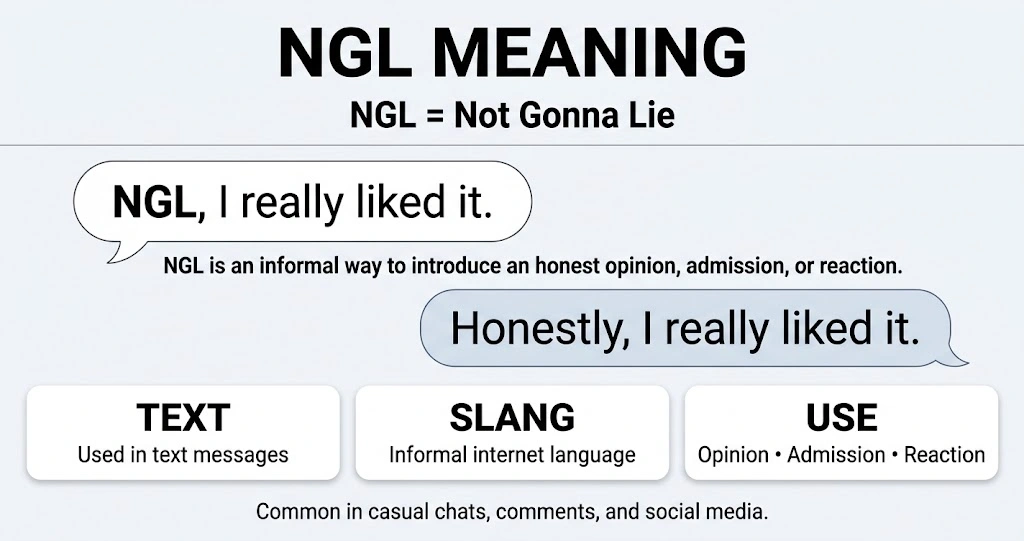
If you see “NGL” in a text, comment, or social media post, it usually means “not gonna lie.” People use this informal abbreviation when they want to give an honest opinion, make a personal admission, or say something candidly.
The tricky part is that NGL does more than replace three words. Its meaning depends on the sentence around it and the tone of the conversation. If someone writes “ASF, I really liked it,” they are signaling that the following statement is their genuine opinion.
If you searched for NGL, you may be wondering:
- What does NGL actually mean in a text message?
- Is NGL considered slang?
- How do people use NGL naturally in a sentence?
- Does NGL have the same meaning as TBH?
- Is it appropriate to use NGL in formal conversations?
This guide explains the NGL meaning in text, shows how the abbreviation works in real messages, explains its slang usage, and covers when it is appropriate to use.
What Does NGL Mean in Text and Slang?
NGL means “not gonna lie.” It is an informal abbreviation commonly used in online conversations, text messages, comments, and social media.
If you’re searching for the NGL meaning slang, the simplest explanation is that it is a casual way of saying “not gonna lie” before giving an honest opinion, admission, or reaction.
The phrase generally introduces something the writer wants to present as honest or candid. It can be used before an opinion, an admission, a reaction, or even a statement that may be slightly unexpected.
For example:
“NGL, that was a really good movie.”
Here, NGL tells the reader that the person is being straightforward about their opinion. In natural conversation, it can be understood as “Honestly, that was a really good movie.”
What “Not Gonna Lie” Means
“Not gonna lie” is a casual way of saying that you are about to be honest or frank about something.
For example:
“NGL, I was nervous before the interview.”
The speaker is admitting something personal. The abbreviation does not necessarily mean they were previously lying; it simply adds an informal sense of honesty or openness to what follows.
NGL can introduce both positive and negative opinions:
“NGL, this is probably my favorite song.”
“NGL, I expected the food to be better.”
In both cases, the writer is emphasizing that the statement reflects their genuine view.
Why People Use NGL in Messages
NGL is popular because it is short and conversational. Instead of writing “not gonna lie” or “honestly,” someone can add three letters to quickly signal a candid comment.
It can also make a statement feel less formal. Compare:
“Honestly, I did not expect that.”
with:
“NGL, I did not expect that.”
The basic idea is similar, but the second version has a more casual texting and internet-conversation style.
How Do You Use NGL in a Sentence?

NGL is usually placed near the beginning of a sentence, especially when the writer wants to emphasize that the following statement is honest.
It can introduce an opinion, an admission, or a reaction. The meaning stays connected to the surrounding sentence rather than functioning as a standalone definition.
NGL Before an Opinion
One of the most common uses is to introduce a personal opinion.
“NGL, I really like this design.”
“NGL, the second episode was better.”
In these examples, NGL signals that the writer is giving their genuine assessment.
NGL for an Honest Admission
NGL can also introduce something the person is admitting openly.
“NGL, I forgot about the meeting.”
“NGL, I was pretty nervous.”
Here, the abbreviation adds a candid or confessional tone.
NGL for a Reaction or Personal View
People may also use NGL before a reaction to something that happened.
“NGL, that ending surprised me.”
“NGL, I didn’t think you would finish it that quickly.”
The abbreviation makes the reaction sound conversational rather than formal.
In most cases, you can mentally replace NGL with “honestly” or “not gonna lie” to understand the intended meaning.
NGL Examples in Text Messages
Seeing NGL in complete conversations makes its use easier to understand. The exact meaning is usually straightforward once you look at what comes immediately after it.
Casual Conversation Examples
Friend 1: Did you like the new restaurant?
Friend 2: NGL, the food was really good.
Here, NGL introduces an honest positive opinion.
Friend 1: Are you ready for tomorrow?
Friend 2: NGL, I’m a little nervous.
In this example, NGL introduces a personal admission.
Positive and Negative Opinions
NGL can introduce either a positive or negative opinion.
“NGL, your presentation was really good.”
The speaker is emphasizing their genuine positive reaction.
“NGL, I didn’t enjoy the ending.”
The speaker is being direct about a negative opinion.
The abbreviation itself does not make the statement positive or negative. The words that follow it determine the actual opinion.
Social Media and Comment Examples
NGL is also common in casual online comments.
“NGL, this is one of the best photos you’ve posted.”
“NGL, I thought the old version looked better.”
“NGL, I wasn’t expecting this update.”
These examples show why context matters. NGL simply signals that the person is speaking candidly; the rest of the sentence tells you what they actually think.
Is NGL Formal or Informal?
NGL is informal language, so it is best suited to casual conversations rather than formal writing.
You can naturally use it in text messages, social media comments, chats, and conversations with friends. For example:
“NGL, I really enjoyed the event.”
That sounds normal in a casual conversation.
However, NGL is generally not appropriate for formal emails, academic assignments, business reports, official documents, or professional communication where a more standard expression would be clearer.
When NGL Is Appropriate
NGL works well when you are talking casually with people who understand internet and texting abbreviations.
Common situations include:
- Texting friends
- Social media comments
- Online chats
- Casual group conversations
- Informal messages
If the conversation is relaxed, NGL can make your message sound natural and conversational.
When to Use a More Formal Expression
For professional or academic communication, replace NGL with a clearer phrase such as “honestly,” “to be honest,” “in my opinion,” or simply state the point directly.
For example:
Casual:
“NGL, I think we should change the plan.”
More professional:
“Honestly, I think we should reconsider the plan.”
The meaning is similar, but the second version fits a wider range of situations.
NGL vs TBH: Are They the Same?
NGL and TBH are similar, but they are not always interchangeable. Both can signal honesty or a straightforward opinion, but they can create slightly different conversational tones.
TBH means “to be honest.” It is also an informal abbreviation and is often used when someone wants to introduce a candid opinion or admission.
| Expression | Meaning | Common use |
|---|---|---|
| NGL | Not gonna lie | Candid opinion, admission, or reaction |
| TBH | To be honest | Honest opinion, statement, or admission |
What NGL and TBH Have in Common
Both expressions can introduce something the speaker wants to say openly.
For example:
“NGL, I didn’t expect that.”
and
“TBH, I didn’t expect that.”
The overall meaning is very similar. In both cases, the writer is presenting a straightforward reaction.
How Their Tone Can Differ
The distinction is subtle rather than absolute.
NGL often has a conversational feel, especially when someone is making an admission or giving an unexpectedly honest reaction.
TBH can sound more like a direct statement of honesty or personal opinion.
In everyday texting, however, people may use the two expressions in very similar ways. The surrounding sentence and the relationship between the people communicating usually matter more than the abbreviation itself.
Can NGL Mean Something Else?
In ordinary texting and social media conversations, NGL most commonly means “not gonna lie.” However, abbreviations can have different meanings in different contexts.
That means you should not automatically interpret every occurrence of NGL without looking at the surrounding text.
Why Context Matters
Suppose you see:
“NGL, that was unexpected.”
The meaning is clear because the phrase fits naturally as “not gonna lie.”
But abbreviations can also appear in specialized contexts, including names, organizations, technical terminology, or other expressions. If “not gonna lie” does not make sense in the sentence, consider the context before deciding what the abbreviation means.
For everyday texting and slang, though, “not gonna lie” is the meaning most readers will expect.
How to Tell Which Meaning Is Intended
Look at three things:
- The surrounding words — Does “not gonna lie” make grammatical and contextual sense?
- Where you saw it — A text message and a technical document may use abbreviations differently.
- The conversation topic — The subject can reveal whether NGL is being used as slang or as another abbreviation.
Context is especially useful when an abbreviation has multiple possible meanings.
How Should You Respond When Someone Says NGL?
There is no special response required when someone uses NGL. Treat it as part of the sentence and respond to the actual point they are making.
If You Agree
If someone says:
“NGL, I think this is the best option.”
You could respond:
“Yeah, I agree.”
or:
“Same. I think so too.”
If You Disagree
If someone says:
“NGL, I didn’t like the ending.”
You can simply give your own view:
“Really? I actually liked it.”
The fact that they used NGL does not mean you have to agree with their opinion.
If You Want to Continue the Conversation
NGL can sometimes introduce an opinion that gives you an easy opportunity to ask a follow-up question.
For example:
Person A: NGL, I didn’t expect the movie to be that good.
Person B: What did you like about it?
This keeps the conversation focused on the statement rather than the abbreviation itself.
Frequently Asked Questions About NGL
Does NGL mean “not gonna lie”?
Yes. In texting, social media, and casual online conversations, NGL most commonly means “not gonna lie.” It is used to introduce an honest opinion, admission, reaction, or personal statement. The expression is informal and usually appears in relaxed conversations rather than professional or academic writing.
What does NGL mean in text?
In text messages, NGL usually means “not gonna lie.” It tells the reader that the following statement is intended to be honest or candid. For example, “NGL, I’m tired” means the person is openly admitting that they are tired.
Is NGL slang?
Yes, NGL is commonly used as informal internet and texting slang. It is an abbreviation rather than a traditional slang word. You will most often see it in messages, social media posts, comments, and other casual digital conversations.
Is NGL rude?
NGL is not inherently rude. Its tone depends on what comes after it and how the overall message is written. “NGL, I love your new haircut” is positive, while “NGL, I don’t like it” may sound blunt. The abbreviation itself does not make a message rude.
Is it okay to use NGL in a text?
Yes. NGL is perfectly natural in casual texts and online conversations when the people involved understand the abbreviation. It is less suitable for formal emails, academic work, professional documents, or other situations where standard language is expected.
What is another way to say NGL?
Depending on the sentence, alternatives to NGL include “honestly,” “to be honest,” “to tell the truth,” or “truthfully.” In casual conversation, “honestly” is often the simplest replacement. The best alternative depends on the tone and sentence in which NGL appears.
The Bottom Line on NGL
NGL usually means “not gonna lie,” and it is a casual way to introduce an honest opinion, admission, or reaction. You will most often encounter it in texts, social media, chats, and other informal conversations.
The easiest way to understand NGL is to read what comes after it. If someone writes “NGL, I loved it,” they are simply emphasizing that the positive opinion is genuine. If they write “NGL, I was nervous,” they are making a candid admission.
So when you see NGL in a casual message, think “not gonna lie” first, then use the surrounding conversation to understand exactly what the person means.


Leave a Comment