
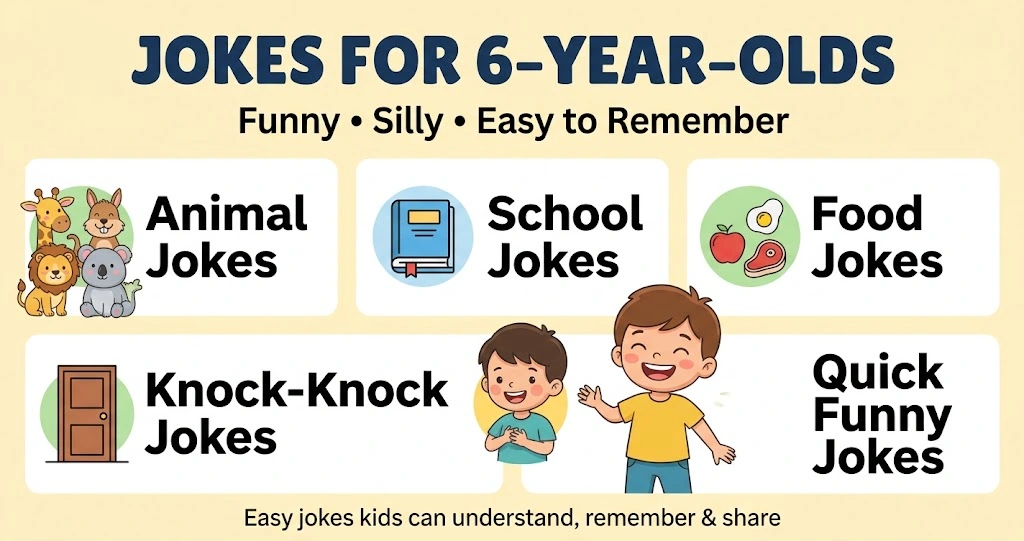
Finding good jokes for 6-year-olds should be simple. At this age, children usually enjoy jokes that are short, silly, easy to understand, and fun to repeat. A funny question, an unexpected answer, or a playful animal joke can be enough to get a big laugh.
Whether your child wants to entertain friends, make the family laugh, or simply asks, “give me a funny joke,” this collection has plenty of easy options to try. You will find school jokes, animal jokes, silly punchlines, and other great jokes that children can understand and tell themselves.
What Are Some Good Jokes for 6-Year-Olds?
If your child asks, “what’s a funny joke?”, start with something short and familiar. Six-year-olds don’t need complicated wordplay or long stories to enjoy a joke. The best jokes often use things they already know, such as animals, school, food, or everyday situations.
Here are some easy jokes to get started:
- Why did the teddy bear say no to dessert?
Because it was already stuffed! - What do you call a sleeping bull?
A bulldozer! - Why did the banana go to the doctor?
Because it wasn’t peeling well! - What do you call a bear with no teeth?
A gummy bear! - Why did the student eat his homework?
Because the teacher said it was a piece of cake! - What kind of tree fits in your hand?
A palm tree! - Why did the bicycle fall over?
Because it was two-tired! - What do you call a fish without eyes?
Fsh! - Why did the cookie go to the doctor?
Because it felt crumby! - What do you call a dinosaur that is sleeping?
A dino-snore!
These jokes are short enough for children to remember and tell without needing a long explanation. If one gets a laugh, let your child practise telling it again—the delivery can become part of the fun.
Funny School Jokes for 6-Year-Olds
School is an easy source of humour because six-year-olds are familiar with classrooms, teachers, books, pencils, homework, and playgrounds. School jokes also give children something they can share with classmates or family members.
Here are a few school-themed great jokes:
- Why did the pencil go to school?
To get sharper! - Why was the maths book sad?
Because it had too many problems. - What did the teacher say when the class was noisy?
“I need some peace and quiet!” - Why did the student bring a ladder to school?
Because they wanted to go to high school! - What did the pencil say to the paper?
“I’ve got you covered!” - Why did the student sit on the clock?
Because they wanted to be on time! - What is a teacher’s favourite type of music?
Schoolhouse rock! - Why did the book join the school band?
Because it had great covers!
School jokes work particularly well when the child already understands the situation. A simple joke about homework or pencils can be much funnier to a young child than a complicated adult joke.
Silly Animal Jokes
Animals are a favourite subject for young children’s humour because they are familiar, visual, and naturally lend themselves to silly ideas. Dogs, cats, cows, fish, bears, and other animals can easily become characters in simple jokes.
Try these animal jokes:
- What do cats eat for breakfast?
Mice Krispies! - Why did the dog sit in the shade?
Because he didn’t want to be a hot dog! - What do you call a cow that plays music?
A moo-sician! - Why don’t elephants use computers?
Because they’re afraid of the mouse! - What do frogs order at restaurants?
French flies! - What do you call a sleeping sheep?
A woolly sleeper! - Why did the chicken cross the playground?
To get to the other slide! - What do you call a rabbit with fleas?
Bugs Bunny! - Why did the duck bring a pencil?
To draw some quacks! - What do cows read?
The moos-paper!
Animal jokes are especially easy for children to retell because the punchlines often depend on simple wordplay or an unexpected connection.
Easy Knock-Knock Jokes
Knock-knock jokes are great for 6-year-olds because they are interactive and easy to remember. Children can enjoy being both the person telling the joke and the person waiting for the punchline.
Here are some simple ones to try:
1.
Knock, knock.
Who’s there?
Boo.
Boo who?
Don’t cry—it’s only a joke!
2.
Knock, knock.
Who’s there?
Cow says.
Cow says who?
No, silly! A cow says moo!
3.
Knock, knock.
Who’s there?
>Lettuce.
>Lettuce who?
>Lettuce in—it’s cold outside!
4.
Knock, knock.
Who’s there?
Tank.
Tank who?
You’re welcome!
5.
Knock, knock.
Who’s there?
Banana.
Banana who?
Knock, knock.
Who’s there?
Banana.
Banana who?
Knock, knock.
Who’s there?
>Orange.
>Orange who?
>Orange you glad I came?
6.
Knock, knock.
Who’s there?
Atch.
Atch who?
Bless you!
The fun of a knock-knock joke comes from the rhythm and surprise. Encourage children to pause before the final line instead of saying the punchline too quickly.
Funny Food Jokes

Food is another easy topic for young children because everyone recognises familiar foods. These jokes use simple wordplay and silly situations, making them easy to understand and share.
Here are some more jokes to add to your collection:
- What did one slice of bread say to the other?
“We make a great team!” - Why did the tomato turn red?
Because it saw the salad dressing! - What did the baby corn say to the mama corn?
“Where’s pop corn?” - Why did the orange stop rolling?
Because it ran out of juice! - What kind of room has no doors or windows?
A mushroom! - Why did the peanut go to school?
Because it wanted to be a little smarter! - What did the ice cream say when it was happy?
“This is really cool!” - Why did the sandwich go to the gym?
To get a little more bread! - What do you call cheese that isn’t yours?
Nacho cheese! - Why did the cupcake go to school?
To get a little smarter!
These are useful when a child wants to give me a funny joke style answer quickly. Food jokes are also easy to adapt because children can create their own silly versions using their favourite foods.
Quick Question-and-Answer Jokes
Some children prefer jokes that get to the punchline quickly. Question-and-answer jokes are ideal for this because they usually have only one setup and one surprising answer.
Try these:
- What has four wheels and flies?
A rubbish truck! - What gets wetter the more it dries?
A towel! - What has hands but cannot clap?
A clock! - What has a face and two hands but no arms or legs?
A clock! - What can you catch but never throw?
A cold! - What has one eye but cannot see?
A needle! - What has ears but cannot hear?
A field of corn! - What goes up but never comes down?
Your age! - What has a neck but no head?
A bottle! - What has many keys but cannot open a door?
A piano!
For a six-year-old, the best riddles and jokes are those where the answer is understandable once they hear it. If a joke needs a long explanation, it may be better saved for an older child.
How to Tell a Joke So Everyone Laughs
Knowing a joke is only part of the fun. The way a child tells it can make the punchline even more entertaining.
1. Say the setup clearly
Make sure the listener can hear the question or first part of the joke. There is no need to speak quickly.
2. Pause before the punchline
A short pause creates anticipation. It gives the listener a moment to wonder what the answer might be.
3. Say the punchline confidently
Children sometimes laugh before they finish telling their own joke. That’s perfectly fine, but practising the final line can make the joke easier to understand.
4. Keep it simple
There is no need to add extra explanations. Tell the joke, deliver the punchline, and let everyone enjoy it.
5. Have fun with it
Not every joke will get the same reaction. That’s normal. The goal is to enjoy telling and sharing jokes rather than expecting everyone to laugh every time.
What Makes a Joke Good for a 6-Year-Old?
A good joke for a six-year-old does not need to be complicated. In fact, simple jokes are often easier for children to understand, remember, and tell to someone else.
Look for jokes that have:
- Simple vocabulary: The child should understand most of the words.
- A short setup: Long stories can make young children lose interest.
- A clear punchline: The funny part should be easy to recognise.
- Familiar subjects: Animals, school, food, toys, and everyday situations work well.
- Playful humour: Silly ideas and harmless wordplay are usually a good fit.
- Easy delivery: Children should be able to remember and repeat the joke.
If you’re choosing jokes for a child, think about whether they can understand the setup without an adult explaining it. A joke that makes sense immediately is usually a better choice than one that depends on complicated wordplay.
FAQ About Jokes for 6-Year-Olds
What’s a funny joke for a 6-year-old?
A funny joke for a 6-year-old is usually short, silly, and easy to understand. Animal jokes, school jokes, food jokes, and simple knock-knock jokes are good choices because children already know the subjects and can easily remember the punchlines.
What is an easy joke a 6-year-old can tell?
Knock-knock jokes and short question-and-answer jokes are among the easiest for children to tell. They usually have a predictable structure, so a child can remember the setup and punchline after hearing the joke once or twice.
Are knock-knock jokes good for 6-year-olds?
Yes. Knock-knock jokes are particularly suitable for this age because children can participate in the joke by asking and answering the repeated questions. The format is easy to remember and makes the child feel involved in telling the joke.
How can I make a 6-year-old laugh?
Try using simple jokes about familiar things such as animals, school, food, toys, or everyday situations. Silly voices, funny expressions, and a short pause before the punchline can also make an ordinary joke more entertaining for a young child.
What type of jokes do young children like?
Young children often enjoy jokes involving animals, silly situations, wordplay, repetition, and unexpected answers. The most successful jokes are generally short and use ideas the child already understands rather than complicated references or adult humour.
Conclusion
The best jokes for 6-year-olds are simple, playful, and easy to share. Whether your child enjoys animal jokes, school humour, food jokes, knock-knock jokes, or quick questions and answers, there are plenty of options to try.
If your child asks, “what’s a funny joke?”, pick one that is short enough to remember and let them practise telling it. Sometimes the simplest joke, told with a big smile and a perfectly timed pause, can be the one that gets everyone laughing.


Leave a Comment